There is a particular kind of origin story that circulates in entrepreneurship – polished, linear, and retrospectively inevitable. Pooja Dhingra is not that story. She began baking at six with her aunt, discovering early that mixing butter and sugar could produce something that made people happy. She enrolled in law school because the world expected it of her, recognized within two weeks that it was the wrong direction, and – with parental support that she named as genuinely unusual – chose to pursue what she loved instead.
She took training in Switzerland. She studied at Le Cordon Bleu. She returned to Mumbai with a specific idea: introduce macarons – a French patisserie product virtually unknown in the Indian market at the time – and build a business around them. What followed was sixty failed batches. Not ten. Not twenty. Sixty attempts at getting the macaron recipe right before she had something worth selling.
“I didn’t give up. I just kept baking until I got it right.” Le15 Patisserie became India’s first macaron store. But the story, Dhingra told the audience at VLF – Vadodara Literature Festival 4.0, is not about the success. It is about what the sixty failures taught her.
Arya and the Magic Apron: Why She Wrote for Children
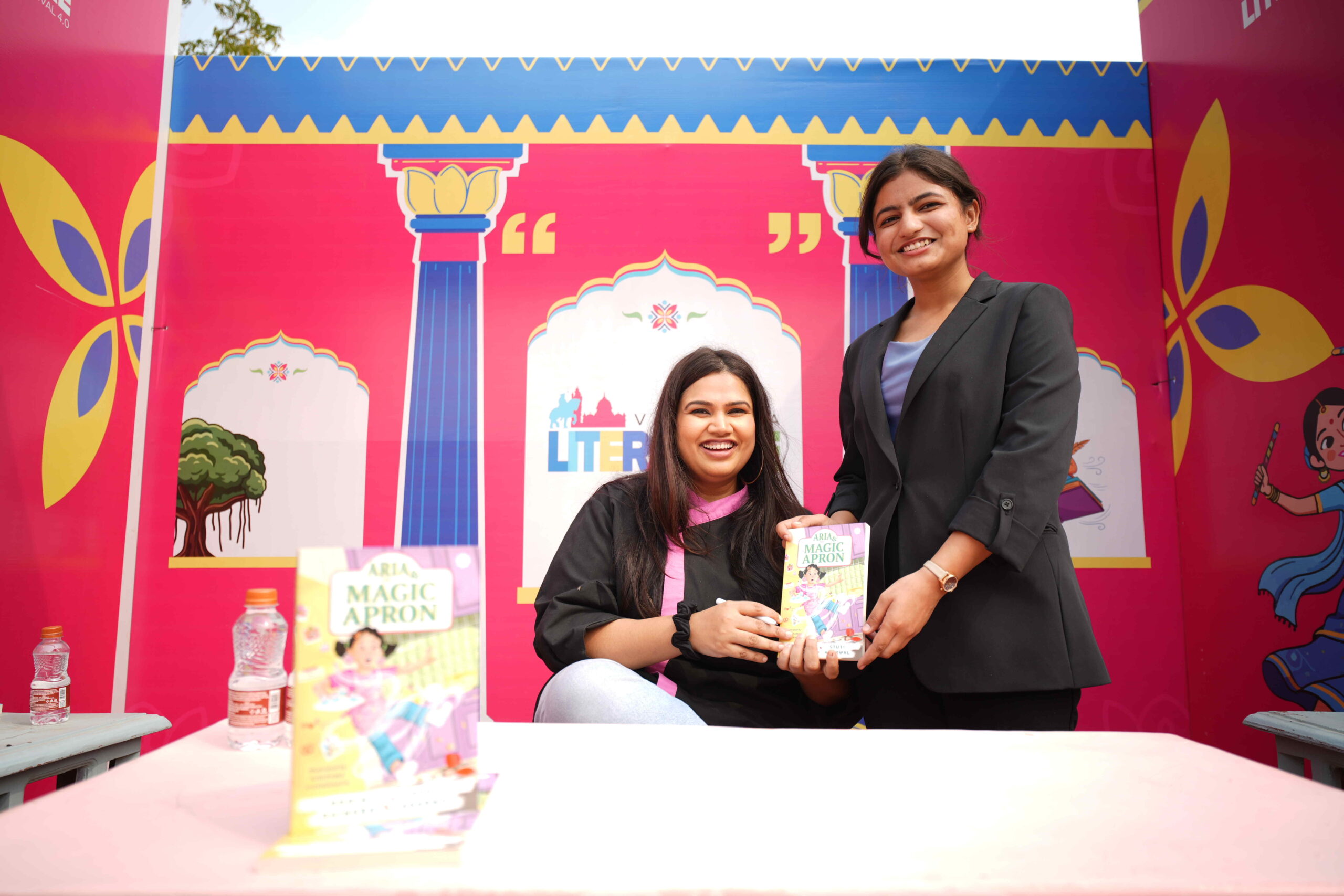
The thematic anchor of the session was Dhingra’s 2025 children’s book, Arya and the Magic Apron. Arya is a girl who is skilled but struggles with belief in herself – a character Dhingra described as a direct reflection of her own childhood experiences. The book’s core message, carried through Arya’s cooking mistakes and gradual growth, is one that Dhingra argued every child – and most adults – needs to hear: nobody is perfect, and what matters is focusing on the process, not the outcome.
The moment that inspired her transition from cookbooks to children’s fiction was specific. She was reading Giraffes Can’t Dance to a close friend’s daughter. Something in the emotional simplicity of the story – Gerald the giraffe finding his own music to dance to, at his own pace, in his own way – struck her as the kind of narrative she had needed as a child and had not found in Indian children’s publishing.
She wanted to write a book for Indian girls who, like her younger self, needed to see themselves in a story to believe they could be anything they wanted. The magic apron of the title is not magic in the conventional sense – it does not fix mistakes. It creates the conditions in which mistakes can be made safely, which is the only environment in which real learning happens.
Key ideas from Arya and the Magic Apron that extend beyond children’s literature:
• The Magic of ‘Yet’: mistakes aren’t failures – they’re experiments that haven’t worked yet
• The lesson of the oven: once the cake is baking, the outcome is out of your hands – focus on the mixing
• Process over outcome is not a consolation prize; it is the only reliable path to the outcome you want
• Stories create community – reading about someone who shares your struggle makes the struggle survivable
Gender Bias, Focused Work, and ‘Outside Noise’
The audience at Chanakya’s Courtyard included students at various stages of forming their career ambitions. Several questions in the Q&A came from young women navigating environments that were, in various ways, not designed for them. Dhingra’s answers were direct.
She spoke about the gender bias she encountered while building Le15 – the questions about where her husband was, where her father was, the implicit assumption that a woman building a food business required male oversight to be credible. Her response to these questions, she said, was not to confront them. It was to return to work.
“Outside noise will always be there. You focus on your work.” This is not advice to ignore systemic bias. It is a practical tool for survival within it: the clearest way to invalidate an assumption is to keep building the thing that demonstrates the assumption was wrong. Her success – Le15’s growth, her presence on MasterChef India as a judge in Season 8, her books – did not end the bias. But it built something that the bias could not undo.
On the practical question of how to convince parents to let you pursue an unconventional career, she offered what she called a ‘business plan’ approach: Show, don’t just tell. Demonstrate passion with a plan and small victories – proof of concept. Parents respond to evidence of seriousness differently than they respond to declarations of passion.
Books in the Age of Reels: On Reading, Attention, and the Endurance of Stories
A significant portion of the session addressed a concern that runs through every conversation about literature and young people in the current moment: the competition between long-form reading and short-form content for attention.
Dhingra’s position was neither defensive nor dismissive. Reels, she said, don’t replace books. They can lead readers back to them. Short-form content, viewed as a gateway rather than a threat, can function as an entry point – a way of encountering ideas or narratives that prompt curiosity rather than satisfying it. The challenge for writers and publishers is to understand this rather than resist it.
She credited the library culture of her childhood as foundational – summers spent reading, imagination shaped by stories, a worldview enlarged by encounters with lives and perspectives that differed from her own. She acknowledged, without nostalgia, that this environment has changed. The response is not to mourn the library but to understand what function it served and to ask how that function can be preserved in a different media landscape.
“Stories stay with us long after they are told.” The durability of narrative – its capacity to reshape how we understand our own experience – is not dependent on the medium. What is required is the willingness to go slowly enough to let a story work on you.
The Rapid-Fire Round and What It Revealed
The session’s closing rapid-fire round captured something important about what made Pooja Dhingra’s presence at VLF – Vadodara Literature Festival 4.0 distinctive – and why a children’s book author who founded a patisserie was received as one of the festival’s most resonant voices.
When asked to associate ‘macarons’ with three words: love, failure, and lessons. When asked to describe India in one word: home. When asked to choose between vada pav and dhokla: vada pav, which prompted genuine laughter. When asked to describe her working style: a balance of planning and jugaad.
These answers matter not because they are clever, but because they are coherent with everything else she had said. The willingness to name failure alongside love in the same breath as macarons – the product she had failed sixty times to perfect – is not performed humility. It is the working philosophy of someone who has learned, through experience rather than instruction, that imperfection is not the enemy of excellence. It is the medium through which excellence is approached.
The session closed at 11:54 a.m. with book signings, a participatory dance activity, and the particular energy that follows a conversation that has actually changed something. For the students who were there – many of whom arrived wondering whether the unconventional career they had imagined for themselves was genuinely possible – Dhingra’s session provided something more valuable than inspiration. It provided evidence.


