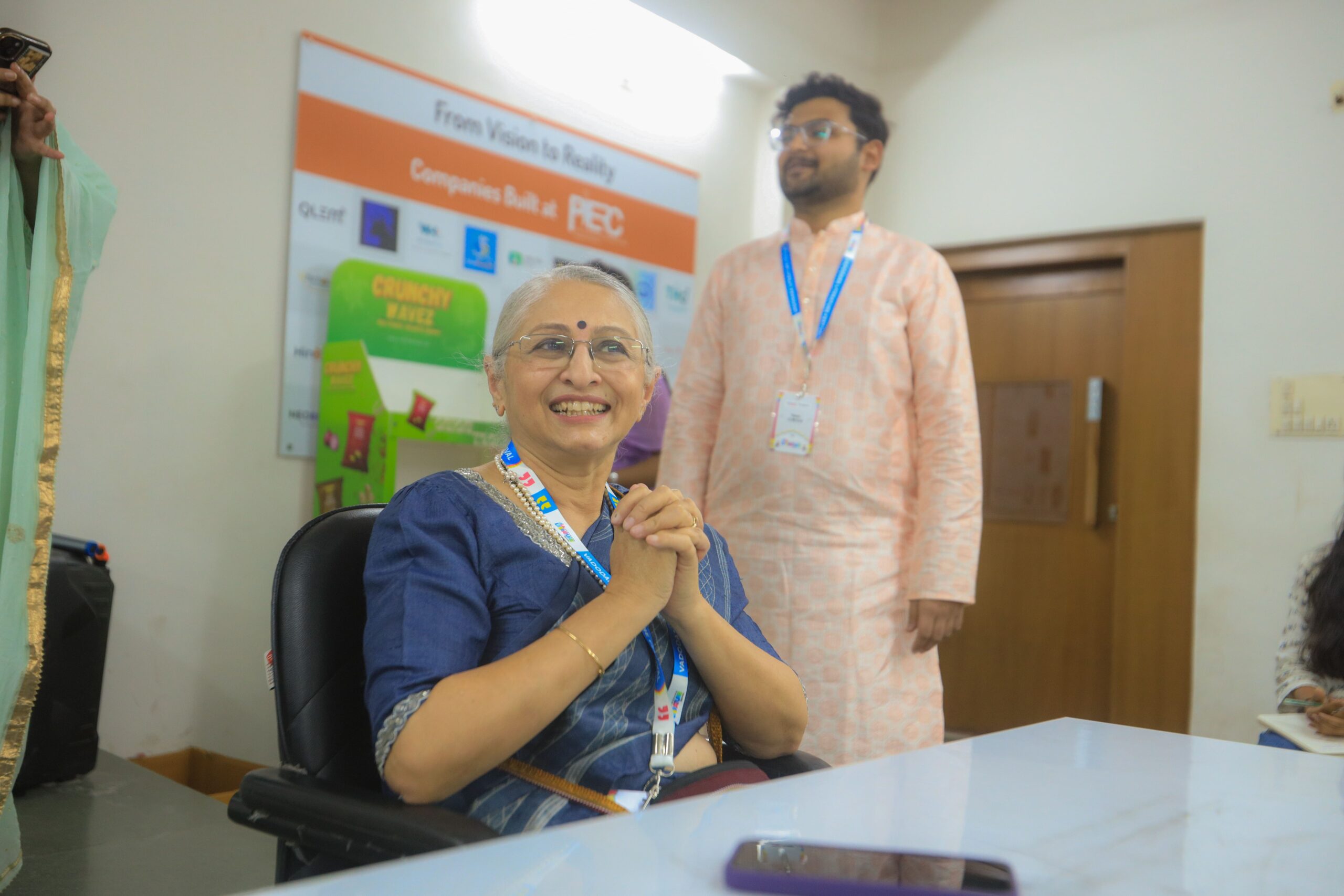
Workshops at literature festivals are, by design, more intimate than large sessions. The Founders’ Studio at Parul University’s BBA Building on January 29, 2026, held UPSC aspirants, engineering students, literature students, NCC cadets, and faculty members – a cross-section that would not normally occupy the same educational space simultaneously.
Lt. Gen. Madhuri Kanitkar walked in and immediately established the tone she would maintain throughout: direct, warm, and completely honest. She acknowledged the generation in front of her – described them as highly digitalised, seeking direction and structure, needing a ‘map’ to navigate life – and then did something that earned immediate trust: she defended them.
“Ek baar baal safed hote hai toh lagta hai humein sab aata hai,” she said, drawing laughter that also carried recognition. Once hair goes grey, people assume they know everything. The implicit critique was gentle but pointed: the challenges faced by the generation in front of her are real and contemporary, and elders who dismiss them as generational weakness rather than engaging with them as genuine difficulty are missing something important.
Pressure Is a Rubber Band: Stretched Right, It Holds Things Together
The workshop’s most quoted analogy came from a question about UPSC preparation – one of the most pressure-intensive experiences in Indian student life. A student asked how to handle the weight of a years-long goal with uncertain outcome.
Lt. Gen. Kanitkar began where she always began: with the prior question. Why do you want this? Is it your passion, or is it someone else’s expectation? The question is not rhetorical. The answer changes everything about how preparation is experienced and what resources the student can draw on during the inevitable periods of difficulty.
Her pressure analogy was precise: pressure is like a rubber band. Stretched too much, it breaks. Stretched just enough, it holds things together. The difference between constructive and destructive pressure is not the quantity of challenge but the relationship between challenge and the person meeting it. A goal that is genuinely yours – aligned with your actual values, connected to what you want your life to mean – generates a different quality of motivational resource than a goal adopted from social expectation.
Saraswati and Durga: On What Women Carry - and Must Not Lose
One of the session’s most culturally resonant passages came when Lt. Gen. Kanitkar described the dual nature she saw in women – and in the particular demands of a career that requires both.
She described women as embodying both the avatar of Saraswati and the avatar of Durga – wisdom and strength – and stressed that neither can be sacrificed for the other. A woman who develops professional competence and institutional authority while losing the qualities of emotional intelligence and relational care has not achieved integration. She has made a different compromise than the one she was resisting.
She quoted these five essential skills for every student:
- Understand money and financial responsibility – financial literacy is a life skill, not only a professional one
- Learn to listen to people – genuinely, with full attention, not as a waiting period before speaking
- Stay humble – knowledge grows through openness, not through the performance of already knowing
- Recognize that there is no age limit to learning – the habit of growth is not stage-specific
- Surround yourself with positive and influential people – the environment shapes the person over time
Adjust, Adapt, and Adore: Navigating What You Didn't Expect
Lt. Gen. Kanitkar offered a three-part framework for navigating unexpected change: Adjust, Adapt, and Adore. The sequence is not accidental. Adjust first: change what needs to be changed in your approach, your expectations, your behaviour, to function in the new context. Adapt next: internalise what is genuinely useful in the new environment without losing what is genuinely yours. Adore eventually: find what is worth valuing in the new context, because there is always something.
Key Takeaway : Information, Knowledge, and the Generation That Has Everything Except Direction
“Today’s generation lives in an age of information overload, not knowledge,” she said. The distinction is precise and consequential. Information is data – available in abundant quantities. Knowledge is what happens when information is filtered through experience, reflection, and judgment. The process of transformation from information to knowledge is what education is supposed to facilitate – and what it frequently fails to do because the metrics by which education is measured are information metrics, not knowledge ones.
Her framework for the transformation: we receive data; from data we extract information; through reflection and experience, information becomes knowledge. How we use that knowledge defines our growth. Her advice on values, in closing, carried the directness that had characterised the whole session: when a student mentioned being told their values were ‘old school,’ she responded that values should be upheld, communicated confidently, and never changed to seek validation. The courage to hold your values under social pressure is not stubbornness. It is integrity – and integrity, as every speaker at VLF – Vadodara Literature Festival 4.0 had said in their own language, is the foundation of everything else that lasts.


