The Origin: A University That Decided to Take Ideas Seriously
Parul University was established in Vadodara, Gujarat, in 2015. In 2024, it became the youngest university in India to receive the NAAC A++ accreditation – the National Assessment and Accreditation Council’s highest rating – a distinction that places it alongside institutions decades older and significantly better resourced. Its student body includes over 5,500 international students from 75 countries, and its academic profile spans engineering, medicine, liberal arts, management, and design.
The decision to partner with IIMUN – India’s International Movement to United Nations – to create a literature festival was, at the time of the first edition, a bet. Not a safe institutional programme designed to generate positive press coverage. A genuine bet that the combination of a campus community, a youth – run organisation with deep reach into student populations, and a curated gathering of serious thinkers and practitioners would produce something that neither partner could achieve alone.
Four editions later, the bet has paid off. VLF has become the most significant literature festival in Gujarat and one of the most substantive in India outside the major metros – not because of its scale, but because of what it consistently chooses to do with its platform.
Four Editions: A Brief Chronicle
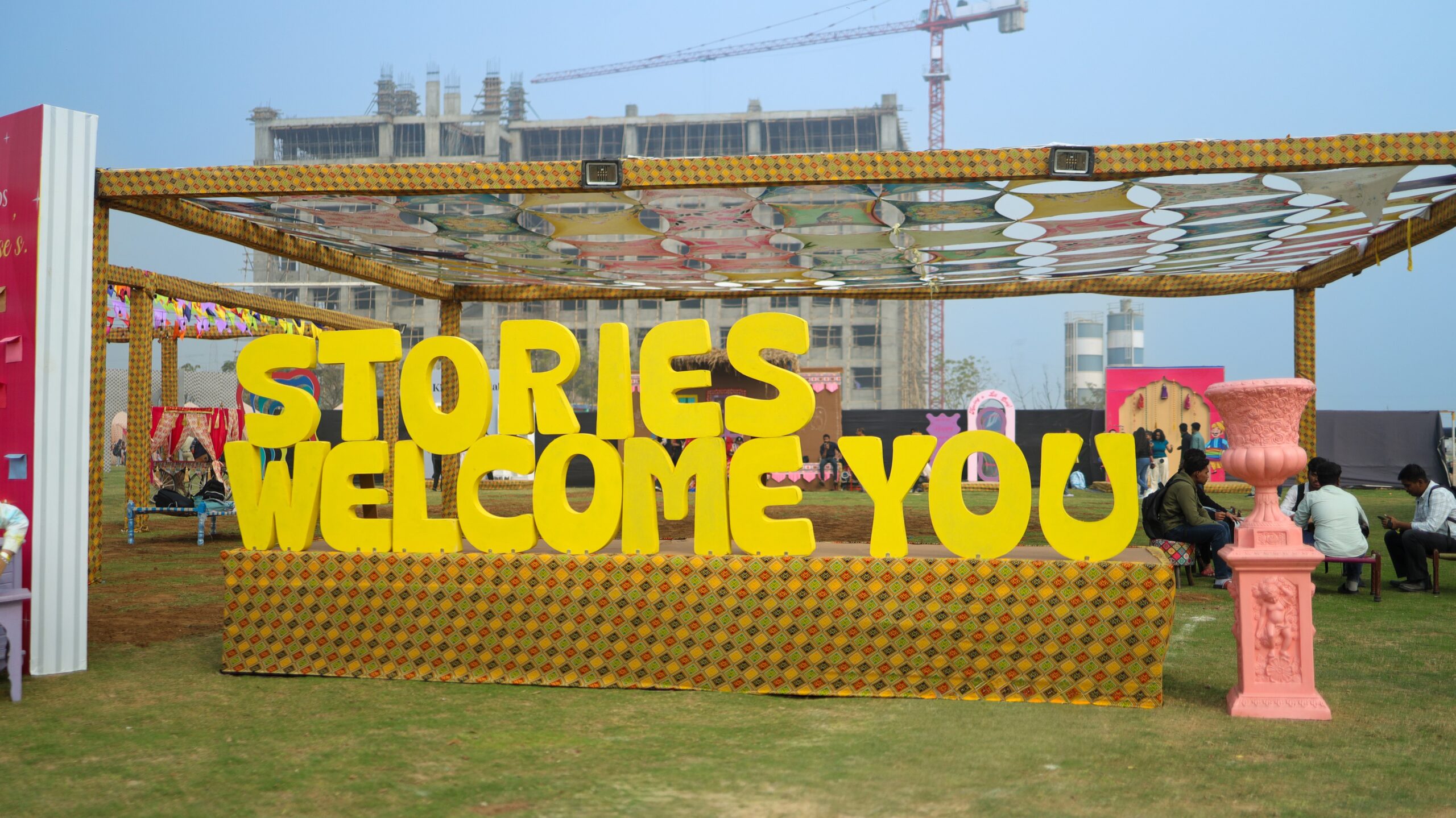
VLF 1.0 established the model: a multi – day festival on campus, free for students, programming that combined literary figures with practitioners from policy, business, and public life. The intention, from the first edition, was that literature would not be siloed from the other domains of knowledge that shape how people live. Authors would share stages with economists, soldiers, doctors, and lawyers – because the questions that literature asks are the same questions that all serious engagement with human life eventually reaches.
VLF 2.0 and VLF 3.0 expanded the scope and the footfall. By VLF 3.0 in January 2025, the festival was drawing over 15,000 attendees and a speaker roster that included Jeffrey Archer, Prajakta Koli, Ila Arun, and Rajdeep Sardesai – names that, in the metropolitan literary festival circuit, command significant appearance fees and audience premiums. At VLF 3.0, they appeared at a university campus in Vadodara. Students attended for free.
VLF 4.0, held across January 27–29, 2026, brought Justice D.Y. Chandrachud, Shobhaa De, General Manoj Mukund Naravane, Ankur Warikoo, Kanwal Rekhi, Geet Chaturvedi, Kaajal Oza Vaidya, Pooja Dhingra, Vivaan Shah, Dimple Jangda, and over twenty other significant voices to the same campus, in the same format. The programming covered constitutional law, governance, regional literature, health and wellness, military service, entrepreneurship, food diplomacy, design thinking, economics, and the digital lives of young people. Three days. Over 25 sessions. Free for students.
What Makes VLF Different: The Intentionality
The distinction between VLF and the metropolitan literary festivals it might superficially resemble is not primarily a matter of size. JLF is larger. Mumbai LitFest has a longer history. The distinction is intentionality: what the festival is trying to do, and how its programming decisions reflect that intention.
At JLF, the dominant mode is the polished reading followed by a moderated conversation – the author presenting a curated version of their thinking to an audience that is, itself, often literary and already inclined toward the work. This is a legitimate and valuable model. It is not what VLF does.
At VLF, the dominant mode is direct engagement between practitioners and students who are at the beginning of their working lives. The sessions are not primarily about the speaker’s work. They are about what the speaker’s work, experience, and accumulated thinking can offer to someone who is eighteen years old and trying to figure out what to do with the life in front of them. The questions come from the audience. The best exchanges are unscripted. The most memorable moments are the ones that could not have been planned.
Justice Chandrachud sitting in Vadodara and telling students he never actually wanted to be a lawyer – that he wanted to be an economist, that the law was an accident that turned into a vocation – is not a polished literary statement. It is a human being sharing something true about how lives actually develop, in a way that required the specific setting of a room full of students who needed to hear it. That setting is what VLF creates. The programmes at larger metropolitan festivals rarely prioritise it.
The IIMUN Partnership: What Youth – Run Curation Produces
The partnership between Parul University and IIMUN is not merely logistical. It is the reason the festival’s programming has the specific character it does.
IIMUN was founded in 2011 by Rishab Shah at the age of nineteen. It has grown, in fifteen years, into the world’s largest youth-led organization, with a network spanning 75+ cities in India and 40+ countries. Its core mission- giving young people platforms to engage with the world’s most important questions in the present rather than waiting for institutional seniority to grant them permission – is the same mission that VLF embodies.
The practical implication is that the people curating VLF’s programming are themselves young, themselves recently navigated the transitions that the student audiences are currently in, themselves interested in the questions that the audience will actually ask rather than the questions that would make for the cleanest panel discussion. The result is a festival that is less curated in the sense of being polished and more curated in the sense of being genuinely responsive to the intellectual needs of the people attending it.
Why the Pro Bono Model Matters
The decision to make VLF free for students is not incidental to what the festival is. It is foundational. The Metropolitan literary festival model – where ticket prices exclude the students and young people who most need exposure to serious ideas, and where audiences are self – selected from among those who can afford cultural participation – reproduces a cultural economy in which access to intellectual life correlates with existing economic privilege.
VLF 4.0’s free – entry model means that the student from a first – generation university family in Gujarat, who has never previously been in a room with a former Chief Justice of India or a Silicon Valley pioneer or one of India’s most significant living poets, can be in that room. The exposure is real. The conversations are real. The impact on what that student believes is possible for their own life is real.
After four editions, VLF has proven what the bet was made on: that the combination of a serious university, a youth – centric curatorial philosophy, an extraordinary network of speakers, and a commitment to keeping the gates open produces something that the literary culture of India’s major cities, with all its resources and reputation, consistently struggles to achieve. It produces a room where the ideas actually land.


