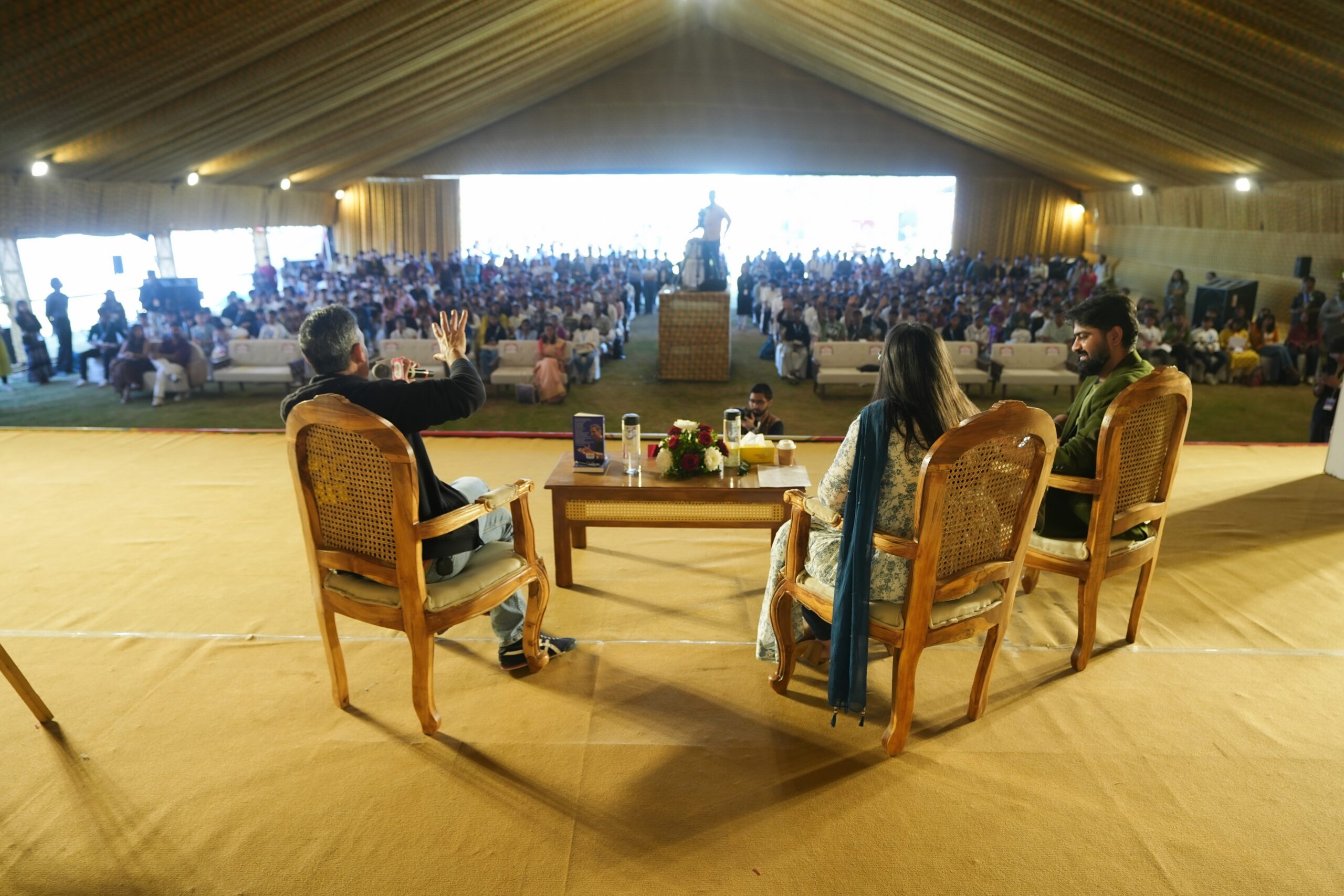
There is a map of India’s cultural conversation that anyone working in media, publishing, or public intellectual life knows instinctively, even if it is rarely drawn explicitly. The conversation happens in Mumbai. It happens in Delhi. It happens, to a lesser extent, in Bangalore and Chennai. It is hosted in universities that were established when most of independent India’s current cities did not yet exist as major urban centers, covered by publications that are headquartered in the same cities, and attended by audiences whose geographic proximity to these centers correlates strongly with their access to the conversation.
Everything outside this geography has, for most of the history of independent India’s public intellectual life, been peripheral. Not unimportant – the ideas produced in Vadodara, in Indore, in Coimbatore, in Guwahati are not less interesting than the ideas produced in South Mumbai – but less visible. Less likely to be covered. Less likely to be in the room when the conversations that shape national cultural discourse are happening.
This is changing. Not because the metropolitan cultural institutions have decided to include the periphery – most of them have not – but because institutions in the periphery have decided to stop waiting for inclusion and have begun building their own platforms. VLF 4.0 is among the most developed and most instructive examples of what this looks like when it works.
What Parul University Represents in Gujarat’s Educational Landscape
Parul University’s achievement of NAAC A++ accreditation in 2024 – making it the youngest university in India to receive this distinction – is a data point that is easy to cite and easy to underestimate. The NAAC process is exhaustive: it evaluates teaching quality, research output, student outcomes, infrastructure, and institutional governance across a multi – year assessment period. Receiving the A++ rating requires genuine excellence across all these dimensions, not merely adequate performance in some and excellence in others.
For a university founded in 2015, achieving this standard in under a decade represents an institutional velocity that is unusual in Indian higher education. It is also, in the context of the argument this essay is making, significant: Parul University is not a legacy institution coasting on reputation. It is an institution that has built genuine quality quickly, in a city that is not a national cultural capital, with a student body that includes over 5,500 international students from 75 countries – a figure that reflects both the university’s academic credibility and the pull that serious institutions create regardless of geography.
The decision to host VLF fits this institutional profile. A university that is building genuine academic quality and genuine international reach does not need to wait for permission from metropolitan cultural gatekeepers to host world – class intellectual programming. It has the infrastructure, the community, and the institutional credibility to go directly to the speakers it wants and the programmes it believes in.
The IIMUN Model: What 75 Cities Looks Like From the Inside
IIMUN’s reach – 75+ cities in India, 40+ countries, 15 years of operation – is a different kind of evidence for the same shift. When Rishab Shah founded the organisation in 2011 at the age of nineteen, the premise was that young people in cities that were not Mumbai or Delhi deserved the same quality of intellectual engagement, the same exposure to serious ideas and serious practitioners, and the same platforms for their own voices that metropolitan students took for granted.
Fifteen years later, the network has proven the premise. The young people in Indore, in Nagpur, in Bhopal, in Surat, in Vadodara who have participated in IIMUN’s programmes are not less capable of engaging with complexity than their counterparts in South Delhi colleges. They were simply less visible to the people who write about intellectual culture in India – a visibility problem that a 75 – city network has materially changed.
The synergy between IIMUN’s youth-run curation and Parul University’s institutional infrastructure is what gives VLF its specific character. IIMUN knows what young people in non-metropolitan India want to engage with because it has been building programs for them for fifteen years. Parul University provides the physical and institutional environment in which that engagement can happen at scale. The result is a festival that is neither a smaller version of JLF nor a provincial imitation of Mumbai LitFest. It is something different – purpose – built for the specific audience it serves.
Reading Habits, Non – Metro India, and the Cultural Hunger the Data Shows
The argument for literature festivals in tier-2 and tier-3 India is sometimes made as a supply-side argument: these cities lack cultural infrastructure, so building it is a charitable act. This framing misses the more important truth, which is a demand-side argument: the appetite for serious cultural engagement in non-metropolitan India is enormous, and it is underserved not because the demand is weak but because the supply has been concentrated elsewhere.
India has a reading culture that metropolitan cultural commentary often underestimates because the evidence for it is not in the bookshop chains of South Mumbai or the publishing catalogues designed for English-language readers in major cities. It is in the regional-language publishing industries – in Gujarati, in Hindi, in Tamil, in Bengali, and in Malayalam – that produce more titles annually than the English-language market, and in the readers who buy and discuss those titles in cities that the national literary press rarely covers.
When VLF 4.0 included a Regional Literature Panel that featured Geet Chaturvedi, Dr. K. Srilata, and Jaideep Mazumdar, and when that panel drew one of the festival’s largest and most engaged audiences, it was not because these three writers had manufactured an audience for regional literature in Vadodara. It was because the audience already existed. It had simply not previously had a platform that took its interests seriously.
What the Student Marketplace Reveals About the New Ecology
One of VLF 4.0’s most distinctive features is the student marketplace that runs alongside the programming- an entrepreneurship and creative showcase where students display products, businesses, and creative projects they have built. The coexistence of this marketplace with the literary and intellectual programming is not incidental. It is a precise expression of what the Parul – IIMUN model believes about the relationship between ideas and action.
Ideas, in this model, are not only for contemplation. They are for building with. The student who attends a session on entrepreneurship in the morning and displays her own business at the marketplace in the afternoon is living the relationship between intellectual engagement and practical application that the festival’s programming articulates. The festival is not a retreat from the world into culture. It is a place where culture and the world are brought into direct contact.
This is, arguably, the most important structural difference between VLF and the metropolitan literary festival model. JLF and Mumbai LitFest are cultural events. VLF is an educational event that uses culture as its primary instrument – and the distinction produces a meaningfully different experience for the students who attend.
The Decentralisation That Is Already Happening
The Vadodara Literature Festival is not alone in what it represents. Across India, in the decade since JLF established the template for what a literary festival could be, dozens of regional festivals have emerged – in Pondicherry, in Chandigarh, in Ahmedabad, in Kolkata’s neighborhoods, and in smaller towns across Kerala, Maharashtra, and Karnataka. Some are well-funded. Most are not. All of them are expressions of the same underlying fact: the appetite for serious cultural engagement is geographically distributed in a way that the institutions serving it have not been.
VLF is distinguished from most of these initiatives not by its ambition – many regional festivals are ambitious – but by its institutional depth. Parul University provides the infrastructure. IIMUN provides the curatorial philosophy and the network. The combination has produced, in four editions, a festival that is not aspirational. It is real.
Justice Chandrachud sat in Vadodara and told students about the accidents that design their lives. Shobhaa De sat in Vadodara and told students that freedom has a price and that the price is worth paying. General Naravane sat in Vadodara and told students that discipline begins at a red light. Ankur Warikoo sat in Vadodara and told students that the biggest lie they had been told was that marks matter.
These conversations happened in Vadodara, at a university founded ten years ago, at a festival entering its fourth edition, organised by a youth – run institution that began in 2011 with a nineteen – year – old’s conviction that young people should not have to wait for ‘someday’ to matter. They were attended by students who did not pay for the privilege.
The decentralization of India’s cultural conversation is not a future project. It is a present fact. The only question is how many more cities are building the institutions to make it visible – and how long it takes for the parts of the cultural conversation that are still primarily happening in South Delhi and South Mumbai to notice that the room has grown considerably larger.


