
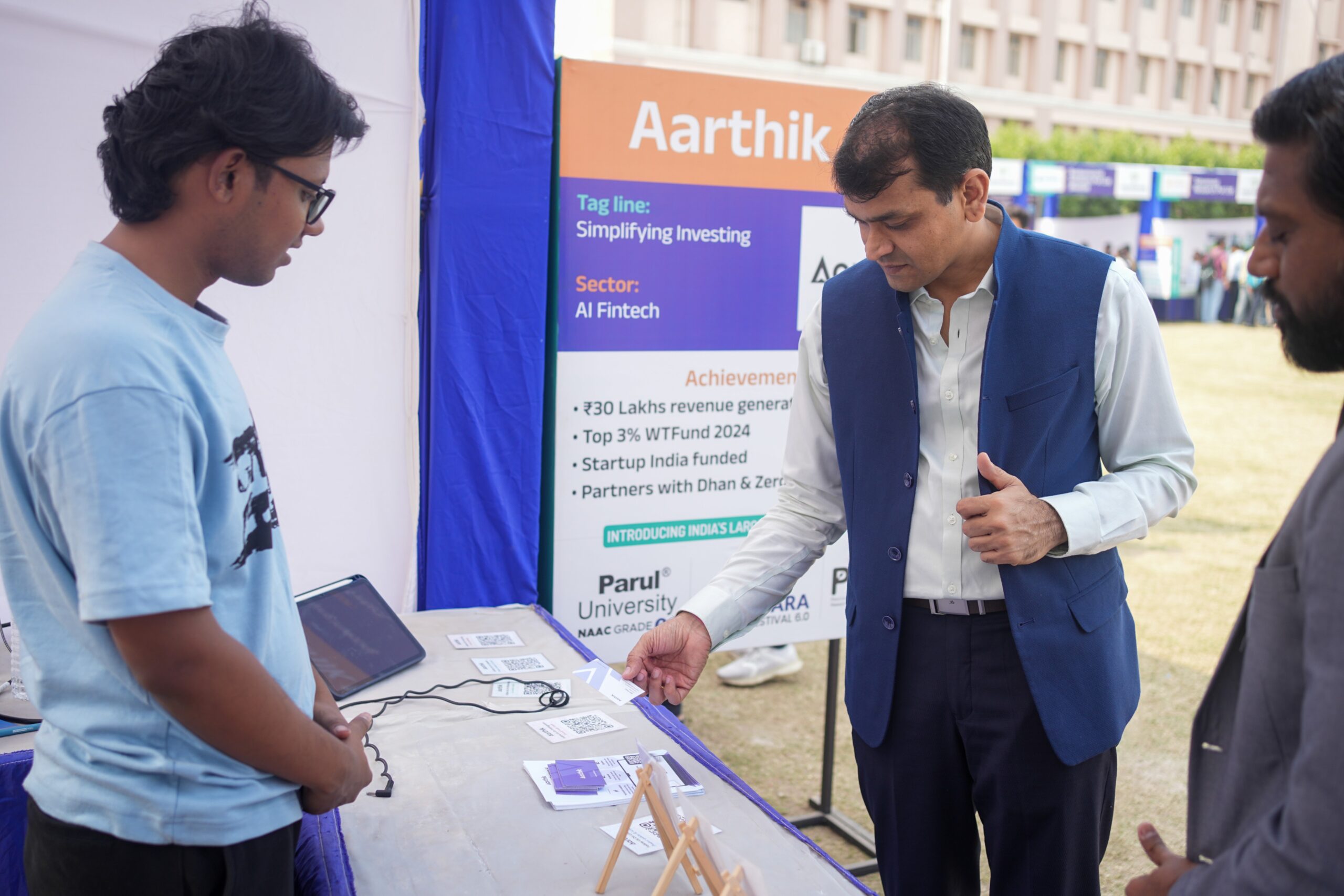
VSF – Vadodara Start-up Festival 6.0 revealed something unexpected: The best problem-solvers aren’t in Silicon Valley boardrooms. They’re in college hostels. Here are the 7 real problems student founders tackled and why investors funded them.
Problem #1: The ₹8,000 Cr
Core Scholarship Black Hole
The problem nobody sees:
Every year, India offers ₹8,000+ crore in scholarships. Students who desperately need them can’t find them. Scholarships who need deserving recipients can’t reach them.
Why this exists:
- 500+ scholarship websites (all showing different info)
- Each scholarship has different deadline, eligibility, application process
- Poor students spend more time hunting scholarships than studying
- Information is power, and information is deliberately scattered
Student founder who lived this: Mayank Pareek
His story at VSF – Vadodara Start-up Festival 6.0: “I had the grades. I didn’t have the money. Every scholarship required hours of research. Different portals. Different forms. Some I discovered after deadlines passed. I was smart enough for college but too poor to find the money.”
His solution: Scholify
Not another scholarship search engine. An ecosystem:
- Aggregates 500+ scholarship sources into one platform
- Personalized matching based on student profile
- Application deadline tracking and reminders
- Direct application support and mentorship
- Post-scholarship placement assistance
The validation:
- ₹7-8 crores disbursed to students
- Ranked above Byju’s, Unacademy, Vedantu in scholarship category
- 10,000+ students who would’ve dropped out now completing degrees
Why investors funded this:
Not because of market size. Because Mayank personally experienced every pain point. He didn’t research this problem; he survived it.
His pitch metric that mattered: “Last year, 127 students told me they couldn’t afford tuition. This year, all 127 are enrolled because of Scholify.”
What other students can learn:
If you’ve personally struggled with something for years, you understand nuances no market research reveals. That deep understanding is an unfair advantage.
Problem #2: 80% of Gifted Plants Die (₹3,000 Crore Wasted Annually)
The problem everyone ignores:
You give someone a plant. Thoughtful gesture. Represents growth, care, life.
Two weeks later: Dead. Brown. Forgotten.
Emotional cost: Giver feels their gift was rejected. The receiver feels guilty they killed something.
Financial cost: ₹500-2,000 per plant × millions of gifts = ₹3,000+ crore wasted.
Environmental cost: Production resources (water, soil, transportation) wasted on plants that don’t survive.
Student founders who saw differently: Giftreeng team
Their insight at VSF – Vadodara Start-up Festival 6.0: “We asked: Why do plants die? Not because people don’t care. Because people don’t know. Different plants need different care. Nobody tells you.”
Their solution:
Smart biodegradable pots with QR codes linking to:
- AI-powered plant care platform
- Database covering 4,000+ plant species
- Personalized care schedules (watering, sunlight, feeding)
- Real-time troubleshooting (“leaves turning yellow” → diagnosis + fix)
- Community support from other plant parents
The validation:
- Generated ₹5 lakh revenue before graduation
- Featured on Shark Tank India
- 80% of Giftreeng plants survive first year (vs. 20% industry average)
Why this mattered to investors:
Most VCs would say: “Plants? Too small. Too niche. Not venture-scale.”
But one investor at VSF – Vadodara Start-up Festival said: “India’s gifting market is ₹40,000 crore. If 10% are plants, that’s ₹4,000 crore. They’re solving a ₹3,000 crore waste problem. That’s not small.”
What other students can learn:
“Small” problems that affect millions aren’t small. They’re invisible to people who don’t experience them. But they’re massive to people who do.
Problem #3: Farmers Getting Cheated by Middlemen (Every Single Day)
The systemic problem:
India has 150 million farmers. Most sell through middlemen (mandis). Middlemen take a 30-40% margin. Farmers get ₹10 for vegetables that sell for ₹30 in cities.
Why this persists:
- Farmers lack direct market access
- Don’t know fair market prices
- Can’t reach end consumers directly
- Forced to accept whatever middlemen offer
Student founder who grew up watching this:
His story at VSF – Vadodara Start-up Festival 6.0: “My father farms 3 acres in Anand district. Every harvest, same story. Middleman comes, quotes low price, says ‘take it or let it rot.’ We take it. Been happening for 30 years.”
His solution:
Not a fancy AgriTech app with ML and blockchain. A WhatsApp group.
How it works:
- Connects farmers directly to buyers (restaurants, local stores, consumer groups)
- Shares real-time market prices from nearby cities
- Facilitates direct transactions
- Charges 5% instead of 30-40%
The validation:
- 47 farmers actively using platform
- ₹2.3 lakh monthly GMV (gross merchandise value)
- Farmers earning 25-30% more per harvest
- Zero technology investment (just WhatsApp + basic website)
Investor reaction at VSF – Vadodara Start-up Festival:
“I’ve seen 50 AgriTech pitches this year. Beautiful apps. ML models. None solved the actual farmer problem. This kid used WhatsApp and made farmers richer. That’s real innovation.”
What other students can learn:
The best solution isn’t always the most sophisticated. It’s the one that actually works for the people who need it. Farmers don’t need blockchain. They need fair prices and direct access.
Problem #4: Tier-2 City Healthcare Access Gap
The invisible crisis:
Metro cities: World-class hospitals. Specialist doctors. Advanced diagnostics.
Tier-2/Tier-3 cities: General physicians. Limited specialists. Misdiagnosis. Delayed treatment.
The gap isn’t just money. It’s information, access, and trust.
Student founder from tier-3 city:
His VSF – Vadodara Start-up Festival 6.0 story: “My uncle had a persistent cough. A local doctor said ‘seasonal allergy.’ Gave generic medicine. Six months later, diagnosed with TB. Could’ve been caught early if he’d seen a specialist.”
His solution:
Telemedicine platform built differently:
- Not for routine consultations (local doctors handle those)
- Specifically for second opinions and specialist consultations
- ₹100 per video call (affordable for tier-2/3 residents)
- Doctors volunteer 2 hours weekly (social impact + exposure)
- Regional language support (not everyone speaks English)
The validation:
- 1,200 consultations monthly
- ₹1.2 lakh monthly revenue
- 23 specialist doctors volunteering time
- 4.8/5 patient satisfaction rating
- Lives literally saved (caught 17 serious conditions local doctors missed)
Why this isn’t venture-scale (and why one investor funded anyway):
VC logic: “₹1.2 lakh monthly isn’t unicorn material. Can’t scale to ₹100 crore valuation.”
Family office investor logic: “They’re saving lives in tier-3 cities nobody else serves. I’ll fund this for impact, not just returns.”
What other students can learn:
Not every problem needs to become a unicorn. Some problems are worth solving because lives depend on them. Find investors who value impact alongside returns.
Problem #5: Student Mental Health Crisis (The Silent Epidemic)
The numbers nobody wants to admit:
30-40% of college students experience anxiety or depression. Most don’t seek help because:
- Stigma (mental health = weakness)
- Cost (₹2,000+ per therapy session)
- Access (1 counselor per 2,000+ students on average campus)
- Privacy concerns (campus counselor might know your parents)
Student founder who struggled personally:
Her VSF – Vadodara Start-up Festival 6.0 confession: “Second year, I had panic attacks before exams. Told nobody for 8 months. I thought I was weak. Eventually found an online support group. I realized I wasn’t alone. That saved me.”
Her solution:
Peer support platform with smart design:
- Complete anonymity (even she doesn’t know users’ real identities)
- Moderated by licensed therapists (safety + legitimacy)
- Peer matching based on similar struggles (ADHD, anxiety, depression, etc.)
- Affordable pricing: ₹200/month for unlimited access
- Crisis helpline integration (for serious cases)
The validation:
- 847 active users across 12 colleges
- ₹1.69 lakh monthly revenue
- 94% report improvement in mental health
- Zero security breaches (anonymity maintained)
- Prevented 3 confirmed suicide attempts (users messaged crisis line)
Investor feedback:
“This won’t become a ₹100 crore company. But if it prevents even one suicide, it’s worth more than most startups I’ve funded.”
What other students can learn:
Sometimes the problem you solve is the one you wish existed when you needed it. Personal struggle → Deep empathy → Better solutions.
Problem #6: College Mess Food Waste (₹50 Lakh Lost Per Campus Annually)
The problem hiding in plain sight:
Every college hostel: Mess makes food for 1,000 students. 300 don’t show up. Food wasted daily.
Annual math:
1,000 students × ₹150/day × 25% waste = ₹37,500 daily
₹37,500 × 300 college days = ₹1.12 crore wasted per campus per year
Student founder who got tired of waste:
His VSF – Vadodara Start-up Festival 6.0 realization: “We had ‘skip meal’ coupons, but nobody used them. Why? Because you lose money if you skip. What if you could save money AND reduce waste?”
His solution:
Mess optimization platform:
- Students mark meals they’ll skip 24 hours ahead
- Get 70% refund as credits for next month
- Mess reduces food preparation proportionally
- Excess food donated to NGOs feeding underprivileged
The validation:
- Implemented in 3 college campuses
- Reduced food waste by 60%
- Saved ₹15 lakh per campus annually
- Students love it (free money + less guilt)
Platform charges ₹25,000/month per campus
Revenue math:
3 campuses × ₹25,000 = ₹75,000 monthly
10 campuses in pipeline (₹2.5 lakh monthly projected)
Why investors loved this:
“Boring” problem. Unglamorous solution. Massive potential scale (1,000+ colleges in India). Profitable from Day 1.
What other students can learn:
The most boring problems often have the best unit economics. Don’t chase sexy. Chase sustainable.
Problem #7: Regional Language Learning Gap
The educational inequality nobody discusses:
Elite urban students: English medium since kindergarten. Speak, read, write fluently.
Tier-2/3 students: Regional medium until Class 10. Struggle with English in college and jobs.
Impact on careers:
- Can’t ace interviews (even when technically skilled)
- Miss opportunities requiring English communication
- Feel inferior in professional settings
- Limit career growth potential
Student founder who experienced this firsthand:
His VSF – Vadodara Start-up Festival 6.0 honesty: “I topped my district in Class 12. Got into a good college. In the first semester, I couldn’t understand half the lectures. English wasn’t taught in my school. I felt stupid every day.”
His solution:
English learning app built for regional medium students:
- Teaches in their native language first (Gujarati, Hindi, Marathi)
- Gradual transition to English
- Focus on speaking and confidence, not just grammar
- Voice practice with AI feedback
- Costs ₹200/month (affordable vs. ₹5,000+ coaching classes)
The validation:
- 3,200 active users across Gujarat and MP
- ₹6.4 lakh monthly revenue
- Average user improves from A2 to B2 English level in 6 months
- 78% land better jobs/internships after completing course
- Word-of-mouth is primary growth driver (65% come from referrals)
Why this works when other EdTech fails:
Built by someone who personally struggled with this exact problem. Understands psychological barriers (“I’m too old to learn English”), not just educational gaps.
What other students can learn:
The problems you’re embarrassed about are often the ones millions face silently. Your shame can become your superpower if you build solutions.
The Pattern Across All 7 Problems
What these student founders have in common:
1. Personal Experience
Not one of them researched problems. They solved problems they personally lived with.
2. Unglamorous Markets
VCs wouldn’t fund most of these. Scholarships, plants, mess food, regional English skills and the list is endless.
3. Simple Solutions
No blockchain. No AI (mostly). WhatsApp groups. Google Sheets. Basic apps.
4. Real Revenue
All generating money within 90 days. Proof that people actually pay for solutions.
5. Mission + Margin
They care about impact AND profitability. Not one or the other.
Mission + Margin — https://www.pierc.org/
The Problems Nobody at VSF - Vadodara Start-up Festival 6.0 Solved (Yet)
These are opportunities for you:
Problem A: Campus Placement Anxiety
Every final year: Stress, competition, comparison. Mental health support specifically for placement season.
Problem B: Affordable Skill Certifications
₹50,000 for Google certificates. ₹30,000 for AWS. Students need skill validation, can’t afford certifications.
Problem C: Student Financial Literacy
Nobody teaches students about credit cards, loans, investing, taxes. Financial mistakes made at 22 cost for decades.
Problem D: Green Campus Initiatives
Every college wastes water, electricity, and generates plastic waste. Systems to reduce environmental impact.
Problem E: Alumni Network Activation
Most colleges have thousands of successful alumni. Zero organized way to leverage them for current students’ benefit.
Do any of these resonate with you? Your startup might be hiding in this list.
How to Identify YOUR Problem to Solve
The 3-Question Framework
Q1: What made you genuinely angry in the last 30 days?
Not mildly annoyed. Actually angry enough to complain multiple times.
Q2: Do 50+ other people have this same problem?
Test: Text 20 people. If 10+ say “yes, I struggle with this too,” it’s real.
Q3: Would someone pay ₹100-1,000 to solve this?
Test: Offer manual solution for a small fee. If 5+ people pay, you have business.
If all 3 answers are yes: You found your problem to solve.
What Makes a Problem "Fundable"
Investors at VSF – Vadodara Start-up Festival 6.0 funded problems that had:
Trait #1: Personal Founder Connection
“Why you?” must have a compelling answer beyond “I saw a market opportunity.”
Trait #2: Clear Revenue Path
How will you make money? Who pays? How much? When?
Trait #3: Scalability Potential
Can this work for 1,000 users? 10,000? 100,000? Or is it forever small?
Trait #4: Unfair Advantage
What do you know/have/understand that others don’t?
Trait #5: Measurable Impact
Lives changed. Money saved. Time recovered. Problems solved. Quantify it.
If your problem has 4+ of these traits, start building.
The VSF - Vadodara Start-up Festival 6.0 Student Founder Mindset
What separated funded founders from rejected ones:
-
Rejected: “I’m solving X because market research shows it’s big opportunity”
Funded: “I’m solving X because I personally experienced this hell for 3 years”
-
Rejected: “We project ₹10 crore revenue in Year 3”
Funded: “We made ₹5 lakh last month. Here’s how we’ll get 10x that.”
-
Rejected: “Our AI-powered blockchain solution disrupts the industry”
Funded: “We use WhatsApp and Google Sheets. It works. Users pay us.”
-
Rejected: “We’re pre-revenue but have amazing team and vision”
Funded: “We have paying customers who love us. Here’s their feedback.”
See the pattern? Reality beats projection. Experience beats research. Revenue beats vision.
Revenue beats vision. —- https://www.pierc.org/growthpad-program
Your Week 1 Action Plan
Monday: List 5 problems you personally experienced this month
Tuesday: Rate each problem:
- How many others likely have this? (1-10)
- How painful is it? (1-10)
- Would someone pay to solve it? (1-10)
Wednesday: Pick the highest-scoring problem. Talk to 10 people. Validate it’s real.
Thursday: Create manual solution (spreadsheet, document, process) that solves it
Friday: Offer a manual solution to those 10 people for ₹100-500. See who pays.
Weekend: If 3+ people paid, you have a fundable problem. Start building automated solutions.
The Truth About Problem-Solving
You don’t need:
- Perfect idea
- Revolutionary technology
- Huge market
- VC funding
- Team of 10
You need:
- One real problem
- That you deeply understand
- That others will pay to solve
- That you can solve better than current options
- The courage to start before you’re ready
Every VSF – Vadodara Start-up Festival 6.0 founder proved this.
The question isn’t whether problems exist.
The question is: Which one will YOU solve?
FAQs
Q1: What made the startups at VSF - Vadodara Start-up Festival 6.0 different from typical student ideas?
These founders solved problems they personally experienced, scholarship access gaps, farmer exploitation, mental health struggles, food waste, and language barriers. Their solutions were validated with real paying users before pitching investors.
Q2: Did these startups actually generate revenue?
Yes. Every featured startup had paying users, with revenues ranging from ₹75,000 monthly to ₹6+ lakh monthly. Investors responded to traction, not projections.
Q3: Why did investors show interest in “unglamorous” problems like mess food waste or scholarships?
Because these “boring” problems affect millions. When solved effectively, they create measurable impact, strong unit economics, and scalable models, making them both meaningful and investable.
Q4: What pattern did funded founders share at VSF - Vadodara Start-up Festival 6.0?
They had personal connection to the problem, clear revenue paths, simple but effective solutions, and measurable impact. Experience and execution mattered more than buzzwords.
Q5: What role does PIERC play in enabling such student startups?
PIERC (Parul Innovation and Entrepreneurship Research Centre) provides structured mentorship, incubation, investor access, and ecosystem support, helping students convert lived struggles into sustainable businesses before graduation.
Based on 7 real student startups that pitched at VSF – Vadodara Start-up Festival 6.0, Parul University, January 2026.
Organized by PIERC (Parul Innovation and Entrepreneurship Research Centre).
These aren’t hypothetical case studies. These are real founders solving real problems with real revenue.
Some raised funding. Some didn’t. All are building businesses that matter.
Your problem is out there. Go find it.


