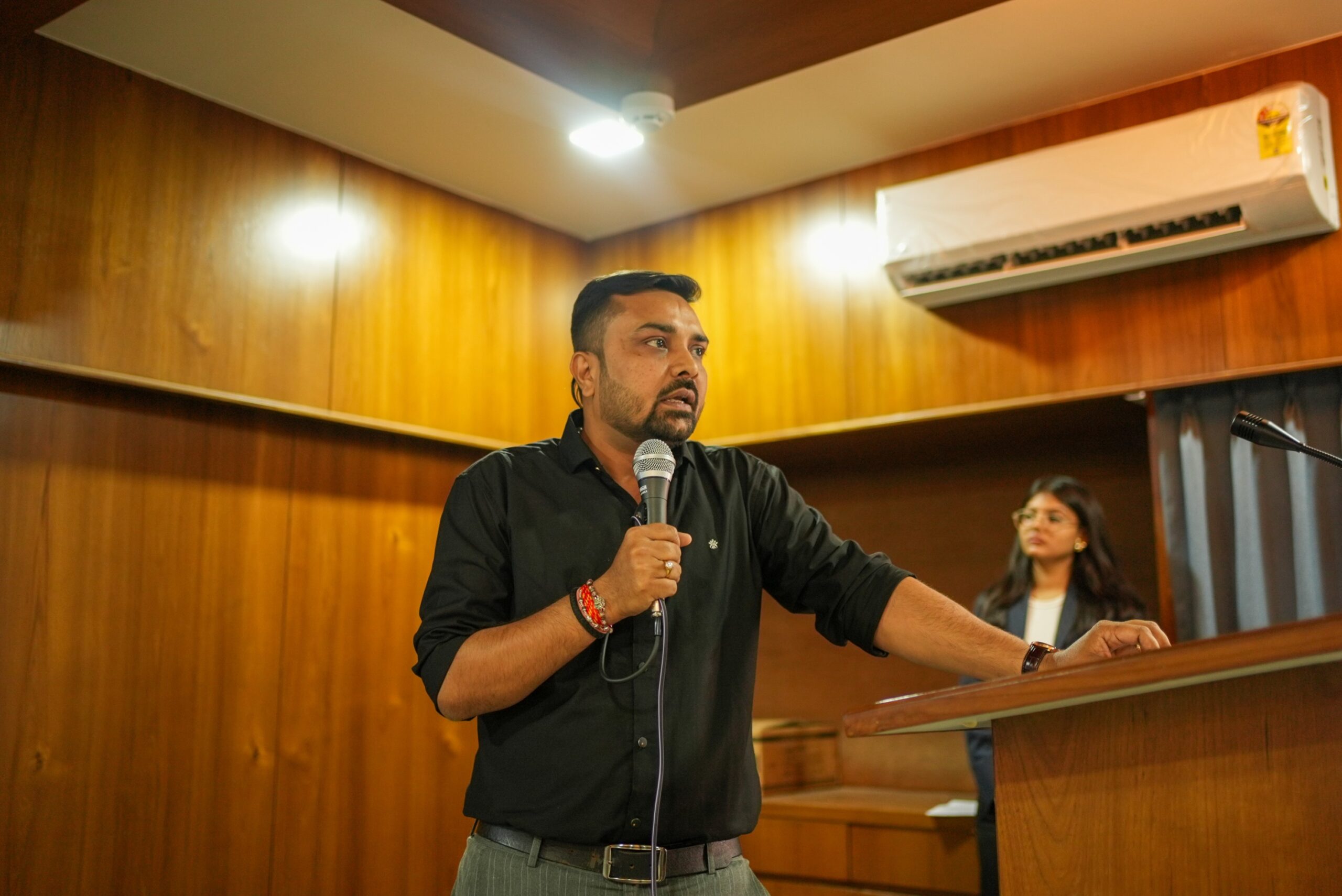
The startups that survived weren’t the ones with perfect plans. They were the ones willing to kill their darlings and rebuild. Here’s what happened when founders at Vadodara Startup Festival 6.0 changed everything.
Most startup advice tells you to “stick to your vision.”
The founders who spoke at Vadodara Startup Festival 6.0 tell a different story.
They succeeded precisely because they didn’t stick to their original vision.
The ₹20,000 Vegetable Business That Became ₹10 Crore Publishing Empire
Anurag Sundarka’s first venture was Saralife.com, a direct-to-consumer platform selling vegetables.
Total lifetime revenue: ₹20,000.
Not monthly. Total.
Most entrepreneurs would call this failure and quit. Sundarka saw it as data.
After Saralife crashed, he tried:
- Street plays and scrap collection
- Aatisbazi.in (crackers business)
- Writing a book (couldn’t find a publisher)
Each attempt failed. Each failure taught something.
But the real pivot happened when Sundarka couldn’t find anyone to publish his completed manuscript. That rejection revealed a gap in the publishing ecosystem: authors needed help not just writing books, but getting them published.
ZebraLearn was born.
The First Pivot: From Writing Platform to Publishing House
Initial concept: Help authors write better books.
Reality: Authors didn’t need writing help. They needed publishing infrastructure.
The team built a platform that handled everything from content creation to publication.
They went live. The response was… unpredictable.
- Month 1: ₹6 lakh revenue
- Months 2-9: Nothing
- Month 10: Big profit again
- Months 11-15: Nothing
This wasn’t a sales problem. It was a product problem.
The Second Pivot: From General Publishing to Children's Books
The revenue rollercoaster forced a hard question: “What are we actually building?”
They analyzed the data. General publishing wasn’t working consistently.
Without expecting much, they started publishing children’s books.
It worked.
Not just “worked” it worked wonderfully.
This led to the breakthrough concept that would define ZebraLearn: Visual Books.
Instead of text-heavy content, they combined:
- Structured narrative
- Strong design elements
- Visual storytelling
The result? Books where “even if someone reads just three pages, those three pages stay in their mind forever.”
Monthly sales jumped to 10,000-20,000 copies.
The Growth After Pivoting
Revenue trajectory after the children’s books pivot:
- 2022: ₹10 lakh
- 2023: ₹3.05 crore
- 2024: ₹10.7 crore
That’s not incremental growth. That’s exponential validation.
Then came Shark Tank India Season 4. Ritesh Agarwal invested ₹1 crore for 1.6% equity.
From ₹20,000 in vegetable sales to ₹10.7 crore in visual learning books.
Two pivots made that possible.
When Desalination Became Solar: Yash Tarwadi's Tech Pivot
Yash Tarwadi started with a college project on desalination recycling seawater into usable water.
He received a ₹2 lakh SSIP grant from Parul University to develop a prototype.
The prototype worked. It recycled 20 liters of water per day.
But as Tarwadi researched the market, he realized something critical: the desalination market was already dominated by established players with decades of experience and massive infrastructure.
Breaking into that market would require capital he didn’t have and connections that would take years to build.
Then he noticed something else.
The Solar Opportunity Nobody Was Talking About
While researching alternative energy solutions, Tarwadi discovered that Gujarat had massive untapped potential for rooftop solar installations.
The state received abundant sunlight. Electricity costs were high. Government subsidies existed.
But adoption remained low because:
- Installation costs were high upfront
- ROI calculations confused consumers
- Quality concerns plagued the market
- No platform simplified the entire process
This gap became Solnce Energy.
The Pivot Decision
Tarwadi didn’t abandon water recycling because it was a bad idea. He pivoted because solar had better market fit with available resources.
Key factors in the pivot decision:
- Market accessibility: Solar had lower entry barriers than desalination
- Government support: Multiple subsidy schemes for rooftop solar
- Scalability: Each installation could be completed independently
- Revenue model clarity: Upfront payment plus maintenance contracts
The Results
Solnce Energy now offers:
- Turnkey rooftop solar installations
- Transparent pricing (no hidden costs)
- Post-installation maintenance
- ROI guarantees
Recognition followed:
- Award from Piyush Goyal for renewable energy innovation
- Exhibition at GITEX Global 2023, Dubai
- Interest from UK company to license the technology
- Multiple chamber of commerce awards
The pivot from desalination to solar didn’t just save the startup. It created a thriving business.
The Pattern: Why Successful Pivots Work
Looking across VSF – Vadodara Start-up Festival 6.0 founders, several patterns emerge about why pivots succeed:
Pattern #1: They Respond to Market Feedback, Not Ego
ZebraLearn didn’t cling to general publishing because “that was the original vision.”
They looked at the data: unpredictable revenue, no consistency, unclear product-market fit.
The market was telling them something. They listened.
Pattern #2: They Pivot to Adjacent Opportunities
ZebraLearn went from general publishing to children’s books, not from publishing to restaurant delivery.
Solnce Energy went from water desalination to solar energy, not from desalination to e-commerce.
Successful pivots leverage existing knowledge while changing the application.
Pattern #3: They Pivot Based on Problems, Not Trends
Sundarka didn’t pivot to children’s books because “EdTech is worth it.”
He pivoted because general publishing had inconsistent demand, while children’s books had clearer market needs.
Tarwadi didn’t chase solar because it was trending. He identified a real gap in Gujarat’s renewable energy adoption.
Pattern #4: They Keep Core Competencies
ZebraLearn’s core competency: Creating high-quality published content
The pivot: Changed what kind of content they published, not the publishing expertise itself
Solnce Energy’s core competency: Tech-enabled infrastructure solutions
The pivot: Changed which infrastructure problem they solved, not the tech-first approach
Pattern #5: They Pivot Fast When Data Says So
ZebraLearn didn’t spend three years trying to make general publishing work.
When revenue patterns showed inconsistency, they tested children’s books within months.
Speed matters. The longer you cling to a failing model, the more resources you burn.
The PIERC Effect: Infrastructure for Pivoting
Why do VSF – Vadodara Start-up Festival startups pivot successfully while others fail?
Part of the answer: PIERC (Parul Innovation & Entrepreneurship Research Centre).
PIERC provides:
- Mentorship from founders who’ve pivoted themselves
- Funding support (₹14.53 crores disbursed to startups)
- Prototyping labs for testing new directions quickly
- Industry connections to validate market assumptions
- Co-working spaces where founders share pivot stories
When Tarwadi needed to shift from desalination to solar, PIERC connected him with:
- Solar industry experts
- Government subsidy program managers
- Potential customers for early validation
When ZebraLearn needed to test children’s books, PIERC provided:
- Access to educators for feedback
- Design resources for visual content
- Distribution channel insights
250+ startups incubated at PIERC. ₹100+ crores in investment raised. 1,400+ jobs created.
Those numbers exist because PIERC doesn’t just support original ideas. They support smart pivots.
The Three Questions That Trigger Successful Pivots
Based on VSF – Vadodara Start-up Festival 6.0 founder stories, three questions consistently led to successful pivot decisions:
Question #1: “Is the problem we’re solving actually painful enough?”
ZebraLearn asked this about general publishing.
Answer: The problem existed, but it wasn’t urgent for most authors.
Children’s educational content? Parents and schools urgently needed high-quality visual learning materials.
Urgency drives adoption. Without urgency, you’re pushing uphill forever.
Question #2: “Do we have product-market fit, or are we forcing it?”
If you’re constantly explaining why customers “should” want your product, you don’t have product-market fit.
Solnce Energy realized: Explaining desalination benefits to potential customers required extensive education.
Solar benefits? People already understood them. The barrier was trust and transparency, not education.
Product-market fit feels like pulling, not pushing.
Question #3: “Can we win with our current resources?”
Tarwadi looked at his team, funding, and network.
Competing in desalination? He’d need:
- Years to build credibility against established players
- Massive capital for manufacturing scale
- Distribution networks across multiple states
Winning in rooftop solar? He needed:
- Tech platform for seamless installation process
- Partnerships with local installers
- Strong customer service
The second path was achievable. The first wasn’t. That’s not giving up—that’s strategic clarity.
What Pivoting Doesn't Mean
VSF – Vadodara Start-up Festival founders are clear: Pivoting isn’t:
- Not quitting: ZebraLearn didn’t abandon publishing. They changed what they published.
- Not random: Tarwadi didn’t pivot to food delivery. He pivoted to adjacent renewable energy.
- Not admitting defeat: Sundarka doesn’t call Saralife a failure. He calls it “understanding what initiative means.”
- Not starting over: Successful pivots leverage existing work, relationships, and learning.
Pivoting is strategic evolution based on evidence.
The Emotional Reality of Pivoting
During masterclasses at VSF – Vadodara Start-up Festival 6.0, founders talked about the emotional toll of pivoting.
Sunk Cost Feelings
“We spent six months building this. Do we really throw it away?”
Team Alignment Challenges
The Five-Step Pivot Framework from VSF - Vadodara Start-up Festival Founders
Based on multiple founder stories at VSF – Vadodara Start-up Festival 6.0, here’s the framework they used:
Step 1: Acknowledge the signal
Stop explaining away bad data. If revenue is inconsistent, don’t blame “seasonal factors.” Investigate product-market fit.
Step 2: Analyze adjacent opportunities
ZebraLearn didn’t abandon publishing; they shifted to children’s books.
Look for pivots that leverage existing assets while fixing the core problem.
Step 3: Test quickly
Don’t spend six months building the pivot. Test the assumption in weeks.
ZebraLearn tested children’s books by publishing a few titles. Market response validated the direction.
Step 4: Commit when validated
Once the test shows traction, go all-in. Half-committed pivots fail.
Step 5: Communicate clearly
Tell your team, investors, and early customers why you’re pivoting and what evidence supports it.
Transparency builds trust.
Why College Is the Perfect Time to Pivot
Multiple VSF – Vadodara Start-up Festival speakers emphasized: College is when pivoting costs the least.
Sundarka’s message to students: “Initiatives become very expensive later in life, but right now they are free.”
When you’re a student:
- No mortgage depending on your income
- No team of 50 people relying on you
- No investor expectations to manage
- Time to experiment without catastrophic consequences
The cost of pivoting increases with every year of life.
Use the low-cost phase to experiment aggressively.
The PIERC Resources for Pivoting Founders
If you’re a student founder at Parul University considering a pivot, PIERC offers:
- Mentorship Sessions: Talk to founders who’ve successfully pivoted
- Prototyping Labs: Test new product directions without major investment
- Market Research Support: Validate assumptions before committing resources
- Funding for Pivots: SSIP grants available for pivot execution
- Peer Network: 250+ incubated startups, many of whom have pivoted
- Investor Connections: 50+ VC firms and angel investors who understand pivots
Access all of this at pierc.org.
Three Lessons from Pivot Stories
Lesson #1: Original Plans Are Hypotheses, Not Commitments
ZebraLearn’s original plan: Help authors write better books
Reality: Authors needed publishing infrastructure, not writing help
Your first plan is your best guess. Data determines the final direction.
Lesson #2: Pivoting Is Pattern Recognition, Not Panic
Solnce Energy didn’t panic and randomly choose solar.
Tarwadi recognized patterns: Market dominance in desalination, untapped demand in rooftop solar.
Good pivots come from observation, not desperation.
Lesson #3: The Fastest Path Isn’t Always Forward
Sometimes the fastest path to success is sideways.
ZebraLearn moving from general publishing to children’s books wasn’t “starting over.” It was finding the path of least resistance to product-market fit.
What to Do Monday Morning
If you’re a student founder wondering whether to pivot:
Monday morning, answer these questions honestly:
- Has our revenue been consistent for 3+ months?
- Do customers naturally understand our value without extensive explanation?
- Can we win with our current resources?
- Is the problem we’re solving urgent for customers?
If you answered “no” to two or more questions, investigate pivot opportunities this week.
Don’t wait six months. Test adjacent opportunities now.
The Final Word from VSF - Vadodara Start-up Festival Founders
Sundarka’s closing message at VSF – Vadodara Start-up Festival 6.0: “As the river flows, it finds its will.”
You don’t need to see the entire path. You need to start flowing and adjust based on what you discover.
The startups that succeed aren’t the ones with perfect initial plans.
They’re the ones willing to pivot when the market shows them a better path.
FAQs
1. What does pivoting mean in a startup?
Pivoting is when a startup changes its product, business model, or target market based on feedback or market signals to improve its chances of success.
2. Why do startups need to pivot?
Startups pivot when the original idea does not achieve product-market fit or when founders identify better opportunities aligned with market demand.
3. What is an example of a successful startup pivot?
ZebraLearn pivoted from general publishing to visual learning books, which helped the company achieve rapid revenue growth and strong market traction.
4. How do founders know when it is time to pivot?
Founders often analyze metrics like revenue consistency, customer feedback, and market demand to determine whether their current model is working.
5. How does Parul University support student startups?
Through PIERC, Parul University offers incubation, mentorship, funding opportunities, and startup programs to help students build and scale their ventures.


