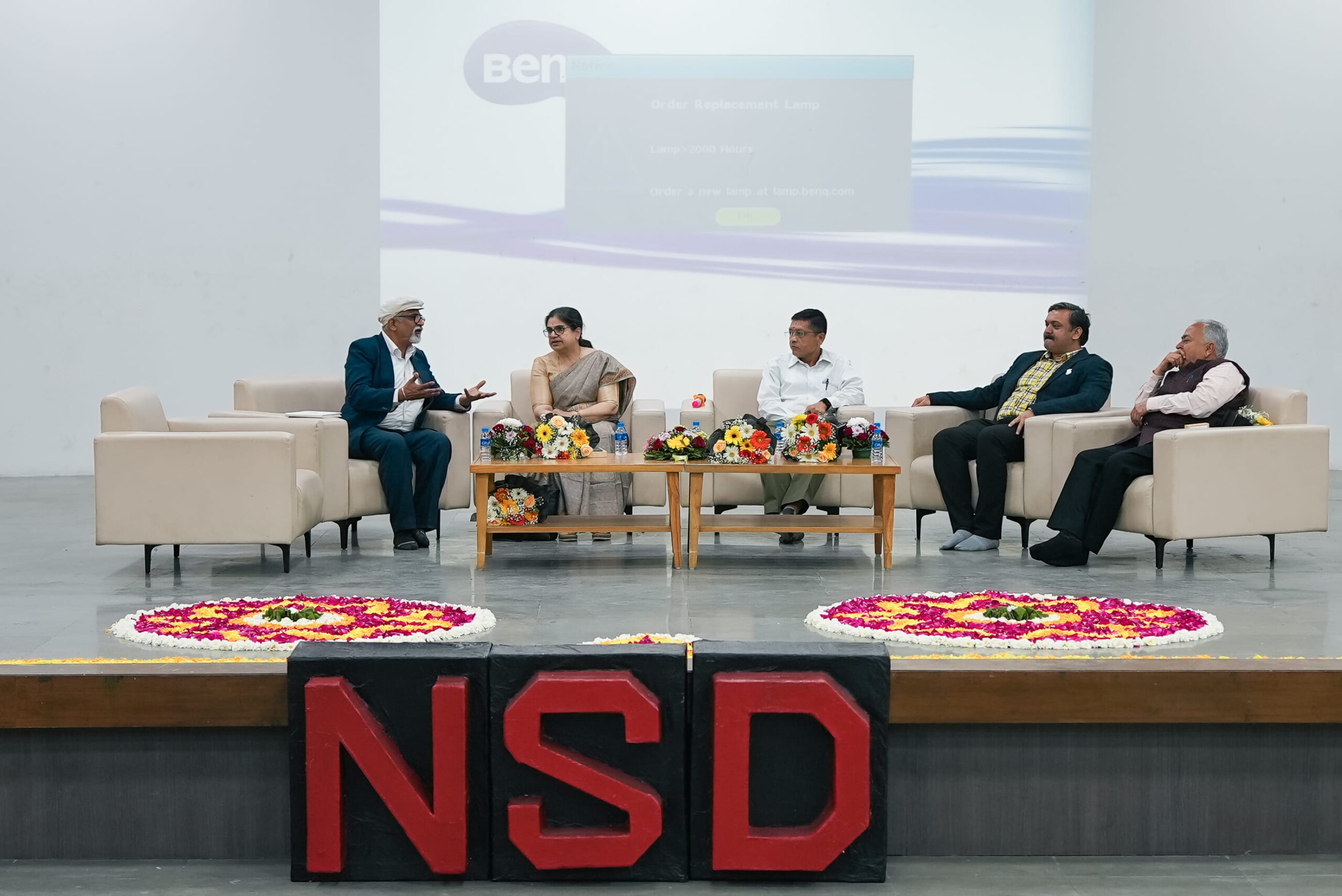
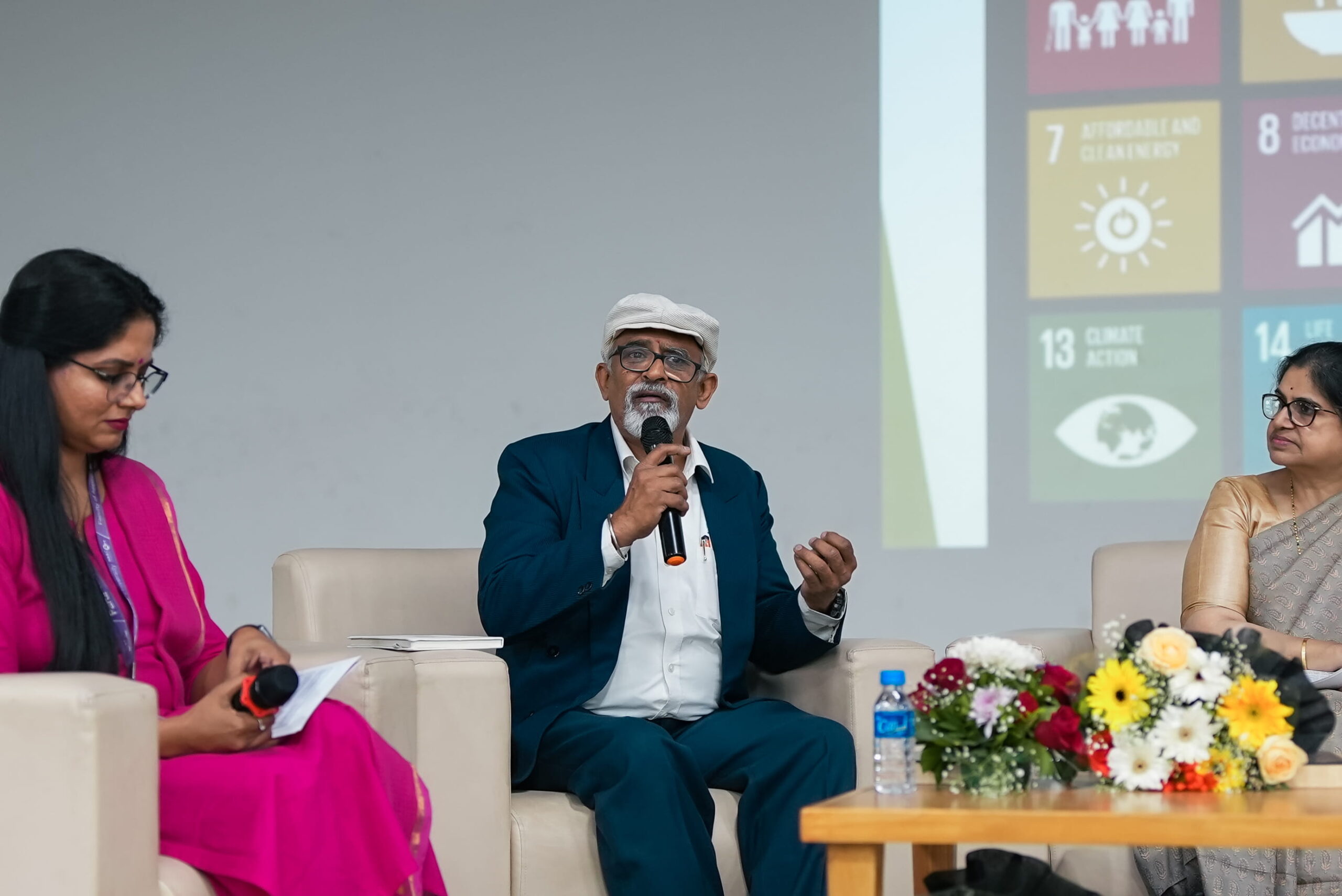
National Science Day 2026 was hosted at the Medical Auditorium at Seva Ashram, Parul University. Organized on 28th February by the Faculty of Applied Science, where many great speakers and experts attended the event. The event was hosted by Ms. Pooja Bhadrecha, Assistant Professor.
The event was led with the theme ‘Innovation Without Exhaustion,’ which was not a slogan. This was the main focus of the event, which is that India needs to work on sustainable development with serious measures and make the most out of the guided ethics and scientific temper.
The event opened with a lamp lighting ceremony attended by all five guest speakers. The event started with a dance performance by applied science students representing the culture of Gujarat. Professor Trilok Akhani, Dean of the Applied Science Faculty, gave an inaugural speech. He said, “It is a Sangam, an opportunity for all departments to come together.” He mentioned the following activities of the event, like a treasure hunt, a model-making competition, a poster presentation, and much more, all done by students.
Prof. Trilok Akhani, the dean, shared how science makes you curious. He shared the origin story of the Raman Effect. While travelling on the SS Narkunda to the Mediterranean Sea, Sir CV Raman noticed the blue color of the sea and raised an objection to Lord Rayleigh’s explanation that water has a blue color because it reflects the sky.
CV Raman explained, with simple equipment like a pocket spectroscope and a Nicole prism, Raman blocked the reflection, and still the water stayed blue.
This shows how curiosity, pursued with whatever tools were available, led to seven years of research and the discovery of the Raman Effect on 28 February 1928, earning him the Nobel Prize in Physics and making him the first Asian scientist to receive one.
Professor Akhani’s message: question what has been accepted, and work with whatever tools you have. That mindset framed everything that followed.
The Panel: Five Experts, Five SDGs, One Interconnected Conversation
Dr. Alok Saxena - Food Technology (SDG 9: Industry, Innovation and Infrastructure)
Dr. Saxena, Senior Food Safety Lead Auditor at DNV Baroda, shared how his team solved a milk contamination problem not with technology but with ethics – telling farmers that the milk they were adulterating would be given to babies and children. The appeal to moral values (Naitik Mulya) transformed milk quality. He connected this to India’s position as the world’s largest milk producer for seven consecutive years and as the number one producer of buffalo milk globally. He discussed the vegan movement’s criticism of dairy, countering that India’s dairy tradition is rooted in the Rigveda and the concept of Gau Seva – and that the Amul model has transformed hygiene standards far beyond what Western critics assume. During his speech he said that he still remembers his school day and participation in the science exhibition. And, he shared his science exhibition story, and it was based on the traditional dahi-making process, connecting modern food science with traditional ways of food making. He said that right innovation uplifts the quality of routine life without hampering the natural resources. Linking his work with the Sustainable Development Goals, Zero Hunger (2), Industry (9), and Responsible Consumption (12).
He discussed converting food waste into bioethanol as a petroleum alternative and the broader potential of biogas and biofuels as renewable energy sources. He emphasized that 65% of India’s population is below 35 – giving youth enormous power to drive sustainable change.
Dr. Suneeta Chandorkar - Nutrition (SDG 13: Climate Action)
Dr. Chandorkar, Associate Professor at M.S. College challenged the audience with a simple truth: we eat food, not nutrients. She recognised the role of the Pink Revolution in improving protein access in India, noting that milk and eggs remain essential in many diets. She argued that Indian pulses and legumes contain all essential amino acids, are culturally familiar, and cause far less environmental harm than meat production. She addressed the two-way relationship between food systems and climate change – climate lowers yields while unsustainable production accelerates damage – and warned about aflatoxins as an overlooked threat to food safety. Her closing principle: everything in moderation (Ati Sarvatra Varjayet).
Dr. Om Prakash Jasuja - Forensic Science (SDG 2: Zero Hunger)
Dr. Om Prakash Jasuja leads the Forensic Science department at RIMT University, which is recognized by the Ministry of Home Affairs. When he took the stage, he didn’t launch straight into science. Instead, he kicked things off with a lesson in ethics. He shared a simple principle: pay people before their sweat dries. Then, shifting gears, he brought everyone back to familiar ground, reminding the crowd that energy can’t be created or destroyed – a law every science student in the room knew by heart, and they all recited it together.He pointed to the flower petals scattered across the stage and asked what would happen to them – illustrating that every action stores energy that will eventually release. He compared Earth to a spring. If you pull it too much, it snaps back. He pointed to the 5-magnitude earthquake that shook West Bengal as proof. Then, he brought up COVID-19, showing how global disasters can throw food supply, production, and even sustainability into chaos. After that, he talked about forensic food labs. These places check if honey’s been cut with sugar syrup or if labels really tell the truth. Forensic science sits right where law, science, and food security all meet.
He compared Earth to a spring: stretch it too far, and it snaps back, referencing the 5-magnitude earthquake felt across West Bengal as evidence. He closed the entire session with words the audience quietly agreed with: ‘Sab ka ek hi goal hai – hum sabhi ka janam ek insaan sa hua hai, sirf insaniyat ki seva karne ke liye’ – we are all born human simply to serve humanity.
Dr. Kishor Kumar Sadasivuni - Material Science (SDG 15: Life on Land)
Dr. Sadasivuni, Associate Professor at Qatar University, opened with a striking fact: in Qatar, people buy soil imported from India because the desert produces none. He described Qatar’s 2017 blockade, when dairy imports were cut overnight and the country airlifted 4,000 Holstein cows to restore milk supply. He covered biochar (food and farm waste heated without oxygen) as a sustainable soil enhancer, warned about cancer risks from certain nano-fertilisers, and highlighted the role of artificial intelligence in agriculture – monitoring soil health, predicting crop yields, managing irrigation systems, and reducing waste.
He cited Toyota and Apple as examples of companies that adopted innovation and sustainability practices to improve efficiency, arguing that similar strategic thinking is needed in farming. He also discussed how vitamins are produced through microbial fermentation, biotechnological methods, and chemical synthesis, and injected into plants through leaf spraying, soil application, and drip irrigation to improve crop production. His closing argument: do not create new things when you have not maximised what already exists.
Dr. Kalpesh Ishnava - Biosciences (SDG 12 & 15: Responsible Consumption and Life on Land)
Dr. Ishnava, Associate Professor at Sardar Patel University (17 years teaching, 23 years research), tied the themes together. He addressed the conservation of medicinal plants through contract farming, ex-situ conservation, tissue culture, and traceability systems. He introduced green manufacturing through everyday examples – replacing plastic phone covers with recycled aluminum composites and using biochar in green concrete to reduce construction emissions. His conclusion: green manufacturing, ethical sourcing, and circular economy thinking do not hold back growth – they make growth sustainable.
Cross-Cutting Themes the Panel Agreed On
• Chasing new things can exhaust you. Use what you have before seeking something new – from traditional jaggery-making to the Amul model.
• India’s path to sustainability comes from India’s own knowledge – pulses, dairy cooperatives, traditional practices, and cultural moderation.
.
Beyond the Panel: 40 Research Papers and 6 Interactive Science Exhibits
After the panel discussion, students presented approximately 40 research papers covering human gut microbiome, nanoparticle-based drug delivery against antibiotic-resistant bacteria, marine microorganisms for plastic degradation, dietary patterns in athletes, mindful eating, and sustainable food technologies. Six interactive exhibits demonstrated food adulteration detection using household methods, coral bleaching simulation, forensic investigation techniques (fingerprint analysis, poison detection, secret writing), biodegradable bowls from sugarcane waste, psychological testing, and healthy millet-based breakfast recipes designed for PCOD/PCOS awareness. Sustainable food and tech also give a direction for nutrition-filled diets.
FAQ - National Science Day 2026 at Parul University
What was the theme of National Science Day 2026 at Parul University?
The theme was 'Innovation Without Exhaustion: Parallel Scientific Routes to Sustainable Development. Five domain experts discussed food safety, nutrition, forensic science, material science, and biosciences - all mapped to UN Sustainable Development Goals.
Who were the speakers?
Dr. Alok Saxena (DNV Baroda, food technology), Dr. Suneeta Chandorkar (M.S. College, nutrition), Dr. Om Prakash Jasuja (RIMT University, forensic science), Dr. Kishor Kumar Sadasivuni (Qatar University, material science), and Dr. Kalpesh Ishnava (Sardar Patel University, biosciences).
Why is National Science Day celebrated on 28 February?
National Science Day commemorates the discovery of the Raman Effect by Sir C.V. Raman on 28 February 1928. Raman received the Nobel Prize in Physics in 1930, becoming the first Asian scientist to win a Nobel in science. India declared 28 February as National Science Day in 1986.


