How do you save a crop without wrecking the earth it grows in?
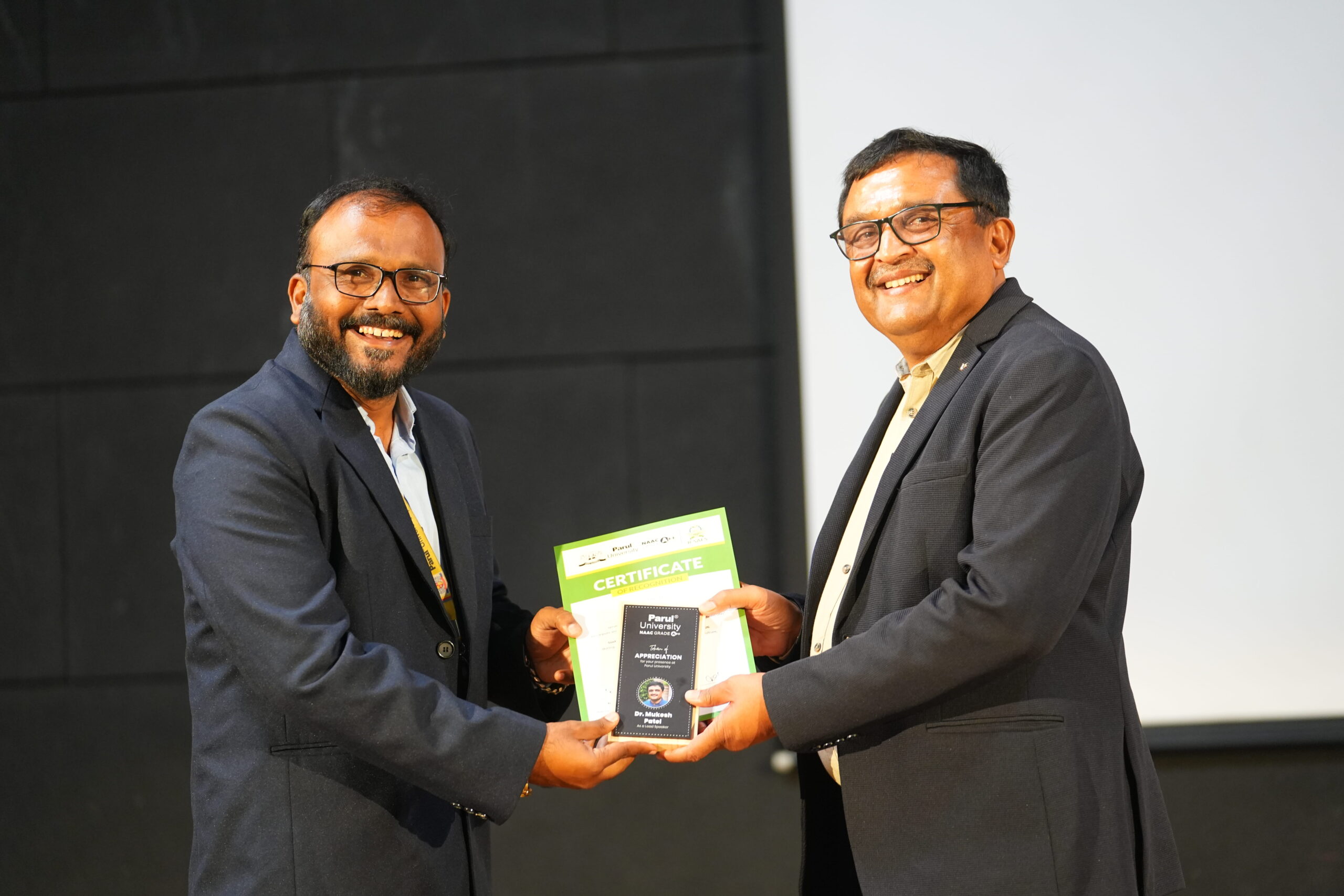
That question is not phrased exactly that way, but running underneath every slide and every data point is what drove Dr. Mukesh J. Patel’s opening session at ICSAFS 2026. And when a man who has spent 36 years buried in biological sciences stands up and tells a roomful of agriculture students that the answer is already here, already working, already commercial, you listen differently than you would to someone pitching a theory.
Some background on who was speaking. Dr. Patel is the Founder and Managing Director of Agriland Biotech Limited. Also Chairman of Agroxa Bio Innovations LLP. He has a doctorate in Plant Pathology. An M.Sc. in Agriculture. Postgraduate diplomas in both Business Management and Export-Import Management. The man straddles the lab and the market with equal comfort, which is rare. His company has been around since 1994 started right here in Vadodara, still based here and it runs a dedicated research centre that has produced over 55 different products. All ISO 9000:2008 certified. All IMO compliant for organic agriculture. This is not someone who wandered into biologicals last Tuesday.
So what did he actually cover?
Everything. Or close to it. He started from the ground up, what biological control means, why it matters, why the shift away from chemical pesticides is not just an environmental preference but an agricultural inevitability. Then he got into mechanics. Four main mechanisms make biocontrol work: competition for food, mycoparasitism, antibiosis, and induced systemic resistance. Four different ways living organisms fight back against crop-destroying pests without leaving poison in the soil.
He named names. The key biocontrol fungi, Trichoderma, Paecilomyces, Beauveria bassiana, Verticillium lecanii, Metarhizium anisopliae. The important bacteria Pseudomonas fluorescens, Bacillus subtilis, Bacillus amyloliquefaciens. Neem-based products with Azadirachtin. He went through four application methods too: seed treatment, soil amendment, soil drenching, aerial application. And then because 36 years gives you the long view, he laid out what he sees as the top 10 agricultural innovations reshaping the field: Surface Technology, Carrot Hairy Root Culture for Mycorrhiza, parapheromones for fruit flies, microencapsulation, spray drying, freeze drying, among the rest.
Now. Here is the part where I need you to stop skimming and actually look at these numbers.
Biopesticides globally? Growing at 16% annually. The USA already consumes 40% of all biopesticides produced worldwide. Europe takes 20%. And India, the country where agriculture still employs close to half the working population uses 1 to 2%. One to two percent. Let me say that differently. The rest of the world is sprinting toward biologicals and India has barely laced up its shoes. For any student or entrepreneur sitting in that auditorium who was wondering where the next big agricultural opportunity lies, Dr. Patel just drew them a map. A canyon between where India is and where the global market has already moved. Somebody is going to build across it. Why not someone from this room? That was the unspoken question hanging in the air when he finished.
Day 2: Medicinal Plants, Microwave Processing, and Natural Farming Voices
Morning of Day 2. The screen lit up and Dr. Jnanesha AC appeared on it — joining virtually from the CSIR-Central Institute of Medicinal and Aromatic Plants (CIMAP) Research Centre in Hyderabad. His title: Senior Scientist. His topic: medicinal and aromatic plants as natural alternatives for crop production and food safety. Virtual or not, the data he brought hit the room like it was standing right there in person.
-
- First – scale. The global medicinal plant business clocks in at approximately ₹8,000 crore annually. India’s slice of that? About ₹1,000 crore in exports per year. Sounds decent until you hear the next number. There is a 30 to 40% supply shortfall for crops like Ashwagandha and Kalmegh.
- Demand is outrunning supply by a third. Minimum. That is not some speculative forecast about what might happen in 2030. That is right now. Today. And it means somebody who starts growing Ashwagandha this planting season is walking into a market that already wants more than it can get.
- But Dr. Jnanesha did not just throw around market numbers. He made it personal. Here is the comparison he put up, and honestly it is the kind of slide that changes career decisions. A farmer growing paddy? Earns ₹30,000 to ₹40,000 profit. That is a living. Nobody is going to pretend otherwise. But grow Ashwagandha on the same land and the profit jumps to ₹90,000 and above. Grow Rose Geranium? Over ₹3.5 lakh profit.
- Same farmer. Same soil. Same monsoon. A completely different financial life. Those two columns of paddy versus medicinal crop sat side by side on the slide, and the gap between them said more than any speech could.
- He ran a second session too, this one focused on sustainable cultivation of medicinal and aromatic plants. Covered his current research project conservation of medicinal plants in the Deccan Plateau, protecting species like Santalum album and Gymnema sylvestre through both in-situ and ex-situ methods. He got into the science of secondary metabolites, which is really the molecular reason these plants are worth money in the first place.
- He outlined why medicinal plants make sense for farmers beyond just the profit margins, high market demand, low water requirement, and short growing period. Less risk on multiple fronts. And he highlighted varieties that CIMAP has released and made commercially available: Ashwagandha ‘Poshita’, Aloe vera ‘CIM-Sheetal’, Brahmi ‘Subodhak’, Stevia ‘CIMAP Madhu’. Government research turned into seeds a farmer can actually buy and plant. That is the pipeline working the way it should.
- Then the conference took a sharp turn into food science territory. Professor Pradyuman Kumar. SLIET Punjab. His subject, microwave-assisted food processing as a non-thermal technique. And if you think microwaves are just the box that heats your leftovers, this session would have recalibrated your understanding entirely.
- He presented data on microwave extraction of bioactive compounds. The yield? 34.14 mg/g total anthocyanin with microwave extraction versus 19.57 mg/g using conventional methods. Nearly double. For the same raw material. Then he moved to dairy, microwave pasteurisation of milk.
And here is a number that anyone connected to the dairy industry should have tattooed somewhere visible: fouling accounts for nearly 80% of dairy production costs. Eighty. Percent. Microwave pasteurisation brings that down substantially. He also covered microwave vacuum drying for milk powder, effects on protein digestibility, starch modification, enzyme activity. Dense, technical, deeply researched work. The kind of research that does not make headlines but quietly transforms how food gets processed at the industrial scale.
Afternoon. The suits and the lab coats cleared out. The farmers walked in.
-
- Shri Raju M. Thakkar, they call him the Walkman of India, moderated a panel discussion with four natural farmers from Gujarat. Not textbook farmers. Award-winning, field-tested, dirt-under-the-fingernails farmers who have bet their livelihoods on natural farming and come out the other side with trophies to show for it.
- Smt. Usha Ben Vasava. She received the Nari Shakti Puraskar in 2022. She organised more than 3,000 women through her Asangathan. Pause on that for a second. One woman. Three thousand others followed her into natural farming. That is not an agricultural achievement. That is a movement.
- Smt. Sejalben Patel. Shreshtha Pashupalan Pramanpatra awardee. Owns 70 cows. Runs a Gaushala. Built a sustainable dairy operation not by reading about it but by doing it, animal by animal, year after year.
- Shri Dhanshukbhai Chaudhari. Won the Best ATMA Farmer Award in 2023–24. Farms a 5-acre model plot in Gondha village. Five acres is small. What he has done with those five acres is not.
- Shri Valjibhai Rayabhai Chaudhari. Best Farmer Award. ATMA-affiliated. Natural farming pioneer based out of Surat. He has been at this long enough that the results are not preliminary anymore. The model works. He is the proof.
Four people. Four different stories. Four different routes into natural farming. All four arrive at the same conclusion, you can farm productively without destroying the land that feeds you. That was the note the conference ended on. Not a scientist’s chart. Not an economist’s projection. A farmer’s conviction, backed by years of doing it for real.
FAQ - ICSAFS 2026 at Parul University
What was the sustainable agriculture conference at Parul University 2026?
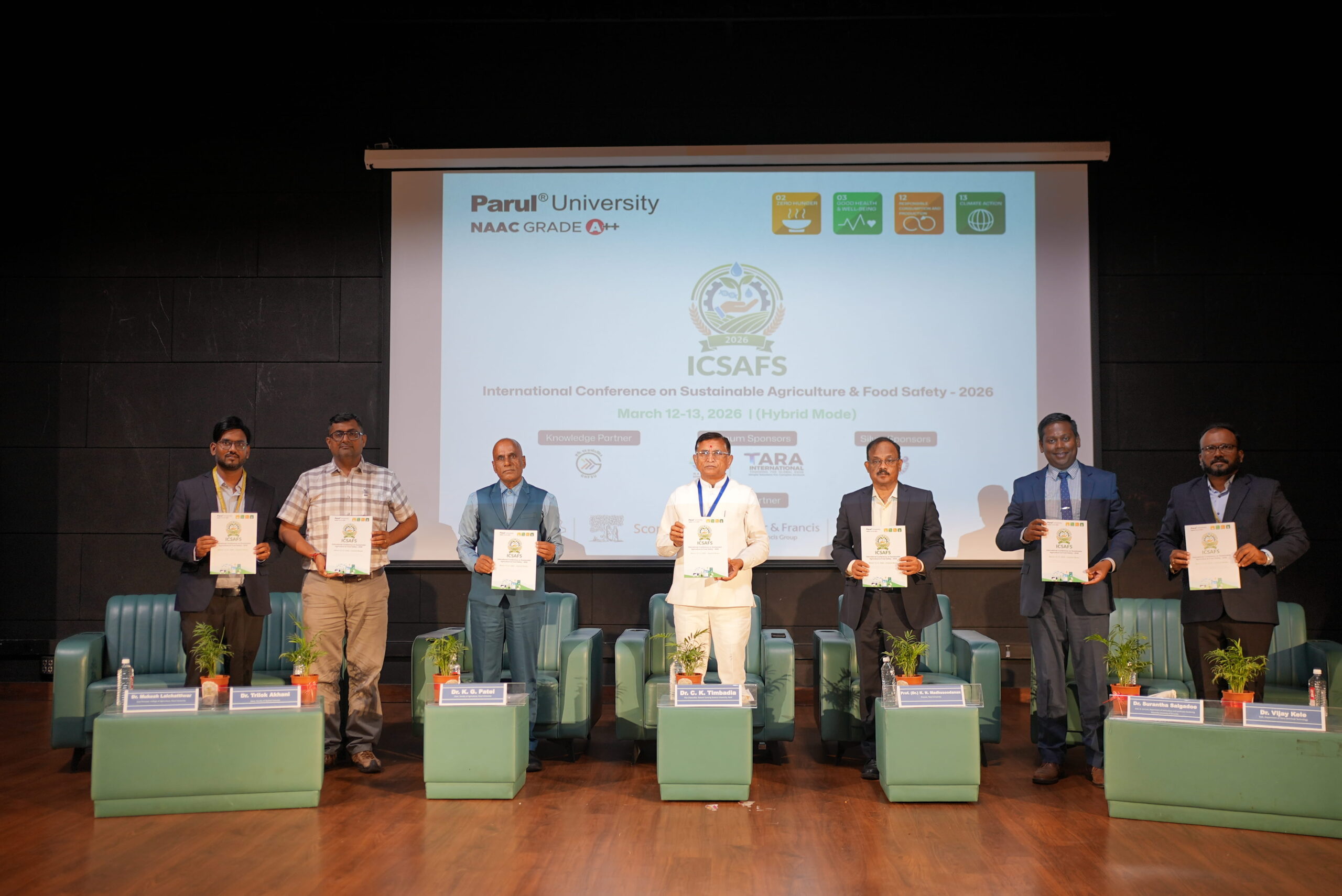
ICSAFS 2026, short for the International Conference on Sustainable Agriculture and Food Safety, was a two-day event on 12–13 March 2026 at the Central Auditorium, Parul University. It covered biological pest control, medicinal and aromatic plants, microwave-assisted food processing, and natural farming through expert sessions and a Gujarat farmer panel. Four speakers. Two days. A lot of ground covered.
Who spoke at the sustainable agriculture conference at Parul University?
Dr. Mukesh J. Patel (Founder of Agriland Biotech, 36 years in biologicals), Dr. Jnanesha AC (Senior Scientist at CSIR-CIMAP Hyderabad), Dr. Pradyuman Kumar (Professor at SLIET Punjab), and a panel of four award-winning Gujarat farmers moderated by Shri Raju M. Thakkar. The speakers ranged from biotech entrepreneurs and government scientists to farmers who are doing this work on the ground every single day.
Does Parul University offer agriculture and food technology courses?
It does. The Faculty of Agriculture, Gujarat’s first private agricultural college, designated a Centre of Excellence offers B.Sc. (Hons.) Agriculture. The Parul Institute of Applied Sciences runs B.Sc. and B.Sc. (Hons.) Food Technology. And the Faculty of Engineering offers B.Tech Food Technology. Worth noting these students study in the same auditorium where CSIR scientists and biotech founders just presented their latest research. The classroom and the conference hall share a postcode.


