Portfolio management has relied on models that assume relationships between assets stay roughly constant over time. In calm markets, that assumption holds. During market crises, it collapses. Asset correlations spike simultaneously. Volatility explodes. By the time a classical model catches up to the new reality, the losses have already happened. The COVID-19 market crash of early 2020 exposed this failure with painful clarity. Risk parity strategies that institutional investors depended on could not keep pace with the speed and severity of the selloff.
Dr. Sanjay Agal‘s research started with a direct question. Could a system be built that anticipates regime shifts rather than reacting to them? Not a system that waits for a crash to happen and then adjusts. A system that detects the early signals of a structural market change and repositions the portfolio before the worst of the damage materialises.
That question drove the development of a layered machine learning framework tested on out-of-sample data from 2017 through 2022. The results are widely published in Scientific Reports i.e., (DOI: 10.1038/s41598-025-26337-x)
Future Research Pipeline (2026 – High-Impact Submissions)
The research portfolio is further strengthened by a robust set of manuscripts currently under peer review and editorial evaluation in leading high-impact (Q1) journals. These ongoing works reflect sustained scholarly momentum and demonstrate active engagement with globally recognized publication platforms. The diversity of topics, coupled with submissions to prestigious IEEE Transactions and Springer Nature journals, highlights both the depth and translational relevance of the research contributions. This ongoing pipeline not only reinforces academic credibility but also indicates strong potential for near-term publications in top-tier venues.
The 2026 research pipeline is strongly anchored in high-impact Q1 journals, including premier IEEE Transactions and Springer Nature journals. The current set of submissions under peer review and editorial evaluation spans advanced domains such as multimodal generative AI, explainable NLP, financial intelligence, privacy-preserving machine learning, and intelligent smart systems. Notably, recent submissions to IEEE Transactions further strengthen the research profile, demonstrating contributions in socially aware AI systems and hybrid NLP architectures. The overall pipeline reflects a strategic focus on scalable, explainable, and real-world AI solutions, with a strong presence in top-tier (Q1) journals, indicating high potential for impactful publications in the near term.
Table: Future Journal Papers under Review / Editorial Stage (2026)
| Paper Title | Domain | Target Journal (Quartile) | Stage |
|---|---|---|---|
| SynthCity: A Multi-Modal Generative Framework for Socially Aware Synthetic Data Creation in AI-Driven Smart City Ecosystems | Multimodal AI / Smart Cities / Generative Models | IEEE Transactions on Computational Social Systems (Q1) | Under Review |
| BERT-LSTM Hybrid Models for Explainable NLP: A Comparative Study on Sentiment Analysis and Text Summarization | NLP / Explainable AI | IEEE Transactions on Artificial Intelligence (Q1) | Under Review |
| A Hybrid Deep Learning Framework for Volatility Prediction in Financial Markets | Financial AI / Deep Learning | Scientific Reports (Q1) | Peer Review |
| Hybrid LSTM–GNN Models for Early Student Success Prediction Using Synthetic Educational Data with Real-World Validation | Educational Data Science / Graph ML | Scientific Reports (Q1) | Peer Review |
| PipeBench: A Benchmarking Framework for End-to-End Machine Learning Pipelines | ML Systems / Benchmarking | Scientific Reports (Q1) | Peer Review |
| A Machine Learning Framework for Early Warning Prediction of Student Success Using Privacy Preserving Synthetic Educational Data | Educational AI / Privacy | Scientific Reports (Q1) | Peer Review |
| A Machine Learning Framework for Uncertainty-Aware Predictive Optimization in Smart Environment and Financial Systems | AI Optimization / Smart Systems | Scientific Reports (Q1) | Peer Review |
| A Systematic Survey of Artificial Intelligence Based Approaches for Information Security in Higher Education | AI Security / Survey | International Journal of Information Security (Q1) | With Editor |
| A Theory of Disentangled Representations for High Frequency Market Microstructure | Financial AI / Representation Learning | Operations Research Forum / Digital Finance (Q1/Q2) | With Editor |
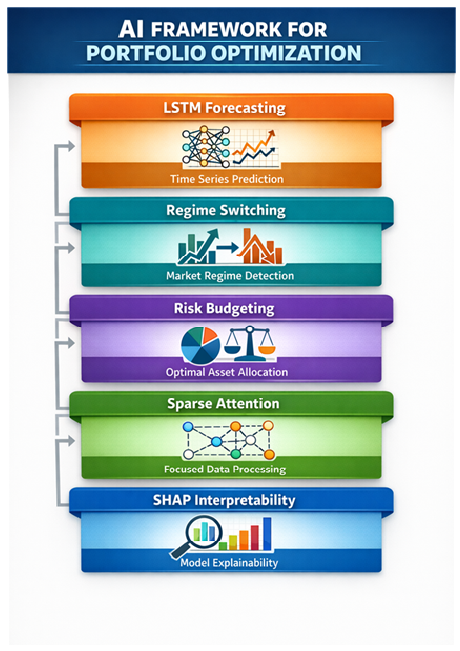
Five Layers That Work Together: How the Framework Operates
Scientific Reports is published by Springer Nature, the house that publishes Nature, widely considered the most prestigious scientific journal in existence. Scientific Reports serves as a sister publication covering research across natural sciences, engineering, medicine, and mathematics. It is ranked Q1, the highest possible quartile for academic journals. With over 834,000 citations in 2024, it is the third most-cited journal in the world. Its 2024 impact factor stands at 3.9.
Getting past its peer review process requires work that meets international standards of scientific rigour, novelty, and methodological soundness. The fact that a research paper from Parul University’s Department of AI and Data Science cleared this threshold places the department’s research output alongside work from institutions that have been producing top-tier research for decades.
The paper is open access, meaning anyone in the world can read it. The co-authors are Krishna Raulji and Niyati Dhirubhai Odedra. The DOI is 10.1038/s41598-025-26337-x.
Transparency That Regulators and Risk Managers Need
Finance is one of the industries most suspicious of AI. Regulators, compliance teams, and investment committees need to know why a model recommends what it recommends. A black box is not acceptable in front of an audit committee. Dr. Agal’s framework addresses this through SHAP-based risk attribution (SHapley Additive Explanations). This layer allows a risk manager to look inside any decision and see which factors drove the allocation.
What the SHAP analysis revealed was genuinely reassuring. In stable markets, the model relied on momentum factors and yield-curve signals. This is consistent with how experienced human portfolio managers approach steady environments. When stress signals appeared, the model shifted attention to the VIX and liquidity indicators. Again, exactly what a seasoned risk manager would do. The framework was not just producing good numbers. It was learning the logic of financial markets.
This interpretability is what makes the difference between a research paper and a deployable system. Institutional investors will not adopt a model they cannot explain. Dr. Agal’s framework can be explained, interrogated, and audited at every decision point. If you too wish to grow your career in the same domain, pursue BBA in Data Analytics at Parul University!
The Numbers: What Out-of-Sample Testing Showed
The framework was tested on data from 2017 through 2022, a period covering some of the most dramatic market conditions of the past two decades. The Sharpe ratio achieved was 1.38. The Sharpe ratio measures return per unit of risk. Higher is better. Against traditional risk parity strategies, the framework showed a 55% improvement. Against contemporary machine learning methods representing the current state of the art, the improvement was 23%.
During periods of high market stress specifically, the improvement over classical risk parity was 187%. Maximum drawdown during crises was reduced by 41%. Maximum drawdown is the worst loss from peak to trough. A 41% reduction means significantly less damage when markets are at their most brutal.
The most striking result came during the February-March 2020 COVID-19 crash, the steepest equity selloff in modern history at that time. The framework began reducing equity exposure two full weeks before the market hit its bottom. No human intervention. No manual override. The model read the volatility signals and widening credit spreads and made the call on its own. Inspired already? Delay no more and create your successful career in Bachelor of Technology in Artificial Intelligence and Data Science!
Scientific Reports: What This Journal Means in Academic Publishing
Scientific Reports is published by Springer Nature, the house that publishes Nature, widely considered the most prestigious scientific journal in existence. Scientific Reports serves as a sister publication covering research across natural sciences, engineering, medicine, and mathematics. It is ranked Q1, the highest possible quartile for academic journals. With over 834,000 citations in 2024, it is the third most-cited journal in the world. Its 2024 impact factor stands at 3.9.
Getting past its peer review process requires work that meets international standards of scientific rigour, novelty, and methodological soundness. The fact that a research paper from Parul University’s Department of AI and Data Science cleared this threshold places the department’s research output alongside work from institutions that have been producing top-tier research for decades.
The paper is open access, meaning anyone in the world can read it. The co-authors are Krishna Raulji and Niyati Dhirubhai Odedra. The DOI is 10.1038/s41598-025-26337-x.
What Comes Next: The Research Roadmap
The research team is already exploring several directions beyond the current paper. ESG (Environmental, Social, and Governance) integration is a natural extension, as institutional mandates increasingly require ESG constraints in portfolio construction. Alternative data sources including sentiment signals from news and social media, supply chain disruption data from satellite imagery, could give the regime detector even earlier warning of structural market shifts.
Broader applications in insurance risk modelling, derivatives hedging, and pension fund management all face similar dynamic risk challenges. The framework’s architecture is designed to generalise across these domains. Quantum computing could eventually push the computational ceiling higher for very large portfolios. These are not speculative ideas. They are active research directions built on a foundation that has now been validated in a Q1 journal.
FAQ - AI Portfolio Optimization Research
What journal did Dr. Sanjay Agal publish in?
Scientific Reports, a Q1 journal under Springer Nature. It has a 2024 impact factor of 3.9 and is the third most-cited journal in the world with over 834,000 citations. The paper is open access (DOI: 10.1038/s41598-025-26337-x).
What results did the AI portfolio framework achieve?
Sharpe ratio of 1.38, 55% improvement over traditional risk parity, 23% improvement over contemporary ML methods, 187% improvement during high-stress periods, 41% reduction in maximum drawdown during crises, and equity exposure reduced 2 weeks before the COVID-19 market bottom with no human intervention.
Can students study AI and Data Science at Parul University?
Yes. Parul University offers B.Tech CSE in AI and Data Science, B.Tech CSE with AI and Machine Learning, B.Tech in Quantum Computing and AI, MBA in AI and Technology Management, and BBA in Data Analytics. The department is headed by Dr. Sanjay Agal, whose research is published in the third most-cited journal in the world.
What is the SHAP method in the framework?
SHAP (SHapley Additive Explanations) is a transparency layer that lets risk managers see which factors drove each allocation decision. In stable markets, momentum and yield-curve signals dominate. In stress periods, the VIX and liquidity indicators take over. This mirrors how experienced human portfolio managers think.