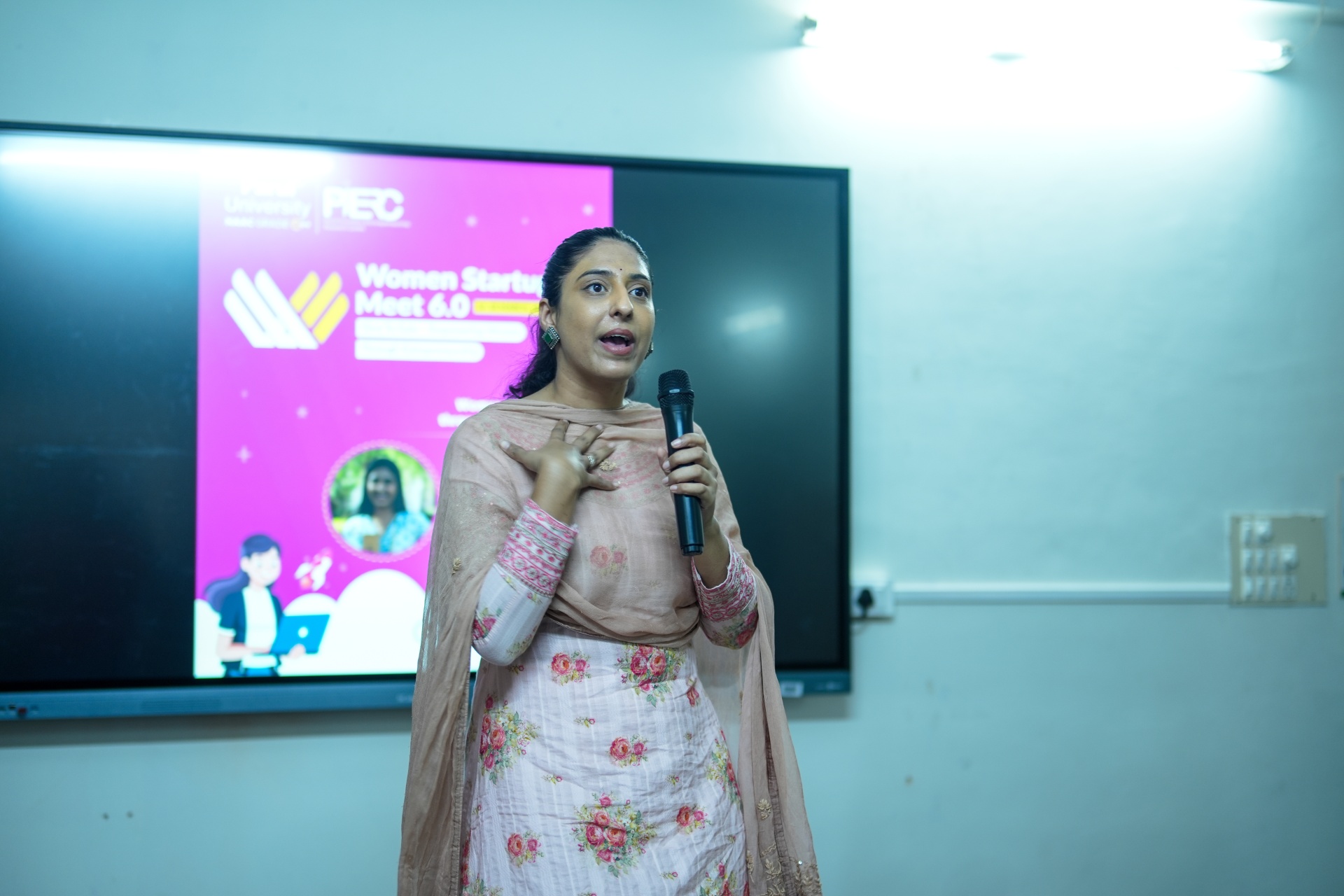
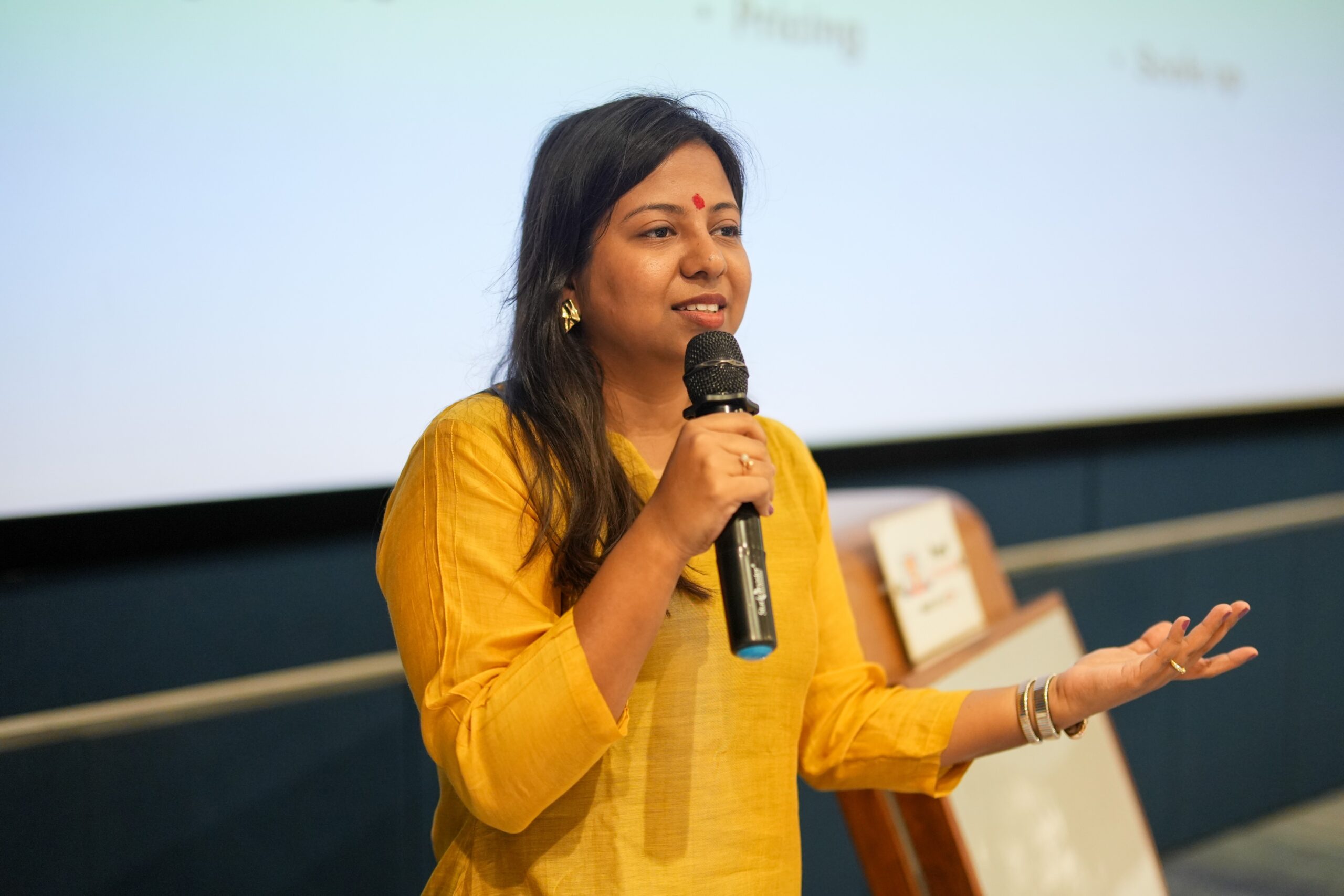
Ms. Itisha Agrawal opened with a fundamental distinction: a startup is not a small business. It is a problem-solving venture built around innovation and scalability. The most important framework she presented was Why-What-How. Why does your startup exist? They fail because the founders never answered Why clearly enough.
Dr. Mukta Sharma complemented this with four foundational requirements: idea (identifying an opportunity from real life, often from problems people do not even notice), customer (understanding who will buy and what they can afford), funding (not necessarily personal money, but government schemes, PIERC support, and institutional grants), and USP (what makes your product stand out when competitors already exist).
She emphasised USP with a practical question: if making herbal toothpaste, big brands already exist, so why would a customer pick yours? Making the unique benefit obvious and simple is what converts browsers into buyers.
Itisha’s own journey illustrates the framework. From content writing to social media marketing, she rigorously worked for 4 years in this industry before launching her very own startup. If you wish to pursue your business idea, enrol into Parul University’s Master of Business Administration in Digital Marketing & Sales Program!
12 Steps From Research to Scale: The Complete Startup Lifecycle
Ms. Agrawal laid out the startup lifecycle in twelve concrete stages.
- Step 1 – Research and Development: identifying problems, conducting market research, and validating ideas.
- Step 2 – Pitch Decks: creating a presentation that explains the business idea, attracts investors, and communicates the vision clearly.
- Step 3 – Incubation: joining an incubation centre (like PIERC at Parul University) for mentorship, resources, and networking opportunities.
- Step 4 – Legalities: business registration, documentation, and legal compliance.
- Step 5 – Funding: raising capital through investors, personal savings, government grants, or institutional support.
- Step 6 – Branding: creating identity, building trust, and standing out in the market.
- Step 7 – Production: developing the product or service while ensuring quality and functionality.
- Step 8 – Trial Phase: testing the product, collecting feedback, and making improvements before full launch.
- Step 9 – Go-to-Market Strategy: planning how to introduce the product, reach the target audience, and position it effectively.
- Step 10 – Marketing: using various platforms to promote, increase visibility, and attract customers. You too can create a successful career in international marketing by enrolling in Parul University’s Bachelor of Business Administration in Digital Marketing.
- Step 11 – Scaling: expanding by increasing production and reaching more customers.
- Step 12 – Scale-Up: taking the business to a larger level with strong systems, sustainable growth, and wider impact.
The lifecycle Ms. Agrawal described is the roadmap. PIERC provides the infrastructure to walk it.
Customer Psychology, Pricing, and Bootstrapping: Lessons From Dr. Mukta Sharma
Dr. Mukta Sharma’s session was pure ground-level reality. She explained that in a startup, the first customers should not be the whole world. They should be the people around you. According to the type of community you live in, pricing must match local affordability.
Her bootstrapping philosophy was practical. No need to hire a celebrity for promotion. Be the face of your own product. No need for expensive marketing in the beginning. Learn the basics and do it yourself. No need for premium packaging initially. Simple packaging is enough if the product quality is strong. The product must speak for itself. If customers love it, they come back regardless of how the packaging looks. She said the line that captured her entire approach: do not love your product. Let your customer love it. Have an idea and want to get it funded? Enroll into Parul University’s MBA in Marketing and give wings to your dreams!
Branding, Trust, and the Ayurveda Startup Path
Dr. Mukta Sharma shared a trust lesson from her training days. A patient came to her with pain and she prescribed medicine, but felt it might not be very effective. Later, the same patient visited her senior, received the same medicine in different packaging, and reported it worked better. She talked about marketing impact through a vivid example: celebrity endorsements like Salman Khan for Thums Up create instant product recognition. Her Hindi insight captured it perfectly: what is visible is what sells. For Ayurveda startups specifically, she noted that students are encouraged to prepare their own medicines during BAMS education.
If confident, they can test them on trusted patients. If results are good, building a brand from that knowledge is a logical next step. If you too wish to grow your career in the field of Ayurveda, enrol into Parul University’s Bachelor of Ayurvedic Medicine and Surgery (BAMS) Program!
Dr. Mukta shared how a friend who initially contributed nothing started noticing packaging problems and gradually took over that responsibility. Work gets divided naturally when the team dynamic is right. Ms. Agrawal echoed this through her concluding quote: design with the user in mind to speak to their needs. The user, whether customer or team member, is always the centre of the startup.
FAQs - Foundation of Startup!
What are the 12 steps in a startup lifecycle?
R&D, Pitch Deck, Incubation, Legalities, Funding, Branding, Production, Trial Phase, Go-to-Market Strategy, Marketing, Scaling, Scale-Up. Presented by Ms. Itisha Agrawal (Founder, See-Sow Kids) at Parul University's Women Startup Meet 6.0.
What are the four things needed to start a startup?
Idea (find an opportunity from real life), Customer (understand who will buy and what they can afford), Funding (government grants, PIERC support, personal savings), USP (what makes your product unique). Taught by Dr. Mukta Sharma (Founder, Old Veda Medsols LLP) at Parul University.
How should a startup price its first product?
Match local affordability. Start with nearby customers. Choosing quality over quantity is the go to policy for any product enhancement!


