Mahesh Baliga: A Painter's Journey From 2002 to 2016
L.N. Tallur was born in 1971 in Udupi, Karnataka. He studied at the Chamarajendra Academy of Visual Arts in Mysore, completed a Master’s in Museology at MS University Baroda, and received a Commonwealth Scholarship to Leeds Metropolitan University in the UK. His museology background shapes everything: he understands how objects are displayed, how value is assigned to them, and how institutions influence perception.
His presentation centred on the Uncanny Valley Effect, the uneasy feeling when something looks almost familiar but not entirely right. He applies this concept to art by creating objects that are familiar but distorted, traditional but altered, real yet artificial. Key works include Unicode (a spherical structure representing globalisation and standardisation), Obituary (a temple chariot suggesting the death of traditional practices), Milled History (traditional sculptures altered by digital machines), Alzheimer’s (termite-eroded wood representing memory loss, 2006), Glitch Tandava (distorted classical sculpture combining tradition with digital glitch, 2024), Mind-Gut Link (hybrid mechanical-organic sculpture, 2024), and Data Mining (carved wooden form reflecting how data shapes identity, 2022). His works are not just sculptures. They are questions in physical form.
Mahesh Baliga: A Painter's Journey From 2002 to 2016
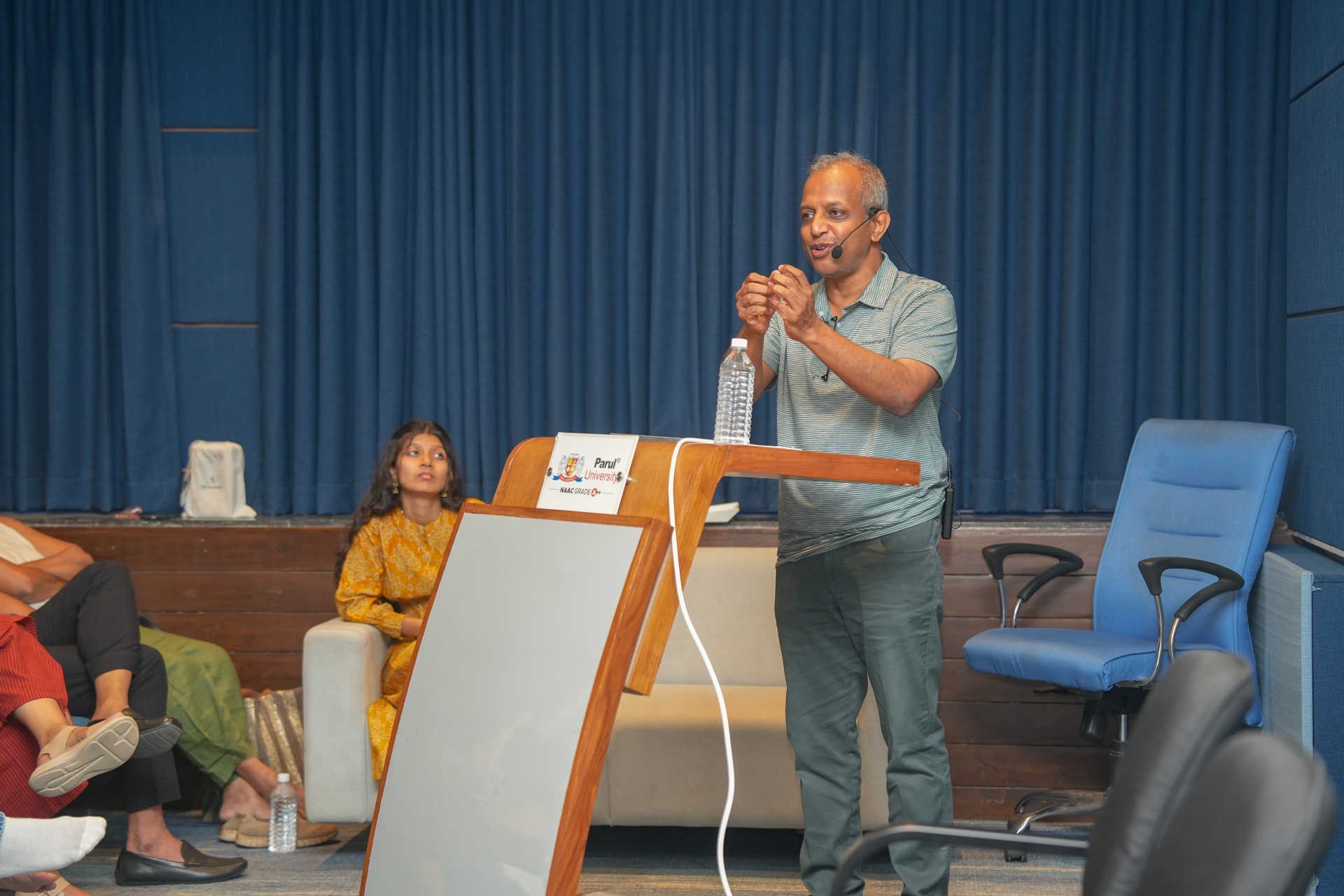
Mahesh Baliga, a prominent Vadodara-based painter, shared his personal journey alongside his works. After completing 12th, he joined an art school by mistake, not knowing the difference between an art school and an art college. He discovered the difference through a senior after one year and then joined Mysore Art College on that senior’s advice. One of his teachers initially ignored him. He later understood that in that environment, people were recognised only by their work. This motivated him to improve.
He walked through works chronologically from 2002 to 2016 without formal slides, explaining the story, medium, and thinking behind each. Highlights included Tape Recorder (2005, painted to explore the interior mechanics of the device), College Studio (2005, a view from above the washroom beside the classroom), A Page from a Diary Madman in the Sayajirao Road (2004), Wallet (2007, containing paintings of friends he missed from Mysore), and works in acrylic, oil, bronze, and glass across canvases ranging from intimate to large-scale. The session demonstrated that a painting practice is built work by work, year by year, through sustained looking and making. Turn Your Passion for Art into a Career with BVA at Parul University
Archana Hande: Marriage, Jacquard Cards, and Light at Jaipur Fort
Archana Hande’s presentation revealed a practice that moves between technology, social research, and site-specific installation. She started with the Xerox machine as a creative tool, not just for copying but for making people interact with it and making it part of art. She created arrangeurownmarriage.com, a website and interactive experience exploring the Institution of Marriage with stop animation where users could choose their life partner. The project connected art with India’s legal system around marriage and divorce. Legal companies funded the work, recognising its practical implications.
Her Os Panorama project studied honeymoon locations and how films show places romantically. She travelled and cycled for months, observing, sketching, and creating thousands of animation frames from the research. Her work with Jacquard punching cards was revelatory: these textile machine cards, she explained, function like binary systems and pixels, making them effectively the first computer. She collects old Jacquard cards and uses them with light to create shadows, patterns, and moving experiences that combine analog and digital.
At Jaipur fort, she spent over a month understanding how the city uses light from sun and moon. She built two installations: Chandrakiran (House of the Moon), where shows were cast on walls using moonlight, and Suryakiran (House of the Sun), where sunlight created unique shadows. Her core message: there is nothing called original. Everything comes from something else. Stealing an idea can change your life. What matters is transformation: adding your own thinking until it becomes unmistakably yours.
Indrapramit Roy: The Nocturnal Artist and the Mumbai Airport Mural
Indrapramit Roy was born in 1964 in Calcutta. His father was associated with Bohuroopi, one of India’s oldest theatre groups. His mother played sitar. Theatre and music were his first languages. He studied printmaking at Visva-Bharati University (Santiniketan), painting at MS University Baroda, and received an Inlaks grant for a Master’s at the Royal College of Art London. A Fulbright grant sent him to Bennington College and the University of the Arts in Philadelphia. He has completed 19 solo shows and over 80 group shows across New York, London, Berlin, San Francisco, Sydney, and Kolkata.
He introduced himself simply: an artist and a teacher. His artistic persona, he said, is split like Dr Jekyll and Mr Hyde: vocal and engaged in the day job, needing complete silence in the studio at night. Almost 95% of his practice happens after dark, sometimes until 3 or 4 AM. The work he presented was titled 3AM, marking simply the hour he finished it. The pandemic gave him uninterrupted studio time for two months, producing much of the work he showed. Before that, a Fulbright took him to the US, and he worked at the Cité des Arts in Paris and Hochschule der Kunst in Berlin.
His series include Nocturnal City (cities that glitter from above but hide harshness below), Windows (inspired by Hitchcock’s Rear Window and his Fulbright studio on the 19th floor), the Cactus Series (geometrically beautiful plants that spike back when touched, connecting to Noli Me Tangere), shaped canvases exploring why painting must be rectangular, and cloud paintings inspired initially by Paul Klee. Clouds, he said, are shape-shifters that carry romance from Kalidasa onwards but also carry radioactivity and acid rain. Text appears in his paintings alongside images without explaining them. A Gertrude Stein paraphrase in one work reads: you carry your roots wherever you go and they take care of you. When you start looking for them, you admit they are dying.
His 12-by-26 feet mural for Mumbai Airport Terminal 2 (2013) depicted Bombay as a global city, referencing the Queen’s Necklace, chawls, high-rises, religious neighbourhoods, and the city’s relationship with water. A raised panel extends forward showing close-up windows. His key insight for students: painting does not start with ideas. It starts with something that presents itself as a visual problem, something that makes you want to pick up a brush. The search for an image to fit a pre-existing idea almost never works. Nurture your creativity and shape your future with Parul University’s Faculty of Fine Arts.
FAQ
Who is L.N. Tallur?
Contemporary sculptor born 1971 in Udupi, Karnataka. BFA from Chamarajendra Academy Mysore, Master's in Museology from MS University Baroda, Commonwealth Scholarship to Leeds. Known for the Uncanny Valley Effect in sculpture: creating objects that are familiar but distorted, traditional but altered. Works include Unicode, Obituary, Glitch Tandava, and Data Mining.
What is the Mumbai Airport Terminal 2 mural?
A 12-by-26 feet mural by Indrapramit Roy (2013) depicting Bombay as a global city. References the Queen's Necklace, chawls, high-rises, religious neighbourhoods. A raised panel extends forward showing close-up window scenes. Roy is Associate Professor and Dean of Students at MS University Baroda.
What is Archana Hande's Jacquard punching card work?
Archana Hande discovered that Jacquard punching cards from textile machines function like binary systems and pixels, making them effectively the first computer. She collects old cards and uses them with light to create moving shadow patterns that combine analog history with digital thinking.


