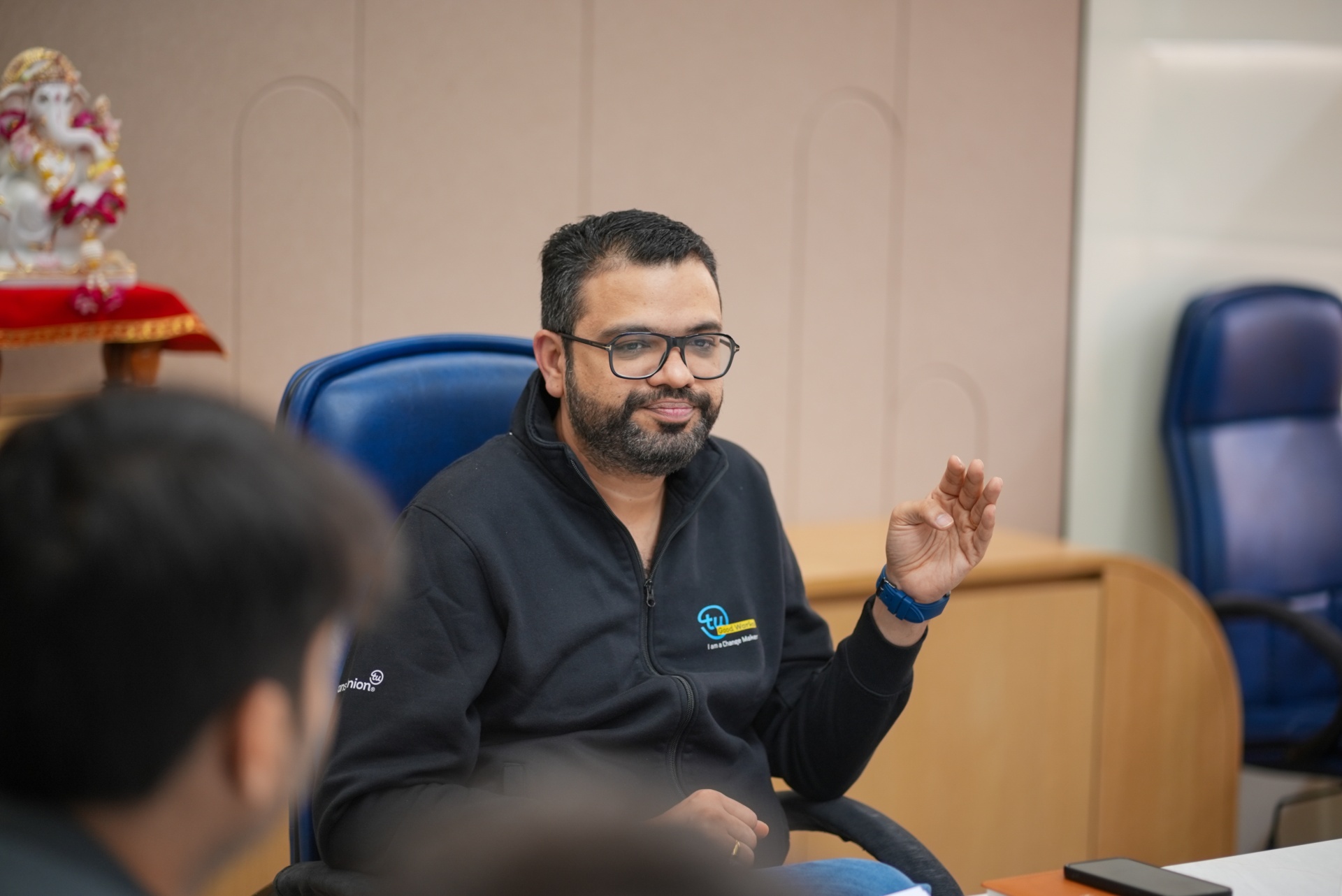

Mr Krishnan Iyer (Senior Vice President, NSE) walked students through the operational architecture of India’s largest stock exchange. The NSE is not just a platform where shares are bought and sold. It is a surveillance system, a risk management engine, and a clearing infrastructure operating simultaneously.
Market surveillance system detect manipulation at all the levels, in real time by monitoring trading patterns, volumes, price, across all the listed securities. When an issue is flagged, be it inside trading, front running or pump-dump activity, the system generates automatic alerts for investigation. The surveillance operates continuously during peak market hours, and processes millions of data points.
Due to AI, high-frequency and algorithm based trading can now constitute a significant portion of final trading volume. The system execute orders in milliseconds, and creates challenges for surveillance, and that questions – how do you distinguish between strategy and market manipulation happening at machine speed? NSE addresses this via a sophisticated process, recognized and coordinated with SEBI!
Clearing and settlement mechanisms ensure that every trade is completed. Clearing corporations act as shock absorbers: they stand between buyer and seller, guaranteeing that if one party defaults, the other still receives what they are owed. This reduces systemic risk. Efficient settlement reduces the time between trade execution and final transfer of securities and money. If you’re equally passionate about economics, then enrol into Parul University’s Bachelor of Arts in Economics!
“Scalability is a core exchange requirement.”
REAL EXPERIENCE – STRAIGHT FROM THE ECONOMICS & FINANCE TOUR, PARUL UNIVERSITY!
NSDL: The Invisible Backbone of Securities Ownership
Three C-suite leaders presented: Mr Jigar Shah (CFO), Mr Sameer Patil (CMO), and Mr Ujjwal Punmiya (CBO). NSDL is where your demat account lives. Every share you own, every bond, every mutual fund unit is held electronically at NSDL. It is the backbone of India’s securities market.
The session covered NSDL’s financial sustainability through stable fee-based revenues, cost management, digital transformation, cybersecurity, and regulatory alignment with SEBI. Product diversification (insurance repositories, e-KYC, PAN verification) supports future growth. Data security is a top institutional priority because NSDL holds the ownership records of every market participant.
“Trust is the foundation of depository services.”
Morgan Stanley: Global Investment Banking and India's Growth Story
Ridham Desai (Managing Director, Morgan Stanley) provided the global perspective. Morgan Stanley operates in investment banking, wealth management, and institutional securities across dozens of countries. The session covered macroeconomic trends affecting emerging markets like India, risk management practices in volatile financial markets, use of technology and AI in trading and investment decisions, and talent development in global institutions.
India remains a strategic growth market for global banks. The combination of demographic dividend, formalisation of the economy, and deepening capital markets makes India one of the most attractive destinations for institutional capital. Global firms balance local market knowledge with global strategies. Strong risk culture is critical because one mispriced position in one country can create losses across the entire firm. If you’re passionate about AI & technology, enrol into Parul University’s B.Tech in AI Program!
“Technology is reshaping the way capital markets operate.”
TransUnion CIBIL and Experian: How Credit Scores and Data Drive Lending
TransUnion CIBIL (Mr Bhavesh Jain, MD and CEO) and Experian India (Mr Manish Jain, Country Head) covered the credit infrastructure that determines whether you get a loan, at what rate, and under what conditions.
CIBIL maintains credit information on hundreds of millions of individuals and businesses. Credit data flows between lenders and CIBIL: when you take a loan, your repayment behaviour is reported to CIBIL. When you apply for a new loan, the lender checks your CIBIL score. AI and data analytics are used for credit risk assessment, but Mr Jain emphasised that data accuracy is the backbone of the credit ecosystem. Wrong data means wrong decisions.
Experian brought a different angle: alternative data. Traditional credit scoring uses loan repayment history. But millions of Indians have thin credit files, meaning limited or no formal credit history. Experian uses alternative data (utility payments, mobile usage, digital transaction patterns) to assess creditworthiness for people the traditional system excludes. This is particularly important for MSME lending, where small businesses often lack formal financial documentation.
Both organisations emphasised that data protection equals reputation protection. Credit bureaus hold sensitive personal financial information. A breach destroys trust. Security is non-negotiable for data companies.
Godrej Capital: How a Legacy Brand Does Digital-First Lending
Manish Shah – the MD & CEO of Godrej Capital presented how a company within the godrej group approaches retail and MSME lending with a digital strategy. His session covered customer-centric approach design, analytical skills in sync with data, AI for credit assessment, discipline, managing credit cycles, and NPAs and ESG.
His core message to the students – The core growth must be balanced with Risk + Discipline. MSMEs are the key drivers of economic growth but lending to them required risk assessment because they often lack financial literacy, documentation. Their data-led decisions enhance credit assessment, compliance increases credibility, risk monitoring reduces stress in the overall portfolio as well. You too can take better financial decisions by pursuing B.Tech in Data Analytics from Parul University, delay not and apply right away!
HDFC Mutual Fund and PwC: Marketing Trust and Advising on Complexity
Mr Harish Narayanan (CMO and CDO, HDFC Mutual Fund) showed how asset management operates at the intersection of finance and marketing. Retail participation in mutual funds is increasing, driven by digital platforms that improve onboarding and engagement. AI and automation improve efficiency. But the foundation is trust: investors give money to fund managers based on confidence that the fund will be managed professionally. The distributor and partner ecosystem remains critical for reaching investors beyond digital channels. Personalisation of investment solutions improves outcomes.
“Trust is central to asset management.”
Mr Gautam Mehra (Partner, PwC) covered consulting and advisory from the inside. PwC advises companies on digital transformation, risk management, regulatory compliance, and strategic decisions using data analytics. The core insight: context matters more than generic solutions. Every company operates in a specific regulatory environment, competitive landscape, and risk profile. Cookie-cutter advice destroys value.
What 8 Institutions Reveal About How Finance Actually Operates
- Every institution runs on data and trust simultaneously. NSE processes millions of data points for surveillance. CIBIL holds credit records on hundreds of millions. NSDL holds ownership records for every investor. Morgan Stanley uses AI for trading. The data is the infrastructure. The trust is the product
- Cybersecurity is universal. NSE, NSDL, CIBIL, Experian, NPCI, and HDFC MF all identified cybersecurity as a top strategic priority. Financial systems are interconnected. One breach propagates
- Regulation is not a constraint. It is the architecture. SEBI, RBI, and compliance frameworks at every institution are what make markets trustworthy enough for participation
- AI is transforming every function: trading (Morgan Stanley), credit scoring (CIBIL, Experian), marketing (HDFC MF), lending (Godrej Capital), and consulting (PwC). But every institution emphasised that AI enhances human judgment rather than replacing it
Master World Economics by exploring Economics at Parul University
Frequently Asked Questions
How does the NSE detect market manipulation?
NSE operates real-time surveillance systems that monitor trading patterns, volumes, and price movements across all listed securities. Anomalies such as insider trading, front-running, and pump-and-dump schemes generate automated alerts. The system processes millions of data points continuously during market hours. NSE coordinates with SEBI for investigation and enforcement.
How does your CIBIL score work?
TransUnion CIBIL collects loan repayment data from lenders. When you apply for a loan, the lender checks your CIBIL score, which reflects your repayment history, credit utilisation, and credit mix. AI and analytics enhance assessment accuracy. CIBIL's MD Bhavesh Jain told Parul University students that data accuracy is the backbone: wrong data leads to wrong decisions for both lenders and borrowers.
What does Morgan Stanley do in India?
Morgan Stanley operates in investment banking, wealth management, and institutional securities. MD Ridham Desai told PU students that India remains a strategic growth market for global banks due to its demographic dividend, economic formalisation, and deepening capital markets. The firm uses technology and AI in trading and investment decisions while maintaining strong risk culture across global operations.