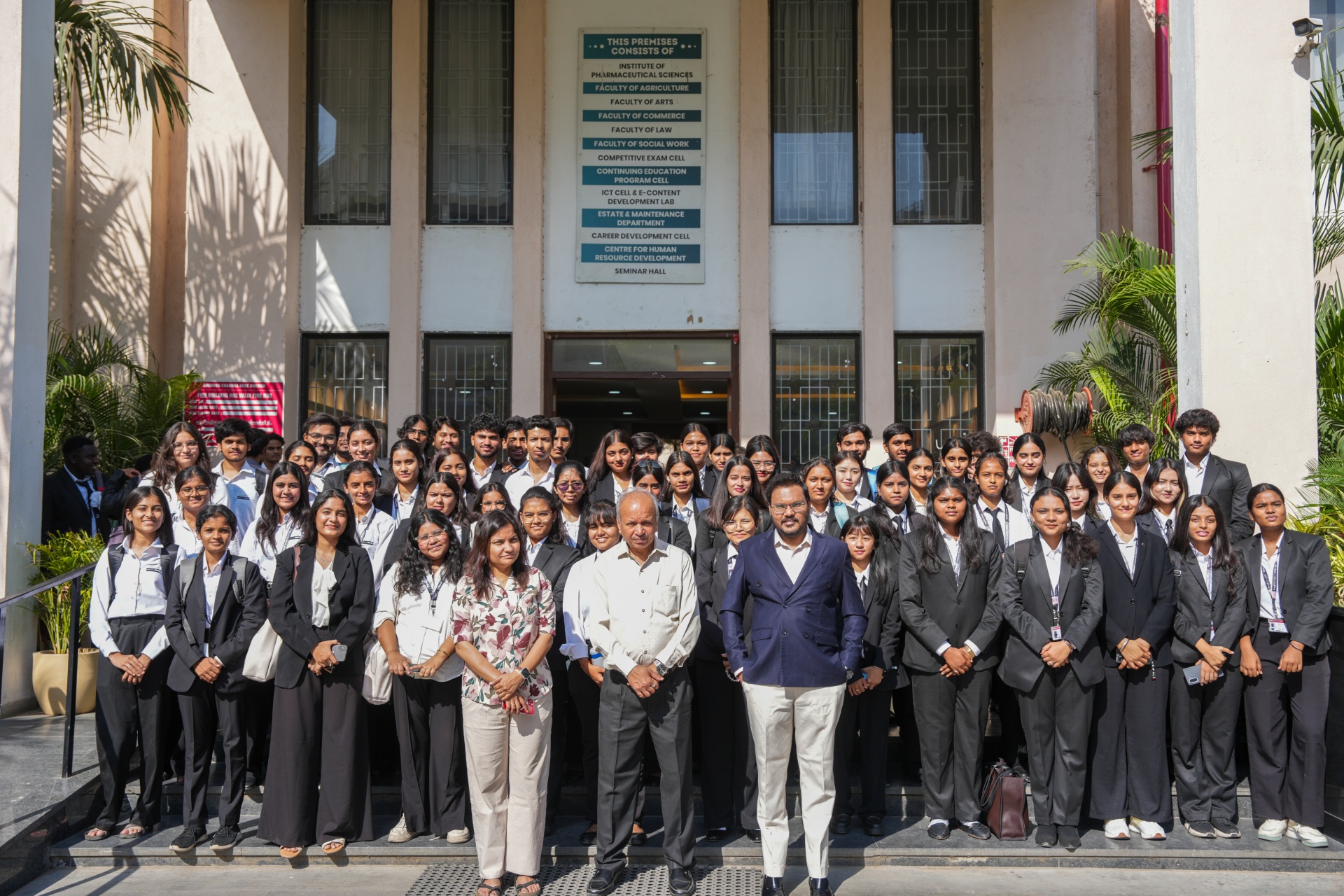
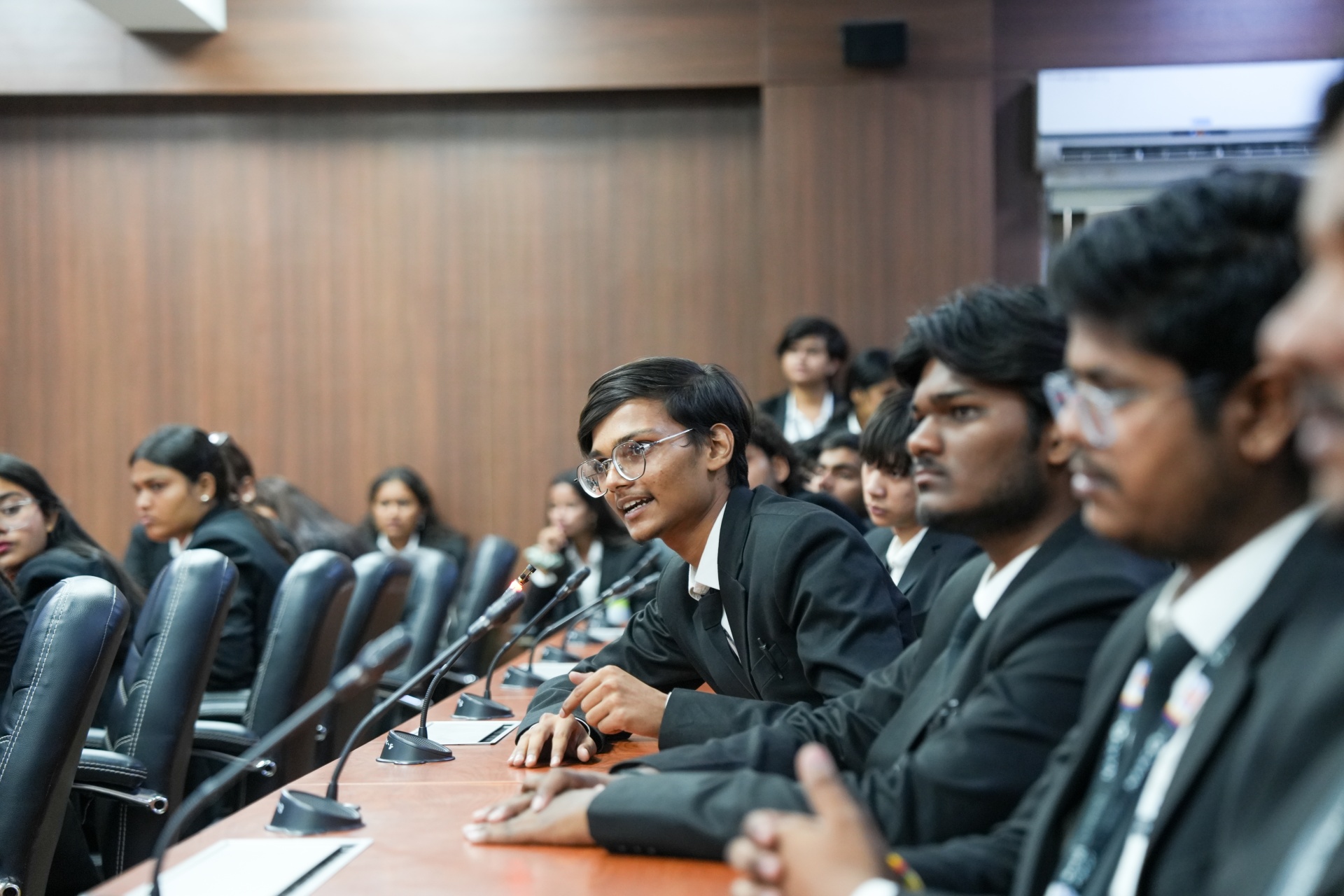
The visit to the Gujarat High Court was, by unanimous consensus among 120 students, the most impactful leg of the state educational visit organised by Parul Institute of Law, Parul University. For most first-year BBA/LLB students, it was their first time inside a working High Court.
Abhinav Sharad, student coordinator for the visit and first-year BBA LLB (Hons.) student, described the courtrooms:
“Our courtrooms were literally looking like a royal type, more royal and more grand. It was very inspirational. Not similar to the movies at all, very different.”
Students sat inside courtrooms and observed live hearings. They witnessed the interaction between judges and advocates in real time. They shared their experience, where they saw the live case and live interaction between the judges and advocates. One of the students, Abhinav Sharad, mentioned in his testimonial observing the proceedings and the courtroom of Justice Mrs. Sunita Agarwal, who is the chief justice of the Gujarat High Court. Further describing her decision-making as filled with clarity, precision, and progressive reasoning. Also, students learned about courtroom ethics like how to maintain silence, follow the code of conduct, and show due respect to the judges.
Before entering the courtrooms, students noticed something textbooks never describe: the sheer volume of case files being carried by court staff through the corridors. Yashasvi Vishwakarma, another first-year BBA LLB student, observed that the real courtroom environment was remarkably different from cinematic portrayals: far more disciplined, far calmer, and far more serious than expected.
“Not celebrity, but feel like an advocate, Gujarat High Court Advocate, because we are in proper uniform and visiting the court, and other advocates are also in the same uniform. We feel like we are also an advocate.”
GSLSA: Justice Is Never Free, Somebody Is Always Paying
The Gujarat State Legal Services Authority, one student, expressed interest in giving free legal services to the poor. The Secretary’s response reframed the entire concept:
“Everybody is saying we are giving free services to the poor people, but it is not free. Somebody is paying always. If poor people do not have to pay anything, the government will pay for it.”
Legal aid is not charity. It is a constitutionally mandated system under Article 39A, funded by government resources and administered through NALSA, State Legal Services Authorities, and District Legal Services Authorities under the Legal Services Authorities Act 1987. A very important insight for students studying law.
Devansh Dubey, BBA LLB student from Pratapgarh, Uttar Pradesh, captured the impact:
“This visit not only enhanced our knowledge but also instilled a sense of responsibility towards contributing to society through legal aid and service.”
Gujarat Vidhan Sabha and GNLU: Legislature and Aspiration
At Gujarat Vidhan Sabha, students watched a documentary on legislative history and observed infrastructure that makes constitutional theory tangible: seating arrangements reflecting hierarchies, speaking protocols, and strict decorum. Sriya Gurung, BBA LLB student from Sikkim, described it as a chance to witness how governance functions at its core.
At Gujarat National Law University, ranked among the top 7 law colleges in India (NIRF 2025 Law Rank 5), students saw the preamble of the Indian Constitution inscribed at the entrance alongside moot court trophies. Mangalhenba Wahengbam, BA LLB student, described it as motivating and enlightening, encouraging students to aim higher. The GNLU visit served as both inspiration and professional standard.
The theory-to-practice gap the visit closed was articulated by Abhinav Sharad:
“When we learn from a textbook, they are saying this is the law, this is the section. When we visit the court, we see how it is applied. And it is totally different because many inner sections are there, divided into more parts. So it is totally different.”
PIMC 2026: When Supreme Court Justices Judge Your Mediation at Parul University
The Parul International Mediation Competition (PIMC) 2026, held on 21 March 2026 in association with DSNLU Visakhapatnam, brought 44 teams to Parul University. The inaugural panel included Justice Pankaj Mithal (sitting Supreme Court Judge), Justice Indira Banerjee (former Supreme Court Judge), and Justice M.K. Thakkar (Gujarat High Court). The grand finale panel included Justice Hemant Gupta (former Supreme Court Judge, Chairperson IIAC) and Justice Girish Kathpalia (sitting Delhi High Court Judge).
The final round case involved a USD 420 million solar investment dispute. Quarter-final and semi-final judges included 17 advocates from Bombay High Court, Delhi High Court, IIDRC, WICCI, OP Jindal, LSE, and IIAM. The winner was University School of Law and Legal Studies, GGSIPU New Delhi. First runner-up: Maharashtra National Law University Mumbai. When NLU teams compete at Parul University and Supreme Court justices judge the proceedings, the institution’s mediation and moot court culture is not theoretical.
Samvidhaan Pe Charcha 3.0 (August 2025) drew 500+ participants from 30+ law schools with a Rs 3.6 lakh prize pool. The annual National Moot Court Competition has been running since 2019, judged by former Gujarat High Court justices.
Law Placements: Jaydeep Findoria at the Supreme Court, Vaideshree Nakrani at ICICI Lombard
Jaydeep Findoria, BA LLB alumnus of Parul Institute of Law (2024 batch), is now Law Clerk-cum-Research Associate at the Supreme Court of India. Justice Pankaj Mithal felicitated him as Distinguished Alumni at PIMC 2026. He headed the Pro Bono Club under the Ministry of Law and Justice (Tele Law and Nyay Bandhu schemes) during his time at Parul University. His trajectory from Parul University to the Supreme Court is documented on LinkedIn and on the university’s events page.
Vaideshree Nakrani (LLB, 2026 batch) was placed at ICICI Lombard. Her Shiksha review reports law-specific packages ranging from 2 to 8 LPA with an average of 3 to 5 LPA. Named law recruiters include ICICI Lombard, ICICI General Insurance, MAY Lawyers, and Salot and Shah Associates. The Training and Placement Cell arranges internships at High Courts, the Supreme Court, District Legal Services Authorities, and law firms.
Law placements operate differently from engineering placements. The career trajectory for law graduates is built through court practice, litigation experience, internships, and bar examinations rather than mass campus recruitment drives. The Rs 3 to 5 LPA average for law is standard across most private law colleges outside the NLU system. What distinguishes Parul Institute of Law is the mediation and moot court exposure (PIMC with Supreme Court judges, Samvidhaan Pe Charcha with 30+ law schools) and the access-to-justice internship pipeline (DLSA placements across India through the T&P Cell).
BBA LLB Fees at Parul University: What It Costs and What It Includes
Parul Institute of Law fee structure for 2026-27: BBA LLB (Hons.) Rs 1,65,000 per year (5-year programme, total Rs 8.25 lakh). BA LLB (Hons.) Rs 1,65,000 per year. BCom LLB (Hons.) Rs 1,25,000 per year (total Rs 6.25 lakh). 3-year LLB Rs 65,000 per year (total Rs 1.95 lakh). LLM (Business and Corporate Law, Criminal and Security Law, Constitutional and Administrative Law, IPR, International Law, Public Policy) Rs 1,25,000 per year (1-year programme). North-East domicile package available. Merit-based scholarship: Rs 5,000 to Rs 20,000 depending on percentage bracket. Domicile scholarship available.
What the fee includes: BCI-recognized program at a NAAC A++ university (CGPA 3.55). State educational visits (Gujarat High Court, Vidhan Sabha, GSLSA, GNLU). Jail visits (Semester 1). DLSA internship facilitation through the T&P Cell with location preferences. Moot Court facility. PIMC (judged by Supreme Court justices). Samvidhaan Pe Charcha (500+ participants, 30+ law schools). Access to 250-acre campus, 24×7 NABH-accredited hospital, 40 GBPS WiFi. 150+ PU Talks speakers including former Chief Justice D.Y. Chandrachud and Attorney General Dr R. Venkataramani. IIMUN Law Tour to Mumbai (sessions with Justice B.N. Srikrishna, Bahram N. Vakil of AZB and Partners, General Counsels of Piramal, Sony Pictures, JSW Steel).
For comparison: GNLU (NIRF Law Rank 5) charges approximately Rs 2.42 lakh per year but requires CLAT qualification. Institute of Law, Nirma University, charges comparable fees but also requires CLAT. Parul Institute of Law admits on merit without CLAT, which makes it accessible to students who did not clear the national law entrance exam but want a BCI-recognised law programme with genuine moot court and mediation exposure in Gujarat.
Career Pathways After BBA LLB: Courts, Corporate, Investigation Agencies, Every Sector
Abhinav Sharad, whose aspiration since Class 10 was national service through the Armed Forces before physical fitness constraints redirected him to law, articulated the breadth of career options the degree opens:
“Through law, I can join army or any legal field, I can also join any investigation agency which directly connects with the country and I can serve.”
The four institutions visited during the state educational visit represent four distinct career directions. Gujarat High Court: litigation, court practice, judicial services. GSLSA: legal aid, public interest law, NGO legal work, government legal services. Gujarat Vidhan Sabha: legislative drafting, policy research, parliamentary affairs. GNLU: legal academia, research, advanced specialisation. Beyond these, law graduates enter corporate legal departments (every company above a certain size has in-house counsel), investigation agencies (CBI, ED, NIA), banking and insurance compliance (ICICI Lombard hired Vaideshree Nakrani from Parul Institute of Law), and international organisations.
Yashasvi Vishwakarma developed specific interest in corporate law after the visit. Devansh Dubey was drawn to legal aid and access-to-justice work. Abhinav Sharad is pursuing investigation and public service. The same program, the same state visit, the same university: three students, three different career directions. This is the structural advantage of a law degree: every sector has legal departments, and every legal department needs lawyers who have seen how courts, legislatures, and legal aid institutions actually function.
Frequently Asked Questions
What are the BBA LLB fees at Parul University?
BBA LLB (Hons.) Rs 1,65,000 per year (5-year programme, total Rs 8.25 lakh). BA LLB (Hons.) Rs 1,65,000 per year. BCom LLB (Hons.) Rs 1,25,000 per year. 3-year LLB Rs 65,000 per year. LLM Rs 1,25,000 per year. Merit and domicile scholarships available. No CLAT requirement for admission.
Is Parul University good for law?
BCI recognised. NAAC A++ (CGPA 3.55). PIMC 2026 judged by Supreme Court justices (Justice Pankaj Mithal, Justice Indira Banerjee). Samvidhaan Pe Charcha with 30+ law schools. Alumnus Jaydeep Findoria is Law Clerk at the Supreme Court. Vaideshree Nakrani placed at ICICI Lombard. State visits (Gujarat High Court, Vidhan Sabha, GSLSA, GNLU). DLSA internships. Jail visits. Moot Court facility. IIMUN Law Tour to Mumbai with AZB and Partners and Supreme Court judges. Law-specific packages Rs 2 to 8 LPA.
What practical exposure does Parul Institute of Law provide?
State educational visits (Gujarat High Court with Chief Justice Sunita Agarwal's courtroom, GSLSA, Vidhan Sabha, GNLU). Jail visits (Semester 1, interaction with inmates). DLSA internships through T&P Cell with location preferences (Abhinav Sharad interned at DLSA Ranchi, featured in newspaper). PIMC (44 teams, Supreme Court judges). Samvidhaan Pe Charcha (500+ participants, 30+ law schools). Moot Court facility. IIMUN Law Tour to Mumbai.
What career options exist after BBA LLB?
Litigation and court practice. Corporate legal departments (every sector has in-house counsel). Legal aid and public interest law. Investigation agencies (CBI, ED, NIA). Judicial services. Banking and insurance compliance (ICICI Lombard recruited from Parul Institute of Law). Legislative drafting and policy research. International organisations. Legal academia. The structural advantage of a law degree is that every sector has legal departments.
How does Parul University law compare to GNLU?
GNLU is NIRF Law Rank 5 with a median salary of Rs 18 LPA and Tier-1 law firm placements (CAM, SAM, AZB, Trilegal). Admission requires CLAT. Parul Institute of Law admits on merit without CLAT. BBA LLB fees Rs 1.65 lakh per year vs GNLU approximately Rs 2.42 lakh per year. Parul Institute of Law's strengths are PIMC (Supreme Court judges), Samvidhaan Pe Charcha (30+ law schools), DLSA internship pipeline, and practical exposure (state visits, jail visits). It is a defensible non-CLAT option with genuine moot and mediation culture, not an NLU equivalent on placements.
What is PIMC at Parul University?
Parul International Mediation Competition. 2026 edition: 44 teams, organised with DSNLU Visakhapatnam. Judged by Justice Pankaj Mithal (sitting Supreme Court), Justice Indira Banerjee (former Supreme Court), Justice Hemant Gupta (former Supreme Court), Justice Girish Kathpalia (sitting Delhi High Court). Final case: USD 420 million solar investment dispute. Winner: GGSIPU New Delhi. Runner-up: MNLU Mumbai. 17 advocates from Bombay HC, Delhi HC, and international institutions judged quarter-finals and semi-finals.