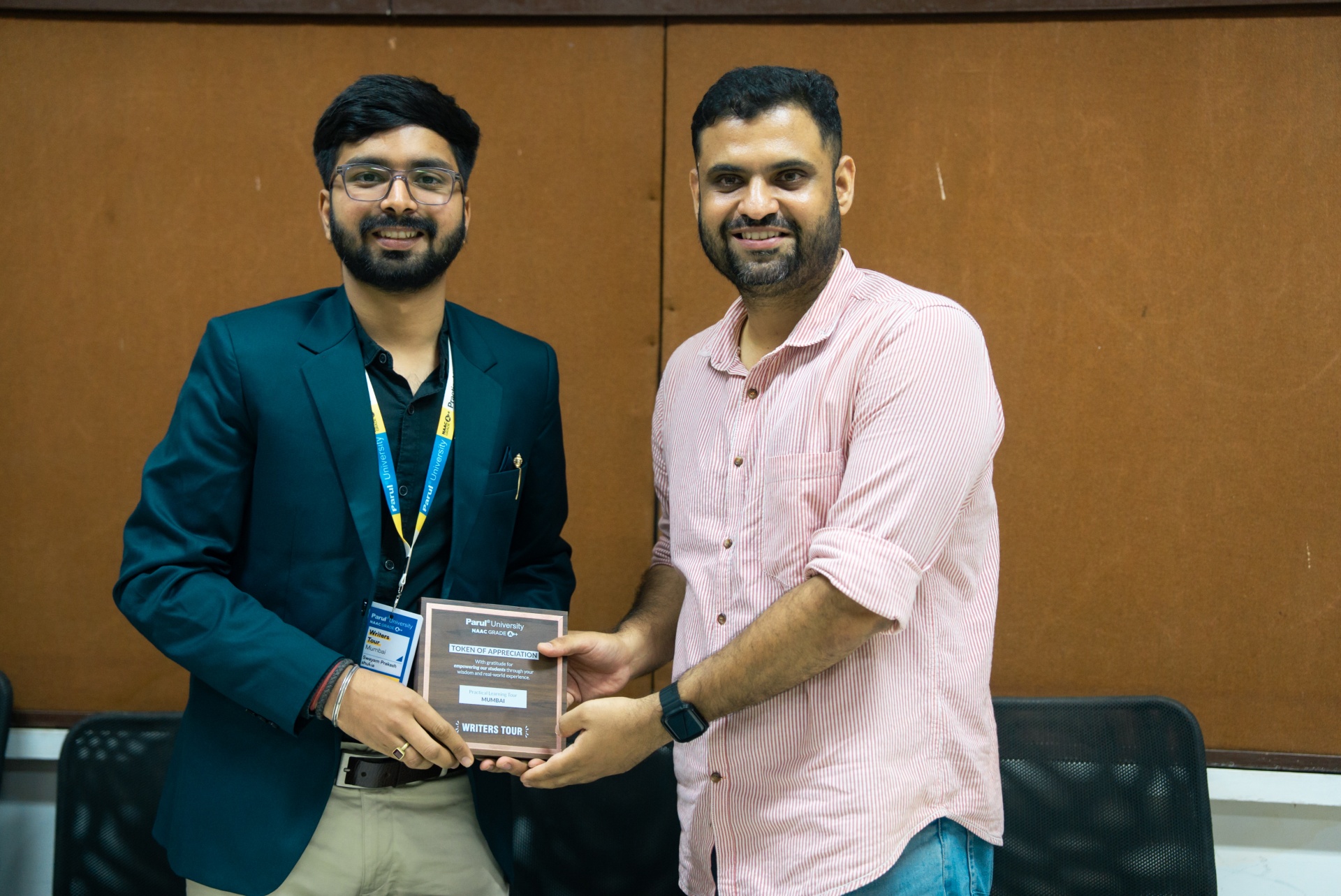
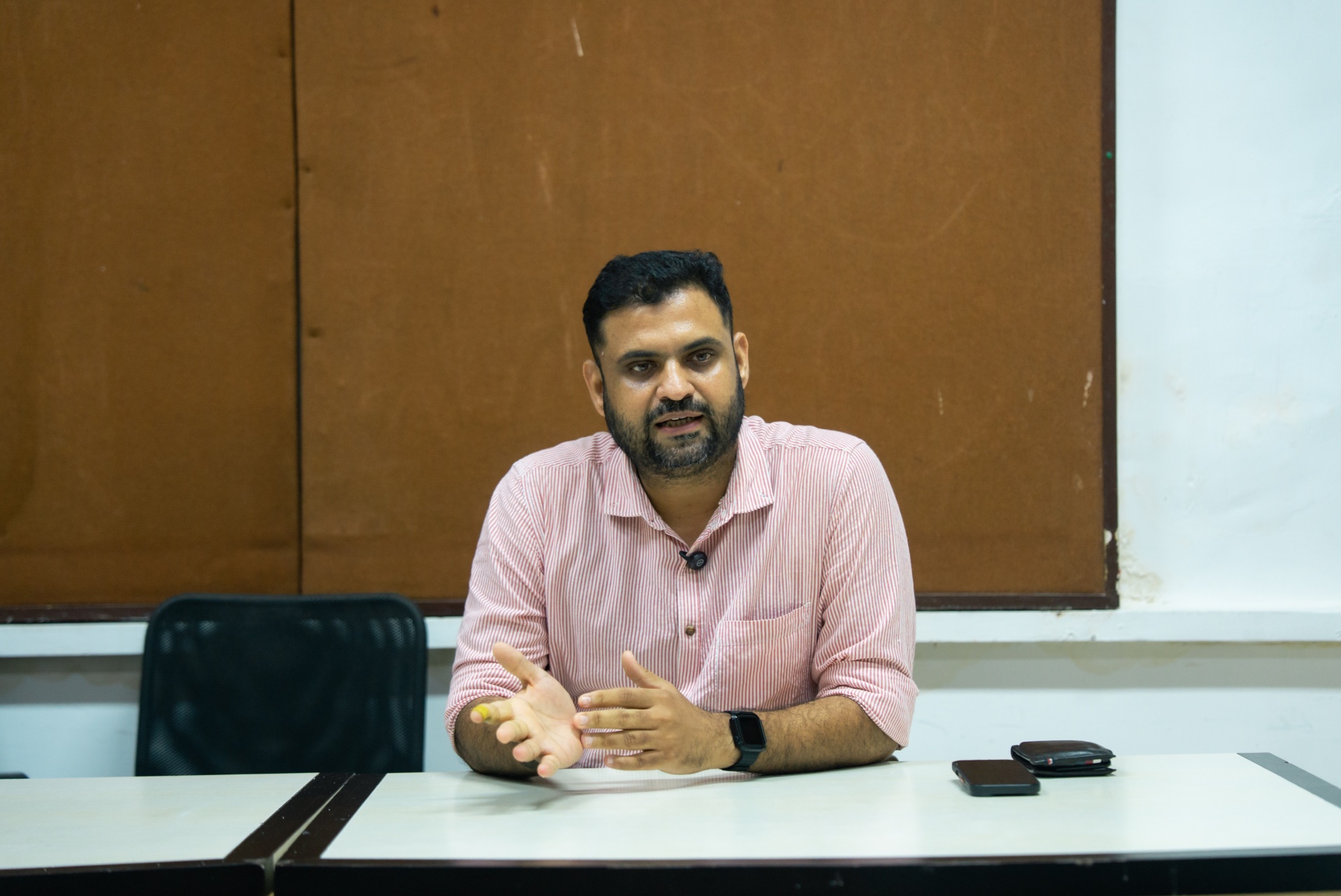
Jaico Publishing House – The team Publisher, Editor (Fei), Marketing head (Clinton) and Author (Puja Rai) spoke to PU students about how and what a book travels through before reaching a reader. They’ve explained the entire process in details.
Editorial Pipeline as follows –
- Blind submission through jaicobooks.com – anyone can submit, every manuscript gets read by a review panel
- Developmental feedback: structure, character, overall shape
- Line editing: grammar, punctuation, track changes in Word (red lines that terrified Puja Rai)
- Typesetting: freelancer decides font, drop caps, pull quotes (Fei has never encountered a female typesetter – students should explore it)
- Proofreading: 2.5 weeks for 240 pages (do not add new material at this stage)
- Cover design: brief to designer, options in 2 weeks, marketing weighs in
- Timeline: 6-8 months from contract to print
One specific editorial change stayed with Puja Rai: her editor moved a line from the body to the preface. She questioned it. Then she read the final book and understood – the placement changed the whole opening. Another: her editor pointed out that Yudhishthira needed a character introduction. She had assumed every reader would know the name. The editor noted the book might reach readers outside India, or younger readers inside India, for whom the name carries nothing. Without that note, a portion of the readership was locked out.
Clinton on marketing: AIDA (Attention, Interest, Desire, Action). How many times does someone need to see an ad before acting? Someone said 4. He said 7. The 8th time they buy. For a running book: go to run clubs. For a sales book: place it outside sales conferences. The book is a byproduct of the event.
The publisher on bookstores: the aisle manager is the most important person in the building as far as she is concerned. The 80-year relationship Jaico has with booksellers across India. She said: you will find a Jaico book in the top ten of any bookstore in India. Go find it, photograph it, send it to me.
Puja Rai: a reputed publisher is a five-star hotel. A quick publisher is a motel with unclean sheets. She knows colleagues with a thousand copies sitting in their house. Enrol into BA English at Parul University and become a successful content writer, social media strategist and communication lead as well!
Student feedback: it helped us understand the real effort beyond just writing. The patience required in traditional publishing gave us a practical perspective on the industry.
Mayuresh Ganpataye, CNN News18: Marathi Medium to the Aryan Khan Scoop
Mayuresh Ganpataye is a News Editor at CNN News18, Maharashtra and Goa politics. Secretary, Mumbai Press Club. Also contributed to All India Radio. Career: Star Maza (ABP Majha), Times Now, NewsX, Aajtak, Mirror Now, TV9 Bharatvarsh, CNN News18.
Marathi medium schooling through 10th. English was a real obstacle. Consistent daily writing over years before he grew comfortable enough. His original inspiration: watching Barkha Dutt covering Kargil and Rajdeep Sardesai on the politics beat on NDTV as a school student. Could not follow the English, but the visuals kept him watching. Wanted to be a print reporter. 2009 global financial crisis: print jobs scarce, TV had an opening.
Before the session, he shared: he visited a higher-ranked journalism institute, gave students a topic. 10 pieces came back. All identical. ChatGPT. He could tell by student number 3.
On standing out:
- Read newspapers including local-language papers (Marathi for Mumbai civic/police sources)
- Write even for TV: you write your points before going on air
- Meet at least 3 new potential sources every week
He does not scream on screen. He was firm: many colleagues feel screaming grabs attention. He disagrees. On sensitivity: covering bodies recovered from debris is not an occasion to rush forward with a camera.
On emotional cost: first year 2009, covered a 14-year-old boy who fell into a water well and died. Saw parents. Saw body. Within 1 hour: clown festival, laughing. Has broken down in front of his wife after stories. Also covered a child marriage story where he became personally connected to the family. Does not think there is anything wrong with reporters crying on camera.
He was the very first journalist to interview Prabhakar in a celebrity case. Legal team brought in. Implications discussed and clearances were obtained and then they were aaired. On political pressure: facts are your protection. On AI: lacking emotional value. 20 students produce 20 different pieces. AI produces. On degrees: bachelor’s is floor. Master’s not needed for newsrooms. Many editors never studied journalism. If you wish to master the art of stories as a journalist, then enrol into Parul University’s MA in Journalism & Mass Communication program!
“News lives in contradiction. If a social work awards ceremony is being held in a five-star hotel, there is a story there.”
Ritu Kapoor (Co-Founder, The Quint) added in a separate session: the question is not will AI replace us but what value do I bring that AI cannot. If art stops being created freely, AI’s database stops growing. Journalism risks homogenisation through search-driven content. Hold on to your voice. Do not start writing like AI.
Student feedback: it helped us see how experience, strong research, and ethical responsibility shape a journalist’s career. It inspired us to approach reporting with greater awareness and integrity. Enrol into BA Journalism at Parul University as it’s specifically designed for the students who are aiming to be a writer, journalist or communication professional!
Boathouse Media: Rs 7,000 to Rs 75 Lakh, and Why an Orange Pencil Box Stopped a Shoot
Devik and Yug Rathod, co-founders of Boathouse Media. Started 2017 with Rs 7,000 shoots. By 2026: Rs 75 lakh+ campaigns for Parachute (15+ campaigns), HDFC Bank, Aditya Birla Capital, Racold.
The Racold ad started with a real person. Devik’s uncle during COVID would get out a lighter to disinfect things. The most paranoid man he had ever met. They built a character: Heater Hit. Two blowtorches. Heats everything. Burns his sofa. The product arrives as the solution. The insight was not invented. It was observed.
The 9-question brand brief before writing a single word:
- Business objective, role of film in funnel (awareness, launch, tactical, festive)
- Target audience (geography, income, persona), communication objective
- Target insight (what consumer behaviour to address, what gap exists)
- Brand promise and reasons to believe, call to action
- Brand persona (Zomato and Swiggy: same business, completely different advertising tone)
- Brand dos and donts, past campaigns (know their last 5 years)
Budget-backward writing:
- Rs 10 lakh: 1 location, few characters
- Rs 20 lakh: 2-3 setups, 7-8 actors
- Rs 50 lakh: build a set
- Rs 75 lakh: multiple cities
Content-to-media-spend ratio: 1:5 (some clients 1:10). Parachute 15 years ago: Rs 2-3 crore single TVC. Now: 4 films per year, fraction of the budget, rest goes to Meta and Google. Every film must look 5X its actual cost.
The HDFC Bank pencil box story: shooting a classroom scene. Wide shot. Child’s pencil box in the background. Orange. Orange is a competing bank’s colour. The shoot stopped.
Growth: Year 1 Rs 1-2 lakh. Year 2 Rs 2-4 lakh. Year 3 Rs 4-8 lakh. Years 5-6 Rs 6-10 lakh. Then Rs 25 lakh. Rs 50 lakh. Rs 75 lakh. Treatment note: 50 slides for a 30-second film (15-18 shots, full day shooting). Budget breakdown: 10 pages, 250+ line items.
Student feedback: it felt like a real-world masterclass bridging creativity with business strategy, making the learning both inspiring and applicable. Stories aren’t developed overnight, if you too wish to master the 5W and 1H of the journalism world, then enrol into MA in Journalism & Communication program of Parul University!
Frequently Asked Questions
How do I submit a book to a publisher in India?
Jaico Publishing accepts blind submissions through jaicobooks.com. Every submission gets read. Process: developmental feedback, line editing (track changes), typesetting, proofreading (2.5 weeks for 240 pages), cover design. 6-8 months total. Marketing uses AIDA framework (7+ exposures before someone buys). The aisle manager is the most important person in the bookstore.
How do I become a journalist in India?
Mayuresh Ganpataye (CNN News18): bachelor's degree minimum. Read local-language papers. Write even for TV. Meet 3 new potential sources weekly. Master's not needed for newsrooms. Many editors never studied journalism. What matters: ability to spot a contradiction. Inspired by Barkha Dutt covering Kargil. Started Marathi medium, struggled with English, overcame through daily writing.
How do ad films get made in India?
Boathouse Media: 9-question brand brief before writing. Treatment note (50 slides for 30 seconds). Budget breakdown (10 pages, 250+ items). Multiple houses pitch same script. Content-to-media ratio 1:5. Writers must understand budgets. Rs 7,000 → Rs 75 lakh over 8 years. Every film must look 5X its cost.
Will AI replace journalists?
Mayuresh: AI lacks emotional value. 20 students produce 20 different pieces, AI produces 1. Ritu Kapoor (The Quint): what value do I bring that AI cannot? If art stops being created freely, AI's database stops growing. Journalism risks homogenisation. Both: AI is a tool, not a replacement.