Surat carries a reputation that most cities would struggle to imagine. Nine in every ten diamonds polished anywhere on the planet move through this one city and behind that number sits an industry employing over 800,000 people across natural stone processing and, increasingly, lab-grown production.
Surface Defect Imaging (SEM)
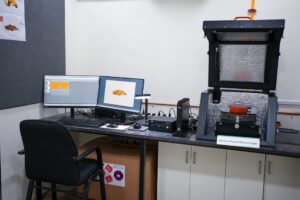
Somewhere between 3 and 4 nanometres is where the Hitachi SU3800 SEM at MNRDC operates. Put that alongside a standard 10x loupe and the difference isn’t incremental, it’s a completely different category of observation.
What shows up at that scale tends to reframe assumptions about surface quality. Polishing micro-scratches that seemed absent become traceable patterns. Subsurface inclusions that broke through during cutting sit exposed and measurable. Residual compound particles left behind after polishing, grain boundaries threading through polycrystalline lab-grown material, thermal damage from cutting that ran too aggressively, the surface holds all of it, and the SEM reads it.
Crystal Structure Verification (XRD)
Confirming diamond means confirming its cubic structure, Fd3m space group, diffraction pattern that doesn’t resemble cubic zirconia or moissanite no matter how similar those stones look in hand. XRD makes that distinction cleanly, without room for interpretation.
Lab-grown stones bring additional questions that XRD handles well. Graphite that survived the growth process intact. Metallic catalyst phases left inside HPHT-grown crystals. Strain patterns baked into the lattice during growth patterns that affect grading conversations and downstream value. None of these show up on a certificate without instrument data behind them.
The industrial side of this is worth mentioning separately. Manufacturers building diamond cutting tools don’t just need diamond, they need diamond with the right crystallographic orientation for the specific application. Wrong orientation, and cutting performance suffers in ways that aren’t always immediately obvious. XRD Testing at MNRDC is where that verification happens before material commits to production.
Diamond Characterisation in Surat and Why Lab-Grown Stones Demand a Different Approach
Surat has worn its diamond city identity for decades, but the industry quietly shifted under its feet. Natural stone processing still dominates the streetscape, the polishing wheels, the sorting rooms, the generations of inherited skill but lab-grown diamonds now occupy a serious and growing share of what comes out of the city’s workshops.
CVD and HPHT methods have matured fast. What started as a niche alternative has become commercially mainstream, and Surat’s manufacturers moved with that shift rather than against it. The stones coming out of these processes are chemically identical to mined diamonds, which is precisely what makes characterisation both important and genuinely tricky.
Natural diamonds get tested for quality. Lab-grown diamonds need something more they need verification. Growth uniformity across the crystal matters in ways it simply doesn’t for mined stones. These aren’t checks that a loupe and a grading report were designed to handle. The instrumentation required is different, and so is the expertise behind interpreting what comes back.
SEM testing at MNRDC sits in the middle of exactly this challenge and how that process works, and what manufacturers actually learn from it before making production and sourcing decisions, is worth understanding properly. Explore SEM Testing at MNRDC to see where the data meets the decision.
Industrial Diamond Applications
Beyond gemstone quality, Surat’s diamond industry supplies industrial diamonds for cutting tools, drilling equipment, and precision abrasives. MNRDC in sync with PIERC also supports entrepreneurship, from ideation to shark-tank level features, they help at all the levels. Head here to read how Parul University’s Startup received a feature in Shark Tank!
FAQ
Can MNRDC measure diamond polish quality objectively?
Yes. AFM measures surface roughness as Sa in nanometres. Single-digit Sa values indicate exceptional polish. MountainsSPIP generates 50+ ISO roughness parameters per scan. This provides a quantitative polish quality measurement that supplements traditional visual grading.