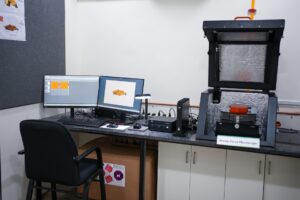
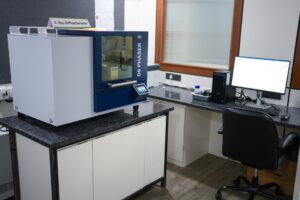
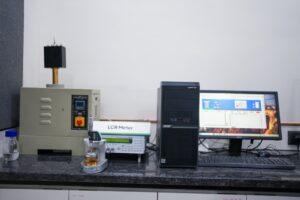
A research facility operating ten advanced instruments, including an X-ray source (XRD), high-vacuum systems (SEM, sputtering), and high-temperature furnaces (LCR meter to 1200C), requires a safety framework that protects both operators and visiting users. MNRDC‘s safety protocols cover physical access, radiation, instrument operation, sample handling, waste management, and ethical boundaries.
Read more about – MNRDC Facilities and Services
Physical Access Control
The MNRDC laboratory operates as a restricted-access facility. Only authorised personnel are permitted inside the instrument rooms. This includes the 17-member core scientific team (all full-time research staff) and approved users with scheduled testing sessions. General campus visitors, unscheduled walk-ins, and unsupervised students do not have access to the instrument rooms. The restriction serves two purposes: protecting sensitive instruments from accidental damage and maintaining the dust-free environment that SEM, AFM, and sputtering operations require.
The laboratory is maintained as a dust-proof environment. Airborne particles can contaminate samples, interfere with vacuum systems, and degrade SEM image quality. Environmental cleanliness is an operational requirement, not just a preference.
XRD Radiation Safety
The Bruker D6 PHASER XRD is the only instrument at MNRDC that generates ionising radiation (X-rays). The system is designed with a fail-safe, hard-wired safety architecture:
- The machine is fully enclosed and shielded. X-rays cannot escape the instrument housing during operation.
- It is physically impossible to generate X-rays if the door is open. This is not a software interlock that could be bypassed; the safety system relies on physical electrical circuits. If the door moves even slightly, electrical power to the X-ray source is cut instantly.
- When operated according to SOPs, the D6 PHASER is considered safe, and no separate radiation safety protocol is required beyond standard operational controls.
The remaining nine instruments at MNRDC (SEM, AFM, Pin-on-Disc, LCR Meter, Sputtering, CNC, Dynamometer, Stir Casting, Compression Moulding) do not involve ionising radiation.
Read more about – XRD Testing at MNRDC
Standard Operating Procedures
SOPs are documented for all major instruments at MNRDC. Each SOP covers:
- Sample handling: how to prepare, mount, and load samples for each specific instrument
- Instrument operation: startup sequences, parameter settings, operational monitoring, and shutdown procedures
- Safety precautions: instrument-specific hazards and mitigation steps
- Data generation workflows: how output data is captured, processed, and delivered to users
The SOP for the HHV Auto 500 sputtering system, for example, specifies the exact sequence of operations: mains on, vent valve, rotary pump, back-off valve, HiVac valve, gas valve. Reversing this sequence or skipping steps can damage the turbomolecular pump. The SOP for SEM specifies that the chamber must remain closed to avoid atmospheric contamination except when inserting samples or during stage motion. Each instrument has its own documented protocol reflecting its specific operational requirements.
Read more about – SEM Sample Preparation Guide
The Zero-Tolerance Policy Behind Samples
MNRDC does not accept samples that fall into the following categories:
- Radioactive materials
- Explosive materials
- Highly corrosive materials
- Samples that exceed instrument size or weight limits
- Materials that cannot withstand high temperature or vacuum conditions required by specific instruments
- Samples that do not comply with published size specifications
If a sample poses any risk to the instrument or could compromise result quality, it is rejected, and the user is formally informed. Rejection occurs approximately once per fortnight, most commonly due to size non-compliance, contamination, or samples unsuitable for meaningful results.
Waste Management and Sample Return
MNRDC does not generate routine hazardous waste. The operational model is straightforward: samples arrive, they are tested using non-destructive or minimally invasive techniques (SEM, XRD, AFM, and LCR meters are all fully non-destructive), and samples are returned to the user after analysis. No long-term sample storage occurs at the Center. No chemical waste accumulates. The sputtering system wraps the chamber interior with aluminium foil; post-run cleanup requires only replacing the foil rather than chemical cleaning.
Ethical Boundaries
MNRDC conducts only machine-based testing on material samples. The Center does not perform experiments involving human or animal subjects. Research activities are limited to ethically acceptable, non-invasive, and environmentally responsible practices. Sample ownership and data confidentiality are strictly respected throughout the testing process. If any hazardous or unexpected behaviour is detected during testing, the user is immediately informed.
Read more about – How to Submit Samples at MNRDC
FAQ
Is XRD at MNRDC safe from radiation exposure?
Yes. The Bruker D6 PHASER is fully enclosed and shielded. X-ray generation is physically impossible when the door is open, enforced by hard-wired electrical interlocks (not software). When operated according to SOPs, no separate radiation safety protocol is required.
What happens to samples after testing?
All samples are returned to the user. MNRDC does not store, dispose of, or accumulate samples or chemical waste. SEM, XRD, AFM, and LCR testing are fully non-destructive: samples leave in the same condition they arrived.
Does MNRDC conduct animal or human testing?
No. The Center performs only machine-based testing on material samples. No human or animal subjects are involved in any MNRDC activity.