AICTE Nodal Centre designation for a national innovation programme is not awarded on application. It is awarded on demonstrated institutional capability.
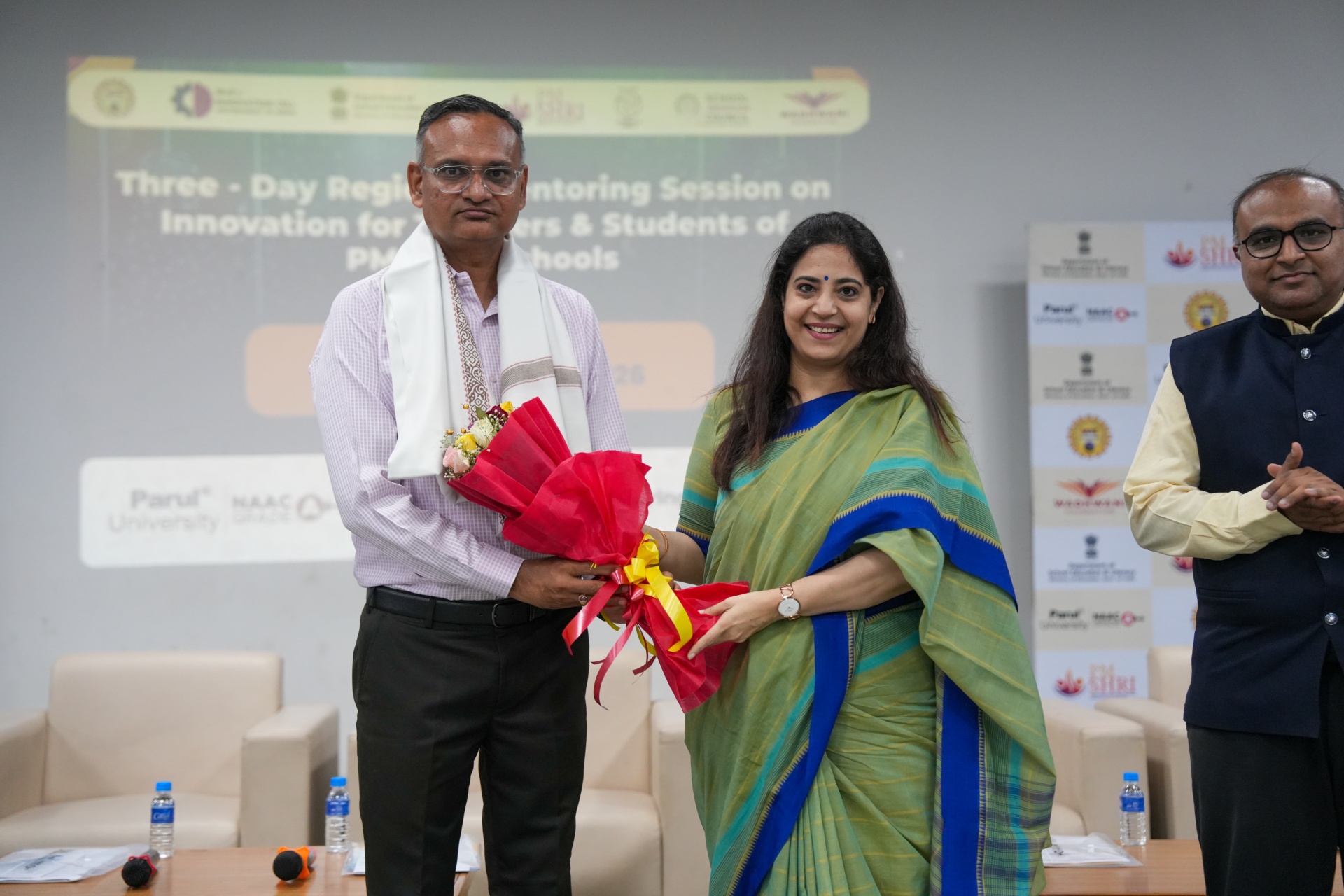
When the Ministry of Education’s Innovation Cell and the All India Council for Technical Education jointly convened the Three-Day Regional Mentoring Session on Innovation for PM SHRI Schools, JNVs, and KVs across Gujarat from 28 to 30 April 2026, the question of which institutional partner could carry the operational responsibility was one of demonstrated track record.
PIERC is operating within the PU campus, where Parul Institute of Engineering & Technology sits, which was the real answer. Mr Hutesh Baviskar (PIERC) served as the POC for AICTE’s end-to-end coordination across the entire programme.
The entire 20-member jury panel comprised Dr. Arvind Deshmukh, Ms. Anbumathi M, Mr. Parth Devariya, Mr. Hardik Kharva (Centre Head, VSS, PIERC), Ms. Sonal Sudani (Incubation Manager, PIERC), and Mr. Umang Panchal (Assistant Professor, PIET) and Mr Anup Chaudhary (Incubation Manager), Mr Umang Panchal, Mrs Sonal Sudani (PIERC), Mr. Hardik Kharwa, Ms. Sujaya Bhattacharjee, Mr. Himansu Das, Ms. Vanshika Muchhara, Dr. Partkumar Sapariya, Dr. Bhavin Dhanavade, Dr. Prashant Khanna, Dr. Sneha Soni, Dr. Saurabh Parmar, Ms. Kajol Patel, Mr. Vivek Joshi, Ms. Riddhi Mehta, and Mr. Omkamal Vashi.
PIERC ecosystem statistics that anchored the Nodal Centre designation
Numbers are the most direct evidence of institutional capability. PIERC’s published record reads as follows:
- Over 240 startups incubated: Through PIERC’s incubation and pre-incubation programmes operating from the Parul University campus.
- More than 1,400 jobs generated: By ventures incubated through the Centre, contributing directly to the Startup India and Atmanirbhar Bharat employment outcomes.
- Over Rs. 40 crore in annual revenue: Produced by PIERC-incubated startups, demonstrating the commercial viability of the incubation model.
- 51.5 lakh in MoMSME funding: Received by Parul University’s women-led startups from the Ministry of Micro, Small and Medium Enterprises, an outcome that PIERC’s gender-inclusive incubation approach directly produced.
- AICTE Innovation Cell recognition: Awarded as the Best Mentoring Institution by the AICTE Innovation Cell.
- Multi-city startup studios: PIERC operates startup studios across Vadodara, Surat, Ahmedabad, and Rajkot, extending the incubation infrastructure beyond a single campus.
Vadodara Startup Festival: Annual gathering of emerging startups and budding entrepreneurs with seasoned investors and venture capitalists for funding and investment opportunities.
Parul University hosts PM SHRI Regional Mentoring Session under AICTE & MoE Innovation Cell!
Nodal Centre responsibilities for the PM SHRI RMS programme
The AICTE programme guidelines for Nodal Centres specify a detailed operational responsibility set. PIERC fulfilled every requirement and, in several dimensions, exceeded the baseline. The complete Nodal Centre responsibility set for the programme included:
- Auditorium provisioning: A 250-capacity auditorium for inauguration and valedictory functions
- Workshop infrastructure: Seating, audio-visual aids, and high-speed internet for over 200 participants
- Five-day accommodation: For all participants from 27 April to 1 May 2026
- Full meal provisioning: From arrival to departure for all participants
- Local transportation: Between venue and accommodation across the programme duration
- Registration kits, banners, and standees: Printed as per AICTE templates
- Documentation: Attendance records, photography and videography, social media coverage, post-event highlights video
- Evaluation panels: Ten three-member jury panels for the Day 3 pitching sessions
- Ideation materials: 60 chart papers and stationery for design thinking sessions
- Day 3 pitch infrastructure: Five pitch boards and five evaluation rooms with LED screens
The PIERC volunteer corps: institutional depth in action
The AICTE guidelines called for 10 to 15 faculty coordinators and 25 to 30 student volunteers. PIERC went significantly further.
Mr. Hutesh Baviskar mobilised the Centre’s entire pre-incubation and incubation student teams as dedicated volunteers across the programme. The decision had two simultaneous effects. The operational quality of the participant experience was elevated through dense volunteer support, and the volunteer corps itself received an immersive peer-learning experience by working alongside the Wadhwani Foundation expert mentors and the school students they were supporting. The phrase that Ms. Anbumathi M used in her valedictory address captured what the decision produced:
When I asked Mr. Hutesh for volunteers, he said, I am giving you my whole incubation team and my pre-incubation team. I never knew that the pre-incubation team would be such a mass of student soldiers.
Ms. Anbumathi M, Innovation Venture Catalyst at the Wadhwani Foundation, in her valedictory address
The volunteer corps that received certificate recognition at the Valedictory Ceremony included Kishan Sagar, Karthik Ram, Hanisha Nagar, Khushi Chaudhary, Vansh Patel, Hridesh Kumar, Tanish Shah, Anandita, Anvika (student anchor for both inaugural and valedictory ceremonies), Shaili, Abhishek Kumar, Ankit Soni, Shahid Patel, Bhavya Patel, Sanskriti Mohakar, and several other volunteers whose contributions were acknowledged from the stage. Mr Yash Tripathi, Venue Coordinator, received separate special recognition for managing logistics, resolving last-minute challenges, and ensuring infrastructure availability across the three days.
AI for School Innovation – Mr. Parth Devariya on Building Applications without Coding!
PIERC leadership: Mr. Jay Sudani and the institutional voice
Mr. Jay Sudani, CEO of PIERC, anchored the institutional presence across both the inaugural and valedictory ceremonies. His framing of the entrepreneurship pathway at the inauguration positioned the programme within the broader national agenda. To serve the country, he emphasised, joining the armed forces is not the only path. Generating employment, contributing to economic growth, and building ventures that create opportunities for others constitute equally substantive forms of national service. The framing aligned directly with the Startup India and Atmanirbhar Bharat priorities of the Government of India.
His valedictory vote of thanks was direct, candid, and committed in equal measure.
He opened with an honest acknowledgement of the discomfort the participating teachers experienced in the summer heat and made a commitment on behalf of PIERC for future editions to provide air-conditioned rooms to all teachers. He recognised the AICTE Innovation Cell team, specifically acknowledging Shri Aseem Kalta, Mr. Pradeep Dhage, and Shivendu Sir, noting that what appeared to outsiders as a three-day event was the product of months of meticulous coordination across the country. His tribute to the Wadhwani Foundation expert mentors was paired with a visible institutional outcome question to the audience: those who now believed they could start their own company were asked to raise their hands. The number of hands raised established what the programme had actually produced
These are the true pipelines for entrepreneurship that we can have from this group.
Mr. Jay Sudani, CEO of PIERC, at the valedictory ceremony
The Day 2 PIERC Incubation Centre visit
A central feature of the programme was the Day 2 visit to the PIERC Incubation Centre and Centre of Excellence at the Parul University campus.
For the school students and teachers, many of whom had never before seen a structured startup ecosystem in operation, the visit converted abstract concepts into observable infrastructure. The visiting participants moved through the incubation spaces, interacted with university student innovators currently working on their ventures, and witnessed first-hand what professional startup-stage development requires in physical, technical, and institutional terms. The experience extended beyond a tour. It positioned the school participants to see themselves as future occupants of similar spaces, whether at PIERC or at the broader Atal Tinkering Lab, Atal Incubation Centre, and Startup India infrastructure network.
Beyond the PM SHRI RMS programme: PIERC's continuing institutional role
The PM SHRI Regional Mentoring Session was one programme among many that PIERC operates and partners on. The Centre’s continuing institutional role spans incubation services for student-led ventures, the annual Vadodara Startup Festival that connects emerging founders with investors and venture capitalists, and structured mentorship pathways through the IDE Lab and Centre of Excellence infrastructure. PIERC also operates as a key institutional partner in the broader Parul University placement ecosystem, alongside the IMPACT training programme and the campus placement infrastructure operated by the Training and Placement Cell. The Faculty of Engineering and Technology feeds directly into PIERC’s incubation pipeline through engineering student innovations that progress from coursework to commercial venture.
FAQs
What is PIERC at Parul University?
Parul Innovation and Entrepreneurship Research Centre. That is what PIERC stands for, and it operates inside the Parul Institute of Engineering and Technology as the university's main innovation arm. Student startup incubation happens here. So does entrepreneurship development, industry partnerships, and the delivery of innovation programmes that bring school students, government bodies, and industry partners into the same space. The outcomes sitting behind it are worth knowing before anything else. Two hundred and forty-plus startups incubated. Over fourteen hundred jobs that did not exist before these ventures were built. More than forty crore rupees in annual revenue is generated by those same ventures. Studios running in Vadodara, Surat, Ahmedabad, and Rajkot. Mr Jay hSudani is the CEO. And the AICTE Innovation Cell has recognised PIERC with its Best Mentoring Institution Award, which is not something given out casually.
Why was PIERC selected as the AICTE Nodal Centre for the PM SHRI RMS programme?
Infrastructure, a 250-capacity auditorium, and workshop seating for over two hundred. Accommodation for a five-day residential programme, the Incubation Centre and Centre of Excellence facilities for the Day 2 site visit. You either have all of that, or you do not, and most places do not. Operating experience and coordinating a multi-day programme with government ministries, academic bodies, industry partners, and school delegations simultaneously is a specific operational skill. PIERC has done this before, repeatedly, without it falling apart. Ecosystem credibility covers when school students arrived, they were not walking into a room full of posters about innovation. They were walking into a centre where two hundred and forty-plus ventures had already been built, where fourteen hundred people were already employed, where forty crore in revenue was already flowing. Mr Hutesh Baviskar coordinated directly with AICTE as the SPOC throughout.
What is the Best Mentoring Institution Award from AICTE Innovation Cell?
AICTE Innovation Cell gives this award to institutions where the mentoring and incubation work has produced real and measurable outcomes, not just to institutions with good facilities and intentions. Startups incubated, jobs generated, revenue produced through those ventures, government and industry funding secured, quality of mentorship delivered, alignment with Startup India and Atmanirbhar Bharat, and Make in India. PIERC received the award because when that full picture was examined, the track record and the infrastructure both held.
How does PIERC support women-led startups and Atmanirbhar Bharat priorities?
51.5 Lakhs in funding for women-led startups incubated through PIERC have been received from the Ministry of Micro, Small and Medium Enterprises. Not an internal university award. Not a certificate. MoMSME funding, government money, is going to founders who built their ventures inside PIERC's incubation pipeline. The centre operates on the straightforward principle that whether someone can build a viable business has nothing to do with their gender, and 51.5 lakh from a government ministry is what that principle produces when the institutional support behind it is actually serious.
What was the Day 2 PIERC Incubation Centre visit during the PM SHRI RMS?
School students and teachers walked through the actual Incubation Centre and Centre of Excellence on the Parul University campus. They spoke to university student innovators who were in the middle of working on their ventures at that moment, not presenting finished work but actively building. They saw what startup development looks like when it is operational rather than described. For students who had spent the first day and a half inside sessions about ideation, prototyping and innovation frameworks, standing inside a facility where all of that had already produced real ventures was a different kind of learning entirely.
How does PIERC connect with broader Parul University infrastructure?
PIERC connects into several things simultaneously. The IMPACT training programme. The Mavericks placement accelerator is running for MBA students. The Training and Placement Cell. The Faculty of Engineering and Technology. Engineering students whose project work shows commercial potential do not have to go looking for a next step; there is a pipeline from coursework into PIERC's incubation track. MBA students on the entrepreneurship side come to PIERC for venture mentorship directly. Every year, the Vadodara Startup Festival runs out of PIERC, pulling founders, investors, and venture capitalists together and extending what the university does well beyond its own campus into the broader startup community across India.