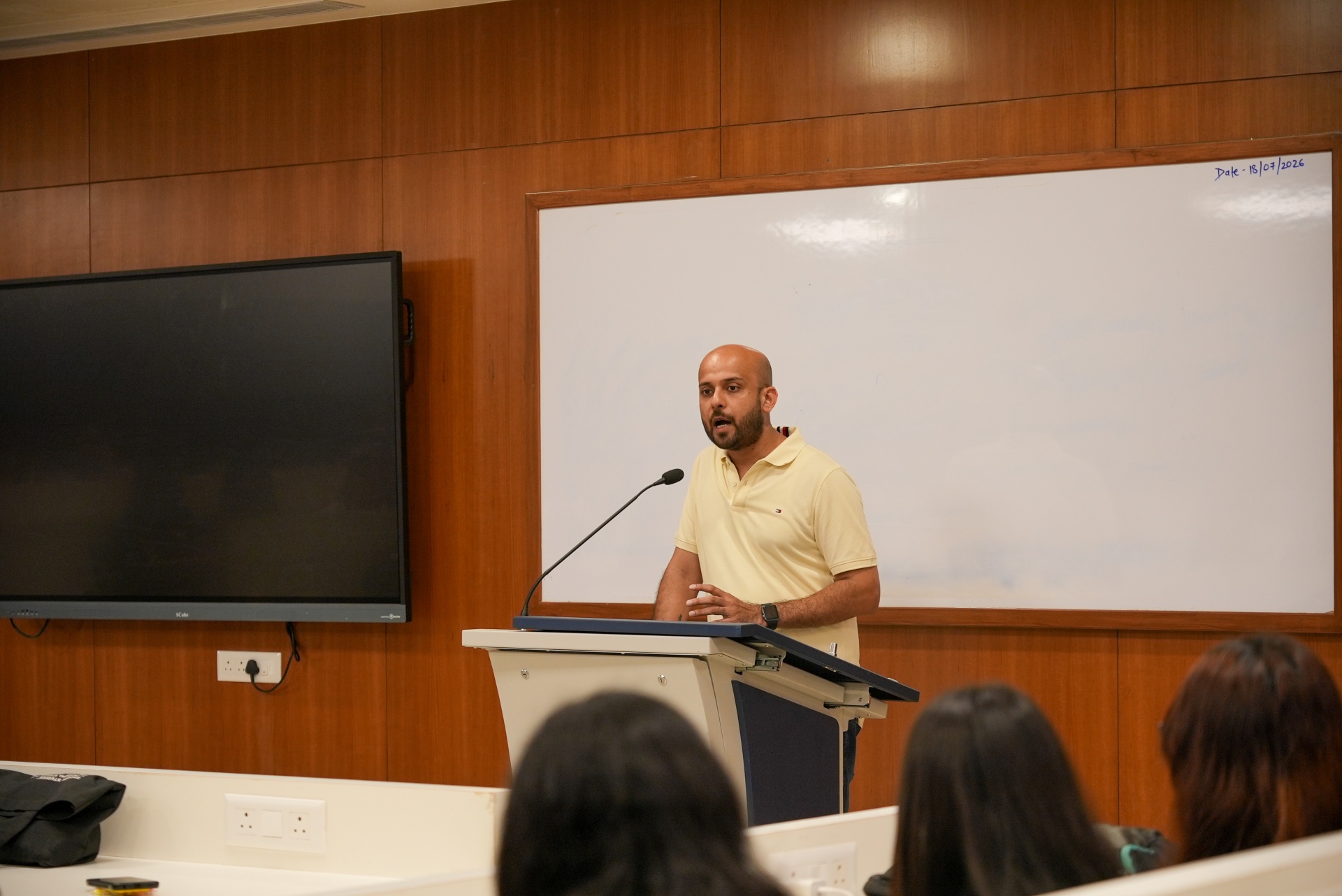
Ask a room of journalism students to define the difference between a podcast and an interview, and the answers arrive quickly: one is scripted, the other is not. One is formal, the other sits somewhere between formal and casual. Both answers are correct, and both are incomplete.
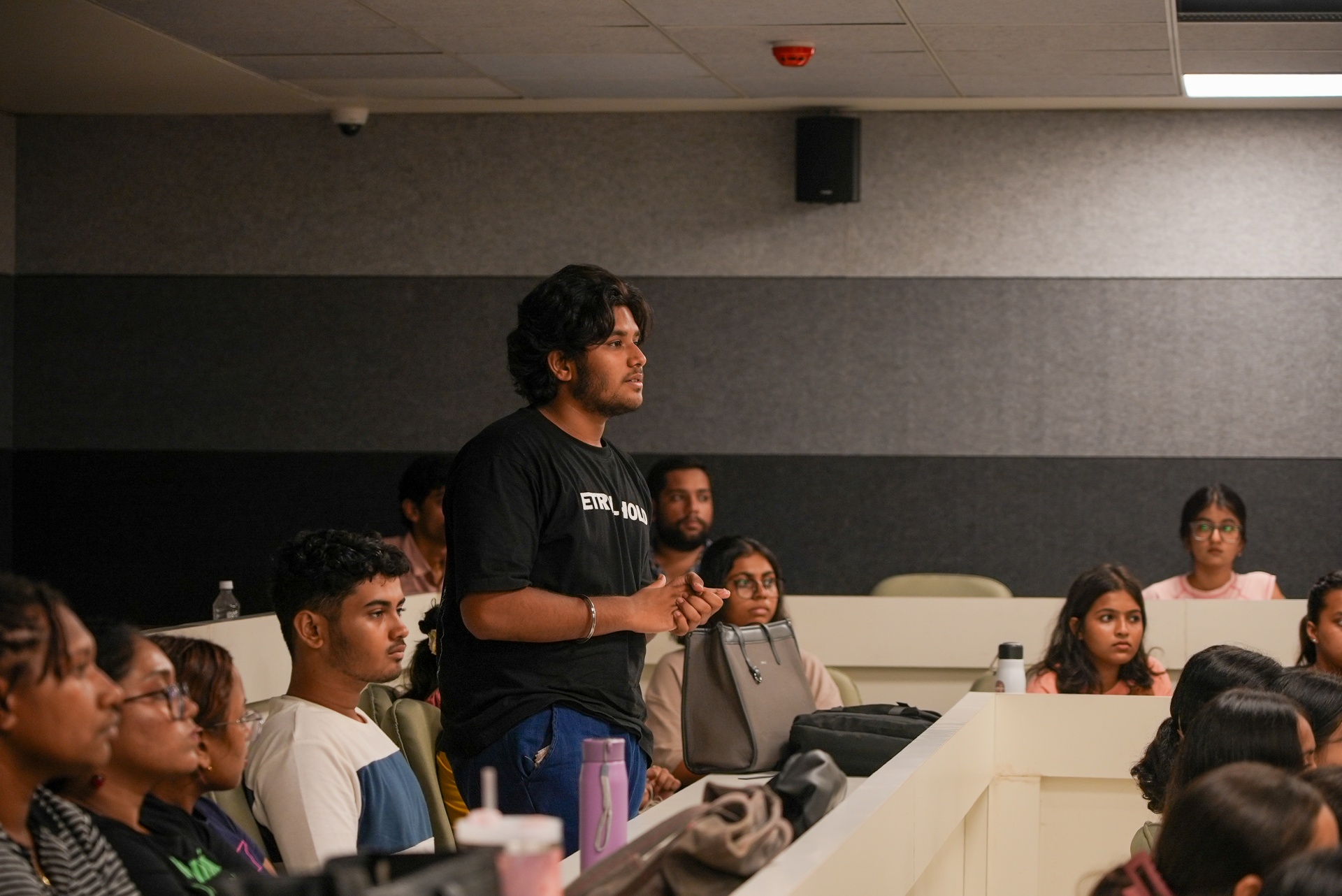
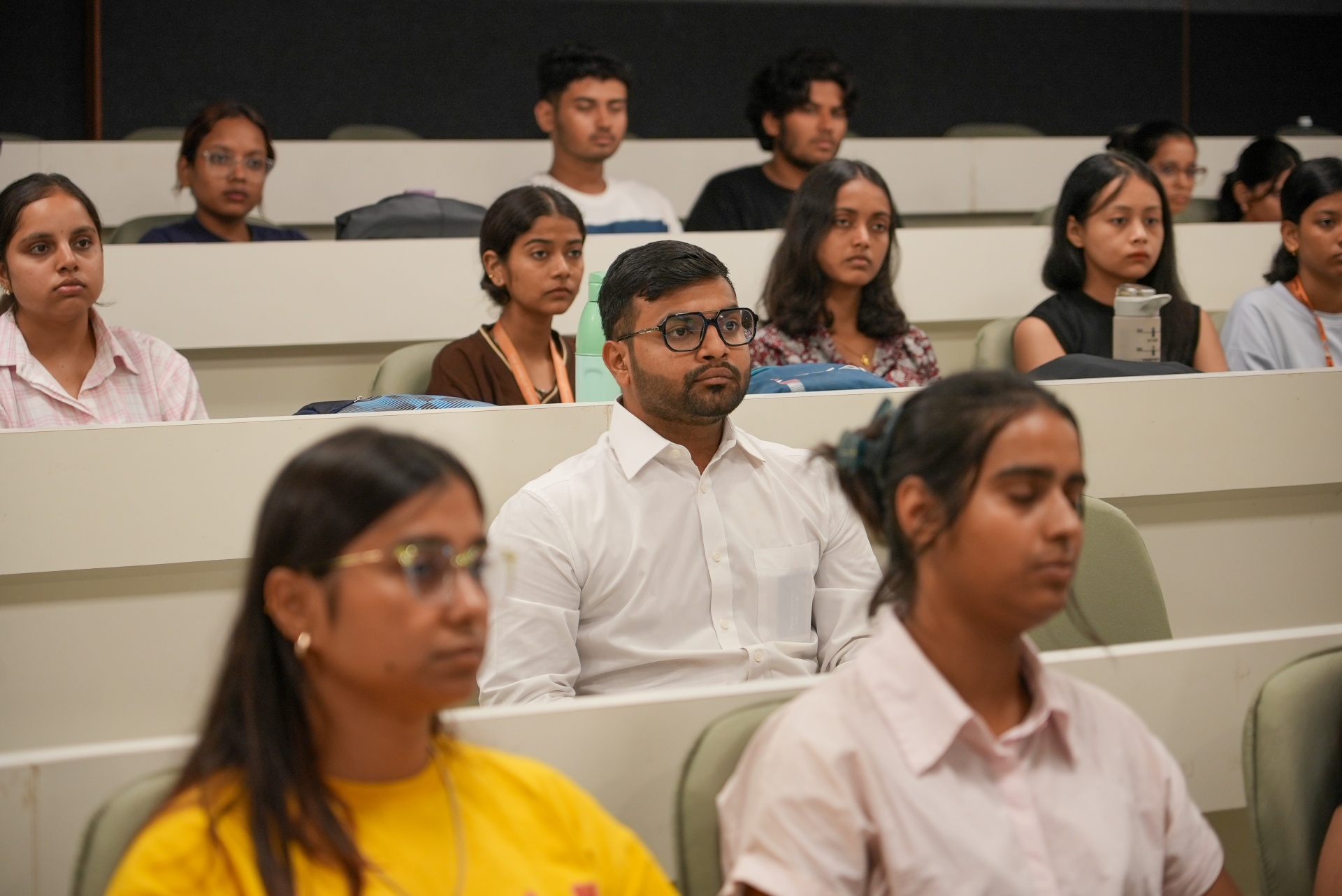
That was the opening move of a session at Parul University on 21 July 2026, when Vaibhav Mathur, National Head of Podcast at India Today Digital, declined to deliver a lecture and asked the room a question instead. Hosted by the Department of Journalism and Mass Communication at Lakshya 2047, the hour that followed moved between media theory, industry economics, career advice and hands-on craft, with students from the first semester to the final year interrupting throughout, which is how he insisted on running it.
What follows is the substance of that session: what genuinely separates the two formats, why storytelling has become the thing audiences actually buy, how a national podcast operation is structured, and what a student should do first if they want to build one of their own.
Podcast vs Interview: What Actually Separates the Two Formats!
The students’ instinct was right as far as it went. A set list of questions and a fixed structure frames an interview. A podcast is unscripted, conversational, and occupies a register between the formal and the casual. But the more useful distinction Mathur drew was not about scripting at all. It was about what each format is permitted to do. News, he argued, has obligations that a podcast does not. It has to be straight, factual and complete, and it cannot obscure a situation or leave things out. A podcast operates under different rules. It has room for opinion, for ambiguity, for personal reflection, and for the parts of a story that do not survive the constraints of a formal news broadcast. That is not a lower standard; it is a different job.
The practical consequence is that the two formats fail in different ways. An interview fails when the questions are not answered. A podcast fails when the conversation does not breathe, which is why so much of the craft, as the rest of the session made clear, is spent on making a guest comfortable enough to say something they had not planned to say.
An interview asks questions. A podcast has a conversation. They fail in different ways, and they are prepared for in different ways.
Why Audiences Now Buy Stories Rather Than Products
A student’s observation that interviews are losing their hold on audiences while storytelling has become the thing that connects became the spine of the session’s first half. Vaibhav Mathur built an argument on it that reached well beyond journalism.
His illustration was generational. A generation ago, a shopper walked into a store and bought a shirt from a familiar brand without much deliberation, driven by what the industry calls top-of-mind awareness, the same reflex that makes a person name a single dairy brand the moment they think of ice cream. That reflex, he argued, is weakening. Younger consumers decide differently: based on what is circulating on social media, on word of mouth, and on what a brand says it stands for, whether that is sustainability, recyclable fabric, or ethical sourcing. When students in the room confirmed these were the factors shaping their own purchases, he made the point explicit.
“In the current times, our decision-making is also changing based on the stories which we get to hear. Now who is building those stories, and who is setting that narrative in the minds of consumers? It is people like us.” – Vaibhav Mathur, National Head of Podcast, India Today Digital
The responsibility, he told the room, now sits with the people in front of him, through their writing, their videos and their reels. What audiences want from a brand is no longer its polished surface but its backstory, its reason for existing, its larger vision. Some brands, he noted, function as an extension of a consumer’s own identity, which is a considerably higher bar than being merely recognised.
He was also clear that journalism students cannot treat the editorial and commercial sides of media as separate concerns any more, because no content operation can be run without accounting for the effect it creates in the wider ecosystem.
Inside India Today's Podcast Formats
Vaibhav Mathur walked students through several of the formats his team runs across India Today and Aaj Tak, using each as an example of a different approach to storytelling. The following are his descriptions of his own team’s work.
Padhaku Nitin: the campus format built to remove surprises
The flagship he described in most detail sends a team to college campuses across the country to produce a full walkthrough of the institution alongside a candid, unscripted conversation with a spokesperson, whether a vice chancellor, a promoter or an owner. Hosted by Nitin Thakur with a dedicated editorial and production team, it is, he was emphatic, deliberately not an interview.
The editorial intent behind it is unusually clear. The format exists, he said, to eliminate what he called eureka moments, the discoveries a student or parent makes only after enrolling. The aim is to surface what a family would want to know about academics, campus life and student experience before the decision is made, going beyond what a website or a single visit can convey. The lens is on the people running the institution, their personality and their larger vision, rather than on infrastructure and brand name.
Reporters Off Air: what does not fit the bulletin?
A Hindi-language round-table format in which journalists discuss the stories and opinions that cannot be accommodated within a formal news broadcast. This is where his distinction between news and podcasting becomes operational: the format is built for the reflection, opinion and texture that a bulletin has no room for, and it sometimes withholds names deliberately to capture the character of a live political or cultural moment without inviting controversy.
Teen Taal: topical, humorous, and deliberately inconclusive
A three-hour weekly format built around whatever is current, a new film, a cricket result, a viral social or political moment. He described its tone as lightly humorous and newsy without being on the nose, and its purpose as presenting journalists’ varied opinions without handing the audience a conclusion. The goal, in his framing, is to provoke introspection rather than deliver a verdict, leaving listeners with a take or a flip on a situation and trusting them to reason their own way to the end of it.
Beyond the flagship shows, he described a broader strategy of building niche, vertical-specific podcasts around fashion, real estate, crime and other categories, each reaching a distinct audience segment while giving young journalists a way to combine their core training with a personal area of interest. For a student wondering how a specialism becomes a job, that is the mechanism.
How Podcasts Carry Advertising Without Announcing It
Given his own background on the business side of media, Vaibhav Mathur pressed students to understand the commercial architecture underneath the content they want to make. He argued that podcasts can carry advertising in a way other formats cannot.
“Advertisement is not always on the face, and that’s the beauty of a podcast.” – Vaibhav Mathur
A product or service can be discussed inside a conversation in a manner subtle and organic enough that the listener does not experience it as a pitch. He set this against what he described as a shift in advertiser spending: the largest budgets have traditionally gone to television, print and radio, but dedicated podcast budgets are, by his account, growing steadily as brands recognise what the format can do that a fifteen or thirty-second spot cannot.
His reasoning is worth holding onto because it explains the format’s commercial logic in a single move. A print advertisement is a tactical placement. A television spot occupies thirty seconds and disappears. A podcast, he argued, stays with a listener for longer, for the straightforward reason that nobody consumes a podcast by accident. The audience is there because it wants to know more, and attention given voluntarily is worth more than attention interrupted.
How to Start a Podcast? Pick a Niche, Then Build a Business Model
The session’s first extended exchange came when a student asked what an independent creator needs to consider when launching a podcast without an agency behind them. His answer had two parts, and he was blunt about both.
The first is niche. He warned against what he called an umbrella approach, covering many industries loosely, and argued instead for committing deeply to a single vertical that can sustain a career over decades.
“Your selection should be a carved-out approach, where you feel: okay, I’m picking up this industry, and I want to have all the podcasts around this specific industry.” – Vaibhav Mathur
He sketched how a fashion-focused series might build outward: opening with textile-industry guests on fabric types and export demand, then progressing to conversations about broader trends, so that the arc of the series makes sense as a whole and each episode contributes to a long-term direction rather than existing in isolation.
The second part was economics, and here he was direct enough to be uncomfortable. Responding to a student who described self-funding food review content, he acknowledged the appeal of making something purely out of love for the subject, then warned that scale brings real costs in travel, equipment and time. There are no free lunches, he said, and a creator has to build a business model rather than subsidising the work indefinitely, so that partners and collaborators eventually fund it and it becomes a business rather than a drain. That is the same reasoning behind the startup and entrepreneurship support at Parul University through PIERC, where student ventures are pushed early toward a model that can pay for itself.
Passion starts a podcast. A business model is what keeps it running once travel, equipment and time start costing real money.
The Craft of Making a Guest Open Up
A student asked about the risk a guest takes on when they share an opinion or a personal detail that might later be judged. The answer produced the most technical passage of the session, and the most useful for anyone who wants to actually make one of these.
Vaibhav Mathur introduced the idea of the frozen shoulder to describe the stiff, guarded posture typical of a formal interview, where a guest is conscious of the camera at every moment. A podcast is designed to prevent exactly that.
“In the podcast, shoulders should not be frozen. Your hand movement, your body language will also communicate as much as you communicate with words.” – Vaibhav Mathur
The mechanism for achieving it is preparation that happens before recording begins: time spent with the guest building comfort and trust, without disclosing every question in advance. His editorial team deliberately holds a few questions in reserve rather than front-loading the full scope of the conversation, so that spontaneous and less rehearsed reactions can be captured.
He reached for a familiar folk tale to make the point, the one in which a cat teaches a tiger every hunting skill it knows except how to climb, and survives the tiger’s eventual ingratitude by going up a tree. Keep something back. It is a memorable way to describe an editorial discipline that a beginner would otherwise never think of.
He also noted a structural safety net that live formats do not have. Because podcasts are recorded rather than broadcast live, there is room to edit and correct, and in some formats to let a guest review content before release, which protects the host and the guest alike.
Beating the Shrinking Attention Span
Asked how a long-form format survives in an era of collapsing attention spans, Vaibhav Mathur described a funnel rather than a compromise. His team cuts sixty- to ninety-second highlights from full episodes and distributes them on social media as, in his words, bait: partial information designed to send an interested viewer to the complete episode.
He framed this as one of digital’s genuine advantages over linear broadcast, since a viewer can save a clip and return to the full episode on a commute or late at night rather than being tied to a broadcast slot. But he was equally clear that promotion cannot rescue weak material. If the main content does not hold attention on its own merits, audiences arrive, watch a little, and leave.
That led him to the metric his team actually watches: drop-off rate, the proportion of a video’s runtime an average viewer completes. He cited an industry benchmark of roughly twenty-three to twenty-four per cent as a strong result, and was candid that sustaining it takes long-term editorial effort, variety, and what he called stickiness inside every segment rather than only at the start. For students used to thinking about views, that reframing matters: the number that counts is not how many people arrived, but how far they got.
What He Told Students About Building a Career?
Asked about his own route into media, Vaibhav Mathur gave the session’s most personal passage, and framed it as a set of principles rather than an inspirational story. His path was not linear: hospitality first, then an MBA, then banking, then close to six years in cement sales, before radio and eventually podcasting.
He was unusually honest about the middle of that sequence. Banking revealed itself quickly as the wrong fit. The cement years brought steady growth in designation and responsibility but no real engagement, and he described that period plainly as having no love in it, which for someone who values learning above title was the disqualifying problem.
“Don’t try to, like a jigsaw puzzle, fit into a mould for which you are not prepared, or which you think is not good enough for you. Follow your passion.” – Vaibhav Mathur
Media changed that, he said, because no day resembles the one before it. The variety of meeting organisations and brands with entirely different problems, objectives and audiences, from a small food business to a car manufacturer to a university, is the part he values. He extended the same logic to the session itself, telling students he expected to learn something from them before he left the room, which is a reasonable test of whether someone means what they say about curiosity.
His counsel to the room was to choose an area of genuine interest, commit to it with patience, and let curiosity rather than convenience decide the next step. It is advice with an obvious cost attached, since it implies leaving roles that look successful on paper, and he had already described doing exactly that.
Learning the Craft by Studying Other Podcasters
Toward the close, Vaibhav Mathur asked students which podcasters they follow, and used their answers as teaching material. When a student named Richa Anil, who moved from radio jockeying into podcasting, he used her as a case study in professional reinvention: evolving your medium as the industry evolves rather than waiting to be made redundant by it.
He also pointed to formats that break the two-people-in-a-studio convention, including episodes recorded in moving cars and built around walk-and-talk segments, as evidence that the format has no fixed template and that a creator can invent their own. He even suggested that students must pursue journalism and must learn the core art of writing and communication by enrolling in Parul University’s Bachelor of Arts in Journalism and Mass Communication Program, Master of Arts in Journalism and Mass Communication and a Diploma in Journalism program as well.
On the podcaster Raj Shamani, he drew attention to a specific technique: questions that sound elementary on the surface are often placed deliberately, because a question simple enough to seem harmless is difficult for a guest to deflect, and frequently opens an entirely new thread. His instruction to students was to study a range of podcasters for their execution rather than their subject matter, and to keep watching for what is new as a form of continuous self-education in the craft.
How the Session Closed?
The session ended the way it started, with students still raising questions on niche selection, guest comfort and industry benchmarks until the time ran out. Vaibhav Mathur thanked the room and said the exchange had been instructive for him as well, before a formal vote of thanks. Mr. Poojan Shah, Head of Outreach and PR, Parul University, presented a token of appreciation on behalf of the university.
Running through the hour was a consistent thread: that podcasting sits at the intersection of storytelling, commerce and craft, and that it is built not on scripts but on trust, preparation and a willingness to let a conversation breathe. India’s media and broadcasting sector, overseen by the Ministry of Information and Broadcasting, has expanded well beyond the formats that defined it a decade ago, and sessions like this one are how journalism programmes and students at Parul University encounter that shift from the people managing it.
FAQs
What is the difference between a podcast and an interview?
An interview is structured around a set list of questions and a fixed format, while a podcast is unscripted and conversational, sitting between formal and casual. According to Vaibhav Mathur, National Head of Podcast at India Today Digital, the bigger difference is what each format is allowed to do: news must be straight, factual and complete, whereas a podcast has room for opinion, ambiguity and personal reflection that a formal broadcast cannot accommodate.
How do you start a podcast as an independent creator?
Vaibhav Mathur advises two things. First, choose a narrow niche rather than covering many industries loosely, committing to a single vertical that can sustain a series over years, with each episode contributing to a coherent arc. Second, build a business model early rather than self-funding indefinitely, because scale brings real costs in travel, equipment and time. As he put it to students at Parul University, there are no free lunches.
Why are brands spending more on podcasts?
Because the format can carry a product or service inside a conversation in a way a listener does not experience as advertising. Vaibhav Mathur argues that a print placement is tactical and a television spot lasts thirty seconds and disappears, whereas a podcast stays with a listener longer since the audience chose to be there. He describes dedicated podcast budgets as growing steadily as advertisers recognise this deeper engagement.
Is podcasting a viable career for journalism students in India?
Vaibhav Mathur described a strategy at India Today of building niche, vertical-specific podcasts around areas such as fashion, real estate and crime, each reaching a distinct audience while allowing young journalists to combine core reporting training with a personal specialism. His advice to students is to pick an area of genuine interest, commit to it with patience, and treat both the editorial and commercial sides of media as part of the same job.


