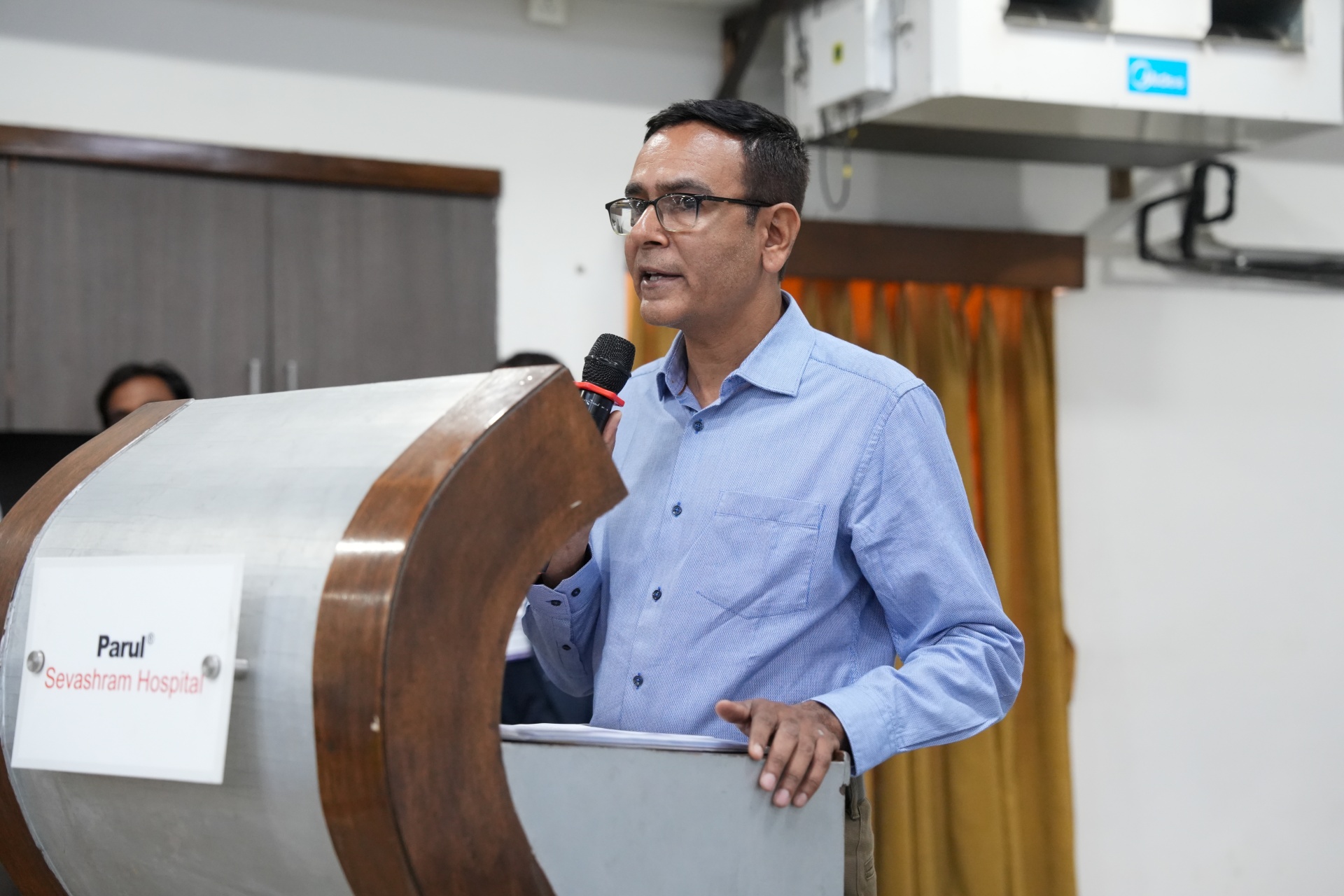
Most AI workshops at the school level demonstrate what AI can do. The Day 2 session at PM SHRI RMS demonstrated what students can build with AI in under ten minutes and what they should know about where their data goes when they do.
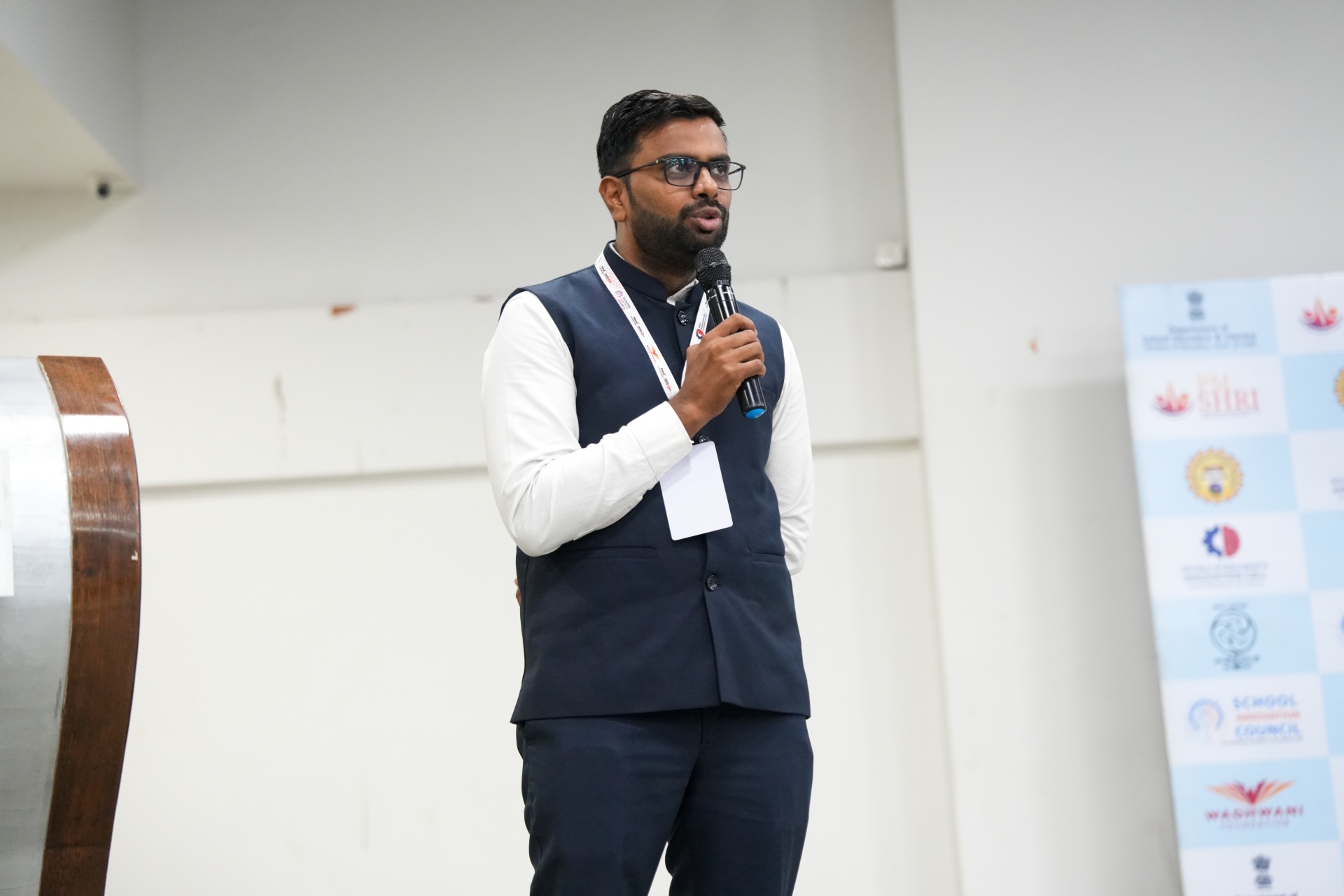
Mr. Parth Devariya, AI and Technology Consultant at GFuture Tech Pvt. Ltd., opened the Day 2 AI session on 29 April 2026 at the Hospital Auditorium with a deceptively simple question: what can we do with AI? The audience of PM SHRI School, Jawahar Navodaya Vidyalaya, and Kendriya Vidyalaya participants responded with the expected answers (finding solutions, creating music, generating images, building presentations, augmented reality, virtual reality). Mr. Devariya’s role was to take the answers beyond the obvious into the operational. The session operated as a structured part of the Three-Day Regional Mentoring Session jointly convened by AICTE, the Ministry of Education’s Innovation Cell, the Wadhwani Foundation, and PIERC at Parul University.
The entire 20-member jury panel comprised Dr. Arvind Deshmukh, Ms. Anbumathi M, Mr. Parth Devariya, Mr. Hardik Kharva (Centre Head, VSS, PIERC), Ms. Sonal Sudani (Incubation Manager, PIERC), and Mr. Umang Panchal (Assistant Professor, PIET), Mr. Anup Chaudhary (Incubation Manager), Mr. Umang Panchal, Mrs. Sonal Sudani (PIERC), Mr. Hardik Kharwa, Ms. Sujaya Bhattacharjee, Mr. Himansu Das, Ms. Vanshika Muchhara, Dr. Partkumar Sapariya, Dr. Bhavin Dhanavade, Dr. Prashant Khanna, Dr. Sneha Soni, Dr. Saurabh Parmar, Ms. Kajol Patel, Mr. Vivek Joshi, Ms. Riddhi Mehta, and Mr. Omkamal Vashi.
Beyond ChatGPT: the platforms students need to know about
Mr. Parth was direct about a limitation that most school AI discussions skip over.
Standard text-generation models like ChatGPT and Gemini are excellent at producing text. They are not designed to produce working software applications from scratch. Students who want to build deployable tools need to understand the difference between text generation and full cloud development, and they need to know which platforms exist for which kind of build. He introduced the participants to Google Labs Opal as the bridge between text-generation interaction and small-application deployment. The key distinctions:
- ChatGPT and Gemini: Strong at text generation, conversational interaction, content drafting. Not designed for application code generation or deployment.
- Google Labs Opal: Environment for building small functional applications using pre-built workflows and automated processes. Ideal for student-level rapid prototyping.
- Traditional cloud architecture (AWS, GCP, Azure): Required for complex applications including video analytics, drone footage processing, or large-scale data systems.
- Claude AI (Anthropic): Useful for complex code generation and structured technical builds, including telematics and dashboard systems.
- Premium tier subscription cost: Generally Rs. 1,500 to Rs. 2,000 per month for the premium tiers of major AI platforms.
The CropCare demonstration: from prompt to working application in one minute
To convert the abstract framework into a concrete demonstration, Mr Devariya built a working agricultural disease detection application live.
Opening Google Labs Opal on screen, he typed a detailed instruction: accept a photograph of a crop, identify any disease present, provide a prioritised list of treatment options, and prefer cultural and organic interventions over chemical treatments. Within approximately one minute, Opal produced a fully functional application that he named CropCare. The audience watched as he uploaded a sample photograph of a plant leaf into the application. The system processed the image, matched the visual anomalies against agricultural disease datasets, and generated a detailed report that correctly identified the condition as wheat stripe rust. The treatment list was prioritised exactly as the original prompt had specified, with cultural controls listed first and chemical interventions only as a last-resort recommendation.
The demonstration carried multiple lessons for school participants thinking about real-world applications:
- Application speed: From conceptual specification to a working deployed application in under one minute.
- Domain accuracy: Correct disease identification (wheat stripe rust) from a sample leaf image, demonstrating that current AI platforms have functional capability across agricultural and biological domains.
- Prompt discipline: The output mirrored exactly what the prompt specified, including the priority ordering of cultural over chemical treatments. Prompt quality directly determines output quality.
- Deployment: The application was deployed and made accessible via a shareable URL within the same demonstration window. Students typed the URL into their mobile phones and ran the analytical tool in their browsers. If you wish to master all these tech dimensions and want to work for Big 4s, delay not and enrol in the Tech CSE program of Parul University & say yes to your techie dreams!
Vehicle telematics with Claude AI: a 10-minute build
Mr. Devariya then demonstrated a more complex build using Claude AI from Anthropic. The target was a vehicular telematics and safety dashboard application that would integrate with a car’s electronic control unit and internal hardware to monitor vehicle status in real time. The demonstration showed a simulated operation: when the car was working normally, the system displayed a vibration pattern consistent with normal road driving. The system was instructed that a sudden spike in energy and vibration would indicate an accident, at which point emergency alerts and GPS location data would be sent automatically to designated emergency responders. He then issued an additional prompt to add computer vision analysis alongside the hardware telemetry. The application’s code was updated within the same demonstration window to incorporate dashboard camera analysis, road condition assessment, and integration with the vehicle’s infotainment system for unified driver controls.
The lesson was structural. Complex multi-system integrations that previously required weeks of engineering work can now be specified, generated, and iterated within a single session.
AI data sovereignty: where your data goes when you use a free tool
Mr. Devariya then turned the session toward a topic that most school AI workshops do not address: what happens to the data you upload.
The framing was direct: when a product is free, the user’s personal data is what gets sold. He explained the operational difference between free and premium AI tier data handling:
- Free tier (ChatGPT, Gemini, others): All user inputs (including bank statements, research data, source code, personal documents) are used to train the underlying models. Once data is uploaded, it remains with the service provider as training material.
- Premium tier: Some platforms offer opt-out controls for data ingestion in their premium subscriptions. However, any data uploaded before the opt-out was activated remains with the service provider.
- Premium subscription cost: Typically Rs. 1,500 to Rs. 2,000 per month for the major Western AI platforms.
He then connected the data flow question to national data sovereignty. ChatGPT’s servers are based in the United States. When an Indian person or institution uploads data to ChatGPT, that data travels directly to US-hosted infrastructure. OpenAI has agreements with the United States government that allow American authorities to access user data under specific security and investigation conditions. For Indian researchers, professors, and institutions uploading sensitive research, intellectual property, or government-adjacent data, the implication is significant. He referenced the Government of India’s plan to build sovereign data centres within India as the structural response to the foreign-data-residency challenge, aligning with the broader Make in India and Atmanirbhar Bharat priorities on digital infrastructure self-reliance.
Use AI as a supporting agent. AI is not everything.
Ms. Anbumathi M of the Wadhwani Foundation, in her valedictory address, echoed the same caution
Other applications demonstrated during the session
Mr Devariya touched on several additional applications, each grounded in a real-world use case students could replicate.
- Deepfake detection app: An application concept for verifying whether photos and videos circulating on social media were genuine or AI-generated, with user-reporting functionality for content removal requests.
- Automated answer sheet evaluation: A system connecting to cloud storage (Google Drive), reading handwritten student answer sheets, evaluating content against curriculum standards, and generating grades with reasoning explanations. Addressed a teacher concern raised during the session.
- Handwriting improvement tool: An application for school-age children that analyses how they form letters and provides specific corrective feedback to improve handwriting quality over time.
- QR-code-based campus information system: A student concept (highlighted during the session) for placing QR codes throughout school facilities; scanning them would deliver contextual content (videos, animations, summaries) about that specific location.
- Algorithmic trading systems: Devariya referenced a case study from a finance and technology conference in which an engineering student deployed Rs. 10 lakh into an automated trading system that generated approximately Rs. 1 crore in one month. The case was offered with appropriate caution about risk and verification.
Open-Source Cloud AI and the Jensen Huang reference
Mr. Devariya closed with a reference to Nvidia’s Chief Executive Officer Jensen Huang‘s framing of Open-Source Cloud AI at a recent technology conference. The framework describes how companies are now operating digital agents from messaging apps like Telegram and WhatsApp, with automated workflows running continuously in the background to process emails, generate summaries, manage databases, and execute software tasks without direct human intervention. The implication for school students and teachers in the audience was direct: software systems worth billions of dollars can now be built and deployed by people who do not know how to code. The technology democratisation that the next decade will produce aligns directly with the Government of India’s Startup India priority of expanding entrepreneurial access beyond traditional technology backgrounds.
The Mr. Parth session in the broader RMS architecture
The AI session was strategically positioned on Day 2 of the programme. The morning session by Mr. Mithilesh Patel of Vraj Innovator covered the structural framework for converting ideas into ventures: problem identification, solution design, material feasibility, prototype development, testing, market strategy, team building, intellectual property, and budget planning. Mr Devariya’s afternoon session then provided the technology toolkit through which students could execute that framework. The Day 1 design thinking foundations laid by Dr Arvind Deshmukh and Ms Anbumathi M provided the methodology that drove the technology demonstrations on Day 2, and the Day 3 final pitch session (where students presented 50 innovation projects) was the evaluative culmination.
FAQs
Who is Mr. Parth Devariya, and what did he teach at PM SHRI RMS?
Mr. Parth Devariya is an AI and Technology Consultant at GFuture Tech Pvt. Ltd. He served as the AI session speaker on Day 2 of the Three-Day Regional Mentoring Session at Parul University on 29 April 2026, and as one of the 20 jury members evaluating the Day 3 student pitch presentations. His session covered working application builds using Google Labs Opal (with a live CropCare wheat stripe rust detection demonstration), vehicle telematics dashboards constructed through Claude AI, AI data sovereignty concerns including free versus premium AI tier data handling, the Open-Source Cloud AI framework referenced by Nvidia CEO Jensen Huang, and additional concepts including automated answer sheet evaluation, handwriting improvement tools, and QR-code campus information systems.
What is Google Labs Opal and how was it used in the session?
Google Labs Opal is an environment for building small functional applications using pre-built workflows and automated processes. It bridges the gap between text-generation AI platforms (which produce conversational outputs) and traditional cloud architecture (which requires substantial engineering effort to deploy applications). At PM SHRI RMS, Mr. Parth Devariya demonstrated Opal by building a working agricultural disease detection application called CropCare in approximately one minute. The application accepted a photograph of a plant leaf, processed the image against agricultural disease datasets, correctly identified wheat stripe rust, and generated a prioritised treatment recommendation that placed cultural controls before chemical interventions, exactly as the original prompt had specified. The application was deployed via a shareable URL and students ran it on their mobile phones during the session.
What did Mr. Devariya say about AI data sovereignty?
Mr. Devariya addressed AI data sovereignty as a structural concern for Indian users of foreign-hosted AI platforms. He explained that when a product is free, the user's personal data becomes the product being sold. Free-tier AI services use all user inputs (including bank statements, research data, source code, personal documents) as training material for their underlying models. Premium tier subscriptions, costing approximately Rs. 1,500 to Rs. 2,000 per month, sometimes offer opt-out controls, though data uploaded before opt-out remains with the service provider. He also noted that ChatGPT's servers are based in the United States and that OpenAI has agreements with the US government allowing American authorities access to user data under specific conditions. He referenced the Government of India's plan to build sovereign data centres within India as the Atmanirbhar Bharat-aligned response to this challenge.
What is the CropCare application Mr. Devariya built during the session?
CropCare is the agricultural disease detection application that Mr. Parth Devariya built live during his Day 2 AI session at PM SHRI RMS using Google Labs Opal. The application accepts a photograph of a crop or plant leaf as input, processes the image against agricultural disease datasets, identifies any disease present, and generates a prioritised treatment recommendation. During the live demonstration, the application correctly identified wheat stripe rust from a sample leaf photograph within approximately one minute of receiving the input. The treatment list was prioritised with cultural controls and organic interventions before chemical treatments, mirroring the prompt specification Mr. Devariya had provided. The application was deployed via a shareable URL during the session, and audience members ran it on their mobile phones to verify the deployment.
How does the PM SHRI AI session align with Atmanirbhar Bharat and Make in India?
The AI session at PM SHRI RMS aligns with Atmanirbhar Bharat and Make in India in three structural ways. First, by introducing school students and teachers to AI application building capabilities that previously required a substantial engineering background, the session expands the entrepreneurial population that India can draw from for Make in India innovation. Second, by raising data sovereignty awareness, the session positioned school participants to think critically about where their data goes and to support the development of Indian sovereign data infrastructure. Third, by demonstrating that complex software systems can now be built by people without traditional coding backgrounds, the session aligns with Startup India's broader objective of democratising entrepreneurship access. The Government of India's sovereign data centre plans, the broader India Stack digital public infrastructure, and the Lakshya 2047 vision of Viksit Bharat all benefit when school participants enter the AI-enabled venture pipeline with the technical and policy awareness this session built.
What other AI applications did Mr. Devariya discuss at the session?
Beyond the CropCare demonstration and the Claude AI vehicle telematics dashboard, Mr. Devariya discussed several additional AI applications during the Day 2 session at PM SHRI RMS. A deepfake detection application for verifying whether social media photos and videos are AI-generated. An automated answer sheet evaluation system connecting to cloud storage, reading handwritten student answers, and generating grades with reasoning explanations. A handwriting improvement tool for school-age children that analyses letter formation and provides corrective feedback. A QR-code-based campus information system in which scanning codes placed around school facilities would deliver contextual content, including instructional videos, animations, and curriculum summaries. He also referenced an algorithmic trading case study from a finance and technology conference!