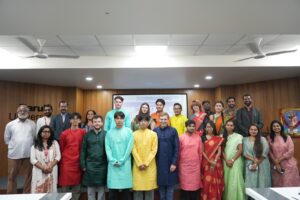
Three studios. Three philosophies. One city. The 2026 tour mapped Mumbai’s built environment from the conservation of its past to the contemporary architecture of its present to the residential scale of its future.
Across the three-day Parul Institute of Design Mumbai Industry Tour, three of the twelve speaker sessions focused on the built environment as the design problem. Each approached it from a different professional position. This article documents the three sessions together because they belong to the same field of practice and because, taken together, they offer Parul Institute of Design students a complete view of how Mumbai is being designed, built, and preserved in 2026.
Abha Narain Lambah on heritage conservation and adaptive reuse
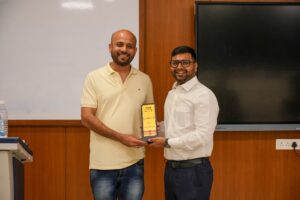
The session with Abha Narain Lambah, founder of one of India’s most respected heritage conservation practices, was held at her office and centred on the architect’s responsibility toward cultural preservation.
Ms. Abha Narain Lambah, founder of Abha Narain Lambah Associates, framed heritage conservation as more than the preservation of old buildings. Heritage sites, she argued, hold emotion as much as story. The architectural response to historical structures has to recognise this dual function: they are not obstacles to development but cultural assets, and the conservation practice has to operate with sensitivity, deep research, and respect for what the structure represents to the communities around it.
Heritage sites hold emotions more than just the stories.
Ms. Abha Narain Lambah, Founder, Abha Narain Lambah Associates
The session covered seven dimensions of the practice. Conservation begins with research and historical documentation because no responsible restoration is possible without first understanding what the original structure was, who built it, and what it was for. Adaptive reuse, in which historical buildings receive new function for contemporary needs without losing their heritage value, is the working method through which preservation becomes practical. Authenticity must be preserved while functionality is upgraded, a balance that requires judgment on what can be added and what must be left untouched. The architect, in this practice, is responsible for connecting past, present, and future through structures that anchor cultural identity. Conservation in urban environments faces specific challenges, including pressure from development, regulatory complexity, and the constant negotiation between preservation and contemporary use.
- Heritage conservation: Cultural identity is preserved through architectural continuity, not despite it.
- Adaptive reuse: Historical buildings gain new life and contemporary relevance when their function is updated while their material and spatial identity is preserved.
- Research and documentation: No restoration is responsible without prior research into what the structure was, why it was built, and what it has meant to its communities.
- Designer responsibility: Architects working with heritage carry a responsibility toward the cultural inheritance their work shapes.
Kayzad Shroff and Maria Isabel Leon at ShroffLeon on spatial storytelling
Mr. Kayzad Shroff and Ms. Maria Isabel Leon, founders and principal architects of ShroffLeon, hosted students at their Mumbai office. Their session framed architecture as the creation of experience rather than the construction of buildings, an approach grounded in spatial storytelling, the integration of structure with landscape and environment, and site analysis as the foundation of any meaningful design.
Their working principle was unusual in its candour: approach every project with a mix of child-like naivety and curiosity.
Approach every project with a mix of child-like naivety and curiosity.
Kayzad Shroff and Maria Isabel Leon, Founders, ShroffLeon
The advice has a specific architectural meaning. Naivety prevents the architect from assuming they already know what the project requires before having engaged with the site, the brief, and the context. Curiosity drives the depth of investigation that produces strong concepts. The pair emphasised that architecture is about experiences, not just buildings, and that context, site, and environment deeply influence design outcomes. Strong concepts guide the entire process. Materials and structure define the identity of a space. Innovation has to remain functional and usable rather than performative. Attention to scale and proportion is critical, and a good architect thinks creatively and logically in the same operation.
- Concept-driven design: Strong concepts established at the start guide every subsequent decision in the project.
- Site and context: The location, climate, and surroundings of a project deeply shape what the architecture must do.
- Experience over object: The building is the medium; the experience of the people who inhabit it is the goal.
- Material and structural expression: The choice of materials and the visible structure of the building become part of its identity, not separate decoration.
The Lodha design leadership team on large-scale residential
The Lodha session was the only seven-person panel of the tour. Each member led a different function within the design operation of one of India’s largest real-estate developers.
The Lodha session was held at the Lodha office and addressed large-scale luxury residential design at the developer scale. Seven design leaders presented their respective functions:
- Deepak Chitinis, Chief Designer: Overall design leadership across the residential portfolio.
- Sonal Bhide, Head of Design: Design strategy and integration across product lines.
- Sushant Patil, Head of Design: Design execution and project coordination across teams.
- Ritesh Shah, Vice President of Interior Design: Interior design strategy for residential and amenity spaces.
- Aun Abdullah, Vice President of MEP Design: Mechanical, electrical, and plumbing systems integration across large-scale projects.
- Vaishali Dangare, Deputy Vice President of Interior Design: Interior design implementation across residential portfolios.
- Sharan Lund, Deputy Vice President of Architecture: Architectural design coordination across developments.
The single most quoted line from the Lodha session was a deliberate counterpoint to assumptions about luxury real estate.
Don’t design for luxury. Design to solve problems.
Lodha design leadership team, on the working philosophy of large-scale residential design
The framing matters. Luxury at scale is not produced by signalling luxury; it is produced by solving the problems that occupants of large residential developments actually have, including circulation, comfort, light, services, and the experience of arrival and habitation. The session covered seven operational dimensions. Large-scale projects require teamwork across multiple disciplines, with no single function able to deliver the outcome alone. Design must align with market, user, and brand identity simultaneously. Functionality is as important as luxury aesthetics; one without the other does not work. Coordination and communication across architecture, interior design, and MEP are critical in execution because failure in any one discipline cascades into the others. Technology is increasingly shaping modern living spaces in ways that affect both layout and amenity. Time management and precision are essential at the scale and timeline of large developments. Every design decision affects large-scale user experience at the resident level.
- Multi-disciplinary teamwork: Architecture, interior design, MEP, and project management have to coordinate continuously across the development timeline.
- Functionality plus aesthetics: Neither is sufficient alone. Large-scale luxury design is the integration of both.
- User experience at scale: The design decisions of a real-estate developer shape the daily lives of thousands of residents.
- Project management discipline: At developer scale, time and precision are not soft virtues; they are operational constraints.
What the three sessions share and where they differ
Three studios, three philosophies, one city. Reading the sessions together produces a working map of Mumbai’s built-environment practice.
The three sessions converge on several principles. Each emphasises that context and site shape what is possible: Lambah on the cultural context of heritage sites, ShroffLeon on the landscape and environmental context of new projects, and Lodha on the user and market context of large-scale residential. Each rejects design as self-expression in favour of design as service to a specific population: heritage communities, building occupants, residential customers. Each emphasises craft, attention to detail, and the discipline of execution as central to the practice. Where they differ is in scale and temporal orientation. Lambah works on what already exists and what must be preserved. ShroffLeon works on what should now be created. Lodha works on what is being built at residential scale across the city. Together they describe the past, present, and future of Mumbai’s built environment as parallel design problems.
Also Read: Architecture, AI and Urban Planning with Kiran Kapadia
What each design discipline took from the three sessions
The three sessions reached students across multiple disciplines. The takeaways landed differently for each.
- Architecture and Interior Design students: Heritage and restoration sensibility from Lambah, spatial planning and large-scale execution from Lodha, contemporary spatial storytelling from ShroffLeon. The discussions emphasised that thoughtful planning and efficient space utilisation create meaningful environments.
- Product Design students: Contextual design, structural usability, functionality as a non-negotiable, and the principle that successful design improves user experience rather than only signals aspiration.
- Fashion, Visual Communication, and Animation students: Cultural relevance, history, and preservation in design from Lambah; concept development, scale, and creative thinking from ShroffLeon; teamwork, coordination, and real-world design application from Lodha.
How the three sessions connect to Parul Institute of Design's curriculum
Each of the three studios models a different career path that Parul Institute of Design’s Architecture, Interior Design, and Product Design students can pursue. The Faculty of Design emphasises practical learning and industry exposure precisely so that students leaving the institution can recognise where their professional inclinations sit on a spectrum from heritage conservation through contemporary architecture to large-scale real-estate development. The Mumbai Industry Tour at IIMUN is the structured occasion at which that spectrum becomes visible.
Also Read: Handmade over artificial is always a better choice.
FAQs
Who is the founder of Abha Naraian Lambah Associates?
The founder of the Abha Naraian Lambah Associates is Abha Naraian Lambah. The associates' group is one of the esteemed heritage conservation architecture practices. During the session of the Parul Institute of Design students' tour, she discussed conservation and planning ways to reuse historical buildings, the role of architecture in bringing out and maintaining the cultural identity, and the research and documentation of responsible restoration. She kept emphasising one thing during the session, and that is heritage sites hold emotions more than just stories, capturing the philosophical core of conservation work.
Who are the founders of ShroffLean?
The founders and principal architects of Shrofflean are Kayzad Shroff and Maria Isabel Leon. The studio is situated in Mumbai. In the industry tour of PID, they talked about architectural design philosophy, spatial storytelling, the combination of landscape with environment, the importance of site analysis and related areas, material findings and exploration with structural expression and the rules, principles that guide the concepts of timeless designs. Their working philosophy: approach every project with a mix of child-like naivety and curiosity, which prevents architects from assuming they know what a project requires before engaging with it.
Who attended the Lodha design session from the Lodha team?
The Lodha session was the only seven-person panel of the tour. The team included Mr. Deepak Chitinis (Chief Designer), Ms. Sonal Bhide (Head of Design), Mr. Sushant Patil (Head of Design), Mr. Ritesh Shah (Vice President of Interior Design), Mr. Aun Abdullah (Vice President of MEP Design), Ms. Vaishali Dangare (Deputy Vice President of Interior Design), and Mr. Sharan Lund (Deputy Vice President of Architecture). The session addressed large-scale luxury residential design, the coordination required across architecture, interiors, and mechanical-electrical-plumbing engineering, the role of user experience and lifestyle-driven spaces, the integration of technology, and the project-management discipline that real-estate-scale design demands. The team's working principle: don't design for luxury, design to solve problems.
What is the relationship between heritage conservation and contemporary architecture in Mumbai?
In the 2026 Parul Institute of Design Mumbai Industry Tour, three sessions presented complementary approaches to Mumbai's built environment. Abha Narain Lambah addressed the conservation and adaptive reuse of historical buildings. ShroffLeon's Kayzad Shroff and Maria Isabel Leon addressed contemporary architectural design and spatial storytelling. The Lodha design leadership team addressed large-scale residential development. The three approaches are not in competition. Conservation preserves the city's cultural inheritance; contemporary architecture adds to it; large-scale residential design accommodates the population growth that the city is undergoing. Together they describe the past, present, and future of Mumbai as parallel design problems requiring different sensibilities, all of which a complete design education should expose students to.
What design disciplines benefit from studio visits to heritage, architectural, and residential practices?
Architecture and Interior Design students gain heritage and restoration sensibility from practitioners like Abha Narain Lambah, contemporary spatial-storytelling exposure from studios like ShroffLeon, and large-scale execution understanding from developers like Lodha. Product Design students engage with contextual design, structural usability, and functionality as a non-negotiable. Fashion, Visual Communication, and Animation students gain awareness of cultural relevance, concept development, scale, creative thinking, and the team coordination that all real-world design projects require. The cross-disciplinary value of these sessions is that built-environment thinking sharpens design judgment across every other field.
What is the Parul Institute of Design Mumbai Industry Tour?
The Parul Institute of Design Mumbai Industry Tour is a structured industry-immersion programme that takes design students from Parul University in Vadodara to Mumbai to meet leaders across the city's creative industries. The 2026 edition, held between 9 and 12 March in partnership with IIMUN (India's International Movement to United Nations), covered twelve speakers across studios, offices, and design houses including Vogue India, Milaaya Embroideries, Kapadia Associates, Architecture BRIO, Applause Entertainment, Abha Narain Lambah Associates, ShroffLeon, the Lodha office, NIFT Mumbai, Papa Don't Preach, and the IIMUN office. The tour is part of Parul Institute of Design's curriculum emphasis on practical learning and direct contact between working professionals.