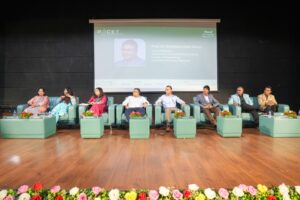
On 2 May 2026 at 10:30 AM, Mr. Aravind Voruganti, Co-Founder and CEO of 1Works, delivered the PiCET 2026 day-two keynote on Reimagining Universities in the Age of AI. The session was directed specifically at the faculty of Parul University. Mr. Voruganti is an entrepreneur and thought leader in AI and blockchain innovation. He holds an MBA in International Business from Liverpool Business School and has pursued specialised education in blockchain and finance from IIIT Hyderabad and the New York Institute of Finance.
Mr. Voruganti opened with a quote that set the tone for the session: ‘I am one among you, it is just that I started little early.’ He thanked Parul University for the invitation and used a metaphor on the role of a keynote: turning a key in the right direction to achieve desired goals. He then introduced the substance of his work. His organisation had recently launched the brAIn platform at the Bharat Mandapam in Delhi, alongside the human capital working group of the IndiaAI Mission. brAIn, in his framing, is India’s and possibly the world’s first institutional intelligence platform, addressing what he called the gap between individual AI and collective organisational AI.
Are the jobs for freshers really shrinking?
The opening question of the substantive content was provocative and direct. Mr. Voruganti walked the Parul University faculty through evidence that the answer is yes. AI is taking over most routine tasks and basic workflows that have historically been executed by freshers. The Chief Human Resources Officer of TCS, one of India’s largest hirers of fresh engineering graduates, recently announced that fresher hiring will stall until 2027. Oracle laid off a senior employee who had worked there for twenty years because the mid-managerial coordination role he occupied is now performed by AI orchestration systems.
The pattern is structural rather than cyclical. The first task bucket that AI absorbs is the entry-level work that universities have historically trained students to perform. The economic structure that gave new graduates a foothold in companies is dissolving in real time. Parul University faculty, in Mr. Voruganti’s framing, need to understand this clearly before discussing what the curriculum should look like.
The 1890s steam-to-electric transition predicts what is happening now
Mr. Voruganti reached back to industrial history for the analogy. In the 1890s, manufacturing facilities operated on steam engines. When electric motors became commercially available, the first wave of factory operators simply removed the steam engines and bolted electric motors into the same mechanical structures. The investment was enormous. The efficiency gain was only about 5 percent. The reason was structural. The old factory was built for the steam era. The mechanical layout, the shaft and pulley systems, the workflow patterns, all assumed steam mechanics. Replacing the engine without rebuilding the factory produced only marginal improvement.
The factories that genuinely captured the value of electric motors were those that redesigned everything. New workflows. New plant layouts. New ways of organising labour. These second-wave electric factories achieved 60 percent efficiency improvements with substantially reduced costs, energy use, and workforce size.
Mr. Voruganti’s argument to the Parul University faculty was direct. The same pattern is now playing out with AI. An AI chatbot bolted onto an admissions office, an AI-augmented customer service line, an AI tutor running alongside a conventional classroom: these are all small incremental improvements at best. The institutions that will capture the full value of AI are those that redesign their operations around AI from the foundation. The technology demands not adaptation but reinvention.
The traditional corporate structure is dissolving
The traditional corporate structure most engineers learn about (CEO at the top, CXOs below, vice presidents, project managers, and functional teams) has defined how work gets assigned, how people get promoted, and how organisations think about talent for decades. The structure was built on the assumption that a role carries a defined set of tasks, and that matching a person to a role is how organisations match talent to work.
Mr. Voruganti cited Infosys as a documented example of the transition underway. The company built an internal talent marketplace where work flows not based on what role a person holds but on what capability they have demonstrated in their actual project execution. The system itself verifies what a person can do based on evidence from their work, not their job title. The result is that organisational structures are becoming irrelevant to how work gets distributed. A junior engineer with rare, demonstrable skills receives a complex project over a senior manager whose capability profile does not match the requirement.
The consequence for mid-level managers, in Mr. Voruganti’s analysis, is sobering. Mid-level managers who spent years building knowledge in their specific domain become less essential when the organisation’s capability mapping happens automatically through observed work patterns. The orchestration function that mid-level managers historically performed is now performed by AI. The strategic, judgement-intensive function of senior managers remains, but the layer between is compressing.
Also Read: AI Has Already Surpassed Ninety-Nine Percent of Humans
What is artificial in 'artificial intelligence'?
Mr. Voruganti raised a question most users of the term never examine. What is actually artificial about artificial intelligence? Trace the data that powers any large language model. It comes from human-created content. Text written by people. Decisions made by people. Experiences recorded and expressed by people. The model is trained on human-derived data. In a fundamental sense, there is nothing artificial about the intelligence. The intelligence emerged from humans. The novelty is the medium, not the substance.
This framing matters for the faculty audience because it locates AI not as an alien intelligence threatening human capability but as an aggregation of accumulated human capability now accessible at scale. The pedagogical implication is that universities should not teach AI as a foreign technology to be feared. They should teach AI as a mirror of the human knowledge work the institution has always been built around, reflected back at unprecedented scale and speed.
The three-bucket task framework
Mr. Voruganti’s most actionable framework for the Parul University faculty was the three-bucket categorisation of tasks. Every organisational function, every workflow, and every individual job decomposes into tasks. Each task now falls into one of three buckets based on what AI can do with it. The B.Tech in AI and Machine Learning and the M.Tech in Computer Science Engineering at Parul University increasingly need to position students within the second and third buckets rather than the first.
- Bucket 1, AI handles alone: tasks with fixed input, dedicated logic, and predictable output. The first bucket is being automated rapidly and is shrinking as a source of human employment.
- Bucket 2, humans and AI together: tasks where the AI handles the execution but a human provides context, checks the output, and takes responsibility for the result. The second bucket is growing.
- Bucket 3, humans alone: tasks requiring creative synthesis, ethical judgement, and the ability to generate ideas that do not yet exist in any training dataset. The third bucket is also growing but is structurally smaller.
Mr. Voruganti’s observation about the implications for universities was direct. Freshers have historically occupied the first bucket almost entirely. Their job was to execute pre-defined tasks with pre-defined outcomes. Now that bucket is being automated. Industry continues to claim it wants job-ready, experienced candidates, but simultaneously reduces the opportunities through which graduates would have gained that experience. The paradox is painful and not easily resolved.
AICTE and UGC have responded by pushing internship requirements into the curriculum, but the quality of internships is also being compressed as companies do more with fewer entry-level contributors. The curriculum shift that universities need to make, in Mr. Voruganti’s framing, is dramatic. Universities have to prepare students for tasks in the second and third buckets: judgement, creativity, and the ability to work fluidly with AI tools rather than compete against them.
Wall climbing, not ladder climbing: the portfolio career
Traditional careers assumed a predictable upward path: enter, perform, get promoted, collect titles. Organisational structures were designed to accommodate this kind of progression. In startups, smaller organisations, and increasingly in large ones, the structure is flat. People move laterally, work across fields, and switch projects. Identity is attached less to a title and more to a portfolio of completed work. This is not a cultural preference. It is a structural response to the demands of a fast-moving environment where rigid hierarchies slow decision-making.
A new career model is emerging in this space, what Mr. Voruganti called the portfolio career. The portfolio careerist is not attached to a single employer or even a single role. They bring a specific set of verifiable skills to multiple organisations simultaneously or in quick succession. The model is already operating at scale through platforms and gig arrangements at the lower-skill end. It is moving up the skill ladder. The skilled specialist of the near future may work on three or four organisational engagements concurrently, matched to relevant projects through verified capability records rather than full-time employment contracts.
Mr. Voruganti’s framing of how students should think about professional identity was direct. Making a career no longer means spending time in a single company. It means building a verifiable record of what one can actually do. The degree remains valuable for establishing credentials, but is no longer sufficient by itself. What matters now is proof of capability: real work completed, problems solved, skills exercised in contexts that others can verify.
'Onlyness': the concept that cuts against standardisation
Mr. Voruganti introduced a concept he called ‘onlyness.’ It is genuinely interesting because it cuts directly against the instinct that has driven higher education for decades, which has been the instinct toward standardisation. Universities have been built to produce graduates with uniform skills. Same syllabus, same examinations, same marking systems. The employers required predictable talent that could be slotted into defined roles with confidence.
That dynamic is reversing. If those roles are dissolving, and if what organisations now need is people who can do things AI cannot replicate, then the ability to think differently, to bring something to a problem that comes specifically from who you are, becomes an economic necessity rather than a soft aspiration. Students need to identify what they uniquely bring (their onlyness) and invest energy there. Trying to be competitive in areas where AI outperforms anyone is a losing game. Trying to bring something genuinely distinctive is the winning game.
brAIn: the institutional intelligence platform
The core of Mr. Voruganti’s keynote was the brAIn platform that 1Works has built. brAIn’s central innovation is the cognitive profile. Unlike a resume or a LinkedIn page, which captures moments (degrees earned, titles held, skills claimed), a cognitive profile captures how a person thinks and works over time. It tracks intent, reasoning, and execution across tasks and interactions. The platform calls the dynamic measure a ‘coherence core’, a real-time view of a student’s actual capability and thinking patterns. The idea is that this profile grows throughout the student’s university years, so by graduation the student carries not just a credential but a living, verifiable record of their intellectual work.
The platform includes a skill lattice, which is a machine-readable map of skills built from global frameworks including the National Skill Qualifications Framework (NSQF) and the European Digital Skills Framework. Rather than requiring students to claim skills on their profiles, the platform identifies and maps skills from what students actually do: the tasks they complete, the queries they ask, the problems they engage with. Self-reported skills are unreliable indicators of capability. Observed, pattern-matched skills from real activity are considerably more credible.
- Student skill twin: a personalised AI agent that learns each student’s patterns, helps them interact with industry tasks, and allows them to explore and develop without the social anxiety that often suppresses questions in conventional classroom settings.
- Faculty teaching twin: an AI agent that handles routine student queries, tracks the aggregate skill profile of a cohort, and frees faculty time for mentorship and research.
- Institutional intelligence layer: an organisational view that allows leaders to identify, for example, twenty students capable of a specific project when an industry partner asks, rather than relying on subjective recommendations or departmental politics.
- Task marketplace: industry-sourced tasks broken into executable units through which students demonstrate capability in context. The proof-of-work graduation credential of the future is not a certificate of attendance but evidence of demonstrated capability.
Data ownership, governance, and the surveillance concern
Mr. Voruganti addressed the governance dimension directly. A platform that tracks student cognitive patterns, maps their skills from observed behaviour, and builds longitudinal profiles of how they think is, by its nature, a system of considerable surveillance power. The question of who owns the data, who can access it, and under what conditions it can be shared is central to whether such a platform can be trusted.
The stated approach involves blockchain as the data ownership layer. Blockchain-based consent mechanisms ensure that no data leaves the system without the explicit intent of the individual it belongs to. India’s recently enacted Digital Personal Data Protection Act (DPDP) is positioned as the compliance framework, requiring consent-based, purpose-limited data processing. On paper, these are the right principles.
The governance question is not just technical. A university deploying a cognitive profiling system retains substantial power over what data is collected and how it is used. Students, particularly in India, where institutional authority carries significant social weight, may not feel genuinely free to withhold consent even if the option technically exists. The point Mr. Voruganti made (that a governed institutional AI is preferable to external platforms like ChatGPT knowing more about a student than their own university does) is well-taken. The bar ‘better than an unaccountable corporate platform’ is, however, a low bar. The goal should be genuinely student-centric data stewardship with independent governance mechanisms, robust student visibility, contestability, and protection.
Faculty as capacity multipliers, not knowledge dispensers
One of the most consequential threads of the keynote concerned faculty. Universities are still largely designed around faculty as the primary delivery mechanism for knowledge. A faculty member prepares, delivers, assesses, and advises. With AI capable of delivering personalised content, answering questions at any hour, and providing instant feedback, the routine knowledge-delivery function of faculty is under pressure.
Mr. Voruganti’s argument was that faculty need to be freed from the tasks AI can handle so they can focus on what they alone can do: deep mentorship, research, contextual judgement about student growth, and the cultivation of intellectual culture. The skill twin and teaching twin agents in brAIn are framed not as replacements but as capacity multipliers. They handle the routine queries that would otherwise consume hours of faculty time. The remaining faculty-student interaction can then be richer and more genuinely developmental.
The honest middle path between corporate jobs and entrepreneurship
Mr. Voruganti closed with an observation about why universities and governments are now actively promoting student start-ups. The traditional implicit social contract of higher education (get a degree, get a job, build a career) is breaking. If AI is automating the entry-level and mid-level functions that used to absorb large numbers of graduates, the alternative is to encourage graduates to create new economic activity rather than compete for shrinking slots in existing organisations.
The honest version of this argument is that not every student will or should start a company. Most start-ups fail. The risk falls on students and their families. What is needed alongside the start-up narrative is a clearer account of the middle path: for students who are neither founding companies nor sliding into the entry-level corporate roles that are disappearing. The portfolio career model, the task marketplace, and the skill-based economy Mr. Voruganti described all point toward an answer where work is more modular, more fluid, and less tied to permanent employment relationships.
Parul University’s PIERC, with 254 incubated start-ups and over ₹20 crore in extended funding, sits within this transition. For students who do choose the start-up path, the institutional infrastructure exists. For students choosing the portfolio path or the corporate path, the same underlying skill-development infrastructure feeds different career trajectories.
A faculty question on Gen Z and the shortcut instinct
A faculty member asked Mr. Voruganti how to handle students, particularly Gen Z, who prefer shortcuts over the long, traditional path of patience and perseverance. Mr. Voruganti’s answer reframed the question. Faculty should let students try those shortcuts. Students today have unlimited opportunities and options in the market, unlike older generations who faced limited resources and where caution was rational. The shortcut instinct is not laziness. It is a rational response to a market environment where rapid iteration and experimentation are rewarded. The faculty role is not to suppress the instinct but to help students develop the judgement to know when a shortcut works and when foundational discipline is required.
Check Out: Faculty of Engineering and Technology at Parul University, programs that prepare you for all the new tracks of research.
FAQs
Who is Mr. Aravind Voruganti?
Mr. Aravind Voruganti is the Co-Founder and CEO of 1Works, an entrepreneur and thought leader in AI and blockchain innovation. He is the architect of the brAIn institutional intelligence platform, launched by 1Works at the Bharat Mandapam in Delhi alongside the human capital working group of the IndiaAI Mission. He holds an MBA in International Business from Liverpool Business School with specialised education in blockchain and finance from IIIT Hyderabad and the New York Institute of Finance. He delivered the PiCET 2026 keynote for Parul University faculty on 2 May 2026.
What is brAIn and what does it do?
brAIn is an institutional intelligence platform developed by 1Works, described by founder Mr. Aravind Voruganti as India's and possibly the world's first institutional intelligence platform. The platform builds cognitive profiles for students that track intent, reasoning, and execution over time, generating a 'coherence core' as a dynamic measure of student capability. brAIn also includes a skill lattice mapping observed student work to global skill frameworks including NSQF and the European Digital Skills Framework, a student skill twin (personalised AI agent), a faculty teaching twin (handles routine queries, frees faculty time), and a task marketplace where industry-sourced tasks are broken into executable units. Blockchain provides the data ownership layer with consent-based controls aligned to India's Digital Personal Data Protection Act.
What are the 'three task buckets' Mr. Aravind Voruganti described at PiCET 2026?
Mr. Aravind Voruganti's three-bucket framework at the PiCET 2026 keynote categorises every organisational task by what AI can do with it. Bucket 1 contains tasks AI handles alone (fixed input, dedicated logic, predictable output): this bucket is being automated rapidly. Bucket 2 contains tasks where humans and AI work together (AI handles execution while a human provides context, checks output, takes responsibility): this bucket is growing. Bucket 3 contains tasks for humans alone (creative synthesis, ethical judgement, generating ideas not yet in any training dataset): this bucket is also growing but is structurally smaller. The framework implies that universities must prepare students for buckets 2 and 3, not bucket 1.
What is the 'onlyness' concept and why does it matter?
'Onlyness' is a concept Mr. Aravind Voruganti introduced at the PiCET 2026 keynote to describe what each student uniquely brings to a problem. The concept cuts against the standardisation instinct that has driven higher education for decades. As traditional standardised roles dissolve under AI automation, what organisations now need is people who can do things AI cannot replicate, including the ability to think differently and bring perspectives that come specifically from who the individual is. Students should identify what they uniquely bring and invest energy there, rather than trying to compete in areas where AI outperforms anyone. The concept makes distinctiveness an economic necessity rather than a soft aspiration.
What is the portfolio career model?
The portfolio career is a mode of working where a person is not attached to a single employer or even a single role, but brings a specific set of verifiable skills to multiple organisations simultaneously or in quick succession. Mr. Aravind Voruganti described this model at the PiCET 2026 keynote as already operating at scale through platforms and gig arrangements at the lower-skill end, and now moving up the skill ladder. The skilled specialist of the near future may work on three or four organisational engagements concurrently, matched to relevant projects through verified capability records rather than full-time employment contracts. Universities need to prepare students for this work pattern alongside (not instead of) traditional employment.