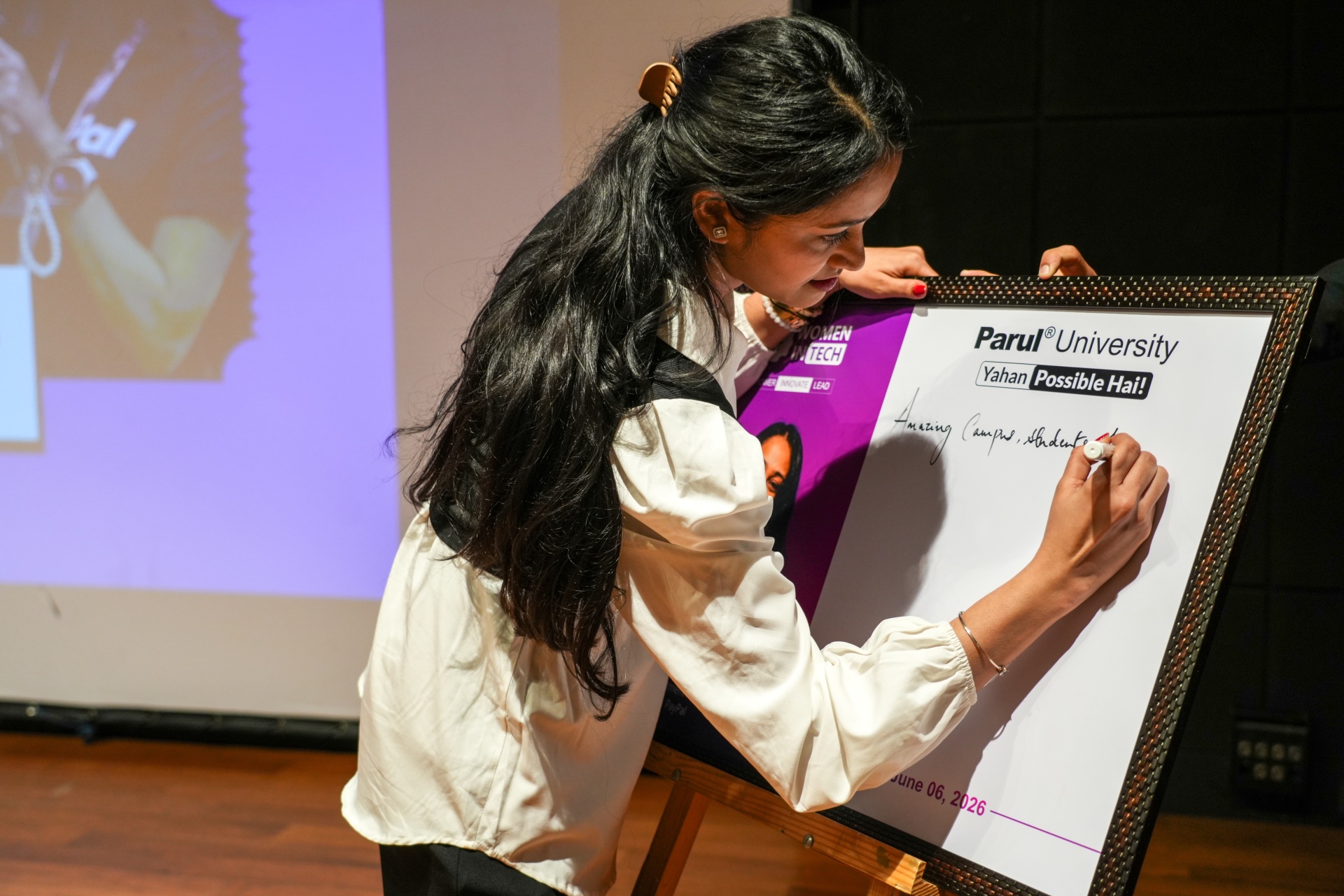
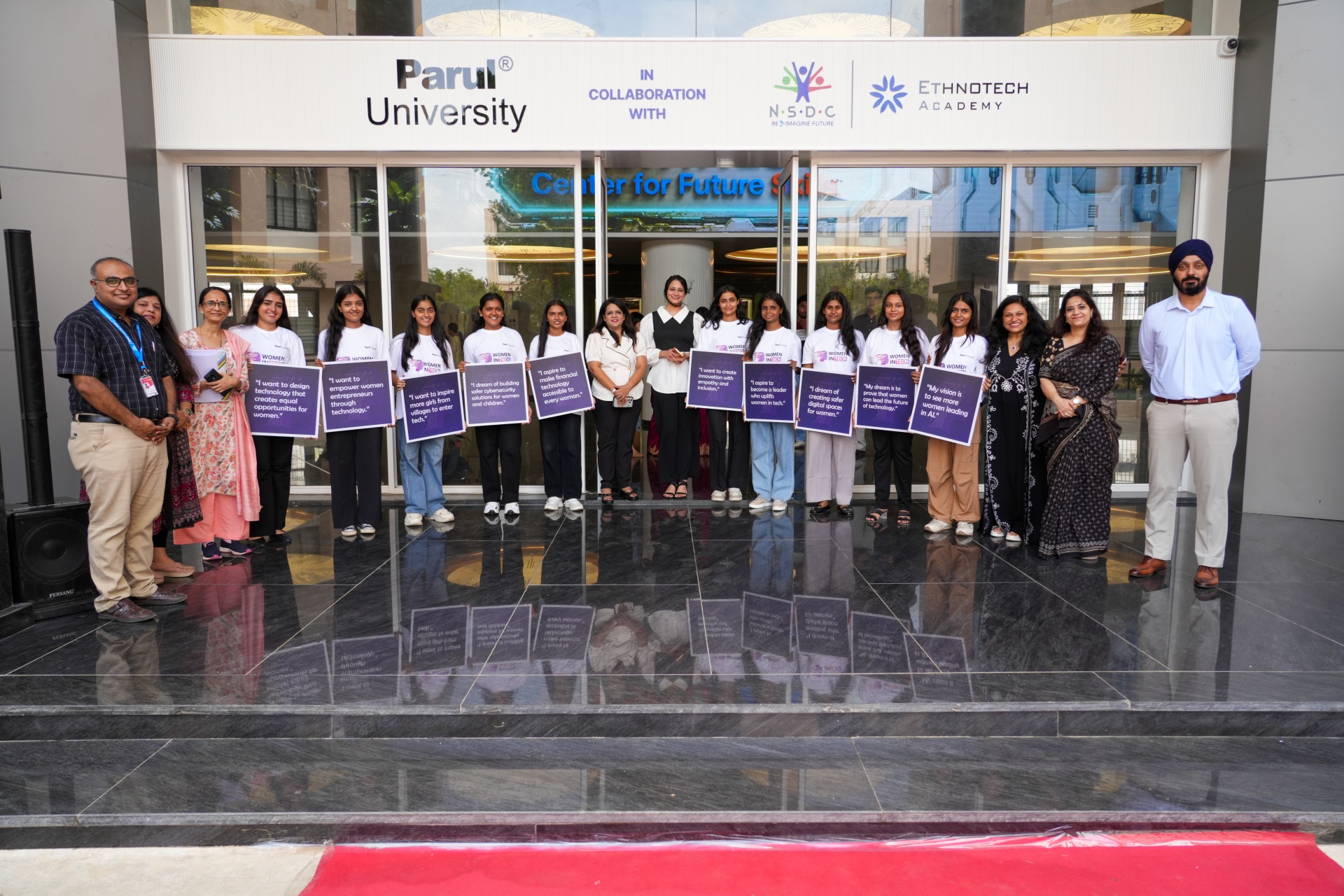
Most career-advice keynotes at student inaugurations are forgettable. Most use generic frameworks that could apply to any audience. Ms. Sanjana Sipani’s keynote at Parul University’s Women in Tech Club inauguration was different in both content and delivery, anchored by four core mantras she has carried through her own career and is now passing forward.
Ms. Sipani structured her keynote around four core mantras for young women in technology, principles she has carried through her own career and shared with the students at Parul University.
- Be You. Stay authentic to your values and trust in your unique strengths. No two people bring exactly the same combination of skills, perspective, and potential to a room. The framing inverts the implicit pressure women often feel in technology environments to suppress distinctive characteristics in pursuit of fitting in.
- Stay Curious. Never stop learning. The most resilient professionals are those who treat every challenge as a new subject and every role as an opportunity to grow beyond what they already know. Curiosity is positioned as a career-long discipline rather than a short-term phase.
- Build Relationships. Professional success is rarely built alone. Strong connections with peers, mentors, and collaborators form the invisible infrastructure of every successful career. The framing recognises that relationship investment compounds in ways that pure technical investment alone does not.
- Grow Holistically. Technical excellence is necessary but not sufficient. The professionals who advance furthest pair deep domain expertise with strong communication, empathy, and collaborative intelligence. Holistic growth as the path to senior roles rather than narrow specialisation alone.
The RCB analogy: patience over time
She explained the mantras in process through an example of the long-awaited win of RCB. Royal Challengers Bengaluru and their thirst to win, which they could do after 18 years. They achieved it after almost two decades. Before the win, they missed many chances, but they consistently worked on building. The moral of the story is success is not denied; it will come to you and to those who are talented and consistently work.
The lesson she drew from the example was deliberately framed: success is not denied to those who are talented. It is sometimes simply deferred for those who are not yet patient or consistent enough.
The journey matters as much as the destination, and sustained effort across years is what separates achievers from aspirants. The framing landed for an audience that included many students who would likely face setbacks, deferrals, and patience-testing waiting periods across their own career trajectories.
The T-shaped professional concept
Ms. Sipani spent particular time on what she described as becoming a T-shaped professional: someone who develops deep expertise in one primary domain while simultaneously cultivating knowledge and competence across adjacent areas. The vertical bar of the T represents the deep specialisation. The horizontal bar represents the breadth across adjacent disciplines that allows the specialist to collaborate effectively beyond their core domain.
- Why versatility amplifies rather than dilutes value. In a rapidly evolving technology landscape, deep specialisation alone produces narrow professionals who struggle to engage adjacent domains. T-shaped professionals can both contribute depth and translate across boundaries, which is increasingly what senior roles require.
- Foundational technical skills she emphasised. Data Structures and Algorithms; programming languages including C++ and Java; problem-solving capability; Generative AI literacy; and Building Communities as a skill rather than just an activity. Ms. Sipani noted that several of these areas are often underemphasised in traditional educational pathways.
- How to build the horizontal bar. Active engagement across adjacent technology domains, contribution to communities outside one’s primary specialisation, and deliberate exposure to fields that intersect with the primary one. The horizontal bar is not built passively; it requires intentional investment alongside the vertical depth.
Portfolios over resumes: the GitHub framework
Ms. Sipani’s framing on professional identity inverted the standard student approach. The resume is the artefact students typically prioritise. The portfolio is what hiring leaders increasingly evaluate.
She advised students to prepare a portfolio that is rich and filled with projects, internship experiences, works, and programming competitions rather than keeping resumes as the only primary way to show professional identity. The observation she shared was on early talent recruitment: a well-maintained GitHub profile is potentially a stronger representation of capability than anything printed on a credential document. Recruiters are looking for a curious and go-getter attitude in the candidates, which can be reflected in the portfolio rather than the resume.
- Why portfolios outperform resumes structurally. Portfolios show actual work product. Resumes list claims. The evidentiary asymmetry favours portfolios in hiring conversations where verification matters.
- What a strong portfolio includes. GitHub repositories demonstrating active project work; documented contributions to open source where applicable; project descriptions that explain the problem being solved rather than just the technologies used; programming competition participation and outcomes; internship project artefacts where confidentiality permits.
- The compounding effect. A portfolio built consistently across academic years compounds into a career-stage artefact that no late-term resume polish can replicate. Starting early matters more than starting impressively.
The question that landed: 'What would you do if you knew you couldn't fail?'
One of the most memorable moments of the keynote came when Ms. Sipani posed a question and asked each student to sit with it: What would you do if you knew you couldn’t fail? The silence that followed was not empty. It was the kind of charged stillness that happens when a question actually lands. She used the question to challenge and dismantle self-doubt in the room, encouraging students to develop their definitions of ambitions based on what they would attempt if fear of failure were removed from the calculation.
The question matters because most career limitation is self-imposed rather than externally enforced. Students who define their ambitions only within the range of guaranteed-success outcomes systematically underestimate what they could pursue with reasonable effort applied across reasonable timelines.
PayPal's people-first, win-together philosophy
Ms. Sipani spoke about PayPal‘s organisational culture, which she described as built on a people-first philosophy and a win-together attitude across teams. The focus within the company, she explained, is not on individual accomplishments but on what each member of a team produces collectively, anchored in understanding customer needs, respecting each other’s contributions, and commitment to outcomes greater than individual performance.
- From ‘I’ to ‘We’ as competitive edge. She encouraged students to shift from an ‘I’ orientation to a ‘We’ orientation, framing this not as idealistic but as a real competitive advantage in modern work environments. Teams that operate genuinely collectively outperform teams of competitive individuals, and professionals who can operate inside genuinely collective teams have an advantage that pure individual achievement cannot replicate.
- Why this matters for women technologists specifically. The ‘I’ orientation that pure-meritocracy frameworks reward in academic settings often creates challenges for women entering industry environments where collaborative dynamics, relational capital, and team-level achievement matter more than visible individual heroics. Internalising the ‘We’ framing from the start of one’s career builds patterns that compound rather than patterns that have to be unlearned.
The student interaction session: motivation, burnout, and honest answers
Between the formal segments, Ms. Sipani conducted a focused interaction session with women students in the conference hall of the Lakshya Building. The session was not a formal panel but an open conversation between students with genuine questions and a professional with both extensive experience and the generosity to answer them thoughtfully. Students raised a wide range of personal and career-related questions, including how to deal with burnout, what motivates professionals through different phases of their careers, and what companies like PayPal are truly looking for in early-stage candidates.
She responded to each question with remarkable attention and depth, reflecting the experience she has gained across organisations such as Samsung, PayPal, and others. Her answers resonated strongly with the students, many of whom were seen taking notes while the hall remained silent as everyone listened with complete attention. The interaction became one of the most engaging parts of the conference, offering students practical insights that extended well beyond the formal presentations.
One-to-one mentoring: 25 minutes that mattered
After the speech by Ms.Sipani, a one-on-one mentoring session was conducted with each student for approximately 25 minutes. Students from different disciplines got an opportunity to talk with the guest directly and discuss specific questions related to career, leadership, and guidance to get hired by major fintech organizations. She was fully focused and open during the Q&A; she listened to each participant with full conviction. And answered each question rather than giving specific responses.
Parul University Launches Women in Tech Club with PayPal’s Sanjana Sipani.
FAQs
What are the four mantras Sanjana Sipani shared at the WIT Club inauguration?
Ms. Sipani structured her keynote around four core mantras for women in technology. The advice was simple - Be You: stay true to your values and trust your abilities, Stay Curious: keep learning, keep trying new things, give yourself challenges as new subject, new role so that you grow. Networking: a core point for your career building. 360 Degree Growth: have a holistic growth with technical knowledge, deep knowledge of the specific field, strong communication, empathy and collaborative intelligence.
What is the T-shaped professional concept and why does it matter?
A T-shaped professional develops deep is atype where a deep expertise is there in one primary domain (the vertical bar of the T) while collecting the information and competence across the connected fields (the horizontal bars). Ms.Sipani explained that T-shaped experts/professionals can contribute depth while delivering things across the boundaries, which is increasingly what senior roles require. She also focused on having skills like C++ and Java, problem-solving, generative AI literacy, and networking to build communities.
Why does Sanjana Sipani recommend GitHub portfolios over resumes?
Ms. Sipani's framing inverted the standard student approach. Resumes list claims; portfolios show actual work product. The evidentiary asymmetry favours portfolios in hiring conversations where verification matters. From her vantage point in early-talent recruitment at PayPal, a well-maintained GitHub profile is a substantially stronger representation of capability than anything printed on a credential document. Industry professionals are increasingly looking for evidence of curiosity and initiative; portfolios demonstrate these, while resumes merely imply them. A portfolio built consistently across academic years compounds into a career-stage artefact that no late-term resume polish can replicate.
What question did Sanjana Sipani pose that landed most strongly with the students?
Ms. Sipani asked students to sit with a single question: What would you do if you knew you couldn't fail? She used the question to challenge and dismantle self-doubt, encouraging students to define their ambitions based on what they would attempt if fear of failure were removed from the calculation. The framing matters because most career limitation is self-imposed rather than externally enforced. Students who define their ambitions only within the range of guaranteed-success outcomes systematically underestimate what they could pursue with reasonable effort applied across reasonable timelines.