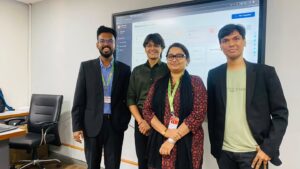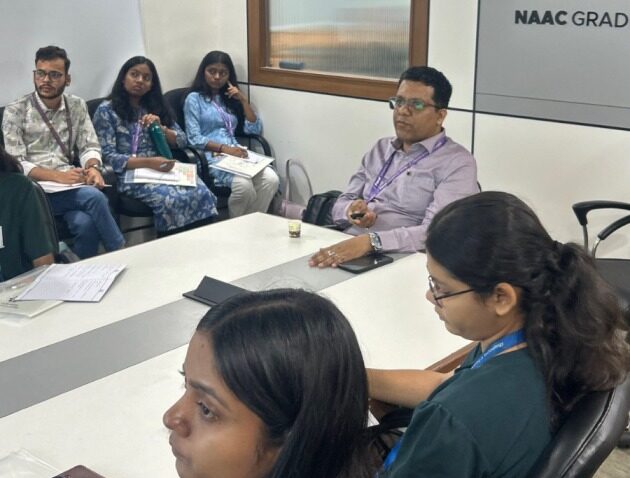
17 students, 2 speakers and 5 research cadre faculty – all gathered for a 1-day workshop on Microbial Cells as Green Bio-foundries for Therapeutics & Environmental Remediation, hosted by the MNRDC of Parul University. As held on 11th April 2026, this exclusive workshop was streamlined and co-ordinated by Dr Juhi Saxena, Dr Anwesha Khanra, Dr Mahendra Singh Rathore, Dr Vishal Mehta, Dr Meenu Khan, and Dr Mohit Tannarana, who ensured ground-level operation across registrations, lecture sessions, and practical stations.
Workshop architecture: how the day was structured
- 10:00 AM | Registration and kit distribution. A folder each, holding a diary, a pen, the schedule, and a detailed brochure of the MNRDC’s equipment. Not a marketing handout. The actual working catalogue of what students would operate later.
- 10:30 to 11:30 AM | Session 1. Microbial Bioactives for Immunomodulatory and Cytoprotective Health Benefits. Taken by Dr Anupam Jyoti, Associate Professor and Chief Research Officer at the Faculty of Applied Sciences, Parul University.
- 11:30 AM to 12:30 PM | Session 2. Biofactories 2.0 Microbial Solutions for a Post-Chemical Era, from Dr Gunjan Sharma, Assistant Professor in the Department of Plant Biotechnology at Gujarat Biotechnology University, GIFT City, Gandhinagar.
- 12:30 to 1:30 PM | Lunch. An hour before the practical work took over.
- 1:30 to 4:00 PM | Hands-on rotation. Seventeen students, three groups, three stations: SEM micrography on microbial cells, microalgae cultivation in the algae lab, and a combined MNRDC walkthrough with UV-FTIR, AFM, and sputtering demonstrations. The groups kept rotating until everyone had done everything.
- 4:00 PM | Valedictory session. Q&A first, certificates next, and a Google feedback form sent around for written responses.
Session 1: Dr. Anupam Jyoti on microbial bioactives, cytoprotection, and dysbiosis
The morning session started with the session of Dr. Anupam Jyoti, and the credentials set the right tone before he discussed the technical details. A PhD from CSIR-Central Drug Research Institute in Lucknow, more than 83 published research articles, an h-index of 29 and an i10-index of 46, with over 3,051 total citations, and the headship of the Inflammation Research Lab at the Parul Institute of Applied Sciences, where two funded projects, both extramural and intramural, are currently running. The funding has come through GSBTM and an IMR, and his own research keeps coming back to three things: sepsis, chronic obstructive pulmonary disease, and free radical signaling.
What followed covered a lot of ground without ever feeling padded. He began by defining microbial bioactives as secondary metabolites, then moved into short-chain fatty acids, the acetate, propionate, and butyrate that act as immune and metabolic regulators. From there, it was reactive oxygen species and the two transcription factor pathways that decide how cells protect themselves and how they inflame, Nrf2 and NF-κB. He did not keep it abstract either, bringing in published experimental evidence on pyrogallol shielding against carcinogen-induced DNA damage and on p-coumaric acid used as a pre-treatment against UV-induced melanogenesis. The innate and adaptive immunity framework came next, and then dysbiosis, which he tied to a long list of conditions: inflammatory bowel disease, type 2 diabetes, rheumatoid arthritis, pulmonary fibrosis, cardiovascular disease, non-alcoholic fatty liver disease, obesity, and cancer. The gut-brain axis got its turn. So did the GPCR and HDAC inhibition mechanisms through which short-chain fatty acids talk to the immune system; the bacteriocins sublancin and nisin; the anti-inflammatory work of exopolysaccharides; and, finally, the clinical trials underway right now on microbial metabolites, among them LPS-derived bacteriocins, SCFAs, and urolithin A.
The session is documented in full in a dedicated speaker deep-dive article on Dr. Anupam Jyoti’s talk, with the SCFAs, cytoprotection, and gut-brain axis material also written up separately as a category-level explainer for readers searching those concepts on their own.
Session 2: Dr. Gunjan Sharma on engineered biofactories and the post-chemical era
Dr Gunjan Sharma started her session with the initial beginning of the actual word – Biotechnology, which goes back to Karoly Ereky in 1919. Then she made a point that people had been doing biotechnology for thousands of years, through domestication around 10,000 BCE & fermentation between 6000 & 4000 BCE. As she is a faculty member at Gujarat Biotechnology University in GIFT City, Gandhinagar, she even presented her published work to the students. It covered the chemical epigenetic modifier research she co-authored with Dr. Kharwar in Frontiers in Microbiology!
The heart of her session was a structural tour of microbial biofactories across five biological kingdoms, and she did not skimp on the species. On the bacterial side, she covered Escherichia coli, Streptomyces, which alone produces somewhere between 70 and 80 percent of all bioactive compounds, along with Corynebacterium glutamicum, Ralstonia eutropha, Rhizobium, Azotobacter, and Pseudomonas putida. The fungal group ran through Aspergillus niger, Aspergillus oryzae, Trichoderma reesei, Fusarium venenatum, the mycoprotein sold commercially as Quorn, then Penicillium, Ganoderma lucidum, and Trametes versicolor. Among the yeasts she took in Saccharomyces cerevisiae, the workhorse behind insulin and Hepatitis B vaccine production, plus Pichia pastoris, Yarrowia lipolytica, and Kluyveromyces marxianus. The algal biofactories included Chlorella vulgaris, Haematococcus pluvialis for astaxanthin, Dunaliella salina for beta-carotene, and Nannochloropsis for omega-3. The plant biofactories rounded it off with Nicotiana benthamiana, Lactuca sativa, and Lemna japonica.
She brought it home with the bigger picture: systems biology, metabolic engineering, the circular bioeconomy, biosynthetic gene clusters, the antiSMASH platform that identifies those clusters, and the One Strain Many Compounds approach for waking up silent ones. The practical hurdles of scaling fermentation commercially got their due, as did the increasingly serious role of AI and machine learning in designing metabolic pathways.
Afternoon practical stations: three groups rotating across five hands-on instruments
This was the moment the morning stopped being something heard and became something handled. The seventeen students broke into three groups and rotated through three stations, and nobody left until every student had seen and operated everything on offer.
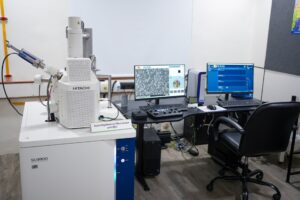
Station 1 put scanning electron microscopy in front of them, run by Dr. Meenu Khan specifically on microbial cell samples, with the discussion turning to resolution limits, how samples have to be prepared, and the kinds of microbial morphology SEM lets a researcher actually characterise.
Station 2 moved into the algae lab, where Dr. Anwesha Khanra walked them through live microalgae culture, the variables that govern growth conditions, and how the lab itself functions as a working bio-foundry, which connected straight back to the morning’s discussion of algae as solar-powered, carbon-neutral biofactories.
Station 3 was really a cluster of three. Dr. Vishal Mehta led the wider facility walkthrough, Dr. Mohit Tannarana handled the UV-FTIR and atomic force microscopy demonstration, and Dr. Mahendra Singh Rathore introduced sputtering as both a sample-preparation and a surface-modification technique. The full account of each station, the research cadre faculty who led them, and the thread tying morning theory to afternoon instrumentation sits in the MNRDC research cadre and hands-on stations article.
Why the workshop matters beyond the seventeen students who attended
The same logic that Parul University applies to selective outcomes in Section 12 applies here too. 17 students were in the room, yes, but the infrastructure the day tested and the research it put on record reached a population far larger than that handful.
At the center of it is the MNRDC itself, the university’s main material characterization and bio-research facility, with a documented service catalogue spanning SEM, XRD, AFM, the tribometer, and related instruments. The broader suite of articles around it goes deeper still, covering Scanning Electron Microscopy with EDS, X-Ray Diffraction, Atomic Force Microscopy, the consolidated material characterisation lab in Gujarat, and the material tests that matter most for PhD research across mechanical, materials, and chemical engineering. This workshop is simply one visible example of how the Center’s instruments get opened up to students while still serving research-cadre projects.
Parul University holds NAAC A++ accreditation at a CGPA of 3.55. Seven of its faculty members have made the Stanford-Elsevier global top 2 per cent of scientists, Dr. Juhi Saxena, who coordinated this workshop, among them. The Faculty of Applied Sciences and the Parul Institute of Applied Sciences are home to the Inflammation Research Lab that Dr. Anupam Jyoti leads. And the funding numbers are not small, with government-funded research at the university currently past Rs 58.31 crore, private-funded research at Rs 4.37 crore, and 315 funded projects running across the institution in total.
Where the two sessions intersect: AI, dysbiosis, and the post-chemical thesis
The two sessions were independent, but several themes recurred across both. Both speakers addressed AI’s role in their respective fields. Dr. Anupam Jyoti acknowledged AI’s role in designing immunology experiments without overstating the current state of the technology. Dr. Gunjan Sharma covered AI applications in metabolic engineering, pathway optimization, protein design, and the automation of the Design-Build-Test-Learn cycle. The consistent message across both was that AI is a tool for accelerating experimental and computational work that still requires deep biological judgment behind it. Dysbiosis appeared as a recurring concept: the disruption of gut-microbiome balance that ties directly to the disease landscape. The post-chemical thesis, central to Dr. Sharma’s framing, was implicit in Dr. Jyoti’s clinical-trial coverage of microbial metabolites that may replace conventional pharmaceutical interventions.
The MNRDC research cadre
Beyond the two visiting speakers, the workshop was held together by the research-cadre faculty whose names appear at every station, every coordination point, and every transition through the day.
- Juhi Saxena: Coordinator and Faculty of Applied Sciences researcher. Listed among Parul University’s Stanford-Elsevier global top 2 per cent scientists. Introduced Dr. Anupam Jyoti and Dr Gunjan Sharma to the workshop.
- Anwesha Khanra: Coordinator and lead of the microalgae cultivation station.
- Mahendra Singh Rathore: Research cadre faculty leading the sputtering demonstration.
- Vishal Mehta: Research cadre faculty leading the MNRDC facility walkthrough.
- Meenu Khan: Research cadre faculty leading the SEM micrography demonstration on microbial cells.
- Dr. Mohit Tannarana: Research cadre faculty leading the UV-FTIR and AFM demonstration.
FAQs
What was the MNRDC workshop on Microbial Cells as Green Bio-Foundries at Parul University?
One day, 11 April 2026, and a lot packed into it. The Micro-Nano Research and Development Center at Parul University in Vadodara ran the session under a long title: Microbial Cells as Green Bio-Foundries for Therapeutics and Environmental Remediation. Seventeen students signed up. What they got was wide-ranging, moving from microbial bioactives and immunomodulation through cytoprotection, engineered microbial biofactories, and biosynthetic gene clusters, and then it stopped being theoretical, because the day also carried hands-on stations on SEM micrography of microbial cells, microalgae cultivation, UV-FTIR, atomic force microscopy, and sputtering. Coordination was handled by Dr. Juhi Saxena and Dr. Anwesha Khanra. The two speakers were Dr. Anupam Jyoti, Associate Professor and Chief Research Officer at the Faculty of Applied Sciences at Parul University, and Dr. Gunjan Sharma, who came in from Gujarat Biotechnology University at GIFT City, Gandhinagar.
Who is Dr. Anupam Jyoti, and what was his session about?
Dr. Anupam Jyoti is an Associate Professor and Chief Research Officer at the Faculty of Applied Sciences at Parul University, with a PhD from CSIR-Central Drug Research Institute in Lucknow behind him. More than 83 research articles published. An h-index of 29, an i10-index of 46, over 3,051 citations in total. He also heads the Inflammation Research Lab at the Parul Institute of Applied Sciences and runs two funded projects there under GSBTM and IMR. His session, called Microbial Bioactives for Immunomodulatory and Cytoprotective Health Benefits, went deep. Short-chain fatty acids, reactive oxygen species, the Nrf2 and NF-κB pathways, then experimental data on pyrogallol and p-coumaric acid, and from there into dysbiosis and its connections to multiple chronic diseases, the gut-brain axis, bacteriocins, exopolysaccharides, and microbial metabolites sitting in clinical trials right now. His own work centers on sepsis, COPD, and free radical signaling.
Who is Dr. Gunjan Sharma, and what was her session about?
Dr. Gunjan Sharma works in the Department of Plant Biotechnology at Gujarat Biotechnology University, GIFT City, Gandhinagar. The session she delivered took a far longer view than most. Titled Biofactories 2.0: Microbial Solutions for a Post-Chemical Era, it began in 10,000 BCE with domestication and ran all the way forward to the engineered microbial biofactories of 2026. In between, she covered bacterial, fungal, yeast, algal, and plant biofactories across more than thirty named species. Biosynthetic gene clusters and the antiSMASH platform got their own treatment. So did the One Strain Many Compounds approach and chemical epigenetic modifiers, where she cited her own 2022 Frontiers in Microbiology paper written with Dr. Kharwar. She finished on the circular bioeconomy, the headaches of scaling up commercial fermentation, and where AI and machine learning now fit into designing microbial pathways.
What hands-on instruments did the MNRDC workshop participants use?
This was the part students had been waiting for. After lunch, the seventeen of them broke into three groups and rotated through three stations, and the rotation kept going until every student had touched every instrument, which was deliberate, not incidental. Dr. Meenu Khan took Station 1, scanning electron microscopy on microbial cells. Station 2 ran in the algae lab, microalgae cultivation under Dr. Anwesha Khanra. Station 3 was really three things at once: an MNRDC walkthrough from Dr. Vishal Mehta, a UV-FTIR and atomic force microscopy demonstration from Dr. Mohit Tannarana, and a sputtering introduction from Dr. Mahendra Singh Rathore. The logic of the afternoon was simple. Whatever the morning had explained as biology, the students could now watch and operate themselves on the centre's own machines.
What is the MNRDC and what does it do at Parul University?
The Micro-Nano Research and Development Center is where material characterisation and bio-research come together at Parul University in Vadodara. The instrument list is long: scanning electron microscopy, X-ray diffraction, atomic force microscopy, a pin-on-disc tribometer, UV-FTIR, sputtering, microalgae cultivation, and everything that supports them. Two kinds of work happen here. One is research-cadre faculty projects. The other is student training, and the April 2026 session on microbial bio-foundries is exactly that second kind. Anyone wanting the granular detail will find the MNRDC's instruments and services written up across a dedicated set of articles on the Parul University blog.
Who can attend MNRDC workshops at Parul University?
The door is reasonably open. Students from Parul University's Faculty of Applied Sciences and the Parul Institute of Applied Sciences can attend, and so can students from related faculties whenever their academic interests match what the workshop is dealing with. For the 11 April 2026 session on Microbial Cells as Green Bio-Foundries, that worked out to seventeen students with backgrounds in microbiology, biotechnology, and applied sciences. Announcements normally come ahead of time from the coordinating faculty and the MNRDC itself. Enrollment then gets confirmed through the center's standard registration process. If you want the complete picture, the full service catalogue and the student-access guidelines both sit in the center's main facilities article.
How does the MNRDC workshop connect to Parul University's broader research ecosystem?
No workshop here exists in isolation. This one is a single node inside a much larger research and innovation ecosystem at Parul University, an institution holding NAAC A++ accreditation at a CGPA of 3.55. Seven of its faculty have made the Stanford-Elsevier global top 2 per cent of scientists, and one of them, Dr. Juhi Saxena, coordinated this very session. Government-funded research at the university currently stands at over Rs 58.31 crore, spread across 315 funded projects. The Inflammation Research Lab that Dr. Anupam Jyoti leads at the Parul Institute of Applied Sciences accounts for two of those, both active, working on sepsis, COPD, and free radical signaling. What the MNRDC contributes to all of this is the instrumentation backbone, the equipment that makes both serious faculty research and student training like this workshop actually possible.