The session was the most academically demanding of the day. It opened with the etymology of biotechnology in 1919 and closed with AI-driven pathway design in 2026, with thirty-plus named species across five biological kingdoms in between. 11th April 2026 – the second session by Dr Gunjan Sharma ran from 11:30 AM to 12:30 PM at the MNRDC Department of Parul University. Her session was titled as Biofactories 2.0 – Microbial Solutions for a Post-Chemical Era and began her presentation with an outlook on the history of biotechnology to engineered microbial production platforms.
Biotechnology Beyond Chemicals – Prime Insights from MNRDC’s Bio-Foundry Workshop!
Dr Gunjan Sharma - Department of Plant Biotechnology, Gujarat Biotechnology University
Meet Dr Gunjan Sharma – she is an assistant professor at the Department of Plant Biotechnology at Gujarat Biotechnology University, GIFT City, Gandhinagar. She spoke about her published research, which includes the 2022 paper that she co-authored with Dr. Kharwar in Frontiers in Microbiology. In her thesis, she had mainly covered chemical epigenetic modifiers as a means to unleash the hidden therapeutic molecules via active usage of a cryptic biosynthetic gene cluster. Her session and her presentation style have inspired students, and look how flawlessly she spoke on taxonomic, mechanistic, and next-gen dimensions of microbial biofactory design in just one hour.
Biotechnology from Károly Ereky to engineered microbes: the historical framing
She opened with a word, not a microbe. Sit with the term biotechnology, she said. Follow it back to its root. Károly Ereky coined it in 1919. People had done biotechnology for millennia before that. Plant and animal domestication goes back to 10,000 BCE. Fermentation for bread, cheese, and wine ran from 6000 to 4000 BCE. Crops were bred selectively. Early medicine appeared around 4000 BCE. Then came the Chemical Era. It ran from the nineteenth century into the twenty-first. Fast industrial growth. The chemical revolution. The rise of synthetic chemistry. Traditional synthesis, she said, has hit a wall. That is where microbial biofactories enter.
“The use of living organisms, biological processes, and application of systems to manufacture the products with novel capabilities for human and social welfare.” – Dr. Gunjan Sharma, working definition of biotechnology
Bacterial biofactories: from E. coli to Streptomyces
Escherichia coli came first. The choice is hard to argue with. It is the most widely used research model in the field. It grows fast. Its genetics are well mapped. It takes modification easily.
The engineering done with it is broad. It converts pyruvate into lactic acid and acetyl coenzyme A. It makes polyhydroxybutyrate from that acetyl coenzyme A. It pulls itaconic acid from the tricarboxylic acid cycle. It produces aromatic and bioactive compounds through carotenoid cleavage dioxygenase activity. Streptomyces followed. It alone makes 70 to 80 per cent of all bioactive compounds, antibiotics included. The others had clear roles. Corynebacterium glutamicum handles high-yield amino acid production. Ralstonia eutropha makes biodegradable plastics through polyhydroxyalkanoate synthesis. Rhizobium and Azotobacter work on nitrogen fixation and nutritional control in agriculture. Pseudomonas putida produces essential enzymes and antimicrobial agents.
Then a framing that stuck. Competition between microbes hands us our medicines.
Her slide read How microbial wars create our best medicines. Under it, she covered bacteriocins from E. coli. Colicins were an example. They block iron uptake in rival strains. Studying that antagonism, she said, opens doors in drug discovery. Co-culturing competing species is now a strategy in itself. It surfaces compounds that single-species culture never shows. Plant Growth-Promoting Rhizobacteria came up too. They produce biopharmaceutical precursors. They act as biocontrol agents, biofertilisers, and rhizoremediation tools at once. They throw off enzymes like chitinase, protease, and cellulase. They also make 5-aminolevulinic acid, surfactin, and phloroglucinols.
Fungal biofactories: the master architects
The master architects of microbial biotechnology. The species she named did not sit in one lane. Some belonged to the industry, some to medicine, and several to both.
| Species | What it does |
|---|---|
| Aspergillus niger | Citric acid, gluconic acid, and a range of industrial enzymes |
| Aspergillus oryzae | Fermented food production and agro-food waste processing |
| Trichoderma reesei | Cellulolytic enzymes for biomass-to-product conversion |
| Fusarium venenatum | The mycoprotein sold as Quorn |
| Penicillium species | Antibiotics and antifungals, including the original penicillin |
| Ganoderma lucidum | A medicinal mushroom making bioactive triterpenoids and polysaccharides |
| Trametes versicolor | A white-rot fungus using laccases for delignification and bioremediation |
The medicine shows in what they make. She read out a long run of drugs, and the length was deliberate. Some fight infection, like the penicillins, the cephalosporins, and griseofulvin. Some calm the immune system, cyclosporin being the obvious one. Lovastatin goes after cholesterol. Drospirenone is used in birth control. Then the less familiar names, echinocandins and mycophenolic acid, and finally myriocin, which has found a use in treating multiple sclerosis. Put together, the point made itself. Fungal biofactories reach well past the antibiotics that defined the last century.
Yeast biofactories: insulin, hepatitis B vaccine, and beyond
Yeast starts in one place. Saccharomyces cerevisiae. The old workhorse. Tough, proven, and carrying about as deep a genetic toolkit as any organism in the field.
| Species | What it produces or offers |
|---|---|
| Saccharomyces cerevisiae | Human insulin, the Hepatitis B vaccine, isoamyl acetate (banana oil), and bioethanol |
| Pichia pastoris | High-level recombinant protein expression, including recombinant human serum albumin |
| Yarrowia lipolytica | Three product categories through its own native pathways |
| Kluyveromyces marxianus | Rapid growth, thermotolerance up to 52 degrees Celsius, and astaxanthin among its metabolites |
Algal biofactories: solar-powered, carbon-neutral production platforms
Algae got the best line of the day. Solar-powered, carbon-neutral biofactories. The phrase did real work. It also pointed forward, because the hands-on microalgae station in the algae lab, run by Dr Anwesha Khanra, opened right where this section closed.
| Species | Why it matters |
|---|---|
| Chlorella vulgaris | Chlorella vulgaris Fast-growing and stress-resistant, used in wastewater treatment, biofuel, and high-protein supplements |
| Haematococcus pluvialis | Heavy astaxanthin accumulation, a high-value antioxidant carotenoid |
| Dunaliella salina | Strong beta-carotene under salt stress, with no cell wall to complicate processing |
| Nannochloropsis | High lipid yield for omega-3 fatty acids and biodiesel |
The named species were only part of it. The wider product range told the rest. For omega-3 fatty acids, the commercial sources are Schizochytrium and Crypthecodinium cohnii. Porphyridium purpureum gives sulfonated polysaccharides, and those carry antioxidant, antiviral, and anti-inflammatory properties. Biodiesel traces back to Chlorella and Nannochloropsis. Biostimulants and biofertilizers come from Chlorella and seaweeds. Through all of it, her point stayed fixed. Algae build these things from sunlight and carbon dioxide, not from petrochemicals.
Plant biofactories and molecular farming
The plant section opened a new idea. Molecular farming. The phrase means using plants themselves as platforms to produce high-value molecules.
| Species | Role |
|---|---|
| Nicotiana benthamiana (wild tobacco) | Transient expression and protein production |
| Lactuca sativa (common lettuce) | Oral vaccine and therapeutic production |
| Lemna japonica (a duckweed) | A candidate bioreactor system |
This stretch was shorter than the microbial ones. It still landed its point. The biofactory idea does not stop at microbes. It carries across the whole taxonomic range of living production systems.
Systems biology, metabolic engineering, and the circular bioeconomy
The mechanistic core of the session was the systems-biology layer that ties biofactory species to their working applications.
- Synthetic biology: The design of genetic circuits and biological elements, including promoters, ribosome-binding sites, terminators, and transcriptional regulators.
- Metabolic engineering: The computational analysis of pathway engineering and optimization, including pathway selection, flux balance analysis, and enzyme kinetics.
- Strain improvement: The optimization of biofactory strains for higher yields through pathway tuning, chassis selection, and host adaptation.
The circular bioeconomy concept brought the engineering layer into a sustainability frame. Biological processes, including bioremediation, biodegradation, biosynthesis, biotransformation, bioleaching, and biotreatment, are applied to agricultural wastes, food wastes, industrial wastes, and industrial wastewater to create a closed loop of synthesis and recovery. The circular framing positions microbial biofactories not only as production tools but also as the working substrate for a broader post-petroleum industrial model.
Biosynthetic gene clusters, antiSMASH, and the OSMAC approach
This was the technical heart of the session. It started with biosynthetic gene clusters, BGCs for short. The concept is simple once stated. Picture a set of genes sitting physically together in a genome, all working as one unit to build a specialized metabolite. They live mostly in bacteria and fungi. And they matter for a clear reason. They are the prime targets for genome mining, the non-ribosomal peptide synthetases especially, along with polyketide synthases and the terpene biosynthesis pathways. Finding them in a sequenced genome takes the right tool, and the one she pointed to was the antiSMASH platform.
OSMAC came next, and the name stands for One Strain Many Compounds. The thinking behind it is neat. Raise or drop the temperature & alter the aeration. Any of these can flip on a gene cluster the organism normally keeps quiet, and a quiet cluster switched on means a new product from a strain already in hand. There is a cousin to this method too: the use of chemical epigenetic modifiers to draw out hidden therapeutic molecules. She drew here on her own paper, Sharma and Kharwar, Frontiers in Microbiology, 2022. What it shows is that certain inhibitors of DNA methyltransferases and histone deacetylases can wake cryptic clusters and lift secondary metabolism. The ones she named were 5-azacytidine, suberoylanilide hydroxamic acid, nicotinamide, sodium butyrate, and valproic acid.
Scaling up: from laboratory to commercial fermentation
Moving a biofactory from the bench to commercial volume is genuinely hard, and she did not dress it up. It begins with the chassis organisms. Mostly that means E. coli and Yarrowia lipolytica. Engineering them is its own job, blocking competitive pathways, easing feedback inhibition, and working the cofactors with NADH and NADPH. The host cell then has to be optimised. That brings in genome editing, programmed temperature shifts, and fine-tuning of how the gene of interest is expressed. Only after that does process control come into play, and it spans a lot, from shake flask and bioreactor simulation through media and feed optimisation to continuous product removal. The genuine obstacles fell into four groups.
| Category | The constraints |
|---|---|
| Biological and metabolic | Genetic instability, contamination risk, metabolic shifts under fermentation stress, and extended generation times |
| Physical and engineering | Mixing and homogeneity problems at large volumes, heat transfer limits, oxygen transfer rate ceilings, and shear stress on living cells |
| Operational and economic | Heavy initial capital requirements, hard downstream processing at industrial scale, and the wider cost structure of commercial bioprocessing |
| Ethical | Risk of biological warfare misuse, the philosophical question of defining life and intervention, and concerns over social equity, access to biotechnology, and ownership of genetically engineered organisms |
AI and the future of microbial biotechnology
As the session moved toward its conclusion, Dr. Sharma touched on artificial intelligence and machine learning in microbial pathway design. The applications included metabolic engineering and pathway optimisation, protein design and engineering, prediction of pathway dynamics, and automation of the Design-Build-Test-Learn cycle. The treatment was brief but purposeful, signalling where the field is heading without overstating current capabilities. The same AI thread runs through Dr. Anupam Jyoti’s session and is documented across the workshop hub article.
The next great breakthrough in human health won’t come from a chemical library but from a deeper understanding of the molecular conversations happening in the microbial world.
Dr. Gunjan Sharma, closing slide of the session
The closing slide functioned less as a conclusion and more as a thesis statement for the next decade of microbial biotechnology. The hour-long session had built the evidence for that thesis through the named species, mechanisms, and tools that filled it.
How the session connects to Parul University's MNRDC and applied-sciences research
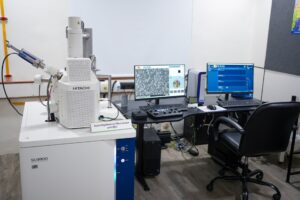
Dr. Sharma’s session was hosted by Parul University’s Micro-Nano Research and Development Center (MNRDC), which provides the instrumentation infrastructure that supports the kind of experimental work the post-chemical era demands. The afternoon practical stations on SEM micrography of microbial cells, microalgae cultivation, UV-FTIR spectroscopy, atomic force microscopy, and sputtering operationalised the morning’s concepts in the centre’s own labs. Workshop coordinators Dr. Juhi Saxena and Dr. Anwesha Khanra, along with the MNRDC research cadre, manage the infrastructure that brings visiting expert sessions like Dr. Sharma’s into direct contact with hands-on instrumentation at the Parul Institute of Applied Sciences.
FAQs
Who is Dr Gunjan Sharma?
Dr Gunjan Sharma is an assistant professor at the Gujarat Biotechnology University, GIFT City, Gandhinagar. She co-authored a paper in 2022 with Dr Kharwar in Frontiers in Microbiology, covering epigenetic modifiers to unlock therapeutic molecules via active activation of cryptic biosynthetic gene clusters. MNRDC’s Parul University has hosted a one-day workshop wherein she delivered Biofactories 2.0 Microbial Solutions. She even spoke about the OSMAC approach and the progressive role of AI and machine learning in microbial pathway design!
Define microbial biofactories?
Microbial biofactories are mainly specialised in biological systems that use engineered plants, microbes, and algae to produce pharmaceuticals, vaccines and sustainable materials. Dr Gunjan Sharma described them as living production platforms, and this field spans 5 biological kingdoms - bacteria, fungi, yeast, algae and plants.
Define major scale-up challenges for commercial microbial biofactories?
Dr Gunjan Sharma explained the scale-up challenges for commercial microbial biofactories work in 4 different categories: biological, physical, operational, & economic constraints, & ethical considerations include biological warfare misuse. She explained this at MNRDC’s one-day workshop, hosted by Parul University!