The morning had been theoretical: two speakers, an hour each, on the science of microbial bioactives and engineered biofactories. The afternoon was where that science met the centre’s instruments. Five research-cadre faculty ran three rotating stations until every student had operated everything.
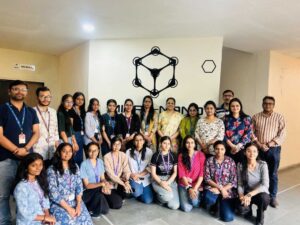
On 11 April 2026, after the two morning lecture sessions of the MNRDC one-day workshop on microbial cells as green bio-foundries at Parul University, the seventeen enrolled students were divided into three groups. From 1:30 PM to 4:00 PM, the groups rotated through three hands-on stations operated by the research cadre of the Micro-Nano Research and Development Center. The workshop kit each student received at the 10:00 AM registration included a brochure with the full equipment catalogue of the MNRDC. The afternoon was the working demonstration of that catalogue.
The workshop kit and the brochure that listed the day's instruments
Registration started at 10:00 AM. Each student received a workshop kit containing a folder with a diary, a pen, the day’s schedule, and the MNRDC equipment brochure. The brochure was not promotional material. It was a working catalogue of the instruments and facilities at the Micro-Nano Research and Development Center (MNRDC) at Parul University. For many of the seventeen students, this was the first time they were reading a complete inventory of what the center actually holds, and for several of them, this was the first time they would later operate those instruments under direct faculty supervision. The brochure mapped the workshop’s afternoon directly. Each station was selected from instruments documented in the catalogue.
The MNRDC suite of published articles covers each instrument category in detail. Students who completed the workshop and wanted reference material to return to could read the Scanning Electron Microscopy (SEM-EDS), the X-Ray Diffraction (XRD) facility article, the Atomic Force Microscopy (AFM) capability article, the consolidated material characterisation lab walkthrough, and the top material tests for PhD research across mechanical, materials, and chemical engineering, each of which documents the equipment used in the workshop’s afternoon stations in production-research context.
The two coordinators: Dr. Juhi Saxena and Dr. Anwesha Khanra
Two faculty members held the workshop together at the coordination level. Both had ground-level operational responsibility for the day, and both led specific moments within the agenda.
Dr. Juhi Saxena, a Faculty of Applied Sciences researcher at Parul University, is listed among the institution’s seven Stanford-Elsevier global top 2 per cent scientists. She introduced the opening session by Dr. Anupam Jyoti and managed the academic framing of the workshop from start to finish. Her own research profile positions Parul University’s applied-sciences research at the level required to host visiting expert sessions of the kind delivered by Dr. Gunjan Sharma from Gujarat Biotechnology University.
Dr. Anwesha Khanra served as the second coordinator and also led the microalgae cultivation station in the afternoon. Her dual role (workshop coordinator and station operator) made the connection between the morning’s content on algal biofactories and the afternoon’s hands-on lab work direct rather than abstract. Algae as solar-powered, carbon-neutral biofactories appear in the Dr. Gunjan Sharma session deep-dive article, and the operational reality of working algal cultivation appeared at her station immediately afterwards.
The five research-cadre faculty who ran the afternoon
The afternoon was operated by five research-cadre faculty whose names appeared at every transition, every demonstration, and every coordination point on the floor.
- Mahendra Singh Rathore: Research cadre faculty leading the sputtering introduction. Sputtering is a sample-preparation and surface-modification technique central to high-resolution microscopy and thin-film research. His station introduced the principle and the working setup of the MNRDC’s sputtering capability.
- Vishal Mehta: Research cadre faculty leading the broader MNRDC facility walkthrough. His station handled the institutional context of how the centre’s instruments fit together as a research workflow, walking students through the lab layout, the equipment placement, and the logic of how a research sample moves through characterisation.
- Meenu Khan: Research cadre faculty leading the SEM micrography station, specifically on microbial cell samples. Her station turned the morning’s biology into directly observable microscopy imagery, with discussion of resolution limits, sample preparation, and the kinds of microbial morphology that scanning electron microscopy allows researchers to characterise.
- Anwesha Khanra: Research cadre faculty (and workshop coordinator) leading the microalgae cultivation station in the algae lab. Her station demonstrated working microalgae culture, growth condition variables, and the operational setup of the lab as a working bio-foundry connecting to the algal biofactory content of the morning.
- Mohit Tannarana: Research cadre faculty leading the UV-FTIR and atomic force microscopy (AFM) demonstration. His station covered the molecular spectroscopy and surface-topology characterisation techniques that connect cellular biology to the analytical chemistry and surface science layers of biofactory research.
Station 1: SEM micrography on microbial cells, led by Dr. Meenu Khan
Scanning electron microscopy (SEM) is the workhorse imaging instrument for high-resolution surface characterisation of microbial cells. Dr. Meenu Khan’s station took the morning’s biological content and made it visible at the cellular surface.
The station covered the basics of SEM operation, including sample preparation requirements (dehydration, mounting, sputter-coating with a conductive layer), the working principles of electron beam imaging, resolution capabilities, and the kinds of microbial features that SEM is particularly suited to characterize. The connection to the morning sessions was immediate. The neutrophil extracellular trap (NET) imagery that Dr. Anupam Jyoti had shown earlier in the day was made using exactly the kind of scanning electron microscopy that students were now operating. The exopolysaccharide characterisation studies that Dr. Anupam Jyoti described in the session deep-dive use SEM as one of their working tools.
The MNRDC’s broader SEM capability is documented in the SEM-EDS facility article, which covers the centre’s service catalogue for external research clients alongside the student-training role demonstrated at the workshop.
Station 2: Microalgae cultivation, led by Dr. Anwesha Khanra
The algae lab is the working bio-foundry on the MNRDC floor. Dr. Anwesha Khanra’s station turned the morning’s discussion of algae as solar-powered, carbon-neutral biofactories into the operational reality of a working microalgae culture system.
The station covered live microalgae cultivation, growth condition variables (light intensity, temperature, nutrient composition, salinity, aeration), the setup of the algae lab as a research-active facility, and the practical considerations of moving from laboratory-scale algal cultivation toward applications including biofuel production, omega-3 fatty acid extraction, beta-carotene production, and biostimulant generation. The connection to Dr. Gunjan Sharma’s morning session was direct. The named algal biofactories she had covered (Chlorella vulgaris, Haematococcus pluvialis, Dunaliella salina, Nannochloropsis, Schizochytrium, Crypthecodinium cohnii, Porphyridium purpureum) became operational rather than theoretical at this station.
Station 3: Combined MNRDC walkthrough with UV-FTIR, AFM, and sputtering
The third station was the broadest in coverage. It combined a facility walkthrough led by Dr. Vishal Mehta, a UV-FTIR and atomic force microscopy demonstration led by Dr. Mohit Tannarana, and a sputtering introduction led by Dr. Mahendra Singh Rathore. The three-part structure was deliberate: each technique sits at a different layer of the research workflow, and seeing them together communicates how a single research question often requires multiple instruments.
- MNRDC facility walkthrough | Vishal Mehta: The walkthrough introduced students to the physical layout of the centre, the placement of major instruments, the workflow of how a sample moves through characterisation, and the institutional structure that connects student users to research-active faculty. The walkthrough was the orientation context in which the other two parts of the station made sense.
- UV-FTIR and atomic force microscopy (AFM) | Mohit Tannarana: UV-FTIR (ultraviolet Fourier-transform infrared) spectroscopy was the molecular characterisation tool covered by Dr. Tannarana. The technique was directly relevant to the morning’s content: Dr. Anupam Jyoti had specifically mentioned FTIR spectroscopy as the technique used to characterise extracted exopolysaccharides in published studies. AFM, atomic force microscopy, provides surface topology measurements at the nanoscale, complementing SEM by mapping height variation rather than projecting a flat surface image.
- Sputtering | Mahendra Singh Rathore: Sputtering is the deposition of a thin conductive coating on a sample surface, typically gold or platinum, that allows the sample to be imaged in scanning electron microscopy without electron-charging artefacts. The technique sits upstream of SEM in the research workflow: every biological sample headed for SEM imaging first passes through sputter-coating. Dr. Rathore’s introduction connected the preparation step explicitly to the imaging step at Station 1.
The dedicated AFM capability article details the MNRDC’s atomic force microscopy facility, including surface roughness and nano-imaging applications for external research clients.
Why the three-station rotation matters: connecting morning theory to afternoon instrumentation
The afternoon’s architecture was not coincidental. Each station was selected to operationalize specific elements of the morning’s content. The rotation ensured that no group missed any instrument, and the connection between theory and instrumentation was structural rather than illustrative.
- Anupam Jyoti’s morning session | Cytoprotection, dysbiosis, bacteriocins, exopolysaccharides: NET formation imagery from his slides came from SEM. The EPS characterisation studies he showed use FTIR spectroscopy. Both techniques were operationally available at the afternoon stations.
- Gunjan Sharma’s morning session | Bacterial, fungal, yeast, algal, and plant biofactories: The algal biofactory content connected directly to the microalgae cultivation station. The biosynthetic gene cluster work and metabolic engineering content are connected indirectly to the surface and molecular characterisation tools at the combined station.
The pedagogical effect of this connection is not difficult to estimate. Students who saw NET formation imagery in the morning and then operated a scanning electron microscope in the afternoon understood both the biology and the technique in a way that a lecture alone cannot deliver. Students who heard about Chlorella, Haematococcus, and Nannochloropsis as algal biofactors in the morning and then watched live microalgae culture under operational conditions in the algae lab in the afternoon were not learning two separate things. They were learning one thing across two layers.
The valedictory workflow: Q&A, certificate distribution, and the Google feedback form
At 4:00 PM, after the three-station rotation was completed, the workshop reconvened for the valedictory session.
- Q&A session: Direct interaction with the faculty cadre on specific instrument questions, technique selection for hypothetical research questions, and follow-up on the morning’s content.
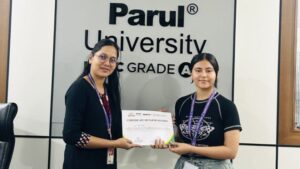
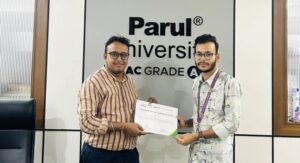
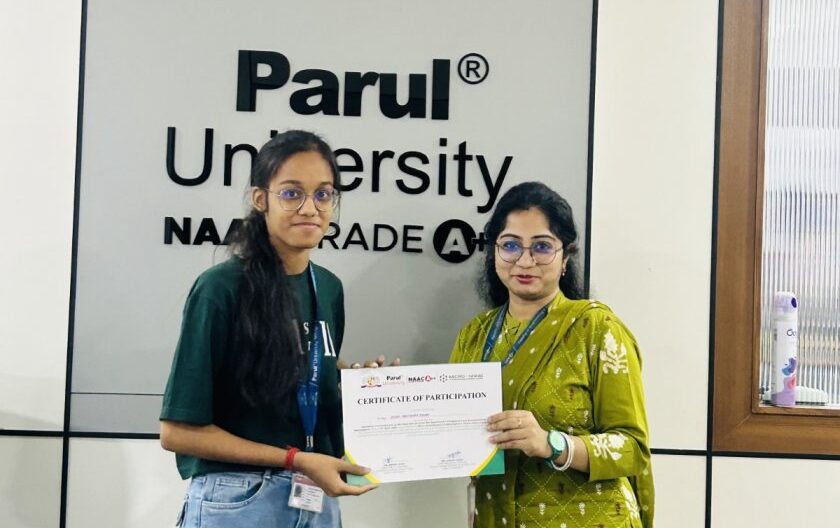
- Certificate distribution: Each of the seventeen enrolled students received a workshop completion certificate, providing formal documentation of participation that students could attach to their academic record and future research applications.
- Google feedback form: A structured written-response form circulated for completion. The form captured both quantitative ratings and free-text written responses on what had worked and what could be improved. The workshop coordinators’ assessment, drawn from the returned forms, was that the day had landed well across the enrolled cohort.
How the MNRDC research cadre connects to Parul University's broader research infrastructure
The five research-cadre faculty who ran the workshop in the afternoon are not exclusively workshop staff. They are research-active faculty whose work feeds into Parul University’s broader research output. The institution holds NAAC A++ accreditation with a CGPA of 3.55. Government-funded research currently stands at more than Rs 58.31 crore across 315 funded projects. Seven faculty members are in the Stanford-Elsevier global top 2 per cent of scientists, including Dr. Juhi Saxena. The Faculty of Applied Sciences, Parul Institute of Applied Sciences (PIAS), and the MNRDC together form the working research stack into which workshops like the April 2026 session on microbial cells as green bio-foundries are embedded.
The broader research and innovation ecosystem at Parul University extends beyond applied sciences. The Parul Innovation and Entrepreneurship Research Center (PIERC) supports student startups across the institution, including portfolio cases that have raised external investment. The institution’s coordinated research-and-development infrastructure means that workshops at the MNRDC are connected to an ecosystem of research, innovation, and entrepreneurship that students can access through multiple pathways.
FAQs
Who are the MNRDC research cadre faculty?
The MNRDC research cadre comprises five research-active faculty members at Parul University's Micro-Nano Research and Development Center. Dr. Mahendra Singh Rathore leads sputtering and sample-preparation work. Dr Vishal Mehta leads facility walkthroughs and coordinates research workflows. Dr. Meenu Khan leads scanning electron microscopy (SEM) work, including specific applications on microbial cell samples. Dr. Anwesha Khanra (also a workshop coordinator) leads microalgae cultivation in the algae lab. Dr. Mohit Tannarana leads UV-FTIR (ultraviolet Fourier-transform infrared) spectroscopy and atomic force microscopy (AFM) demonstrations. Together, this cadre ran the afternoon hands-on stations at the 11 April 2026 workshop on microbial cells as green bio-foundries.
Who coordinated the MNRDC workshop on microbial bio-foundries?
The workshop on Microbial Cells as Green Bio-Foundries for Therapeutics and Environmental Remediation, held at the MNRDC on 11 April 2026, was coordinated by Dr. Juhi Saxena and Dr. Anwesha Khanra. Dr. Juhi Saxena is listed among Parul University's seven Stanford-Elsevier global top 2 per cent scientists. She introduced the morning session by Dr. Anupam Jyoti and managed the academic framing of the workshop. Dr. Anwesha Khanra served as the second coordinator and also led the afternoon microalgae cultivation station in the algae lab.
What instruments did the seventeen workshop participants use in the afternoon?
The seventeen enrolled students were divided into three groups that rotated through three hands-on stations from 1:30 PM to 4:00 PM until every student had operated every instrument. Station 1 was scanning electron microscopy (SEM) on microbial cell samples, led by Dr. Meenu Khan. Station 2 was microalgae cultivation in the algae lab, led by Dr. Anwesha Khanra. Station 3 was a combined facility walkthrough led by Dr. Vishal Mehta, a UV-FTIR and atomic force microscopy (AFM) demonstration led by Dr. Mohit Tannarana, and a sputtering introduction led by Dr. Mahendra Singh Rathore. The three-station structure ensured that every student had hands-on exposure to five different instrument categories in a single afternoon.
How does the afternoon hands-on session connect to the morning lectures?
The afternoon stations were selected to operationalise the morning's content directly. Dr. Anupam Jyoti's session on microbial bioactives included neutrophil extracellular trap (NET) imagery that comes from scanning electron microscopy and exopolysaccharide characterisation studies that use FTIR spectroscopy. Both techniques were operationally available at the afternoon stations. Dr. Gunjan Sharma's session on engineered biofactories included algal biofactories (Chlorella, Haematococcus, Nannochloropsis), which became operational rather than theoretical at the microalgae cultivation station. The connection between morning theory and afternoon instrumentation was structural rather than illustrative, allowing students to learn one thing across two layers.
What is the MNRDC equipment brochure and what does it cover?
The MNRDC equipment brochure, distributed to each of the seventeen enrolled students in the workshop kit at 10:00 AM registration, is the working catalogue of instruments and facilities at the Micro-Nano Research and Development Center at Parul University. The brochure documents scanning electron microscopy (SEM), X-ray diffraction (XRD), atomic force microscopy (AFM), UV-FTIR spectroscopy, sputtering, microalgae cultivation, and related capabilities. Each instrument category is also documented in dedicated articles on the Parul University blog, including the SEM-EDS facility article, the XRD services article, the AFM capability article, the consolidated material characterisation lab walkthrough, and the top material tests for PhD research article. The brochure mapped the workshop's afternoon stations directly, with each station selected from instruments documented in the catalogue.
Can students from outside the Faculty of Applied Sciences access MNRDC workshops?
MNRDC workshops are open to all students & stakeholders, as well as students from related faculties whose academic interests align with the workshop topic. The 11 April 2026 workshop on Microbial Cells as Green Bio-Foundries was attended by seventeen students with backgrounds appropriate to microbiology, biotechnology, and applied sciences. Beyond workshops, the MNRDC operates as a research service centre for external clients and as a teaching facility for student users across the institution. The centre's working catalogue documents the service offering for both student users and external research clients.
What is the connection between MNRDC workshops and Parul University's broader research record?
The MNRDC workshop programme is one node in a wider research ecosystem at Parul University. The institution holds NAAC A++ accreditation with a CGPA of 3.55. Seven faculty members are in the Stanford-Elsevier global top 2 per cent of scientists, including Dr. Juhi Saxena, who coordinated this workshop. The Inflammation Research Lab at the Parul Institute of Applied Sciences, led by Dr. Anupam Jyoti, the speakers' programme that brought Dr. Gunjan Sharma from Gujarat Biotechnology University, and the broader Faculty of Applied Sciences together form the working research stack into which MNRDC workshops are embedded. The infrastructure tested in a one-day workshop is the same infrastructure that supports research-cadre projects and funded research throughout the year.