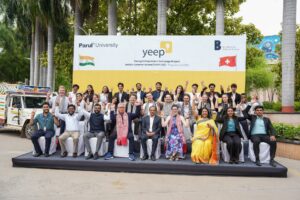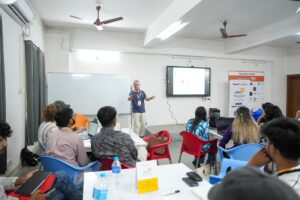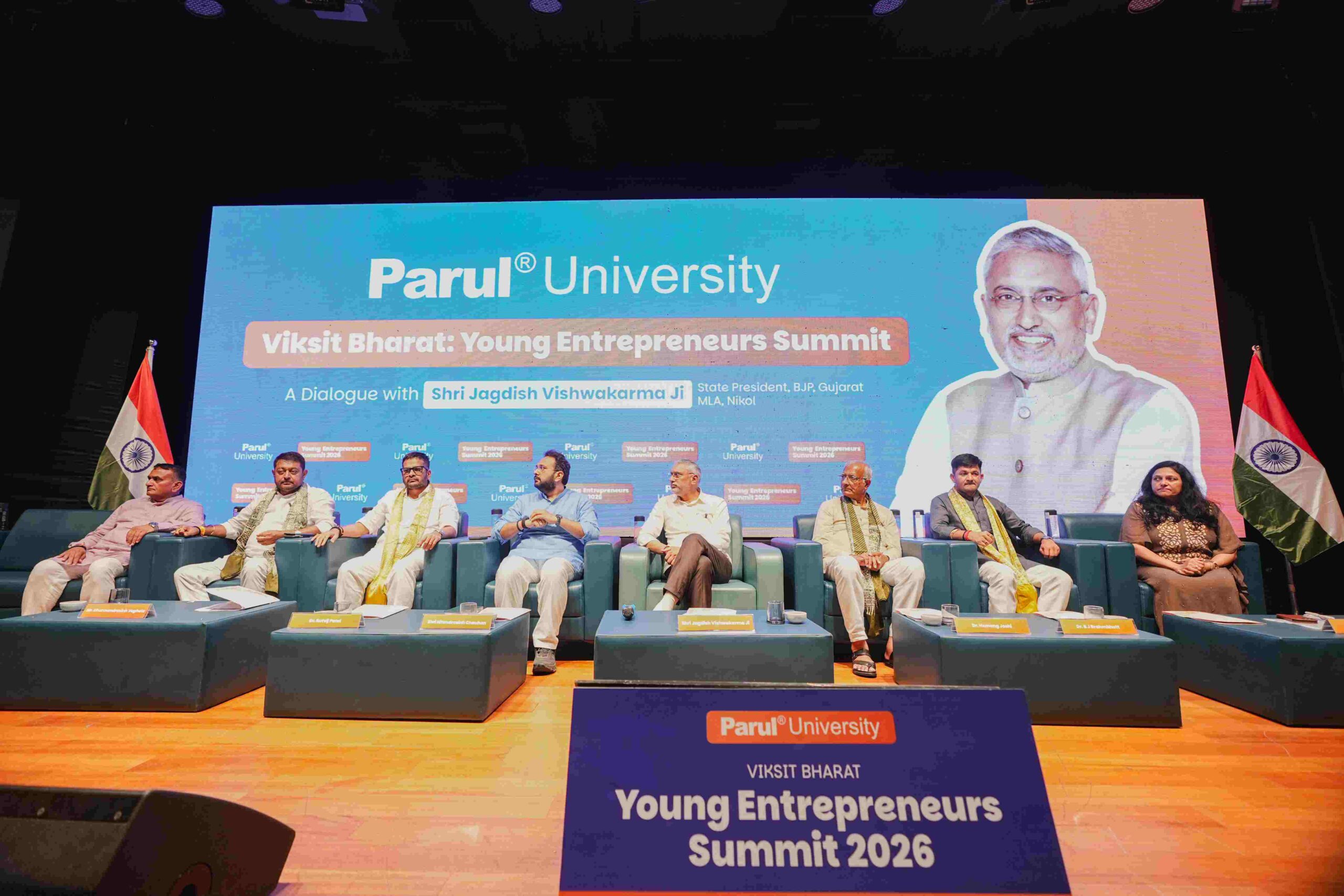
On the sunny day of 25 June 2026, in the Medical Auditorium at Parul University, 8 founders showcased their work to globally revered investors & stalwarts. They were not presenting slideware. They were fielding pointed technical questions about torque, sampling rates, coolant chemistry, and clinical trial counts, from a stage, in front of investors and senior dignitaries, at the Viksit Bharat Young Entrepreneurs Summit.
What made the afternoon worth documenting was not the ceremony around it. It was the enduring journey of a startup that came via PIERC – Parul Innovation & Entrepreneurship Research Centre. The startups showcased customer pipeline, revenue, patents, purchase orders and a full-fledged deck. As hosted by PIERC, it truly inspired students to turn their ideas into reality!
This article covers the summit and the ecosystem behind it. The eight companies that presented, what they built, and how they answered the questions put to them are covered in detail in the companion article on the eight status that pitched. The broader PIERC portfolio, including its 303 incubated startups and the ventures that have reached Shark Tank India and national recognition, is documented at the PIERC ecosystem record. For readers weighing this against conventional career outcomes, the Parul University placement record and the institutional accreditation framework provide the wider context.
Why a university runs a summit like this at all
The conventional promise of higher education is a placement: a degree, a campus interview, a job offer. Parul University makes that promise and keeps it, with 2,200+ recruiting companies and a three-year run as ASSOCHAM’s Best University in Placements. But the summit pointed at something the placement statistics do not capture. For the students who aspire to start their careers into entrepreneurship and not looking to join any company, they must research whether the campus can bring in the same level of seriousness and that’s when programs like GrowthPad Program & Incubation Program help and ensure support at all levels.
The centre operates as a government-recognised Fab Lab and Incubation Centre, running Startup Studios across four cities in Vadodara, Surat, Ahmedabad, and Rajkot, and connecting founders to the grant and investment pipelines that early ventures live or die by. The measure of whether it works is not the number of workshops held. It is whether companies come out the other end. Across the portfolio, PIERC has incubated and supported 303 startups, which have collectively generated over Rs 200+ crore in revenue and drawn more than Rs 40+ crore in funding. The eight on stage were a curated sample of that pipeline.
A room built to pressure-test, not applaud
A summit that only showcases success teaches students nothing about what building a company actually demands. This one was structured around interrogation. After each founder presented, the floor opened to questions, and the questions were not soft. An aerospace founder was asked about starting torque at take-off and the load his landing gear would carry. A medical-device founder was pressed on how her portable machine maintained the same signal accuracy as a full-sized hospital unit. A cooling-technology founder had to specify his coolant chemistry and pipe material on the spot.
This is the real spirit of entrepreneurship, and putting students through it in front of an audience is a deliberate teaching choice. A founder who can answer why the aircraft uses a DC motor rather than AC, or how many human trials a pain-relief device has actually completed, has moved past the idea stage into the operational reality where companies are made or broken. The summit treated that transition as the point, not a footnote.
The through-line from the stage: build for where the country is heading!
The event drew senior guests, including Shri Jagdish Ishwarbhai Vishwakarma Ji (President, BJP Gujarat & MLA, Nikol), Shri Hitendrasinh Chauhan (General Secretary, BJP Gujarat), Dr. Rutvij Patel (In Charge, Vadodara District BJP & State Executive Committee Member), Dr. Hemang Joshi (Member of Parliament, Vadodara & President, Bharatiya Janata Yuva Morcha Gujarat), and Shri Dharmendrasinh Ranubha Vaghela Ji, the MLA for the Waghodia constituency graced the occasion. The substantive advice offered to the student founders converged on a single, useful idea: entrepreneurs should build with an awareness of where national investment and infrastructure are actually moving.
The argument, to its practical core, was that opportunity concentrates where public attention and funding concentrate. Sectors receiving sustained national focus, from semiconductor manufacturing to defence indigenisation to sector-specific schemes, create demand that early ventures can serve. A founder who understands that landscape and aligns a genuine solution to it has an easier path to support than one building in isolation from it. The point was not that students should chase government schemes, but that they should read the direction of the economy before committing years to a product.
Interestingly, the second theme was quite contemporary, the holistic observation of artificial intelligence is generating new problems (ensuring heavy resource consumption) and that’s when the founders who are building solutions to the problem “technology” creates will be in as demand as other ones. It’s adamant to adopt AI as it shall solve real problems in aerospace, healthcare and energy!
The infrastructure a founder actually gets
Encouragement stays for a day, what distinguishes a functioning incubator is the concrete support it provides between an idea and a company, and this is where the PIERC pipeline becomes specific. Founders are guided through the sequence that early ventures rarely navigate well on their own: validating the idea against a real customer need, building a prototype with technical and design support, formalising the business, and securing the registrations and grants that unlock the next stage.
- Grant navigation. PIERC connects founders to the government funding pathways that most students would not know how to access alone, including the Startup India Seed Fund Scheme, MSME support, and Gujarat’s state innovation schemes. Several companies that presented had drawn grant support routed through this pipeline.
- Startup Studios in four cities. Physical operating space in Vadodara, Surat, Ahmedabad, and Rajkot lets founders who cannot base themselves full-time on the Vadodara campus still build within the ecosystem.
- Investor access. The annual Startup Nivesh & Vadodara Startup Festival brings emerging founders together with investors and venture capitalists for funding conversations, and the summit itself functioned as an investor-facing platform where founders presented to a room that included people who write cheques.
- The full institutional backbone. Founders build inside a 250-acre campus with 250+ technology laboratories, a Micro Nano Research and Development Center approved by the Industries Commissionerate of Gujarat, a DSIR-approved R&D Centre, and the research infrastructure that deep-technology ventures in particular depend on.
Entrepreneurship as a genuine alternative to the placement queue
The most important thing the summit communicated was not stated outright, but it was unmistakable to anyone in the room. For a student who wants it, building a company is a supported, structured path at Parul University rather than a leap into the void. The placement record and the incubation record are not in competition. They are two routes the institution takes equally seriously, and the summit made the second route visible in a way that a placement statistic never could.
This matters for how prospective students should think about the university. The question is no longer only which companies recruit on campus. It is also what happens if a student decides they would rather build than be recruited, and whether the institution has the incubation infrastructure, the grant relationships, and the investor access to make that decision viable. On the evidence of eight funded companies fielding hard questions from a public stage, the answer is that the second path is real, resourced, and already producing results.
How this fits Parul University's broader position
The summit sits within an institution that has built research and innovation into its identity rather than treating it as an add-on. Parul University holds NAAC A++ accreditation at CGPA 3.55, Category 1 status with Grant of Graded Autonomy, and a place in the Times Higher Education Sustainability Impact Ratings 2026 that includes Top 20 in India for SDG 17 (Partnerships for the Goals), the goal that specifically measures the industry, government, and investor partnerships an incubation ecosystem depends on. The university also holds 7th in India and joint 46th worldwide for SDG 4 (Quality Education), with a Quality Education score of 81.1.
Research funding at the university totals Rs 58.31 crore in government-funded projects across 315 funded projects, supporting the laboratory and R&D environment that deep-technology startups draw on. For a founder building a hardware or health-technology company, that infrastructure is not a brochure line. It is the difference between prototyping on campus and having nowhere to build.
FAQs
Define Young Entrepreneurs Summit at Parul University?
The Viksit Bharat Young Entrepreneurs Summit was exclusively hosted by PIERC, Parul University. As held at the Medical Auditorium, 8 PIERC-backed startups showcased their work to investors and stalwarts. From aerospace, healthcare technology, education and fintech, the list was endless and it truly reflected Parul University’s positioning of entrepreneurship.
How does PIERC support student startups?
PIERC as known as Parul Innovation & Entrepreneurship Research Centre is a govt-recognised Idea Lab & Incubation Centre at the ever-evolving campus of Parul University. From a basic idea to the final level of funding or company, they support at all the levels. PIERC proudly connects founders to funding pathways such as Startup India Seed Fund Scheme, MSME support, and Gujarat based innovation schemes. Besides this, they’ve elevated, incubated and supported 303 startups and have generated massive levels of funding.
Is entrepreneurship a realistic alternative to placement at Parul University?
Yes, and the Young Entrepreneurs Summit was designed to make that visible. Parul University supports both paths with equal seriousness. The placement route is backed by 2,200+ recruiting companies and a three-year run as ASSOCHAM's Best University in Placements. The entrepreneurship route is backed by PIERC, which has incubated 303 startups, provides grant navigation and investor access, and operates Startup Studios across four cities. For a student who would rather build a company than join one, the university provides the incubation infrastructure, government grant relationships, and investor connections that make that path viable rather than speculative. The eight companies that presented at the summit, each with customers, revenue, patents, or purchase orders, demonstrated that the entrepreneurship path produces real outcomes rather than only aspirations.
What kind of support infrastructure do PIERC startups get access to?
PIERC founders build within Parul University's 250-acre campus and its 250+ technology laboratories, with access to specialised research infrastructure including the Micro Nano Research and Development Center (approved by the Industries Commissionerate of Gujarat), a DSIR-approved R&D Centre, a Drone Lab, a Supercomputer Lab, and a NABL-accredited Environmental Lab. Beyond physical infrastructure, founders receive structured incubation support covering idea validation, prototyping, business formalisation, and grant applications, plus operating space through Startup Studios in Vadodara, Surat, Ahmedabad, and Rajkot. The annual Vadodara Startup Festival and investor-facing events like the Young Entrepreneurs Summit provide access to investors and venture capitalists. This combination of laboratory infrastructure, structured mentorship, grant navigation, and investor access is particularly important for deep-technology and hardware startups that cannot be built on a laptop alone.