
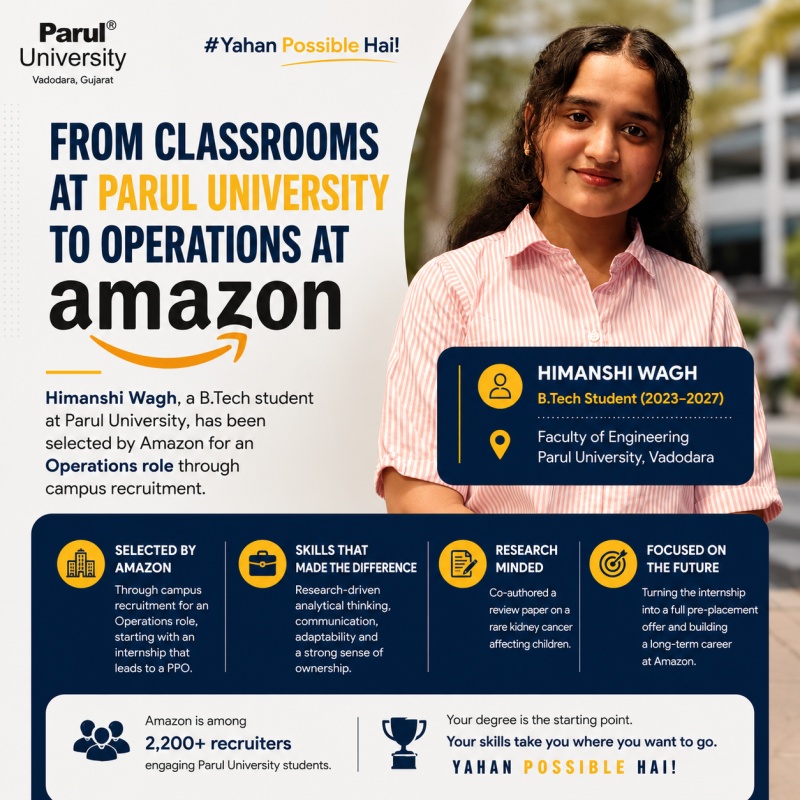
A Parul University Amazon placement does not always follow the route people expect. The B.Tech student, Himanishi Wagh, of the 2023 to 2027 batch from the Faculty of Engineering, cleared the placement drive of Amazon and got selected through campus recruitment for the operations role, a position outside her subject domain.
The route is the one large companies increasingly use for early-career hiring. It opens with an internship, and the full pre-placement offer is confirmed on performance during that stage. The internship is the prior requirement the placement runs through, not a lesser outcome. The useful question is not what the role pays. It is why Amazon selected a b.tech student for an operations position at all, and what that says about whether a degree decides a career.
Who Is Himanshi Wagh, the B.Tech Student Selected by Amazon
Himanshi Wagh joined the B.Tech programme at Parul University in 2023. She treated the degree as more than a sequence of lectures, taking on research, projects, and communication practice from the first year.
- Programme: B.Tech Biotechnology 2023 to 2027 batch, Faculty of Engineering, Parul University, Vadodara.
- Selection: Selected by Amazon through campus recruitment for an operations role, entered through an internship stage.
- Research work: Co-authored a review paper on Wilms Tumor, a rare kidney cancer that mainly affects children.
- Defined next step: Convert the internship stage into a full pre-placement offer, then build a long-term career.
The pattern across three years is consistent. She looked for work that built capability she could demonstrate later, not just marks she could report. That habit is what made her competitive for a role no one would have predicted from her subject alone.
Also Read: Placement season 2026, more than 2,200 recruiters.
What the Amazon Operations Role Involves
The role Himanshi was selected for is a management-facing operations position, not a laboratory one. As she understood it going in, the work centers on operations and workflow:
- Supporting day-to-day operational tasks and tracking how efficiently a process runs.
- Coordinating across departments and the people who run different parts of a system.
- Spotting operational problems and helping improve how work moves through the process.
- Holding quality and timeline standards under pressure.
None of that is biotechnology. All of it draws on skills a serious research and project student builds without noticing: structuring a problem, working with data, coordinating with people who see the same task differently, and staying organised when a deadline is real.
The selection is also less surprising against Amazon’s footprint at the university. Amazon is one of the more than 2,200 recruiters that engage Parul University campuses and sits among its tier-one recruiters alongside Microsoft, IBM, and Google. Its India Chief Financial Officer, Balaji Mani, has featured among the leaders students meet through Practical Learning Tours, the programme that takes students to 280 companies across 19 cities.
The degree looked unrelated to the role. The capability behind it was not.
How a B.Tech Student Qualified for a Non-Core Role
A student of the Faculty of Engineering, getting the degree of B.Tech, got an operations role, a non-science role. Operations roles at large companies usually attract candidates from management and commerce backgrounds. A B.Tech student competing for one has to prove transferable capability, and Himanshi had built a specific, demonstrable case for it.
The research that did the real work
Co-authoring a review paper on Wilms Tumor meant reading scientific literature, judging which sources were reliable, comparing conflicting findings, and organising a large body of information into a coherent argument. That is analytical work. It also meant collaborating with mentors, managing time, and writing for an audience that checks claims. The subject was medical. The skills it built were general, and they are exactly what an operations recruiter screens for.
Communication, adaptability, and ownership
She paired research with deliberate work on how she presents and adapts. Recruiters do not only assess what a candidate knows; they assess attitude and the capacity to keep learning. The transferable cluster she could evidence:
- Analytical rigour: literature review, source evaluation, and structured argument.
- Communication: explaining a technical idea clearly to someone outside the field.
- Adaptability: preparing for a function that her syllabus never named.
- Ownership: treating the degree as a platform for demonstrable work, not only grades.
Why Your Degree Does Not Decide Your Career
Himanshi’s route answers one of the most searched questions among students and parents. A degree sets a starting point and a body of skills. It does not set a ceiling.
When the degree is a starting point, not a limit
Most roles in operations, management, product, sales, and consulting hire across degrees and screen for capability rather than subject. The in-field route is equally valid: B.Tech Computer Science and Engineering students Tanish Patel and Suraj Jagtap, placed at Microsoft at 60 LPA, the highest package in their cohort, deepened their subject and were hired for it. Others from the same cohort crossed fields, including Priyanka Soni at Livspace and Priyanshu Raikwar at Synchrony. Neither route is superior. What matters is that the institution prepares students for both.
When the degree is non-negotiable
Honesty requires the other half of the answer. A licensed doctor, a practising lawyer, a chartered accountant, or a registered architect cannot substitute transferable skills for the qualification their profession legally requires. Regulated and deeply specialised roles need the matching credential. Knowing which category a target role sits in is the first thing a student should establish, because it decides whether the branch is a boundary or only a beginning.
A degree sets a starting point and a set of skills. It does not set a ceiling.
How to Prepare for an Amazon Interview as a Fresher
Preparation is the part a candidate controls, and it matters more than raw talent on the day. Himanshi had no in-field advantage, so everything that worked came from the same campus training that prepared her Microsoft-bound peers. The method breaks into five phases.
Phase 1: Read the company and the role like a brief
She studied Amazon, its customer focus, and the exact responsibilities of the operations position, then matched them against her own experience. That is what let her answer the hardest question in the interview: why Amazon?
Phase 2: Work the Amazon Leadership Principles
Amazon interviews are structured around a published set of Leadership Principles, and behavioural questions are written to test them. She prepared a specific example for each principle she expected, describing the situation, her action, and the result so every answer stayed concrete.
Phase 3: Build a resume you can defend line by line
Every line on a resume is a question waiting to be asked. She made sure each project, her Wilms Tumor research, and every listed skill was something she could explain in depth and defend under follow-up.
Phase 4: Rehearse under pressure, not in your head
The ability to organise a thought and deliver it clearly carries an interview. She used the aptitude sessions, communication training, and mock interviews run by the Parul University Training and Placement Cell to practise under realistic conditions and act on feedback.
Phase 5: Choose honesty over performance on the day
When she was unsure, she stayed calm and answered honestly rather than inventing an answer she could not support. For an operations role, where judgement under uncertainty is the job, that composure is itself part of the assessment.
“In any situation where I was not sure of my answer, I stayed calm and answered honestly rather than giving wrong information.”
– Himanshi Wagh
Placements at Parul University: What the Record Shows
One selection is one data point. It means more against the system it came from.
Recruiters, packages, and outcomes
- Recruiters: more than 2,200 engage the campuses, including tier-one names Microsoft, Amazon, IBM, and Google.
- Highest package: 60 LPA at Microsoft, for B.Tech CSE students Tanish Patel and Suraj Jagtap.
- Recognition: ASSOCHAM Best University in Placements for three consecutive years.
- Breadth: offers span Adani, Infosys, Reliance, and Livspace, and selections as officers in the Indian Navy.
The point is not that every student reaches the same role. It is that one preparation infrastructure serves the whole cohort, whether a student stays in-field or crosses over, a question examined further in whether CGPA actually decides placements.
The training and research behind the numbers
The outcomes are fed by exposure built into the campus. Parul University runs 146 Practical Learning Tours across 280 companies, and its research base, including government-funded research worth 58.31 crore rupees and the Micro Nano Research and Development Center, gives applied-science students the genuine research experience that made Himanshi competitive. The skills that win a cross-field placement are built by a multidisciplinary environment over three years, not improvised in a final semester.
Beyond Placements: The Business-Ready Mindset and PIERC
A placement at Parul University is framed as a beginning, not a finish line. The stated mission goes beyond securing a role: it is to build a business-ready mindset that lets a student carve their own path and scale at their own pace.
Himanshi represents the joining side of that mission. The building side runs through the university’s startup ecosystem.
Through the Parul Innovation and Entrepreneurship Research Centre, PIERC, the university has backed founders directly, and Solnce Energy, which raised 1 crore rupees on Shark Tank India, is one of its documented outcomes. The scale of the ecosystem:
- 254 startups incubated and supported.
- 20 crore rupees plus in funding provided to student ventures.
- 40 crore rupees plus in revenue generated by those ventures.
Whether a student joins a company like Himanshi or builds one, the underlying capability is the same: ownership, problem solving, and the confidence to back an idea. A placement is one exit. A company is another. Both start from the same training.
Frequently Asked Questions
Can a B.Tech student get placed at Amazon?
Yes. Himanshi Wagh, a B.Tech student at Parul University, was selected by Amazon through campus recruitment for an operations role that runs through an internship into a pre-placement offer. Operations roles hire across degrees and value analytical thinking, communication, and ownership more than a specific subject.
Is the Amazon operations role related to B.Tech?
No. It is an operations and workflow position, not a laboratory role. It draws on transferable skills such as data handling, coordination, and problem solving, which Himanshi's final-year research had trained, even though the subject matter was unrelated.
Does your degree decide your career?
Your degree sets your starting field and skills but does not fix your career. Operations, management, and consulting hire across degrees. Regulated professions such as medicine, law, and architecture require the matching qualification, but general functions do not, which is why a B.Tech student could be selected by Amazon for an operations role.
How should a fresher prepare for an Amazon interview?
Read the company and the specific role, study the Amazon Leadership Principles and prepare an example for each, build a resume you can defend line by line, rehearse through mock interviews, and answer honestly rather than bluffing on the day.
How good are placements at Parul University?
Parul University has been recognised by ASSOCHAM as the Best University in Placements for three consecutive years, with more than 2,200 recruiters including Microsoft, Amazon, IBM, and Google. Outcomes include a 60 LPA Microsoft offer for B.Tech CSE students Tanish Patel and Suraj Jagtap, Indian Navy officer selections, and offers across many fields.
Does placement at Parul University mean only a job, or also a startup path?
The mission is to build a business-ready mindset, so students can join a company or build one. Through PIERC, the university has incubated 254 startups, provided over 20 crore rupees in funding, and supported ventures generating more than 40 crore rupees in revenue, including Solnce Energy, funded on Shark Tank India.