Large public gatherings are a safety problem before they are a spectacle. At events like Rath Yatra and Ganesh Visarjan, monitoring how a crowd moves, and preventing the crush that congestion can cause, is genuinely hard. A team of students at Parul University‘s AI and Machine Learning Centre built a system to help, in partnership with the Vadodara Municipal Corporation, and the most striking part is the price.
Crowd management at scale is a matter of seeing what is happening fast enough to act. Organisers need to know how many people are in a space, where pressure is building, and how to route movement before a bottleneck becomes dangerous. Doing that manually across a citywide event is close to impossible, which is why the Vadodara Municipal Corporation was interested in an automated approach.
The stakes are not abstract. At festivals such as Rath Yatra and Ganesh Visarjan, hundreds of thousands of people move through streets never designed for that density, and the gap between a manageable crowd and a dangerous crush can open in minutes. Human observers cannot count a moving crowd accurately or spot a forming bottleneck from the ground in time. A system that can watch continuously, count reliably, and flag risk early is the difference between reacting to a crush and preventing one.
What the Students Built
The system uses computer vision to turn a live camera feed into decisions. Its logic runs in clear stages.
- Detect: It identifies individuals within a crowd and draws bounding boxes around each detected person.
- Count: It estimates the total crowd count from those detections.
- Assess: It compares the count against safe occupancy limits and highlights risk zones where pressure is building.
- Route: It recommends the most suitable and alternate movement routes to ease bottlenecks and improve flow.
The system is being built in three phases. The first two, detection with crowd counting and the risk-and-routing logic, are working, and the third is under iterative refinement. Building it in stages lets the team validate each layer before adding the next, which is how reliable systems are made and a discipline that matters more when the output guides real crowd-safety decisions.
Two of the three planned phases are working, with the third under refinement. The build uses the LWCC library for crowd counting alongside DG Astra tools, and the team is running drone-based testing before advancing to the next stages.
How AI Crowd Counting Actually Works
Counting a crowd by computer is harder than it sounds, and understanding why explains what the students solved. In a dense crowd, people overlap, block each other, and shrink into the distance, so a naive approach that tries to find each whole person fails quickly.
Modern crowd-counting systems handle this with computer vision trained to recognise people even when partly hidden. The system draws a bounding box around each detected individual and tallies them, and in denser scenes it shifts toward estimating a crowd-density map rather than counting heads one by one. The count then feeds a second layer of logic: comparing the number against the safe capacity of a space, marking zones where density crosses a threshold, and suggesting routes that move people away from pressure points. The students’ pipeline follows exactly this pattern, which is why it generalises beyond a single event.
Doing all of this in real time, on a live feed rather than a saved recording, is the harder constraint, because a warning that arrives after a bottleneck has already formed is useless. Building for that speed, and doing it at low cost, is the engineering the students took on, and it is a good deal more demanding than running a model over footage after the fact.
Comparable commercial systems cost close to 1 crore. The students estimate theirs at around 10 lakh.
The Affordability Breakthrough
The number that made the visiting Tech Mahindra leadership take notice was cost. The students estimated that comparable commercial crowd-management systems run close to 1 crore rupees, while they are building a similar solution for roughly 5 to 6 lakh, with an estimated final cost near 10 lakh once all phases are complete.
That is not a small saving. It is the difference between a technology only the largest cities can afford and one a municipal corporation can actually deploy. Affordable public-safety technology, built to the constraints of an Indian city rather than imported at an Indian city’s expense, is exactly the kind of applied innovation that justifies a university AI centre.
It also changes who gets to be safe. A crowd-safety system priced near 1 crore rupees is out of reach for most municipal bodies, so the places that most need it, mid-sized cities running large religious festivals, go without. A system at a tenth of the cost is deployable at scale, and building it to that price point is itself the harder engineering problem, not a compromise on the easier one.
What This Says About Applied AI Learning at Parul University
The project is a window into how applied artificial intelligence is taught here: not as an abstract subject, but as work done for a real client with a real deadline. The team operates out of the university’s AI and Machine Learning Centre, part of the same industry-connected ecosystem as its computing labs and its Tech Mahindra partnership.
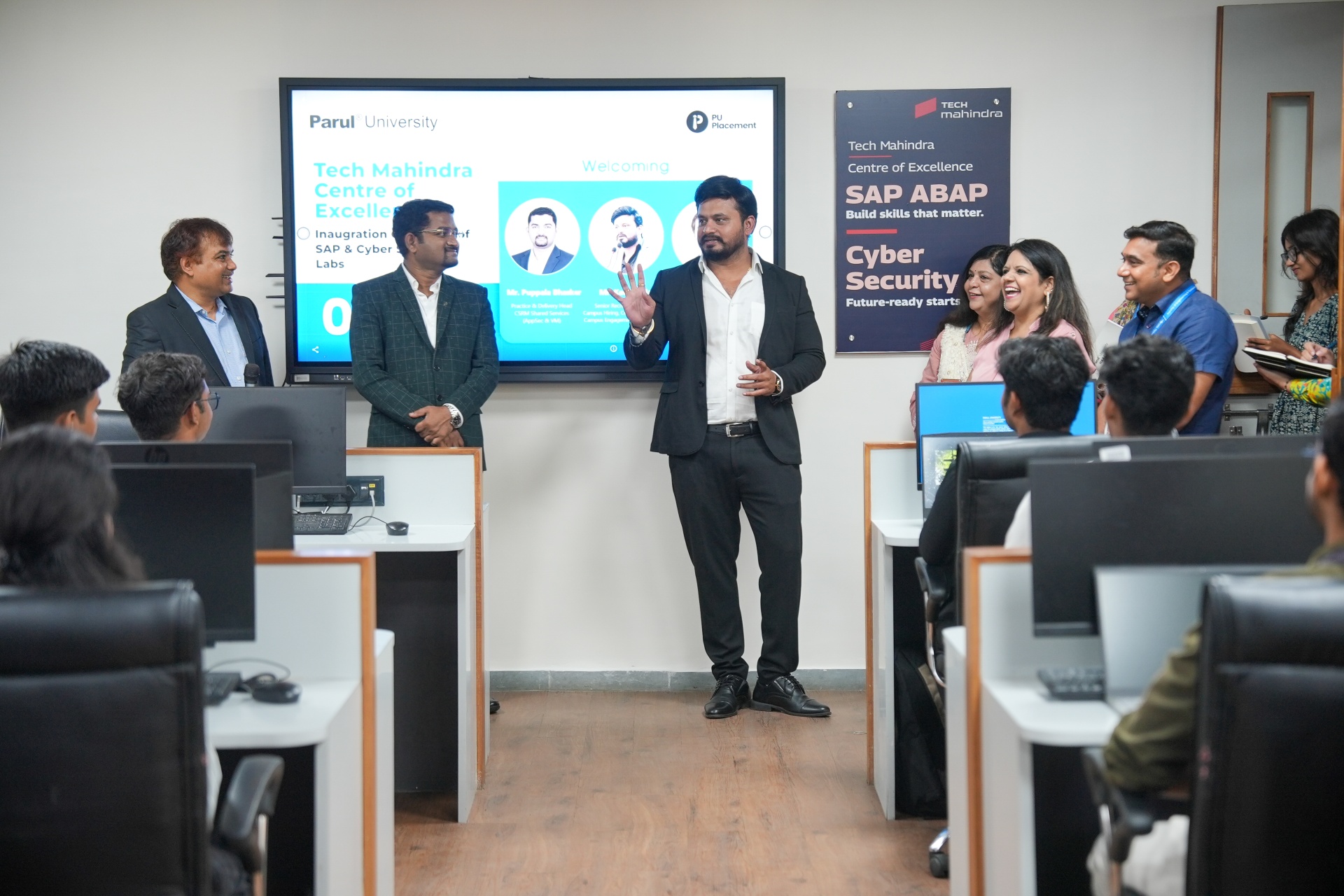
That connection is not incidental. Visiting industry leaders reviewed the project, judged the two-year completion timeline realistic, and encouraged the team to continue, the kind of external mentorship the university’s industry partnerships, including the Tech Mahindra Centre of Excellence, are built to provide. A student who has shipped a working system for a municipal corporation, under industry review, graduates with something a transcript cannot express.
That is the deeper value of the project, beyond the technology itself. It turns a student from someone who has studied artificial intelligence into someone who has used it to solve a stranger’s problem under real constraints of cost, time, and consequence. That shift, from learner to practitioner, is what an applied education is supposed to produce, and it is far easier to claim than to demonstrate.
Frequently Asked Questions
What is the Parul University AI crowd-management project?
It is a computer-vision system built by students at Parul University's AI and Machine Learning Centre for the Vadodara Municipal Corporation. It detects and counts people in a crowd, identifies risk zones, and recommends movement routes to prevent dangerous congestion at large public events.
How does the AI crowd-management system work?
It uses computer vision to detect individuals and draw bounding boxes around them, estimates the total crowd count, compares it against safe occupancy limits to flag risk zones, and recommends suitable and alternate routes to ease bottlenecks. It uses the LWCC library and DG Astra tools, with drone-based testing under way.
How much cheaper is the student-built system?
The students estimated that comparable commercial systems cost close to 1 crore rupees, while their solution is being built for roughly 5 to 6 lakh, with an estimated final cost near 10 lakh once complete. That affordability makes the technology deployable by municipal bodies rather than only the largest organisations.