Most people who visit the Taj Mahal observe the pattern of the stones being laid there, the inlay work, but don’t know the actual name of the technique, known as Parchin Kari. The flowers and geometric patterns set into its marble are cut from semi-precious stone and fitted so precisely that the joins cannot be felt by hand. Europeans called the technique Pietra Dura. Its Indian name is Parchin Kari, and the community that perfected it is disappearing.
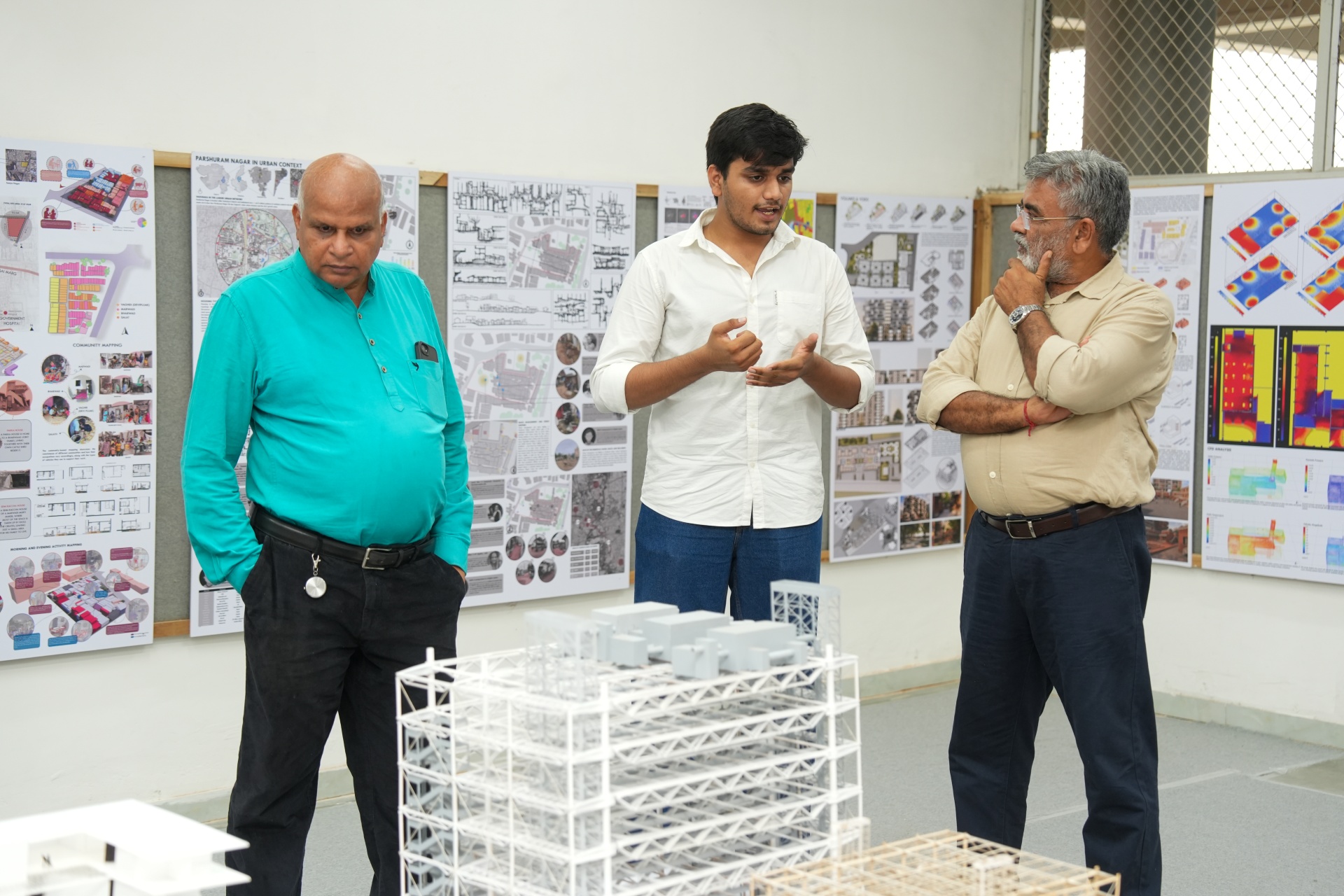
That was the subject of a documentation project prepared by students at the Faculty of Architecture and Planning, Parul University, and displayed at the Young Ideas exhibition alongside ten semesters of student work. It was produced for one of the most demanding student competitions in Indian architecture, and it treats a craft the way an architect should: as a built culture with a history, an economics, and a future in doubt.
The Competition That Sends Students Into the Field
The Council of Architecture conducts an annual National Awards for Excellence, which includes a highly regarded student competition for the Documentation of Architectural Heritage. It is not a design contest. Students must go to a place, measure it, research it, and record it accurately enough that the documentation itself has scholarly value.
The competition is organised in three categories, and the distinction matters, because each demands a different discipline of looking.
- Category A, Architectural Heritage: The documentation of buildings and built structures of heritage value.
- Category B, Arts and Crafts Related to Buildings: The ornamental and craft traditions that make architecture, rather than the structure itself.
- Category C, Indigenous Dwellings: Vernacular housing, the buildings ordinary people made without architects.
Students from Parul University have entered this competition for years. In the previous year, two student groups qualified and presented their theses at the competition, and one student from the department won at the Gujarat level. The Parchin Kari panel was prepared under Category B.
A Craft With an Indian Root and a Persian Name
The documentation traced the craft’s Indian roots and its arrival in Agra during the Mughal era. According to history, the Taj Mahal was not built first, the tomb of Itmad-ud-Daula was built first under the cultural advocacy of Empress Nur Jahan. That building is often called the Baby Taj, as it reverses the actual sequence: the method was proven there before its actual implication on the monument.
Perfection arrived at the Taj Mahal. And with it came a settlement. In the seventeenth century, Taj Ganj was established to house the stone carvers, inlay workers, and calligraphers who worked on the monument. A craft of that precision cannot be commissioned from a distance. It requires a resident community, trained across generations, living beside the work.
An estimated ten thousand artisans a few decades ago. Fewer than three thousand today.
The Numbers That Make This Urgent
The heart of the students’ documentation was not historical. It was an accounting of loss.
The artisan community of Taj Ganj has shrunk from an estimated ten thousand craftspeople a few decades ago to fewer than three thousand today. The causes the panel identified are unglamorous and familiar: demand has fallen, and cheaper reproductions have taken over the market. A tourist buying a marble coaster rarely knows whether the inlay was cut and set by hand over days, or printed and pressed in minutes. The two objects look similar in a photograph. Only one sustains a family.
This is why documentation is a form of conservation. A building can be protected by law. A craft survives only if the knowledge passes to another generation, and knowledge held in the hands of three thousand ageing artisans can vanish inside a single generation without anyone recording that it existed.
Nor is the loss only aesthetic. When the Taj Mahal or Itmad-ud-Daula‘s tomb requires repair, the marble can be sourced and the stone cut, but the hand that knows how to set an inlay so the join disappears cannot be manufactured. Conservation of a monument depends on the survival of the community that built it, which makes the shrinking of Taj Ganj a structural problem for Indian heritage rather than a cultural footnote.
How the Students Documented It
The panel worked on three registers at once, which is what distinguishes documentation from a report.
- The historical: The craft’s trajectory from its Indian origins through Itmad-ud-Daula’s tomb to the Taj Mahal, and the founding of Taj Ganj.
- The formal: The floral, geometric, and calligraphic motifs that constitute the craft’s visual vocabulary, recorded as patterns rather than admired as decoration.
- The living: Photographs of present-day artisans still practising, set beside the historical motifs, so that the craft is presented as a continuing practice rather than a museum object.
The documentation closed where the craft now earns its living: the decorative objects that keep it commercially alive. Tabletops, jewellery boxes, coasters, and plates. It is a modest ending for a technique that ornamented an emperor’s tomb, and the students let that irony sit without commentary, which is the correct decision. Documentation records. It does not editorialise.
Why an Architect Documents a Craft at All
A reasonable question sits behind this project. Parchin Kari is a craft practised on buildings, not a building. Why should architecture students record it rather than art historians?
The answer is that the separation is modern and artificial. The Taj Mahal is not a structure that was later decorated. Its surfaces and its geometry were conceived together, and the artisans who cut its inlay were part of the same building enterprise as the masons who raised its walls. An architect who cannot read ornament reads only half of a historic building, and a conservation proposal made in ignorance of the craft that produced a surface will damage what it intends to preserve.
The Council of Architecture recognises this by giving crafts their own competition category. Category B exists because the arts related to buildings are architectural knowledge, not decorative trivia, and because the people who hold that knowledge are frequently the ones no institution is recording.
Heritage as a Working Discipline, Not a Subject
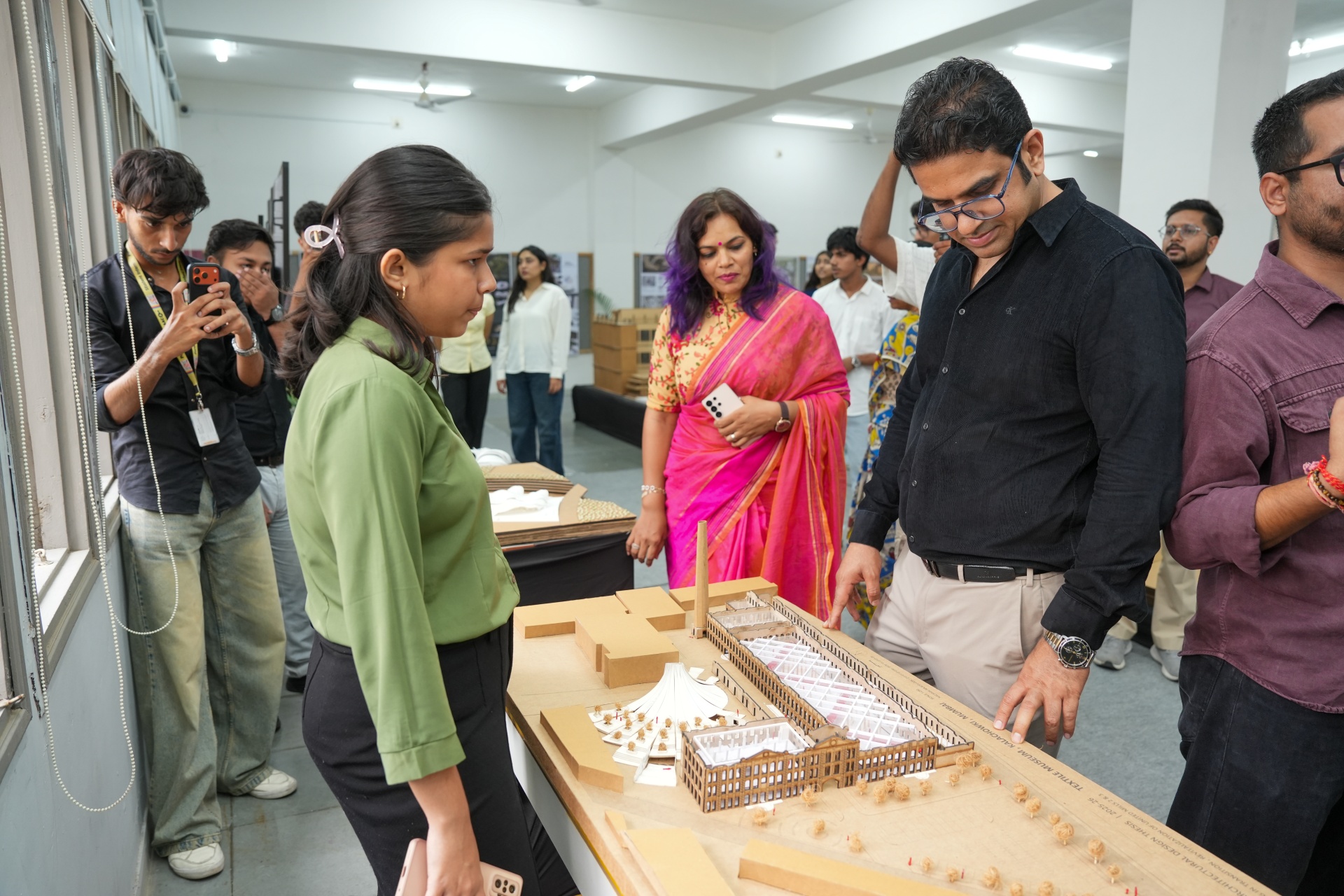
The Parchin Kari panel was not an isolated exercise. The Faculty of Architecture and Planning runs a Heritage Club, and its practice of field and site visits produces documentation year after year. One such visit resulted in a large-scale model recording the neighbourhood around Narsinhji’s Temple, made by students of Architectural Design Studio IV during the 2022-23 academic year. A model of a traditional Gujarati pol was displayed alongside it, and a 3D-printed Somnath Temple sat nearby, produced with the faculty’s 3D printing facilities. Students have also documented the ghats at Maheshwar, work that fed into the temple conservation theses on display at the exhibition.
What connects these is a method rather than a theme. Understand a place completely before proposing anything for it. India’s built heritage is documented unevenly, and much of what the Archaeological Survey of India cannot reach is recorded, if at all, by students sent to measure it. That makes a heritage documentation competition something more useful than an academic exercise. It is a national survey conducted by people young enough to still be learning how to look.
Also Read: What did students get to know and learn during their ten-semester curriculum?
Frequently Asked Questions
What is the stone inlay technique?
The stone inlay technique is known as 'Parchin Kari' but is mostly and widely known by its Persian name, 'Pietra Dura', where these semi-precious stones are cut and set into marble to form floral, geometric and calligraphic patterns. They were brought to Agra during the Mughal era and were perfected at the Taj Mahal.
What are the initial uses of Pietra Dura in India?
If we find the data in the preserved documents, we read that the first use of this technique was for the tomb of Itmad-ud-Daula, built under the cultural advocacy of Empress Nur Jahan, and then, with perfection, it was used for making the Taj Mahal.
Where is Taj Ganj?
Taj Ganj is a place in Agra, built in the 17th century. It was built for the stone carvers, inlay workers and the calligraphers who worked on the Taj Mahal. With time, their community have decreased from an estimated ten thousand to now fewer than three thousand, because the demand fell and cheaper reproductions entered the market.
What is the Council of Architecture heritage documentation competition?
It is a student competition within the Council of Architecture's annual National Awards for Excellence, requiring students to research and record heritage accurately. It has three categories: Architectural Heritage, Arts and Crafts Related to Buildings, and Indigenous Dwellings. Parul University students have participated for years, with a student winning at the Gujarat level.