
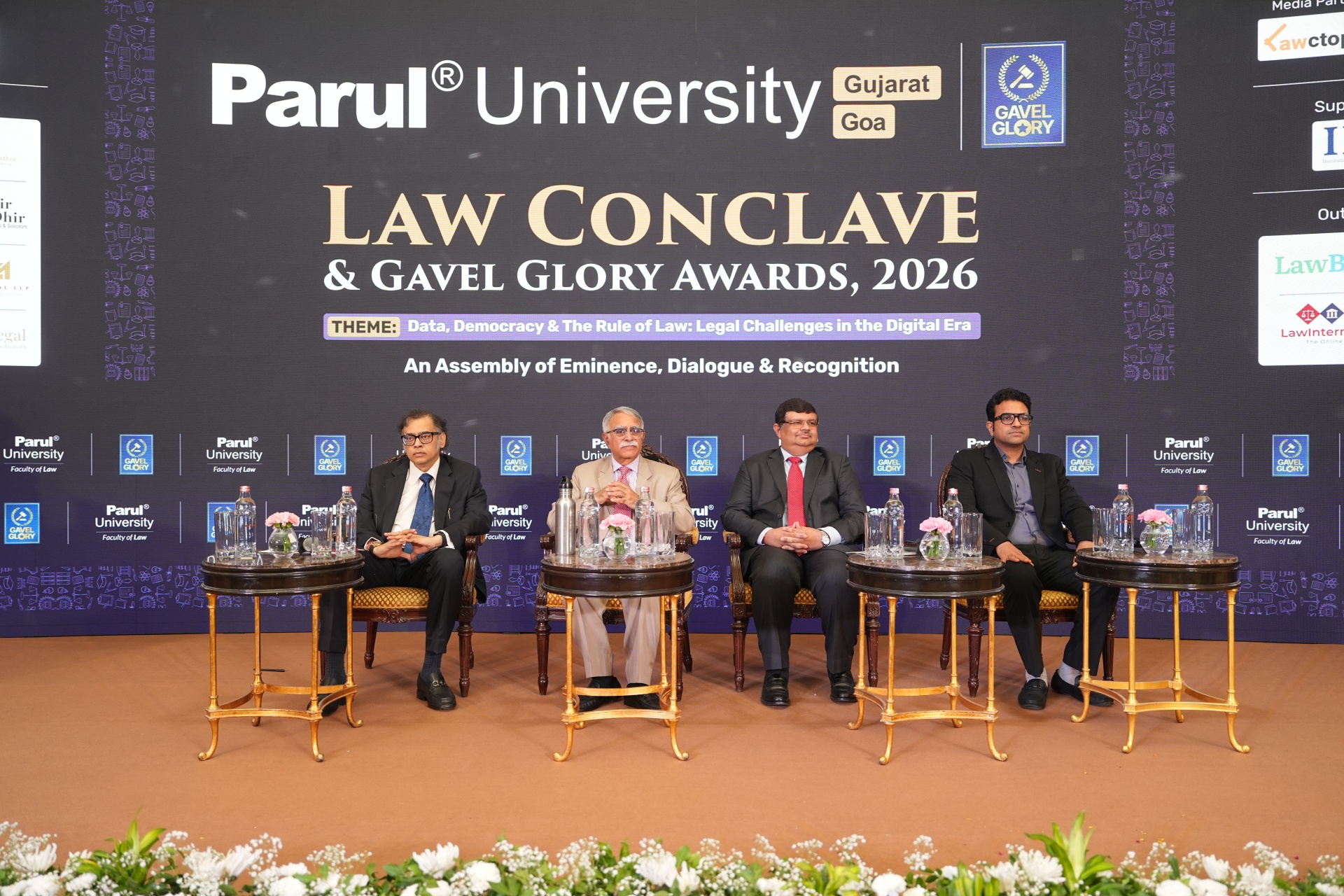
Dr. Devanshu Patel, the President of Parul University’s message for legal professionals!
For most of history, power rested on things you could stand on. Geography, natural resources, and manufacturing capacity. Justice Tejas Karia of the Delhi High Court opened his keynote at Parul Institute of Law‘s Law Conclave 2026 by observing that the twenty-first century has replaced all of it with information.
Every digital transaction, every search, every online action generates data. And because the subjects of that data are people, its protection becomes a matter for the Constitution rather than merely for commerce. Justice Tejas Karia, who spoke of a personal connection to Gujarat and Vadodara that made his participation meaningful, framed the entire day’s theme in a single formulation.
“Data has become the lifeblood of contemporary society.” – Hon’ble Mr. Justice Tejas Karia, High Court of Delhi
It is a phrase worth pausing over, because lifeblood is not a metaphor of value but of dependence. A society can survive the loss of something valuable. It cannot survive the loss of its blood supply, nor can it survive that supply being controlled by parties it cannot see and did not choose. Justice Tejas Karia spent the remainder of his address unpacking exactly that distinction and its consequences for the Constitution.
PU Law Conclave 2026 – Rajesh Kumar Singh’s post on LinkedIn!
The Constitutional Questions That Actually Matter!
Justice Tejas Karia’s central move was to reject the debate about whether data is valuable. That question, he suggested, is settled and uninteresting. The questions worth asking are harder.
“Who controls this data? For what purpose may it be used? What safeguards protect the individual? And who exercises oversight over those who possess such extraordinary power?” – Hon’ble Mr. Justice Tejas Karia, High Court of Delhi
These are not questions of technology or economics, he stressed. They concern democracy itself. Governments hold expanding digital databases for welfare delivery, security, and administration. Private companies accumulate personal information as a business model. Social media platforms shape public debate. Artificial intelligence grows steadily better at predicting what people will do and decide. Information, in that landscape, becomes one of the most significant forms of authority in modern society.
His response was to insist that an old principle survives the change in form. The rule of law has always existed to keep power accountable, and that principle cannot be weakened merely because power has assumed a digital shape.
The greater the concentration of power, he argued, the greater the need for robust constitutional safeguards. And power has rarely concentrated as quickly, or in as few hands, as it has in the holders of the world’s data.
“Elections derive legitimacy not merely from voting, but from informed voting!”
Democracy Depends on Information
The connection between data and democracy is not metaphorical. Democracy has always depended on information, Justice Tejas Karia argued. It requires an enlightened citizenry with access to information, freedom of speech, and the capacity to take part in public discussion. Accountability requires that citizens know what their government does.
This is why he treated electoral legitimacy as an informational question rather than a procedural one. A vote cast in ignorance and a vote cast in knowledge are not the same act, even if they count the same.
The consequence of the law is significant. If the legitimacy of an election depends on the quality of information reaching voters, then the regulation of information is not a peripheral concern of election law but part of its core. Everything that shapes what a citizen knows, platform design, algorithmic ranking, the speed at which a falsehood travels, becomes constitutionally relevant, whether or not any existing statute treats it that way.
Which is what makes disinformation a constitutional problem rather than a nuisance. Justice Tejas Karia observed that unverified material typically spreads faster than verified material, and that platform algorithms sometimes favour engagement over accuracy. Disinformation campaigns have shown a capacity to distort electoral processes, deepen social polarisation, and erode public trust in institutions. Jurisdictional boundaries blur in cyberspace, and cyberattacks originating abroad complicate legal response, raising questions about intermediary liability and the treatment of digital evidence.
Why the Rule of Law Does Not Change Shape!
Justice Tejas Karia’s steadiness came from refusing to treat digital power as a new species of power requiring a new philosophy. The rule of law, in his account, has always existed to keep power accountable, and it exists for the same reason now. What has changed is the form power takes, not the reason it must be checked.
That framing has a practical consequence for lawyers. It means the doctrinal tools are not obsolete. Judicial review, constitutional limits, and the requirement that state action be authorised and answerable apply to an algorithmic decision precisely as they apply to a ministerial one. The rule of law, he observed, is the bedrock upon which justice rests, and a bedrock does not need replacing because the building above it has changed.
The Chilling Effect of Privacy!
Justice Tejas Karia’s account of privacy was the most demanding part of his address, because he refused the common definition. Privacy, he argued, is not merely secrecy or confidentiality. It is a precondition for the exercise of freedom in a constitutional democracy.
The mechanism is psychological before it is legal. A citizen who believes that every action, association, conversation, and preference is observed may gradually experience a chilling effect on liberty and may cease to behave as a genuinely free citizen. The surveillance need not be acted upon. The belief that it exists is sufficient to alter behaviour, and altered behaviour means reduced participation in democratic life.
The relationship between privacy and democracy, he suggested, runs deeper than is generally appreciated. Protecting privacy is therefore not a concession to individual preference but a requirement for maintaining constitutional freedoms. That argument connects directly to the constitutional panel on surveillance and liberty held at the same conclave, where the legality, necessity, and proportionality test was applied to precisely these powers.
Regulation Without Overreach, and the Divide That Undoes It All
Courts and legislatures, Justice Tejas Karia acknowledged, are building mechanisms for the rapid removal of unlawful and disinformational material. He insisted these be balanced against due process, feasibility, and freedom of expression. The challenge lies in framing laws that are effective and fair at once, protecting rights while ensuring responsibility, and maintaining the balance between individual rights and responsible innovation.
He closed on the problem that undercuts everything else: the digital divide. Democracy cannot be genuinely representative when citizens do not have equal access to digital infrastructure, information, and technological advancement. Equal access to the digital world, in his view, is a precondition for equal participation in the democratic process. A right to information means little to someone who cannot reach it, and a data protection regime protects a citizenry that must first be online to be protected.
It is a fitting note on which to end a keynote about power. Every safeguard he described, oversight of those who hold data, protection against disinformation, freedom from the chilling effect of surveillance, presumes a citizen already inside the digital system. Those outside it are not protected by such safeguards; they are simply governed by decisions made in a domain they cannot enter. For a law student, that is the quieter lesson of the address: constitutional protection is only as real as the access that makes it reachable. They must enrol on BA LLB, BBA LLB, and LLM programmes at Parul Institute of Law, where they’ll gain the legal knowledge, courtroom exposure, and practical skills to thrive in an era shaped by artificial intelligence, data privacy, cyber law, and constitutional challenges. Learn from experienced legal professionals and prepare to lead the future of the legal profession with confidence. The impact of the PU Law Conclave extended well beyond the auditorium, with attendees taking to social media to share their experiences and takeaways.
FAQs
Who is Justice Tejas Karia?
Justice Tejas Karia is a judge of the High Court of Delhi. He delivered a keynote address at Parul Institute of Law's Law Conclave 2026 on data, democracy, and the rule of law, and spoke of a personal connection to Gujarat and Vadodara.
Why is data a constitutional issue rather than a commercial one?
Because the subjects of the data are people. Justice Tejas Karia argued at Parul University's Law Conclave that the important questions are who controls data, for what purpose it may be used, what safeguards protect the individual, and who oversees those holding such power. These, he said, are questions about democracy itself.
What is the chilling effect on privacy?
It describes how a citizen who believes their every action, association, and conversation is observed may gradually restrict their own behaviour and cease to act as a genuinely free citizen. Justice Tejas Karia argued that privacy is therefore a precondition for the exercise of freedom in a constitutional democracy, not merely secrecy.
Why is disinformation a threat to democracy?
Unverified or unauthorised material often spreads faster than any verified document. The algorithms of such platforms favour engagement over accuracy. Justice Tejas Karia conveyed to students that such disinformation campaigns have a rigorous capacity to undermine public trust in institutions or any entity, and hence, informed voting, not just voting, is the foundation of a legitimate democracy!