Parul University’s academic strength is reflected in its faculty. Seven professors at Parul University are featured in the Stanford-Elsevier list of the world’s top 2% scientists. The global ranking is based on Elsevier’s Scopus citation data using a methodology developed by John Ioannidis and his colleagues at Stanford University.
These professors have h-indices ranging from 18 to 48 and specialise in fields such as plant biology, pharmacy, chemistry, optoelectronics, mechatronics, and biotechnology.
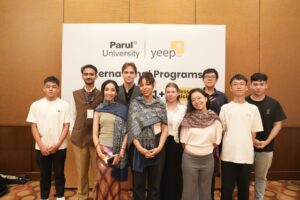
At the university, there are more than 200 faculty members who have studied or worked at leading institutions, including IITs, NITs, IISc, NIDs, and NIFTs. Through its International Visiting Professors Programme (IVPP), Parul University has welcomed 20 professors from more than 12 countries to teach for periods ranging from a few days to several weeks.
Behind global research recognition lies a strong culture of innovation and sustained research support. With more than 315 funded projects receiving Rs 58.31 crore in government funding and Rs 4.37 crore in private funding, Parul University has created an ecosystem that empowers researchers to contribute to impactful work with global relevance.
The 7 Stanford-Elsevier Top 2 Percent Scientists currently serving
The Stanford-Elsevier Global Scientist Rankings are published annually by Elsevier using a methodology developed by Stanford University. The rankings identify the top 2% of scientists worldwide based on research impact, using Scopus citation data, the h-index, and other standardised citation metrics. The ranking is calculated rather than nominated, with no application or self-submission process.
Each year’s edition includes both career-long impact and single-year impact rankings. The seven faculty members listed below are currently serving at Parul University, with their academic departments, h-indices from Scopus, and research domains documented.
- Dr Madhusudan Hiraman Fulekar – Senior Professor (Research), Department of Environmental Science, Faculty of Applied Science. h-index 48, i10-index 120. Stanford-Elsevier global top 2 percent in Plant Biology and Botany. Research focuses on bioremediation, environmental microbiology, and sustainable agricultural systems.
- Dr Mange Ram Yadav – Senior Professor (Research), Faculty of Pharmacy. h-index 36, i10-index 101. Stanford-Elsevier global top 2 percent in Medicinal and Biomolecular Chemistry and Organic Chemistry. Research focuses on medicinal chemistry, drug design, and synthetic organic chemistry.
- Dr Deep Pooja – Associate Professor (Pharmaceutical Sciences), Faculty of Pharmacy. h-index 37, i10-index 73. Stanford-Elsevier global top 2 percent in Pharmacology and Pharmacy. Research focuses on polymers, drug delivery systems, and pharmaceutical nanotechnology. One of two female faculty in the Stanford-Elsevier ranked cohort at Parul University.
- Dr Bhupendra Gopalbhai Prajapati – Professor (Research Cadre), Faculty of Pharmacy. h-index 34, i10-index 151. Stanford-Elsevier global top 2 percent in Pharmacology and Pharmacy, Oncology and Carcinogenesis. Research focuses on novel drug delivery systems and cancer therapeutics.
- Dr Vishal P. Sorathiya – Associate Professor (Research Cadre), Faculty of Engineering and Technology. h-index 30, i10-index 61. Stanford-Elsevier global top 2 percent in Optoelectronics, Photonics, and Applied Physics. Research focuses on photonic devices, optical sensors, and integrated photonics.
- Dr Prince Jain – Assistant Professor (Research Cadre), Department of Mechatronics Engineering, Faculty of Engineering and Technology. h-index 21, i10-index 49. Stanford-Elsevier global top 2 percent in Information and Communication Technology and Applied Physics. Research focuses on signal processing, machine learning for engineering systems, and mechatronics applications.
- Dr Juhi Saxena – Assistant Professor (Research Cadre), Department of Biotechnology, Faculty of Engineering and Technology. h-index 18, i10-index 29. Stanford-Elsevier global top 2 percent in General Clinical Medicine and Biotechnology. Research focuses on bio-pharmaceuticals, microbial biotechnology, and clinical biotechnology applications. The second female faculty in the Stanford-Elsevier ranked cohort.
h-index and i10-index: What the metrics measure?
The h-index measures the productivity and citation impact of a scientist’s publications. A researcher with an h-index of N has N publications each cited at least N times. The metric was proposed by Jorge Hirsch in 2005 and has become the principal single-number measure of cumulative research impact across scientific fields. The i10-index, developed by Google Scholar, counts the number of publications with at least 10 citations each, providing complementary data on broader publication impact.
Within Indian higher education, an h-index above 30 typically positions a researcher among senior research leaders in their field. The seven Stanford-Elsevier ranked faculty at Parul University have h-indices ranging from 18 to 48, with Dr Fulekar at 48 representing four decades of sustained research output and Dr Saxena at 18 representing a career stage that includes substantial recent citation accumulation.
200+ professors from IITs, NITs, IISc, NIDs, and NIFTs
Beyond the Stanford-Elsevier ranked cohort, 200+ professors at Parul University hold previous appointments or doctoral training from the Indian Institutes of Technology, National Institutes of Technology, the Indian Institute of Science, the National Institutes of Design, and the National Institutes of Fashion Technology. These institutions represent the apex of Indian higher education across engineering, sciences, design, and fashion, with admissions and faculty selection processes that screen for academic capability at the top tier of their respective disciplines.
Faculty drawn from these institutions bring teaching methodologies, research practice, and disciplinary networks from their training institutions into the Parul University academic environment. The 200+ figure operates as a measure of the academic depth across the faculty roster beyond the seven who hold formal Stanford-Elsevier ranking.
International Visiting Professors Programme: 20 professors from 12+ countries
Through the International Visiting Professors Programme (IVPP), Parul University welcomes 20 professors from 12+ countries to teach on campus for periods ranging from a few days to several weeks. These professors do more than deliver guest lectures. They conduct regular classroom sessions, teaching students in their areas of expertise over the course of their visit. The programme includes professors from the United States, United Kingdom, Canada, Australia, Malaysia, Thailand, Indonesia, Poland, Germany, Jamaica, Russia, Vietnam, and South Africa.
The IVPP infrastructure operates alongside the broader international academic engagement at Parul University including 120+ foreign university partnerships, the Inspire New Zealand Centre of Excellence with 7 New Zealand universities, the BFH Switzerland Innovation Management Programme (decade-long partnership, Rs 2.30 lakhs per student funded engagement), the Erasmus+ partnership with PIBA reaching Vilniaus Kolegia in Lithuania, and the COIL hybrid programmes that operate across multiple international partnerships.
- Course-integration rather than guest-lecture. IVPP faculty teach for days to weeks rather than appearing for single sessions. The model supports course-content integration with the regular curriculum, with the visiting professors contributing assessment, project supervision, and the broader pedagogical engagement that single-lecture visits cannot provide.
- Disciplinary breadth. IVPP engagement covers engineering, management, pharmacy, hospitality, design, fine arts, performing arts, and other faculties. The disciplinary breadth supports the broader institutional position on international curriculum integration.
Dr Sanjay Agal: from rural Rajasthan to Rs 1.25 crore funded AI Ayurveda project
Dr Sanjay Agal’s research pathway at Parul University documents the institutional infrastructure that supports research-intensive faculty. He grew up in a rural village in Rajasthan and was unable to score well in competitive examinations after Class 12. He then took admission at Vidyabandh Polytechnic College in Udaipur for an IT diploma. His original intent was to use the diploma as a route into engineering. He ranked first in his polytechnic batch and secured engineering admission at his preferred college. Through a faculty mentorship he discovered that he was good at coding. After engineering, he spent six years as Assistant Professor at Pacific College of Engineering in Udaipur and then served as GTU-endorsed Principal at a small-mid sized engineering college in Porbandar.
The structural constraint across the tier-2 and tier-3 positions was geography. Limited research funding, no journal subscriptions, restricted book access, and minimal peer interaction with serious research communities. He had research ideas; the institutional infrastructure to execute them was absent. The move to Parul University on 22 January 2024 was driven by one specific requirement: research resources.
- Funded Q1 publications – Every paper published since joining Parul University has been funded by the institution at approximately Rs 3 lakh per paper, the open-access cost for journals like Scientific Reports (Q1, IF 4.8). None has come from his own pocket. 14 Q1 papers were under review at the most recent count.
- Current funded projects – Rs 1.25 crore project on AI for Ayurvedic colleges, funded and active. Rs 6 crore-plus proposal submitted with verbal approval received. Rs 50 lakh ISRO grant application in progress.
- Library and resource access – Full library checkout privileges across the institutional library, journal subscriptions covering Q1 and Q2 publications across his field, conference attendance funding through the institutional grant scheme, and peer collaboration with faculty at IIT Palakkad through the MoU collaboration.
- Springer Nature License Agreement – Parul University holds a Springer Nature License Agreement supporting open-access publication across the journal portfolio, with the financial pathway covering the Article Processing Charges (APC) that researchers would otherwise need to fund personally.
Faculty research output: Rs 58.31 crore funded research
At Parul University, we have built a strong research ecosystem with over 315 funded research projects. These include Rs. 58.31 crore in government-funded research and Rs. 4.37 crore in private-funded research across the institution.
Our R&D Centre is also recognised by the Department of Scientific and Industrial Research (DSIR) as a Scientific and Industrial Research Organisation (SIRO). This recognition places the centre in the list of DSIR-recognised research organisations in India. The Environmental Lab is also NABL-accredited.
315 of the university’s research projects are supported by funding from leading organisations, including the Department of Science and Technology (DST), Defence Research and Development Organisation (DRDO), Indian Council of Medical Research (ICMR), Science and Engineering Research Board (SERB), Gujarat State Biotechnology Mission (GSBTM), Indian Space Research Organisation (ISRO), and other corporate partners.
MoU with IIT Palakkad and inter-institutional collaboration
At Parul University, we have signed a Memorandum of Understanding (MoU) with IIT Palakkad to collaborate on research in Nanotechnology. Through this partnership, both of the two institutions work jointly on research projects, faculty exchange, doctoral supervision, and shared access to specialised research facilities.
This collaboration also enables the researchers of Parul University to work with the IIT research network on selected projects. It gives them access to advanced equipment, peer review, and publication opportunities.
This partnership is supported by Parul University’s Micro Nano Research and Development Center (MNRDC), which contains research equipment worth Rs. 58.31 crore. The centre is equipped with advanced instruments such as a Scanning Electron Microscope (SEM), Atomic Force Microscope (AFM), X-ray Diffraction system (Bruker D6 PHASER), and other specialised tools for research in nanoscience and materials science.
The MNRDC infrastructure positions Parul University within the network of Indian institutions operating advanced characterisation facilities.
Research policies that support active publication and patenting
The institutional research policies at Parul University include Intramural Research (IMR) Grants for faculty-initiated projects, financial support for attending national and international conferences across disciplinary fields, support for publication in high-impact journals including assistance for Article Processing Charges (APC), research excellence awards for publications, patents, and funded projects, and encouragement and recognition for externally funded research projects.
The IMR Grant pathway supports research that does not yet have external funding, allowing faculty to develop preliminary results that can subsequently support external grant applications. The conference funding pathway supports research dissemination across the academic networks where citation and collaboration develop. The APC support is the funding pathway that allows publication in Q1 open-access journals like Scientific Reports (IF 4.8) without faculty financial commitment, which is the structural difference between Parul University’s research environment and the tier-2 and tier-3 institutional environments where APC funding is absent.
FAQs
Who are the Stanford-Elsevier Top 2 Percent Scientists at Parul University?
Seven faculty members at Parul University have been recognised in the Stanford-Elsevier Global Top 2% Scientists Ranking. Among them is Dr. Madhusudan Hiraman Fulekar, Senior Professor (Research) in the Department of Environmental Science, who has an h-index of 48 and an i10-index of 120 in the field of Plant Biology and Botany. Dr Mange Ram Yadav (Senior Professor Research, Faculty of Pharmacy) holds h-index 36 and i10-index 101 in Medicinal and Biomolecular Chemistry. Dr Deep Pooja (Associate Professor, Faculty of Pharmacy) holds h-index 37 and i10-index 73 in Pharmacology and Pharmacy. Dr Bhupendra Gopalbhai Prajapati (Professor Research Cadre, Faculty of Pharmacy) holds h-index 34 and i10-index 151 in Pharmacology and Oncology. Dr Vishal P. Sorathiya (Associate Professor Research Cadre, Faculty of Engineering and Technology) holds h-index 30 and i10-index 61 in Optoelectronics. Dr Prince Jain (Assistant Professor Research Cadre, Mechatronics Engineering) holds h-index 21 and i10-index 49 in Information and Communication Technology. Dr Juhi Saxena (Assistant Professor Research Cadre, Biotechnology) holds h-index 18 and i10-index 29 in General Clinical Medicine and Biotechnology. The ranking is calculated by Elsevier using Scopus citation data and methodology developed at Stanford University, with no application or self-submission process.
What does an h-index of 48 mean for a researcher?
The h-index measures both productivity and citation impact of a scientist's publications. A researcher with an h-index of N has N publications each cited at least N times. Dr Madhusudan Hiraman Fulekar's h-index of 48 indicates 48 publications each cited at least 48 times across his research career in plant biology and botany. The metric was proposed by Jorge Hirsch in 2005 and has become the principal single-number measure of cumulative research impact across scientific fields. Within Indian higher education, an h-index above 30 typically positions a researcher among senior research leaders in their field. The Stanford-Elsevier global top 2 percent ranking uses h-index alongside additional citation impact metrics calculated through Scopus to position scientists across approximately 8 million researchers globally.
How many faculty at Parul University are from IITs, NITs, or IISc?
200+ professors at Parul University hold previous appointments or doctoral training from the Indian Institutes of Technology, National Institutes of Technology, the Indian Institute of Science, the National Institutes of Design, and the National Institutes of Fashion Technology. These institutions represent the apex of Indian higher education across engineering, sciences, design, and fashion. The 200+ figure operates alongside the seven Stanford-Elsevier Top 2 percent ranked faculty and the broader research-oriented faculty cohort. The International Visiting Professors Programme additionally brings 20 professors from 12+ countries including the United States, United Kingdom, Canada, Australia, Malaysia, Thailand, Indonesia, Poland, Germany, Jamaica, Russia, Vietnam, and South Africa for periods ranging from days to weeks of structured classroom teaching.
What research funding does Parul University faculty access?
Faculty at Parul University access institutional research funding through Intramural Research (IMR) Grants for faculty-initiated projects, Article Processing Charge (APC) support for Q1 publication in journals like Scientific Reports (IF 4.8), conference attendance funding for national and international engagements, and the broader institutional framework supporting externally funded research applications. The Rs 58.31 crore in government-funded research and Rs 4.37 crore in private-funded research across 315 funded projects covers Department of Science and Technology, Defence Research and Development Organisation, Indian Council of Medical Research, Science and Engineering Research Board, Gujarat State Biotechnology Mission, and Indian Space Research Organisation grants. Dr Sanjay Agal's Rs 1.25 crore AI Ayurveda project, Rs 6 crore-plus proposal under verbal approval, and Rs 50 lakh ISRO grant application document a single faculty member's funded project portfolio. The R&D Centre at Parul University is DSIR-recognised under the Scientific and Industrial Research Organisation framework.
Does Parul University support faculty publication in international journals?
Yes. Parul University holds a Springer Nature License Agreement supporting open-access publication across the journal portfolio, with the financial pathway covering Article Processing Charges that researchers would otherwise fund personally. The APC support extends to Q1 journals including Scientific Reports (IF 4.8) at approximately Rs 3 lakh per paper. Dr Sanjay Agal's Q1 publication record across his post-2024 work at Parul University has been entirely institution-funded, with 14 Q1 papers under review at the most recent count. The publication support operates alongside conference attendance funding for national and international engagements, library access including journal subscriptions across the Q1 and Q2 publication landscape, and the inter-institutional collaboration network including the MoU with IIT Palakkad for collaborative nanotechnology research. The combined infrastructure positions Parul University researchers within the publication and citation networks that the Stanford-Elsevier ranking methodology evaluates.