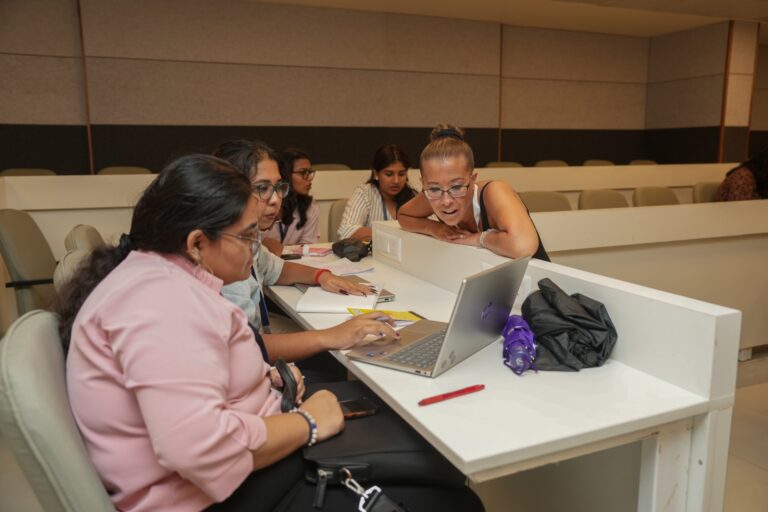
The research infrastructure is primarily useful for operational reliability. A centre with next-gen instrumentation but unpredictable turnaround times, systems or frequent downtime issues creates legit frustration for the researchers. The Parul University’s MNRDC – Micro-Nano Research & Development Centre houses next-gen instruments with structured operations revolving around 5 Prime Principles – Transparent Queueing, Fair turnaround time, responsive urgent service, reliable uptime and a backup plan for situations when instruments are unavailable.
Read more about – MNRDC Facilities and Services
The Queue System: First-Come, First-Served
Sample processing at MNRDC follows a strict first-come, first-served queue. Queue position is determined by the order in which samples are received and logged. Internal university samples and external samples (from other academic institutions, research organisations, and industry) follow the same queue.
To be precise, there is no such priority lane for internal users. This policy ensures benefits and predictability for all users without any bias. The process goes like – when a sample is submitted, it enters the queue for checking which instrument will fit in here. If a sample needs both SEM & XRD Analysis, it usually enters both queues. The centre analyses and processes samples in a queue-driven order, and then users receive updates on sample status to maintain holistic transparency. MNRDC’s external users hold a larger share of overall usage as compared to internal users, showcasing the Centre’s role in providing regional testing resources with fairness and testing excellence!
Read more about – Industry Services at MNRDC: Why 60% Are Repeat Clients
Turnaround Times: Standard and Urgent
Standard: Within 10 Working Days
The standard turnaround for all instrument analyses at MNRDC is within 10 working days from the date the sample enters the queue. This applies to SEM, XRD, AFM, Pin-on-Disc tribometry, LCR meter dielectric testing, and sputtering runs. The 10-day window accounts for queue position, instrument scheduling, actual analysis time, data processing, and report preparation.
For context, before MNRDC opened in September 2024, researchers in Gujarat routinely waited up to three months for advanced material testing by sending samples to external facilities in Mumbai or Pune. The 10-day turnaround represents a reduction from approximately 90 days to 10 days for the same quality of analysis.
Urgent: 1 Working Day
For time-sensitive research or industrial quality control needs, MNRDC offers an urgent testing option with results delivered within one working day. Urgent testing carries additional charges compared to standard rates. The trade-off for speed is reduced output volume:
- Standard SEM analysis: 8 images from different angles and magnifications + 2 EDS spectra. Analysis time: approximately 60 minutes.
- Urgent SEM analysis: 4 images. Reduced angles and magnifications, but sufficient for time-critical decisions.
Urgent samples may be prioritised ahead of the standard queue, which is why additional charges apply. The urgent option is designed for situations where a research deadline, industrial production decision, or quality control hold requires immediate data.
Read more about – SEM Sample Preparation Guide
Instrument Uptime: 99.9%
MNRDC maintains an average instrument uptime of 99.9% across all ten instruments. This figure means that instruments are operational and available for testing 99.9% of scheduled operating hours. The near-perfect uptime is maintained through:
- Annual manufacturer-recommended maintenance for all instruments
- Regular calibration schedules (instrument-specific, typically annual)
- Documented Standard Operating Procedures (SOPs) for every instrument covering sample handling, instrument operation, safety precautions, and data generation workflows
- Trained research cadre staff who operate instruments according to SOPs, preventing operator-caused downtime
- Environmental controls: dust-proof laboratory, restricted access (authorised personnel only), mandatory gloves during sample handling
Backup Facility: M-19 Labs, Vadodara
In the event that an MNRDC instrument becomes temporarily unavailable due to maintenance, repair, or calibration, samples in the queue can be redirected to M-19 Labs in Vadodara. M-19 (Material Intelligence Lab India) is an active industry collaborator with MNRDC and provides compatible testing capabilities. This backup arrangement prevents extended delays for users during the rare periods when an MNRDC instrument is offline. The backup protocol is triggered by the MNRDC operations team; users do not need to arrange alternative testing themselves.
Read more about – Advanced Material Characterisation Lab in Gujarat
What Gets Samples Rejected
Samples are rejected at MNRDC approximately once every fortnight. Rejection is not arbitrary; it follows specific criteria designed to protect instruments, ensure meaningful results, and maintain operator safety.
Reasons for Rejection
- Size or material non-compliance: Each instrument has defined sample size limits. SEM accepts up to 100 mm diameter x 50 mm height. XRD powder samples require a minimum of 800 mg. AFM accepts a maximum of 10 mm x 10 mm x 7 mm. Samples exceeding these limits are returned.
- Contamination or biological growth: Samples with visible contamination, bacterial growth, or fungal growth on or in the sample cannot produce reliable results and risk contaminating the instrument chamber.
- Samples unsuitable for meaningful results: Certain sample types do not yield useful data on specific instruments. For example, some liquid SEM samples show no structural features, making the analysis uninformative. In such cases, the Centre advises the user before proceeding.
- Hazardous materials: Radioactive, explosive, or highly corrosive materials are never accepted. Samples that could damage equipment or interfere with measurement accuracy are rejected.
- Volatile or reactive samples: Materials that cannot withstand vacuum conditions (SEM, sputtering) or high temperature (XRD, LCR furnace) are not processed.
Read more about – Dielectric Testing: LCR Meter at MNRDC
What Happens After Rejection
When a sample is rejected, the user is contacted and formally informed of the reason. The Centre requests a replacement sample that meets the stated criteria. Samples are not destroyed; they are returned to the user. The rejection process is documented for traceability during the testing period.
Read more about – How to Submit Samples at MNRDC
Instrument-Specific Analysis Times
Understanding how long each instrument takes per sample helps researchers plan their experimental timelines:
- SEM only: approximately 45 minutes per sample (8 images)
- SEM + EDS: approximately 60 minutes per sample (8 images + 2 EDS spectra + mapping if requested)
- XRD: scan time depends on angle range and step size; typical 10-80 degree scan completes in under 30 minutes on PSD fast mode
- AFM: approximately 3-4 minutes per scan (10 x 10 micrometre area) plus 5 minutes approach time
- Pin-on-Disc: variable based on programmed test duration; a 120-second test produces 120 individual data points
- LCR Meter: frequency sweep duration depends on the range set; practical testing in 20 Hz-1000 Hz and 10,000 Hz-20,000 Hz bands
- Sputtering (Auto 500): variable; a typical run is 60 minutes at 100W, plus pump-down time
Read more about – XRD Testing at MNRDC
Data Handling After Testing
After analysis is complete, all raw and processed data is delivered to the user. The Centre does not retain ownership of user data. Results are shared only with the submitting user, and all data is treated as confidential. Sample traceability is maintained during the testing period. The Centre does not maintain long-term storage of user data after delivery. Doctoral students who are passionate about doing a PhD in material science and nanotechnology must read this – PhD Research Guide at MNRDC, as it ensures a detailed explanation of projects, supervisors, instruments and career outcomes & possibilities!