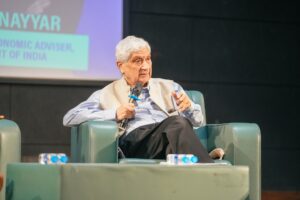
The manufacturing GDP in 1990 in India and China was almost the same. And according to Prof. Deepak Nayyar, the former Chief Economic Adviser, India’s share fell from 20 percent to 14 percent, while China continued on its growth path.
Prof Deepak Nayyar’s conclusion from this divergence:
- There is no latecomer to development that has succeeded in becoming a high-income country without industrialisation
- Manufacturing is the only sector that can absorb surplus labour and allow people to move up
- A person can start on the shop floor and become a manager. This cannot happen in informal services
- India cannot become Viksit Bharat only on the back of the services sector
This diagnosis carries particular weight because it comes from someone who shaped India’s economic policy during the 1991 crisis. Prof Deepak Nayyar is not a commentator. He is someone who worked 18 hours a day for 18 months to prevent India’s sovereign default, who moved the economy from Command and Control to a calibrated market system, and who watched the consequences of those decisions unfold over three decades.
Prof Deepak Nayyar IIMUN session: full overview of the event at Parul University.
Second: Agriculture Employs 45 Percent, Produces 15 Percent
Prof Deepak Nayyar, former Chief Economic Adviser, presented the agricultural employment trap: agriculture accounts for 45 percent of employment but only 15 percent of output. The employment elasticity of output in agriculture is zero or negative. As output grows, employment does not. More tractors and better seeds increase yield. They do not increase jobs.
The implication for the labour market:
- Surplus agricultural labour has nowhere productive to go
- If educated, these workers become the ‘educated unemployed’ who cannot find jobs matching their expectations
- If uneducated, the only option is casual labour in informal markets
- This is India’s biggest challenge, according to Prof Deepak Nayyar
Growth can be pro-poor if and only if it creates employment, Prof Deepak Nayyar told the Parul University audience. The question is not whether GDP is rising but whether that rising GDP is creating jobs that pull people out of subsistence. By his analysis, it is not doing so at the scale India needs.
Third: The Services Dichotomy
The former Chief Economic Adviser, Prof. Deepak Nayyar mentioned that India’s service sector can be split in two:
- High-skill services (IT, finance): 35 percent of GDP but only 8 percent of employment. World-class productivity but narrow employment base.
- Informal services (rickshaws, dhabas, gig economy): 22 percent of employment but very little output. Wide employment base but low productivity and low wages.
Between these two extremes, there is a structural gap that neither agriculture nor services can close. Only manufacturing, Prof Deepak Nayyar argued, can provide the middle ground: productive employment for workers who have basic education but not elite technical skills.
Why classrooms cannot be replaced by AI: Prof Nayyar on education
The 1991 Reforms: How India's Calibrated Path Created Resilience
Prof Deepak Nayyar, former Chief Economic Adviser, placed the manufacturing crisis within the broader story of India’s post-1991 trajectory. In 1991, India had two weeks of foreign exchange reserves. The reforms that followed moved the economy from Command and Control to a market-oriented system, but did so on India’s terms:
- Opened the trade account but remained cautious about the capital account
- Did not follow the Washington Consensus blindly
- Followed a calibrated path that Prof Deepak Nayyar calls the masterstroke of Indian economic policy
- This calibration is why India survived the 1997 Asian crisis and the 2008 global financial crisis
The challenge now, according to Prof Deepak Nayyar, is that the reforms opened India to global trade and capital but did not solve the employment problem. The world is moving from globalisation to slow-balization. Security concerns are overriding economic efficiency. The China Plus One strategy benefits India, but only if manufacturing capabilities improve.
What This Means for Students at Parul University
Prof Deepak Nayyar, former Chief Economic Adviser, addressed students from the Faculty of Law, Faculty of Commerce, and Journalism. His economic diagnosis is directly relevant to their career trajectories:
- Law students: the regulatory architecture around manufacturing, trade policy, and investment requires legal professionals who understand economic structures, not just statutes
- Commerce students: the manufacturing imperative means supply chain, operations, and production management will matter more than pure financial services in India’s next growth phase
- Journalism students: covering India’s economy requires understanding the three-number diagnosis, not just headline GDP figures
Parul University’s placement outcomes already reflect the multi-sector reality Prof Deepak Nayyar described. The 3,500+ placements span engineering (Microsoft 60 LPA, Capgemini 157 offers), hospitality (14 international hotels at 23-28 LPA), law (ICICI Lombard), MBA (DHL, Setco Auto with SAP), healthcare (50 NRHM government appointments, HCG, Shalby), social work (CSRBOX), and computer applications. The university’s 230+ PIERC startups include manufacturing and technology ventures, not just services. The multi-disciplinary placement infrastructure reflects the economic structure Prof Deepak Nayyar described: India needs professionals across every sector, not just IT.
14 international hotel placements at 23-28 LPA the success stories of the students.
FAQ
What did Prof Deepak Nayyar say about India's manufacturing?
Prof Deepak Nayyar, former Chief Economic Adviser, said India's manufacturing share in GDP fell from 20% to about 14% while China's grew. Agriculture employs 45% but produces 15% with zero employment elasticity. No latecomer to development has become a high-income country without industrialisation. India cannot become Viksit Bharat on services alone.
What are the three numbers in India's manufacturing crisis?
(1) Manufacturing GDP share fell from 20% to 14%. (2) Agriculture: 45% of employment, 15% of output, zero employment elasticity. (3) Services dichotomy: high-skill (IT/finance) = 35% GDP but 8% employment vs informal = 22% employment but negligible output. Prof Deepak Nayyar presented these at Parul University through IIMUN.