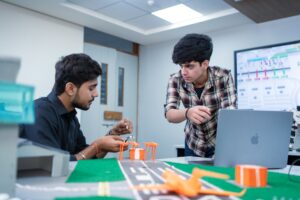
An engineering formula can look easy on a classroom board. But when students try to use the same formula on a machine, material or circuit, many new questions appear. The reading may change. The sample may fail. The machine may behave differently from what the student expected.
This is where real engineering learning begins. Engineering labs are not only rooms filled with machines. They are spaces where students learn how ideas behave in real conditions.
Why Is Classroom Theory Not Enough for an Engineer?
Theory gives students a base. It explains why a machine works, how force acts on a material or how electricity moves through a circuit. However, industry does not work only through written answers.
An engineer may have to choose the right material, identify why a component failed or improve a process that is wasting time. Such work requires observation and judgement.
In a lab, students learn that results are not always perfect. A small error in sample size, alignment, temperature or machine setting may change the output. They must find the cause instead of simply writing the expected answer.
This develops a practical mindset. Students begin to ask: Is the reading correct? Was the machine set properly? Is the sample suitable? Can the experiment be repeated? These are basic but important questions in professional engineering work.
Get Compelete Details From Expert
Request a CallWhat Skills Do Students Build Inside Engineering Labs?
Laboratory learning develops more than machine-handling ability. Students slowly learn how technical work is planned and completed.
Observation :
Students notice small changes in readings, surfaces, sounds and machine behaviour.
Problem solving :
They find why an experiment failed and decide what should be changed.
Data Recording :
They learn to note readings correctly instead of depending on memory.
Safety awareness :
They follow instructions, use protective equipment and understand machine limits.
Team work :
Many experiments require students to divide tasks and communicate clearly.
Technical reporting :
Students explain the procedure, result, error and conclusion in a proper format.
How Do Experiments Teach Students to Handle Failure?
Failure in a laboratory is not always a bad result. It may show students what went wrong in the design or process.
Suppose a material breaks under a lower load than expected. The student must not hide the result. The next step is to study whether the material had a defect, the measurement was incorrect, or the design itself was weak.
In another case, a sensor may provide unstable data. Students may need to inspect the connection, remove any external disturbance, or check the calibration. This process teaches them not to jump towards a quick conclusion.
How Do Modern Instruments Connect Students with Industry Work?
Advanced instruments help students study things that cannot be understood through normal viewing. Some machines examine a material’s surface, while others study its internal structure, roughness, electrical behaviour or resistance to wear.
For example, a Scanning Electron Microscope can support detailed surface and microstructure analysis. An X-Ray Diffractometer can help identify material phases and crystal structure. An Atomic Force Microscope can study nanoscale surface roughness, while a pin-on-disc tribometer can examine friction and wear behaviour.
Students working around such systems understand that engineering decisions depend on evidence. A material may look normal from outside but show internal or surface-level issues during testing.
What Happens Before and After a Machine Is Used?
Much of lab work happens before the machine is switched on and after the result appears.
Before testing, students may have to prepare the sample, clean it, measure it and select the correct settings. A poorly prepared sample may produce weak or misleading results.
After testing, they must study graphs, images or data sheets. They should compare the result with expected values and explain the difference. The final output is useful only when students understand what it means.
This step builds analytical thinking. It also helps students prepare technical reports, project presentations and research work.
How Do Safety Rules Build Professional Discipline?
A good engineer does not treat safety as an extra step. Safe work is part of correct work.
Inside engineering labs, students must learn to:
- Follow written operating procedures before starting a machine
- Wear gloves or other protective items during sample handling
- Check whether the material is safe for testing
- Avoid touching or adjusting moving equipment carelessly
- Stop the process when unusual values or machine behaviour appear
At Parul University’s Micro-Nano Research & Development Centre, access is restricted to authorised personnel, gloves are required during relevant handling, and standard operating procedures guide instrument use, safety and data generation.
How Does Parul University Support Practical Engineering Learning?
Parul University’s Micro-Nano Research & Development Centre provides access to advanced material testing and research facilities. Its equipment includes systems for surface analysis, crystal structure study, nanoscale measurement, wear testing, electrical property evaluation, thin-film coating, micro-machining and composite preparation.
The centre also conducts instrument-focused workshops. One-day sessions may include demonstrations, while longer two-day or three-day programmes include hands-on training. These activities focus on instrument handling, experimental methods and research readiness.
FAQs
Do students need prior machine knowledge before entering an engineering lab?
No, basic operation and safety are usually taught before students begin practical work.
Can lab projects be added to a student portfolio?
Yes, students can include suitable academic projects, reports and skills while protecting confidential data.
Are communication skills important in engineering lab work?
Yes, students must explain procedures, report errors and present technical findings clearly.