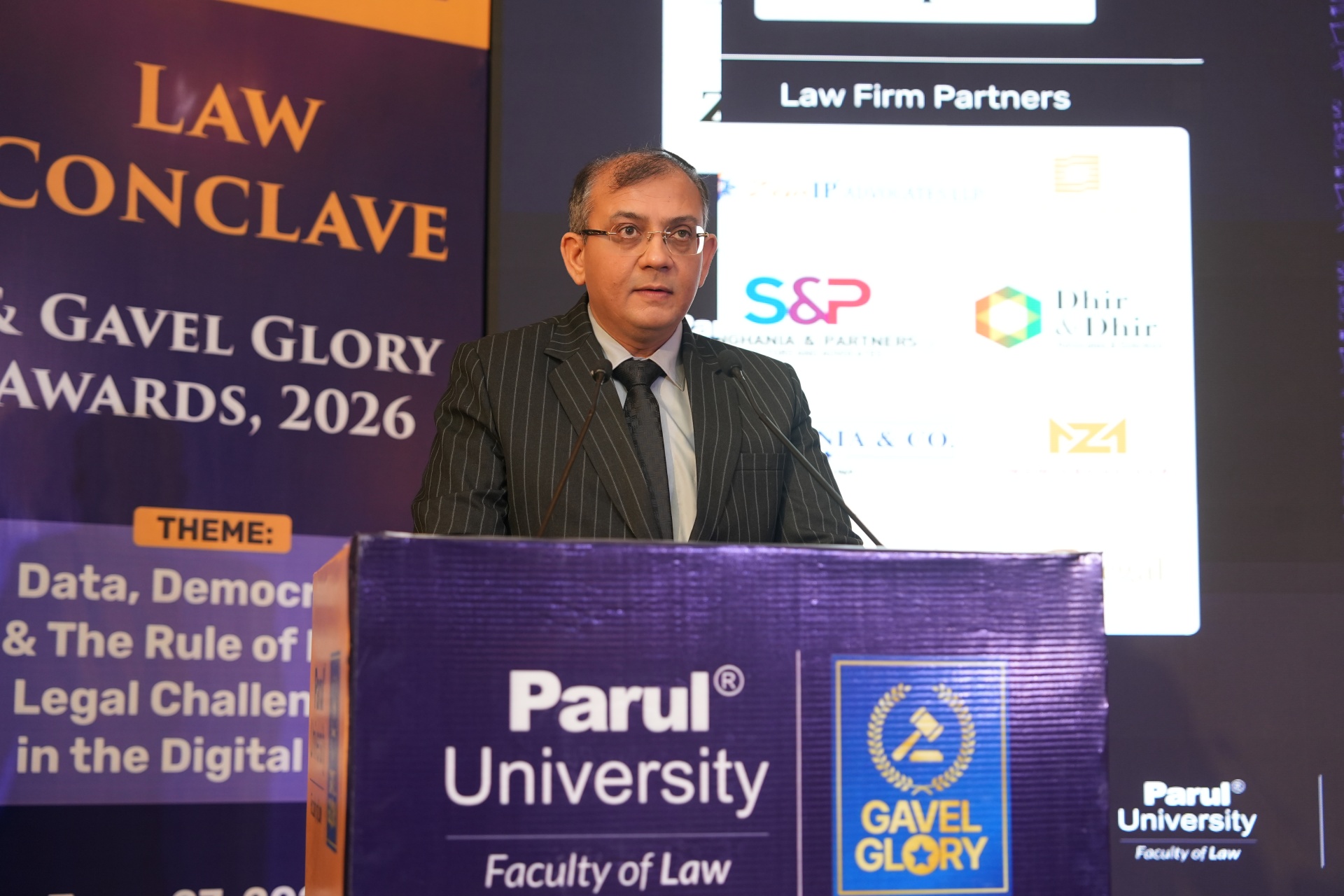

Justice Maulik Jitendra Shelat of the Gujarat High Court opened the morning session of Parul Institute of Law‘s Law Conclave 2026 by naming what has actually changed.
“In the 21st century, there has been a remarkable convergence between data, digital technology and governance.” – Hon’ble Mr. Justice Maulik Jitendra Shelat, High Court of Gujarat
Communication, commerce, education, civic participation, and now dispute resolution itself operate through technology. Artificial intelligence performs functions once reserved for people. Blockchain has transformed how records are secured. Automated platforms have absorbed work formerly done by human beings. Data has become a resource of universal value, and the law is being asked to govern all of it at once, using principles written long before any of it existed.
The Promise, and the Constitutional Bill That Comes With It!
Justice Maulik Shelat was careful to state the benefits before the risks, which is the mark of an argument made in good faith. Technology can deliver universal access to information, improve the functioning of government, promote transparency, and accelerate and democratise the administration of justice. These are not small gains, and no serious critic of AI in the law should pretend otherwise.
In legal work specifically, he identified where the gains sit: AI assists with legal research, document verification, data analysis, and case management. Blockchain provides secure recordkeeping and evidence that cannot be altered. Smart contracts allow commercial parties to automate contractual performance, and in some cases to execute predetermined outcomes without continuous human intervention.
That last capability is where the constitutional bill arrives. Automated execution without human supervision raises serious questions about privacy, accountability, transparency, and fundamental rights. These are not technical difficulties, he stressed. They go to the essence of the Constitution and the rule of law.
Data Democracy and the Rule It Must Obey
Justice Maulik Shelat defined data democracy with precision. It means granting individuals, organisations, and governments an equal and responsible right to access data, rather than allowing it to concentrate in the hands of a few large corporations. It must be managed so that it benefits everyone while respecting the rights of each individual.
The rule of law then imposes its own demands. Every act of collecting, processing, storing, or exchanging data must comply with existing law, because that compliance is what produces justice and equality. The challenge for a modern legal system is finding the balance between technological development and constitutional constraint.
Technology, he argued, is a medium and never an end. The aims of public administration do not change with the tools: upholding human dignity, securing liberty, achieving equality, and delivering justice. The Constitution must serve as the guide through the digital age, and the answer belongs neither to technology alone nor to law alone, but to an integration of both in which innovation is guided by constitutional principle and technological progress advances rather than compromises the cause of justice.
He quoted – “AI may identify precedent and organise evidence. It cannot exercise constitutional judgment.” PU Law Conclave 2026 – Bhumika Induliya’s experience on LinkedIn!
The Line Around the Judicial Function
No technology has drawn more attention from the legal community than artificial intelligence, and courts everywhere are examining its use for speed and convenience. India has embraced the change, Justice Maulik Shelat observed, while remaining faithful to the principle that justice must be administered by an impartial and independent judge.
The Constitution does not merely provide for disputes to be resolved. It requires that they be resolved with justice, equity, and conscience. Principles of natural justice, including the right to be heard and the requirement of a reasoned order, can never be delegated to software.
His formulation of the limit was exact. AI may identify precedent, organise evidence, and simplify administrative functions, but it cannot exercise constitutional judgment, appreciate human beings, assess credibility, or balance competing constitutional values. Courts today face the additional difficulty that AI systems analysing personal and sensitive commercial data rely on massive datasets and continuous learning, which, without careful regulation, risks the unintended storage or release of confidential information. Judicial use of AI therefore demands exceptional safeguards around data collection and storage. He even suggested that students pursue law with sheer authenticity at all levels of the legal domain. If you’re looking to bring change at the intersection of AI & Law, delay not and enrol on Parul Institute of Law’s BA LLB, BBA LLB, and LLM programmes. Besides this, they even have specialisations such as Master of Law in Intellectual Property Rights, Master of Law in Criminal & Security Laws, Master of Law in Constitutional & Administrative Law, and Master of Law in Business & Corporate Law as well.
The Statutes, and Where They Fall Short
Justice Maulik Shelat located the legal architecture precisely. Three statutes carry the weight of India’s digital legal order: the Digital Personal Data Protection Act 2023, which permits processing of personal data only for lawful purposes with the consent of the person concerned; the Information Technology Act 2000, which governs Indian cyberspace, electronic records, and digital signatures, and contains provisions on cybersecurity; and the Bharatiya Sakshya Adhiniyam 2023, the modern law of evidence, which makes electronic records admissible.
Together, they cover collection, conduct, and proof. What they cannot do, he suggested, is generate the public trust on which any of it depends. Trust comes from how institutions behave, not from what a statute says they must do.
Is Your Consent Actually Consent?
Justice Maulik Shelat then turned to the question that touches every person who has ever clicked agree. Digital service providers do ask for consent before collecting personal data. In practice, that consent is buried in lengthy and complicated terms and conditions that users do not read.
His conclusion was unequivocal. Unless an individual is capable of understanding how their data will be used, the consent they provide does not qualify as informed consent. In his opinion, it does not.
The right to privacy has expanded accordingly. It once meant personal space and the secrecy of correspondence. It now covers social media messages, personal information, behavioural patterns, biometrics, and browsing history. The legal question, he clarified, is not whether data was collected but whether it was collected lawfully. Any infringement of privacy must be genuinely necessary, proportionate to the end it seeks, and directed to a proper state objective.
Governments and large corporations gather a great deal of information about individuals, and much of that gathering serves people well. The violation begins where collection exceeds what is needed or proceeds without permission. At that point, Justice Maulik Shelat argued that what is injured is not merely a preference for secrecy but a person’s rights and dignity, which is why the three-part test exists at all.
Speech, Censorship, and the Statutes That Govern Both!
Digital platforms have expanded expression and also become vehicles for misinformation, hate speech, cyberbullying, and harassment. Excessive regulation stifles democratic discussion; insufficient regulation lets harmful material proliferate. Restrictions on speech must be lawful, legitimate, and balanced, with established procedures for review, because arbitrary censorship by a government or a private platform alike threatens democratic values and constitutional freedoms.
Justice Maulik Shelat pointed to three statutes carrying that burden: the Digital Personal Data Protection Act 2023, the Information Technology Act 2000, and the Bharatiya Sakshya Adhiniyam 2023, which renders electronic records admissible as evidence. The limits of the first are examined in Justice N.S. Sanjay Gowda’s address on AI and the DPDP Act.
Laws alone, he concluded, cannot create public trust. Any legal framework must rest on transparency, accountability, fairness, security, the protection of human rights, and democratic governance. India is uniquely placed to lead the world in building a technology-enabled justice system that still upholds the rights of its people, as its e-courts and online dispute resolution portals suggest. The future of justice lies in digitisation, but it must remain human, accountable, and faithful to the Constitution. The question he left the room with was whether technology is building public faith in justice or eroding it.
FAQs
Can AI decide cases in Indian courts?
No. Justice Maulik Jitendra Shelat told Parul University's Law Conclave 2026 that AI may identify precedent, organise evidence, and simplify administrative functions, but cannot exercise constitutional judgment, assess credibility, or balance competing constitutional values. Principles of natural justice, including the right to be heard and a reasoned order, cannot be delegated to software.
Is clicking agree on terms and conditions valid consent?
Justice Maulik Shelat argued that it often is not. Where consent is buried in lengthy terms that users do not read, and where an individual cannot understand how their data will be used, the consent given does not qualify as informed consent in his view.
What is data democracy?
Data democracy means giving individuals, organisations, and government an equal and responsible right to access data rather than allowing it to concentrate among a few large corporations, managed so that it benefits everyone while respecting individual rights.
When can the right to privacy lawfully be infringed?
According to Justice Maulik Shelat, an infringement must satisfy three requirements: it must be genuinely necessary, proportionate to the end it seeks, and directed to a proper state objective. The legal question is never whether data was collected, but whether it was collected lawfully.