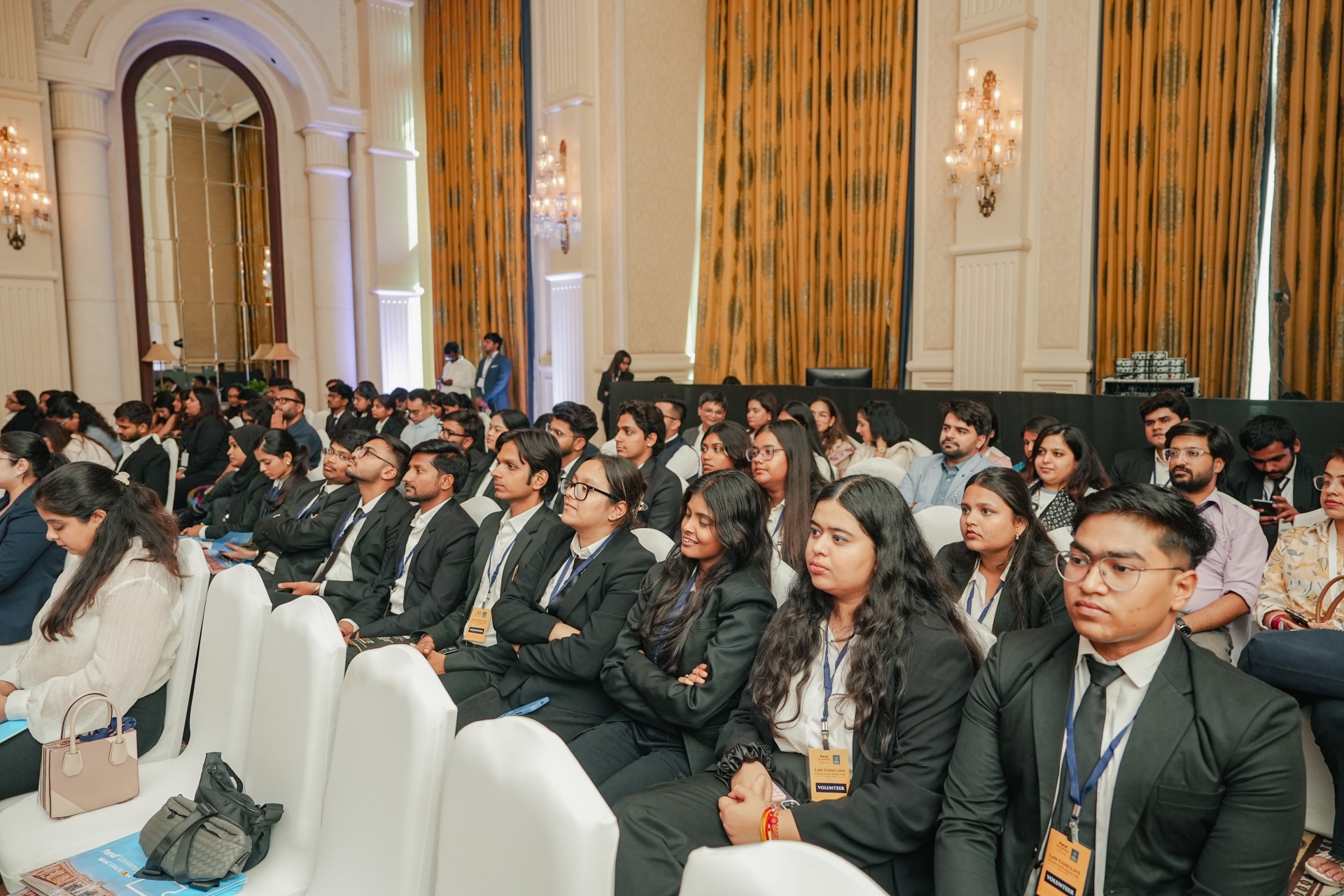
A room full of India’s legal domain debating on Law in the AI era, one judge is explaining the originality of “conclave”, tracing back to its Latin Roots – Con means Together in a room & Clavis means Key. It is the same procedure used to elect a pope. The purpose of a conclave, Justice D.N. Ray of the Gujarat High Court told the room to join hands in search of a key to problems that appear unresolvable.
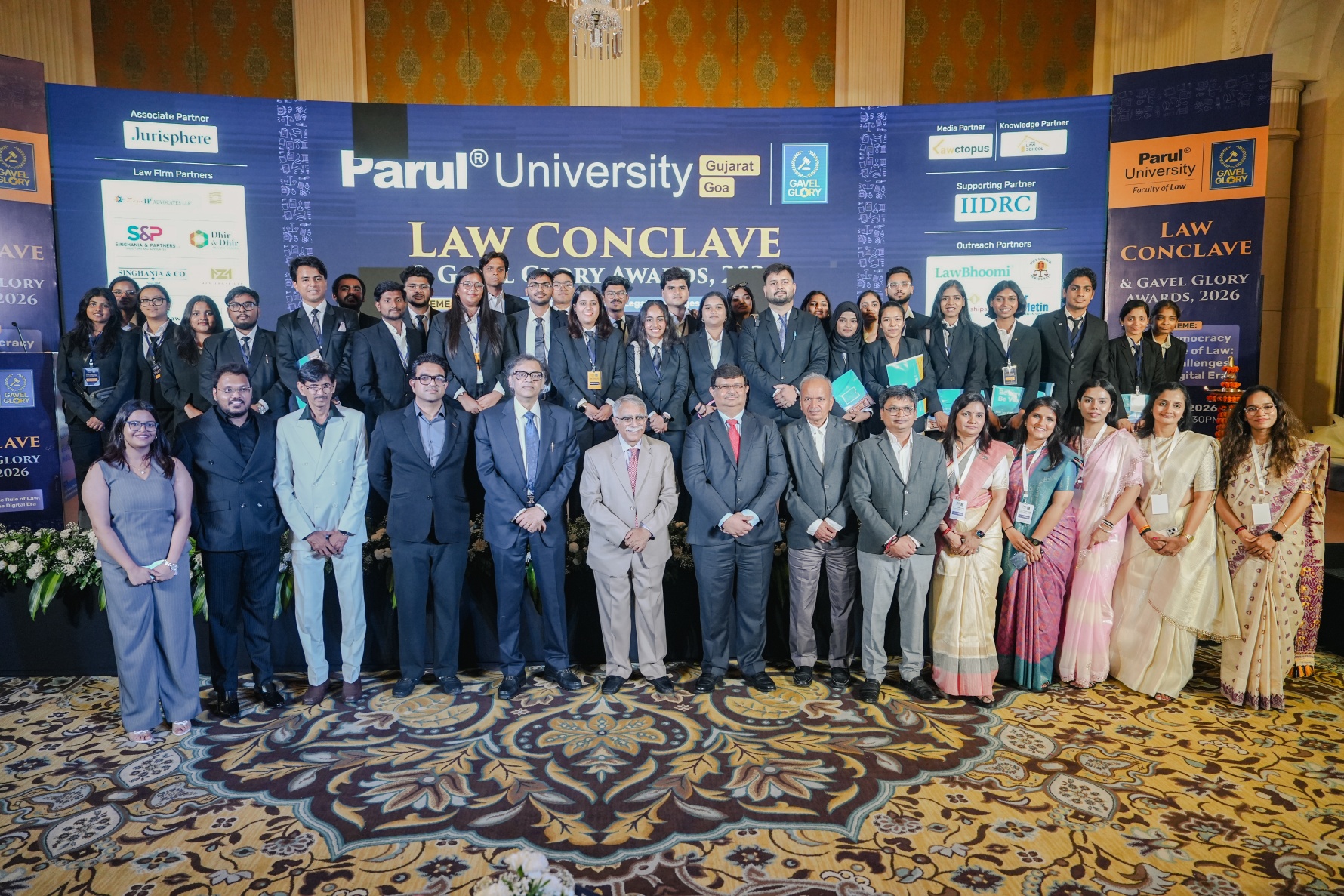
The problem Parul Institute of Law placed before its guests on 27 June 2026 was this: data has become the most valuable and most dangerous resource in the world, and the law has not caught up. The conclave, held at The Leela Palace, Chanakyapuri, New Delhi, under the theme Data, Democracy and the Rule of Law, brought five members of the bench, a law officer of the Union, senior advocates, and the managing partners of national firms together to work on it. It was organised by the Faculty of Law at Parul University in association with NC Legal, Advocates and Solicitors, and was the second chapter of the conclave, following the inaugural edition in 2025.
The Bench: Five Judges, Five Warnings
Each justice approached the theme from a different angle, and each is examined in a dedicated article.
Justice D.N. Ray of the Gujarat High Court warned against surrendering human territory to machines, reaching for HAL 9000 and Frankenstein to make the point. His argument, that AI must remain a servant and never a master, rested on a judge’s ability to watch a witness and know whether they are lying, something no transcript can capture.
Justice Maulik Jitendra Shelat of the Gujarat High Court examined what AI can and cannot do inside a courtroom and questioned whether consent buried in unread terms and conditions is consent at all. Justice N.S. Sanjay Gowda of the Gujarat High Court delivered the conclave’s most legally technical session, arguing that the Digital Personal Data Protection Act 2023 is not equipped for artificial intelligence and that India needs an AI-specific governance framework.
Justice Tejas Karia of the Delhi High Court traced how information became the defining form of power in the twenty-first century. Justice Rajesh Bindal, former judge of the Supreme Court of India and Honorary Professor of Law at Parul University, delivered the longest session of the day on cybercrime, digital literacy, and the limits of AI in judicial administration.
The ceremonies were led by two further members of the bench. The Honourable Justice Vivek Rusia, the Acting Chief Justice of the High Court of Madhya Pradesh, was invited as the Chief Guest, followed by the Justices – Sanjay Gowda & Maulik Shelat as Guests of Honour.
The Honourable Justice – Mr. Sanjay Karol of the Supreme Court of India was invited as Chief Guest with Justices D.N. Ray & Tejas Karia as Guests of Honour.
The entire conclave’s foreword was curated by Justice Rajesh Bindal. He even observed that Bar, Bench, Academia and Young Legal Minds coming onto a common platform will have a lasting impact on constitutional democracy!
Conclave: from the Latin con, together in a room, and clavis, a key. The search for a key to problems that appear unresolvable.
The Statutes the Conclave Kept Returning To!
From 5 addresses & two core panels, all of them went to one single discussion. They’re the foundation of our legal architecture –
- Digital Personal Data Protection Act 2023: It allows the entire processing of personal data only for lawful purposes, in sync with the consent of that particular person. Justice Maulik Shelat described the entire consent architecture, wherein Justice Sanjay Gowda argued that it cannot govern the functionalities of artificial intelligence!
- Information Technology Act, 2000: Governs Indian cyberspace, electronic records, and digital signatures, and carries the country’s principal cybersecurity provisions.
- Bharatiya Sakshya Adhiniyam, 2023: The modern law of evidence, which renders electronic records admissible, and which Justice Bindal placed against the reality of falsified digital evidence now reaching courts.
The Supreme Court’s judgment in Justice K.S. Puttaswamy, recognising privacy as a fundamental right, sat beneath all three and was invoked by name on the constitutional panel by every speaker in turn.
Two Panels, and One That Cannot Be Reported
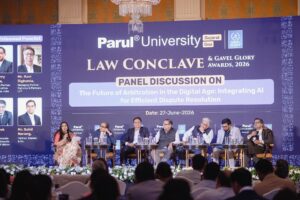
- The first panel took up arbitration in the age of AI, blockchain, and smart contracts. It produced the day’s most practical frameworks, including a three-zone model for where AI may safely be used in legal work. It seated Harry Chawla, Managing Partner of Luthra and Luthra Law Offices; Mr. Ravi Singhania, Managing Partner of Singhania and Partners LLP; Mr. Vivek Kohli, Senior Advocate and former Advocate General of Sikkim; Mr. Sahil Narang, Partner at Khaitan and Co.; Mr. Gauhar Mirza, Partner at Saraf and Partners; and Mr. Vikash Kumar Jha, Partner at Cyril Amarchand Mangaldas. It was moderated by Ms. Nivedita Chauhan, Founder and Managing Partner of NC Legal, Advocates and Solicitors.
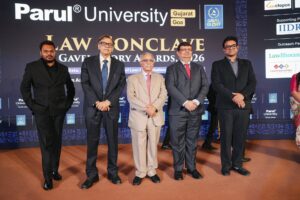
- The second panel, on balancing security and liberty, set an Additional Solicitor General against a senior advocate on surveillance powers and data exemptions, and produced genuine, useful disagreement. The esteemed panellists were Vikramjit Banerjee, Additional Solicitor General of India; Ms. Geeta Luthra, Senior Advocate of the Supreme Court of India; Mr. K.N. Balgopal, Advocate General of Nagaland; and Ms. Rekha Palli, former judge of the High Court of Delhi. It was moderated by Ms. Bhumika Indulia, Director and Editor-in-Chief of The Bar Bulletin and Co-Founder of Innovate Legal.
- The third panel, on intellectual property and technology law, addressed how artificial intelligence unsettles authorship, creativity, and legal practice. It was moderated by Naveen Varma, Senior Partner at ZeusIP Advocates LLP, and brought together senior in-house counsel and intellectual property specialists, among them Ms. Jigna Mehta, Ms. Taarika Pillai, Mr. Samaksh Khandelwal, and Ms. Gunjan Paharia, drawn from organisations including Reliance Retail, Cactus Communications, Vivo Mobile India, and ZeusIP Advocates.
Their presence at the conclave is a matter of record. Their remarks are not, because the session recording was lost to a technical failure. Rather than reconstruct what these practitioners said from memory, this account states only that they were there and that the questions they took up remain among the least settled in Indian law. Who owns the output of a generative model, whether training on copyrighted works constitutes infringement, and what authorship means when expression is produced by a machine are questions no jurisdiction has yet answered convincingly, and a panel of in-house counsel and IP specialists is precisely the room in which they get argued rather than theorised.
Top Panellists!
Beyond the bench and the panels, the conclave drew a substantial cross-section of the Delhi Bar. Special guests included Advocates-on-Record and Senior Advocates of the Supreme Court of India, alongside office bearers of the Supreme Court Bar Association: Mr. Abhinav Garg, Mr. Ayush Anand, Ms. Divya Roy, Ms. Indra Swaney, Dr. Monika Gusain, Mr. Meenesh Dubey, Ms. Pragya Baghel, Ms. Savita Singh, Ms. Smriti Kumari, Mr. Vikrant Yadav, Mr. Susheel Tomar, and Mr. Manish Mohan.
The presence of Bar Association office bearers alongside the bench and the corporate bar is what separates a working conclave from a lecture series. It places students in a room where the profession’s actual constituencies, litigators, in-house counsel, firm leadership, and the judiciary, are represented at once, and where they disagree with one another in public.
Parul University’s POV!
Dr. Parul Patel, Vice President of Parul University, framed the conclave as an opportunity for professionals and scholars to redefine legal paradigms and bridge academic learning with practical application. Dr. Devanshu Patel, President, made the case rather differently, and more memorably.
Rather than delivering a lecture to an audience already several hours into a dense argument, he told a story about a friend who made his house smart. The friend bought a smart watch, a smart television, a smart refrigerator, and an AI assistant, and clicked agree on a hundred-page contract he never read.
Days later, the refrigerator refused him a slice of chocolate cake, citing a clause about his glucose readings and his incomplete step count. When he protested that he owned the fridge, the machine informed him that he owned the hardware and merely licensed the software inside it. When he complained about advertisements appearing after a private conversation, he cited the clause permitting microphone access. That night, he dreamed of an AI judge who dismissed his case because he had traded his rights for a discount on a television.
“Technology is taking away our rights, our privacy, and our democracy.” – Dr. Devanshu Patel, President, Parul University
A computer can read a contract, he observed, but it can never comprehend human freedom. It can monitor data, but it cannot comprehend justice. Turning to the judges and advocates in the hall, he called legal professionals the only shield standing between human beings and machines that feel nothing, and left them with a single sentence: the law has to always remain human.
The Gavel Glory Awards
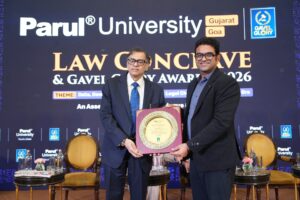
The day closed with the Gavel Glory Awards 2026, a legal recognition platform honouring contributions across the profession. The categories were tiered by experience and by the age of the firm, spanning individual practitioners, organisations, and the legal human resource professionals who rarely feature in awards of this kind.
- Individual categories: Young Legal Professional of the Year, Rising Star of the Year, and Lawyer of the Year.
- Organisational categories: Rising Star Law Firm, Emerging Law Firm, and Law Firm of the Year.
- Human resource categories: Young Achiever in HR Excellence, HR Rising Star, and HR of the Year.
The jury is the clearest measure of how seriously the recognition was intended. It comprised Hon’ble Ms. Justice Indira Banerjee, former judge of the Supreme Court of India; Ms. Mahalakshmi Pavani, Senior Advocate of the Supreme Court of India; Mr. Arvind Nayar, Senior Advocate of the High Court of Delhi; Mr. Pawan Reley, Advocate-on-Record of the Supreme Court of India; Mr. Harry Chawla of Luthra and Luthra Law Offices; Ms. Shweta Bharti, Managing Partner of Hammurabi and Solomon Partners; Mr. Rakesh Chandra Sinha, Vice President Legal at Sun Pharmaceutical Industries; Mr. Pravesh Biswas, Head Legal at Sunflag Iron and Steel; Mr. Rajiv Choubey, Group General Counsel of Dalmia Bharat; and Mr. Tarun Nangia of Legally Speaking.
A former Supreme Court judge, three senior advocates, and general counsel from three listed companies do not sit on a jury to lend a name to a certificate. They sit because the awards were structured to be judged.
Why This Matters for a Law Student
Justices of the Supreme Court and three High Courts, an Additional Solicitor General, and the managing partners of national firms do not give a day to an institution as a favour. They attend where the convening is credible. The Faculty of Law at Parul University runs Bar Council of India-recognised programmes from diploma to doctorate, and treats its mooting culture as central rather than decorative. This was the conclave’s second chapter, following the inaugural edition in 2025, which makes it an institutional commitment rather than a one-off.
The credibility of a conclave is measurable in a way most institutional claims are not. Count the sitting judges. Count the law officers of the Union. Count the firms whose managing partners cleared a working day. Then ask whether the same people would attend next year. This was the second chapter, which answers the question.
Dr. R.I. Parikh, Dean of Parul Institute of Law, framed the conclave as an opportunity for students and professionals alike to engage directly with the evolving legal landscape rather than read about it afterwards. Mr. Gurcharan Singh, Director of the Training and Placement Cell, made the practical case that legal education extends beyond the classroom into industry engagement and that platforms of this kind build the professional networks and employability a legal career requires.
Dr. Devanshu Patel closed by asking the legal fraternity not to let the association end with the conclave, inviting them to mentor students, conduct research, and offer internships.
Key Takeaways for Students & Legal Professionals!
The conclave produced no consensus, and that is its value. Justice Ray held that AI must never take territory from human judgment. Justice Gowda held that India needs an entirely new statute to govern it. The Additional Solicitor General held that surveillance exemptions are constitutional where bounded, while the Advocate General of Nagaland held that the bounds are not yet drawn. Senior practitioners disagreed publicly about whether Indian arbitration deserves its reputation.
A student who attended left knowing that the questions are open, that serious people answer them differently, and that the answers will be settled in courtrooms over the next decade by lawyers currently in law school. That is a more useful education than a day of agreement would have provided, and it is the reason a faculty convenes a conclave rather than a lecture. Parul University truly believes in bringing a change at all levels of innovation. If you’re interested in the legal domain or building a career as a professional lawyer at the intersection of AI & Law, enrol on BA LLB, BBA LLB, and LLM programmes at Parul Institute of Law right away!
FAQs
Define Law Conclave 2026?
Law Conclave 2026 was a national conclave hosted by Parul Institute of Law & NC Legal in New Delhi. They spoke on Data, democracy, rule of law, and the panel had 5 justices, 3 panel discussions and Gavel Glory Awards!
Which judges spoke at the Parul University Law Conclave?
Justices D.N. Ray, Maulik Jitendra Shelat, and N.S. Sanjay Gowda of the Gujarat High Court, Justice Tejas Karia of the Delhi High Court, and Justice Rajesh Bindal, former judge of the Supreme Court of India and Honorary Professor of Law at Parul University, delivered addresses. Justice Sanjay Karol of the Supreme Court and Justice Vivek Rusia, Acting Chief Justice of the Madhya Pradesh High Court, attended as Chief Guests.
Explain the discussion held at Law Conclave 2026?
The very first panel ensured a holistic examination of arbitration in the digital age, AI, blockchain, and contracts. The second panel addressed the constitutional front of powers, data exemptions and the rule of law. And the 3rd one covered how AI is reshaping Intellectual Property & creativity!
Is Parul Institute of Law recognised?
Yes. The Faculty of Law at Parul University offers Bar Council of India-recognised programmes across diploma, undergraduate, postgraduate, and doctoral levels. Parul University is accredited by NAAC A++ and holds Category 1 status with graded autonomy.