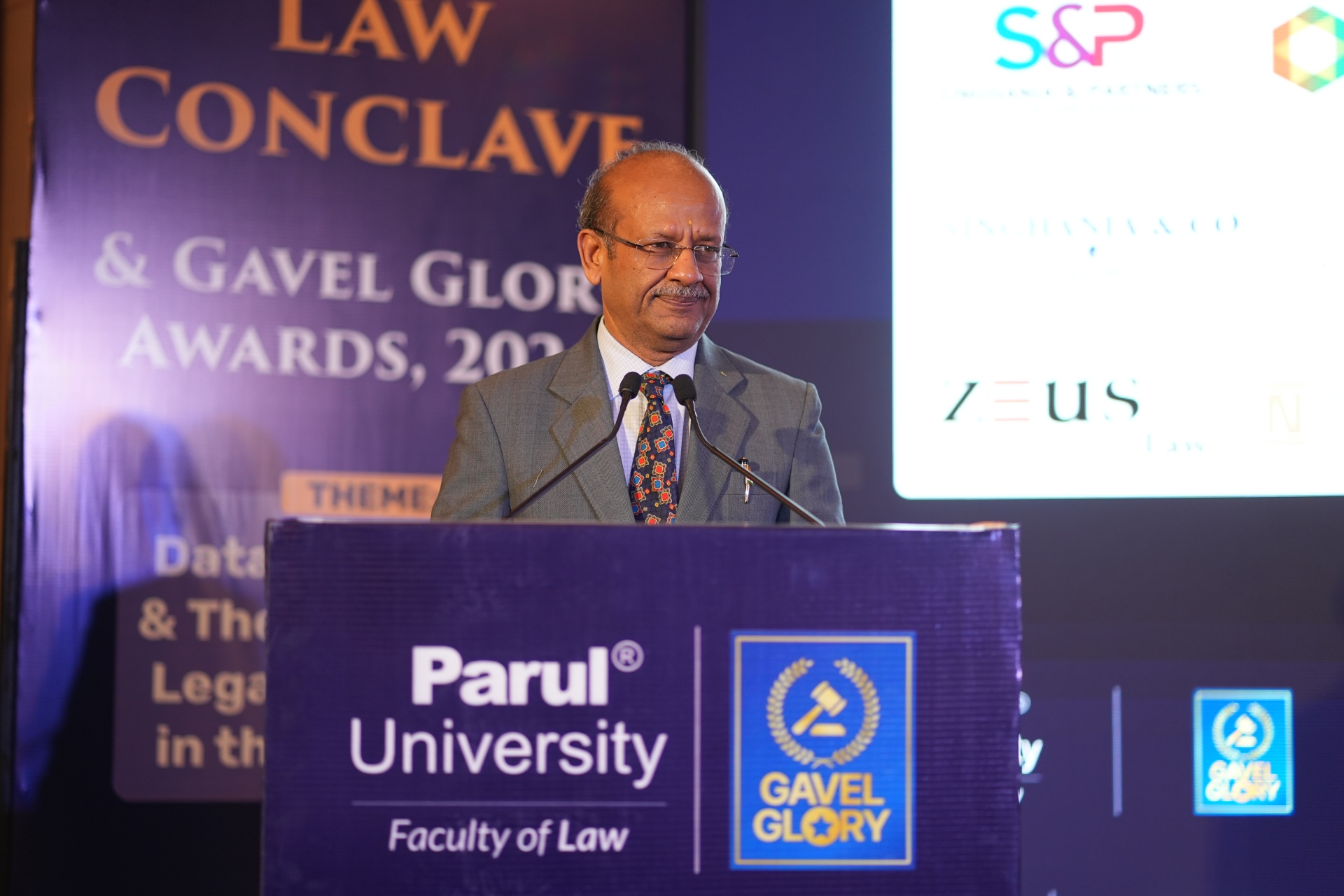
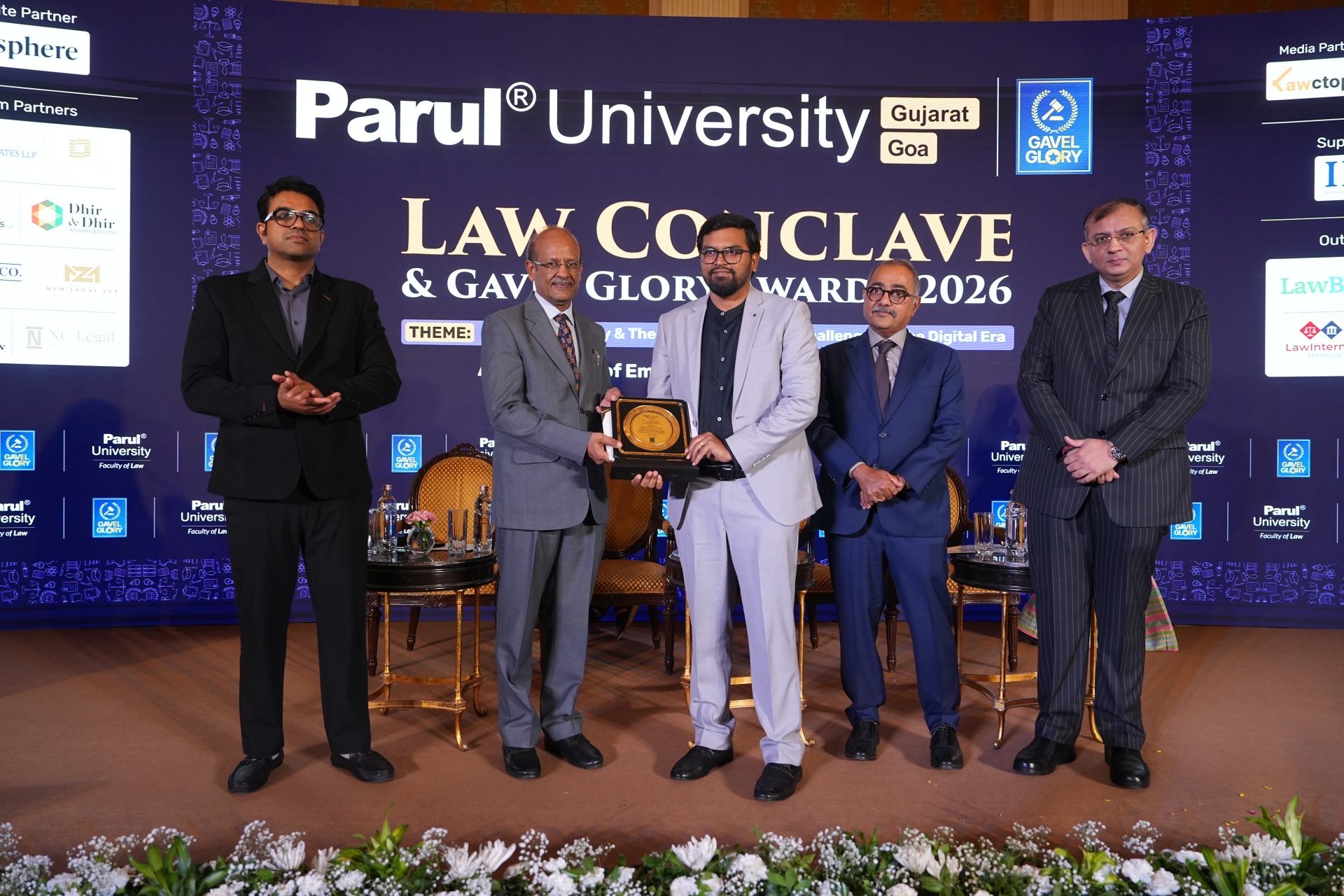
Few people can describe the entire arc of India’s digital transformation from personal experience. One such voice addressed the PU Law Conclave 2026: Justice Rajesh Bindal, former judge of the Supreme Court of India and Distinguished Honorary Professor of Law at the Parul Institute of Law, Parul University.
In 1989, he bought his first desktop computer for Rs. 25,000. It had a 20 MB hard drive and came with a dot matrix printer. The price of a computer, he observed, has not changed dramatically since then. Everything else has.
That observation opened the longest session of Parul Institute of Law’s Law Conclave 2026 and set the direction for everything that followed.
Drawing from lived experience rather than abstract theory, Justice Rajesh Bindal arrived at a conclusion that should challenge every law student who has become comfortable relying on chatbots.
How Data Became Everything!
Data, in Justice Rajesh Bindal’s definition, is simply facts, numbers, names, and information, remaining of little value until it is organised and applied. What has changed over the past few decades is its scale and storage. Records that once occupied physical space, took time to retrieve, and depended on someone knowing where they were kept have now become instantly accessible through digital systems. Human memory, he observed, has increasingly shifted into machines.
He illustrated this transformation with striking figures. He cited an estimate of roughly 200 zettabytes of data existing globally, with nearly 90 percent of it generated in recent years, and approximately 402 million terabytes of new data being produced every day, much of which is never used. He traced the evolution of storage from paper records to personal computers, then to servers and cloud computing, pointing out that while cloud technology offers convenience, it also transfers custody of valuable data to third-party providers.
These were the figures Justice Rajesh Bindal presented during his address. The larger lesson he drew from them was more enduring than the numbers themselves: whoever controls data holds enormous influence, while ordinary users often surrender that control by routinely granting applications access to contacts, photographs, locations, and other personal information without understanding where that data is ultimately stored or who controls it.
He extended the discussion to the infrastructure behind the digital world. Data centres require extensive physical infrastructure and continuous cooling systems, consuming significant amounts of electricity and contributing to environmental costs. At the same time, the nature of security risks has changed. Physical records could be damaged by fire or theft, while digital records face cyberattacks, hacking, and ransomware. Much of the stolen information eventually finds its way onto the dark web. Reflecting on these trade-offs, Justice Rajesh Bindal remarked that the paper era had certain advantages over the convenience-driven digital age.
Summarising his broader philosophy on legal practice, he observed, “A good lawyer spends less time reading and more time thinking.”
The Cybercrime Nobody Is Immune From!
Justice Rajesh Bindal spoke directly about who becomes a victim of cyber fraud. Referring to official figures, he noted that approximately 1.9 million cybercrime cases were recorded in 2024, with reported losses exceeding Rs. 20,000 crore. He emphasised that cybercrime does not target only the digitally inexperienced. Highly educated professionals, business leaders, and technically aware individuals are equally vulnerable.
- The methods have become increasingly sophisticated: Voice spoofing, facial manipulation, deepfakes, and identity fraud now form the basis of many online scams. Drawing from his judicial experience, Justice Rajesh Bindal recalled instances where emails and messages were fabricated in the names of the Chief Justice and other judges, falsely appearing to issue official directions. Some of these originated from outside India, while others came from within the country.
- Personal identity requires constant protection: Aadhaar and PAN documents, routinely shared for everyday purposes, can become tools for identity theft if handled carelessly. Justice Rajesh Bindal argued that protecting personal data is not merely a technical issue but one of safeguarding an individual’s identity and legal rights. His advice was practical: convenience should always be accompanied by verification, because fake emails, fake identities, manipulated videos, and fabricated digital evidence have become common realities.
Digital Literacy Is the New Literacy!
India’s literacy rate has risen substantially. Justice Rajesh Bindal argued that digital literacy has not advanced at the same pace. A person may be able to read and write while still lacking an understanding of how the digital world functions, and it is within that gap that many forms of exploitation occur.
He described cases in which individuals were recruited by criminals to route money through their own bank accounts in exchange for small payments, only to become entangled in serious legal consequences through ignorance rather than criminal intent. Many users accept terms and conditions without reading them or depend on others to carry out online banking on their behalf. At the same time, nearly 500 million Indians use social media regularly, spending around two hours and twenty-eight minutes each day on their phones, generating personal data through every photograph, post, search, and location they share.
Justice Rajesh Bindal also explained the economics behind this digital ecosystem. Early internet services attracted users by offering free email, search engines, and social networking platforms. Over time, these services came to rely on advertising driven by detailed analysis of user behaviour. The services, he observed, were never truly free. Users paid with data rather than money, often without recognising its value. The same concern becomes even more significant with biometric authentication, where fingerprints and facial recognition data, once shared, leave users with very little practical control over how that information may be used in the future.
His proposed remedy begins with education. Justice Rajesh Bindal argued that digital awareness should become part of school education, much like child protection awareness programmes. He noted that several countries have already introduced restrictions on children’s use of social media. The objective, he explained, is not to discourage technology, but to ensure that young people understand what they are consenting to before they give that consent.
What Technology Has Given the Courts
Justice Rajesh Bindal was no technological pessimist. He praised India’s Unified Payments Interface (UPI), launched in 2016 and since imitated by several countries, alongside the Direct Benefit Transfer (DBT) system as examples of technology improving governance and public service delivery.
He explained how GST and online income tax systems allow discrepancies to be identified by comparing declared rentals, property registrations, bank transactions, and tax records across digital databases. Used responsibly, technology makes fraud more difficult and accountability easier.
He also spoke with evident pride about the e-Courts Mission Mode Project, which has been operating since 2007. The system now enables electronic filing, virtual hearings, downloadable certified copies, and online case tracking, ensuring that citizens can access the justice system without unnecessary physical barriers. During the COVID-19 pandemic, these digital systems allowed courts to continue functioning when conventional proceedings became impossible.
The scale of that responsibility is enormous. Justice Rajesh Bindal noted that nearly 5.65 crore cases remain pending across Indian courts and argued that the efficient functioning of the judiciary is fundamental to the rule of law. India’s judicial digital infrastructure, he suggested, has become one of the strongest in the world because the country’s volume of litigation demanded innovation rather than leaving digitisation as a matter of convenience.
The Warning to Future Lawyers
Then came the part aimed squarely at students. Courts now confront falsified electronic evidence, tampered photographs and videos, fabricated online documents, and AI-generated legal citations. Lawyers file pleadings drafted by artificial intelligence without fully comprehending their contents, forcing courts to spend time authenticating what should have been verified before filing.
His diagnosis reached beyond professional carelessness. The effectiveness of any AI system depends entirely on the data used to build it. Inaccurate data produces inaccurate output regardless of how advanced the technology becomes. He invoked the old computing maxim, garbage in, garbage out, and applied it to legal work: poor data cannot produce sound decisions.
Advocacy, he reminded the room, will always rest on reasoning, communication, and persuasion. AI can research and draft. It cannot argue on its feet or respond to a judge’s question in the moment. Writing is not a substitute for thinking, and a lawyer who outsources thought has surrendered the only thing the profession actually sells. That concern was echoed across the conclave, including in the panel on AI in arbitration, where senior practitioners insisted that responsibility for an AI-assisted document always rests with the professional who signs it.
The technologies he flagged as the growth areas of law are worth noting: online arbitration and mediation, the constitutional balance between privacy, free speech, and data protection, and intellectual property questions raised by AI-generated content, digital copyright, and the synthetic re-creation of voices and performances. He also touched on the right to be forgotten, now the subject of substantial legal debate. He even suggested that students who are passionate about law and looking to build their career in the legal domain must pursue the BA LLB (Hons.) program from Parul Institute of Law. As it truly ensures how you can stay ahead in the world of AI and get placed at your dream law firm in India.
Students were truly inspired and enthralled that they’ve shared their experiences on LinkedIn, wherein Ansari Ismat says,
“Some experiences don’t just add to your knowledge; they reshape the way you think!”
FAQs
Who is Justice Rajesh Bindal?
Justice Rajesh Bindal is a former judge of the Supreme Court of India and serves as Honorary Professor of Law at Parul University. He delivered the longest keynote address at Parul Institute of Law's Law Conclave 2026 on data, democracy, and the rule of law in the digital era.
Can artificial intelligence replace lawyers?
No, according to Justice Rajesh Bindal. Speaking at Parul University's Law Conclave 2026, he argued that AI can assist with research and drafting, but advocacy depends on reasoning, communication, and persuasion, and on responding in the courtroom in real time. Technology, in his view, should support human intelligence rather than replace independent thinking.
What is the garbage-in, garbage-out principle in AI?
It means that the quality of an AI system's output depends entirely on the quality of the data used to train it. Justice Rajesh Bindal applied the maxim to legal work at the conclave, arguing that inaccurate data will produce inaccurate results, however advanced the technology, so poor data can never produce sound decisions.
Why does digital literacy matter for legal rights?
Because citizens who cannot assess digital information become vulnerable to cybercrime, misinformation, and unwitting legal liability. Justice Rajesh Bindal described people recruited to route criminal money through their own accounts out of naivety, and argued that digital awareness should be taught from the school level alongside traditional literacy.