The difference between a university that publishes research and a university that produces research with external validation is visible in who funds the work and how much they fund it. At the Research Excellence Awards, specific extramural grants were announced with team names, agency names, and amounts. Each grant represents an external agency reviewing a proposal, evaluating its merit, and committing public money to it. These are not internal awards. They are competitive national-level research grants.
545 Patents & 50 Crore Funding – Parul University Research Excellence Awards 2025!
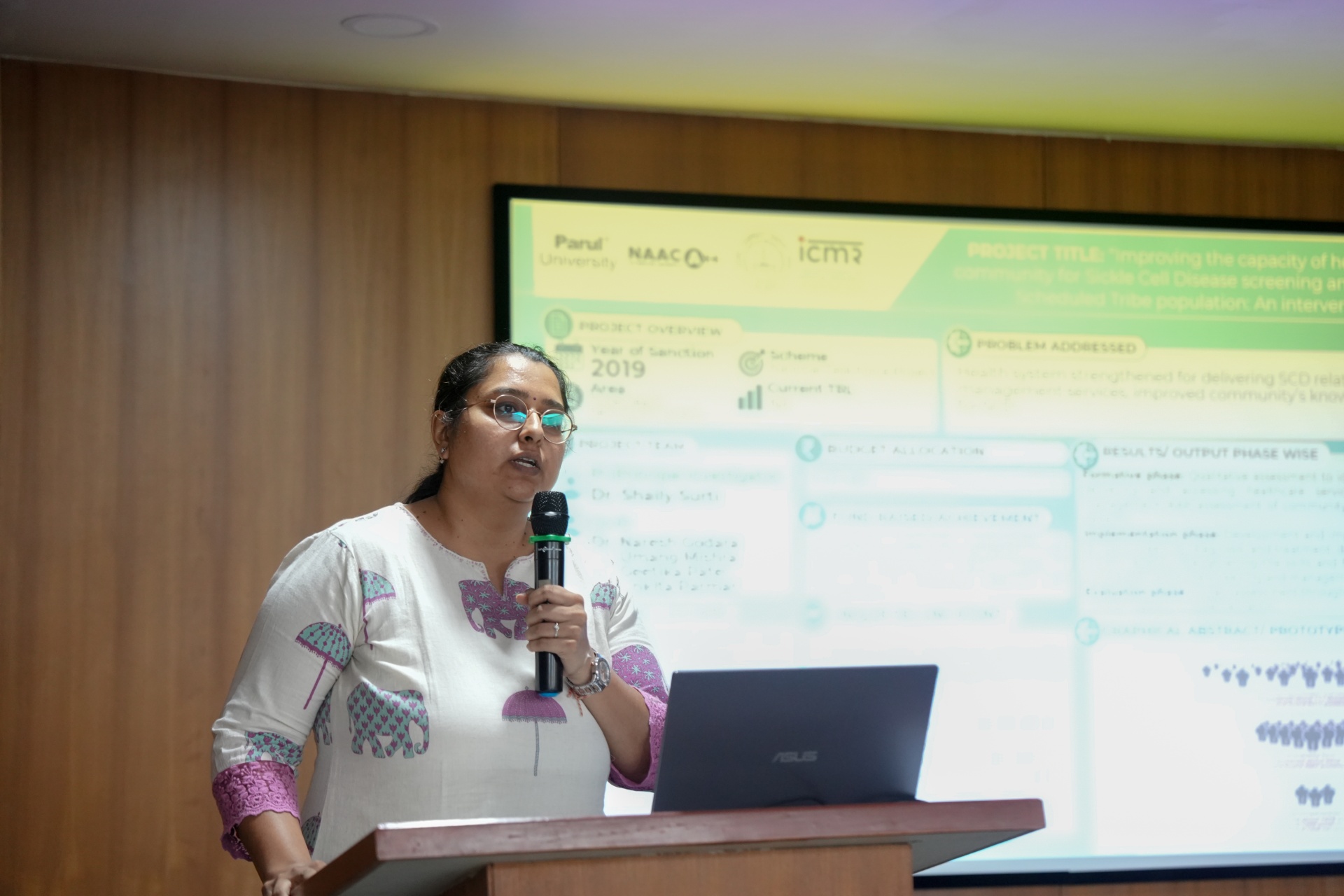
ICMR (Indian Council of Medical Research): Rs 264 Lakh Across 3 Projects
The largest single ICMR grant was Rs 131 lakh, awarded to a team led by Dr Shreyas Patel, Dr Hemant Patadia, Dr V Poornima, Dr Saurabh Parmar, and Dr Labitha Das for research on keeping the oral cavity safe for pregnant women. A second ICMR grant of Rs 75 lakh went to Dr Shreyas Patel, Dr Hemant Patadia, Dr Mehul Marwadi, Dr Ankita Priyadarshini, and Dr Prachi Patel for improving local foods. A third ICMR grant of Rs 58 lakh went to Dr Vasundhara Raina, Dr Reeshu Gupta, Dr Tarun Kumar Upadhyay, and Dr Afzal Nagani for conducting tests on diseased cells. Three projects, three teams and Rs 264 lakh from India’s premier medical research council.
GSBTM (Gujarat State Biotechnology Mission): Rs 93.81 Lakh Across 2 Projects
Rs 63.93 Lakh to Dr Pradeep Kumar, Dr Faraz, Dr Tarun Kumar for innovating and developing a mini-device which is capable of detecting cancers. Rs 29.88 Lakhs were rewarded to Dr Anjali, Dr Anitha H, Dr Maitri Sachinwala, Dr Bijal Prajapati for developing high-end bandages that heal wounds faster than ever. Both projects are amalgamated at the intersection of laboratory research & clinical application, a detection device that can manage and change how early staged cancers are identified, and another innovation was a wound-healing technology that can reduce recovery times in hospital & rural health centres where healthcare is nearly to zero.
Industries Commissionerate, CSIR, and ISRO
The Industries Commissionerate of Gujarat provided Rs 117 lakh, the largest single grant announced at the ceremony, to a team led by Dr Anand Joshi, Dr Unnati Joshi, Dr Sumit Das Lala, Dr Payel Deb, and Dr Bhavesh Mewada for developing a new centre for manufacturing excellence. CSIR funded Rs 31.72 lakh to Dr Prince Jain, and Dr Anand Joshi for high-speed computer networks. ISRO funded Rs 22.52 lakh to Dr Anand Joshi, Dr Unnati Joshi, and Dr Mahendra Singh Rathore for developing special components for space vehicles. When ISRO funds a university to develop space vehicle components, it is a statement about the institution’s engineering and materials research capability that no ranking table can replicate.
The Researchers: Named Faculty With Measurable Output
Research output without names, departments, and metrics is marketing. With them, it is evidence. Parul University has 7 faculty members in the Stanford-Elsevier Top 2% Scientists ranking globally: Dr Madhusudan Hiraman Fulekar (Plant Biology, h-index 48), Dr Mange Ram Yadav (Medicinal Chemistry, h-index 36), Dr Deep Pooja (Drug Delivery Systems, h-index 37), Dr Bhupendra Gopalbhai Prajapati (Pharmacology, h-index 34), Dr Vishal P Sorathiya (Optoelectronics, h-index 30, i10-index 68), Dr Prince Jain (Machine Learning, h-index 21, i10-index 62), and Dr Juhi Saxena (Biotechnology, h-index 18).
At the awards ceremony, the metrics were specific to each winner. Dr Vijay Upadhye (Microbiology, HIV, Tuberculosis, Immunology: i10-index 51, H-index 23) won three awards simultaneously: Best Researcher, Highest Cumulative Impact Factor, and Maximum Patent Grant. Dr Prince Jain (Machine Learning, Biomedical Signal Processing: i10-index 62, H-index 26) received the Young Researcher Award. Dr Vishal Sorathiya (Nano-composite, Metamaterial, Biosensor, Solar Cell: i10-index 68) received the Highest Cumulative Citations Award. Dr Pankaj Kumar (Environment, Water Quality, Sustainable Development: i10-index 40, H-index 23) received the Highest Cumulative Citations Award. These are not ceremonial recognitions. They are evidence of sustained, published, cited, and externally validated research output.
PhD and PG Thesis Winners: The Next Generation of Researchers
Sixteen PhD theses and twelve PG theses were recognised, spanning the full breadth of the university’s research ecosystem. The thesis topics and their mentors tell you what the university’s research pipeline is actually producing:
- Dr Ngobeh Jusu Momoh: sun energy systems (mentor: Dr Vishal Sorathiya)
- Dr Swapnil Vitthal Rahane: simulation exercises for heart attacks (mentor: Dr Ravindra H N)
- Dr Yashasvi Shakdvipiya: herbal medicines for kidney stones (mentor: Late Dr Mushtaq Ahmed Mhaishale)
- Dr Karishma Qureshi: intelligent machines for retail stores (mentor: Dr Bhavesh Mewada)
- Dr Ahemad Abarar: construction with recycled plastic and threads (mentor: Dr Jayesh R Juremalani)
- Dr Chintan Sheth: prevention of cancerous body cells (mentor: Dr Pinkal H Patel)
- Dr Noopur Bhatt: treating knee pain among athletes (mentor: Dr Amalkumar Bhattacharya)
- Dr Joshi Dhara Bipin: making hospitalised children happy (mentor: Dr Uma Siddharth Nayak)
- Dr Stephen Oteng: financial regulations for small businesses in Africa (mentor: Dr Ashwinkumar A Patel)
PG thesis winners included research on recognising words from images, Mr Bhargav Rameshchandra Gor who did a stunning work and was proudly recognized and awarded by dignitaries. His research solved a major issue – detecting Gujarati text from natural scene images is challenging due to variations in lighting conditions, text orientation, shape and font size, so via his research, he has solved it to make accurate text detection and text extraction seamless at all the levels. He thanked Dr Chintan Thacker for his relentless support and contribution in his research journey.
His proud guides were Dr Chintan Thacker & Dr Nitin Mishra), smart machines that prevent forest fires (Ms Parmar Kavita, guides: Ms Tejal Patel, Dr Pragyan Nanda), diagnosing mouth infections using biological codes (Ms Neha Kumari, supervisor: Dr Reeshu Gupta), and creating blue clothing with minimal fabric wastage (Ms Swati Prasad, advisors: Dr Dhara Parmar, Dr Anand Bhargav). The diversity of topics, from solar energy to athlete knee pain to African financial regulation to forest fire prevention, reflects the breadth of a research ecosystem that does not confine itself to a single faculty or discipline. If you too want to ideate, validate, test and publish your research globally, then begin your journey with the excellent support of Research & Development Cell of Parul University!
What Makes This a Research Ecosystem, Not Just a Research Output
Dr Geetika Madan Patel‘s message at the ceremony drew the line between research that exists and research that matters. Her own story, conducting breastfeeding research as a first-year medical student against the advice of her professor, then spending a year persuading senior doctors to implement the findings, then watching the hospital change its practices and educate all mothers, is the model. Research that stays in a journal is incomplete. Research that changes practice, that reaches the people it was designed to help, is the goal.
The portable ECG device story extends this principle into the university’s current ecosystem. A student invented a small ECG device. Parul University supported clinical testing at its own hospital (one of 7 NABH-accredited hospitals on campus). The device was validated. The government now deploys it across healthcare centres.
This is the full pipeline: student idea → university incubation (PIERC, which has supported 254 startups with Rs 20 crore+ in funding) → clinical validation at PU’s own hospitals → government deployment. The pipeline exists because the infrastructure exists: Rs 58.31 crore in government-funded research, Rs 4.37 crore in private-funded research, 315 total projects funded, 6 research centres including a DSIR-approved R&D Centre, a NABL-accredited Environmental Lab, an AICTE-supported Drone Lab, and the Micro-Nano Research and Development Center approved by the Industries Commissionerate of Gujarat.
Parul University Startups on Shark Tank India – Pipeline from College to Global Recognition!
Parul University’s supportive research policies reinforce the ecosystem: Intramural Research (IMR) grants for seed funding, financial support for attending national and international conferences, support for publication in high-impact journals including Article Processing Charges (APC), research excellence awards for publications, patents, and funded projects, and encouragement and recognition for externally funded projects. NAAC A++ (CGPA 3.55). The research is not separate from the teaching or the placement or the startup ecosystem. It is the same institution.
Read more on Parul University Placements
FAQs
How many research agencies have funded Parul University?
ICMR aka Indian Council of Medical Research - ICMR - 264 Lakhs, GSBTM = 93.81 Lakh, Industries Commissionerate - 117 Lakh, CSIR - 31.72 Lakh, ISRO - 22.52 Lakh. Besides this, DST, DBT & BIRAC also funded projects. Total external funding covered 50 Crore in 2021 - 2025. These are the competitive national-level grants awarded after proposal review and merit evaluation.
How many Stanford Top 2% Scientists does PU have?
Almost 7 top faculties were recognized in Stanford-Elsevier Top 2% Scientists globally, Dr Madhusudan Hiraman Fulekar, Dr Mange Ram Yadav, Dr Deep Pooja, Dr Bhupendra Prajapati, Dr Vishal Sorathiya, Dr Prince Jain, and Dr Juhi Saxena.
Does PU support translational research?
Indeed, Dr Geetika Madan Patel emphasised that research should co-create impactful societal impact via tech transfer, entrepreneurship, and clinical implementation. Besides this, a student developed portable ECG device was incubated at the university, clinically validated at PU’s very own NABH-accredited hospital and deployed by the government across various healthcare centres. PIERC has incubated 254 startups with 20 crore+ in funding & 40 crore+ in revenue, GSBTM has funded a cancer detection mini-device, and wound-healing bandages. That’s how the pipeline functions, from research to real-world impact is built into the institutional structure.