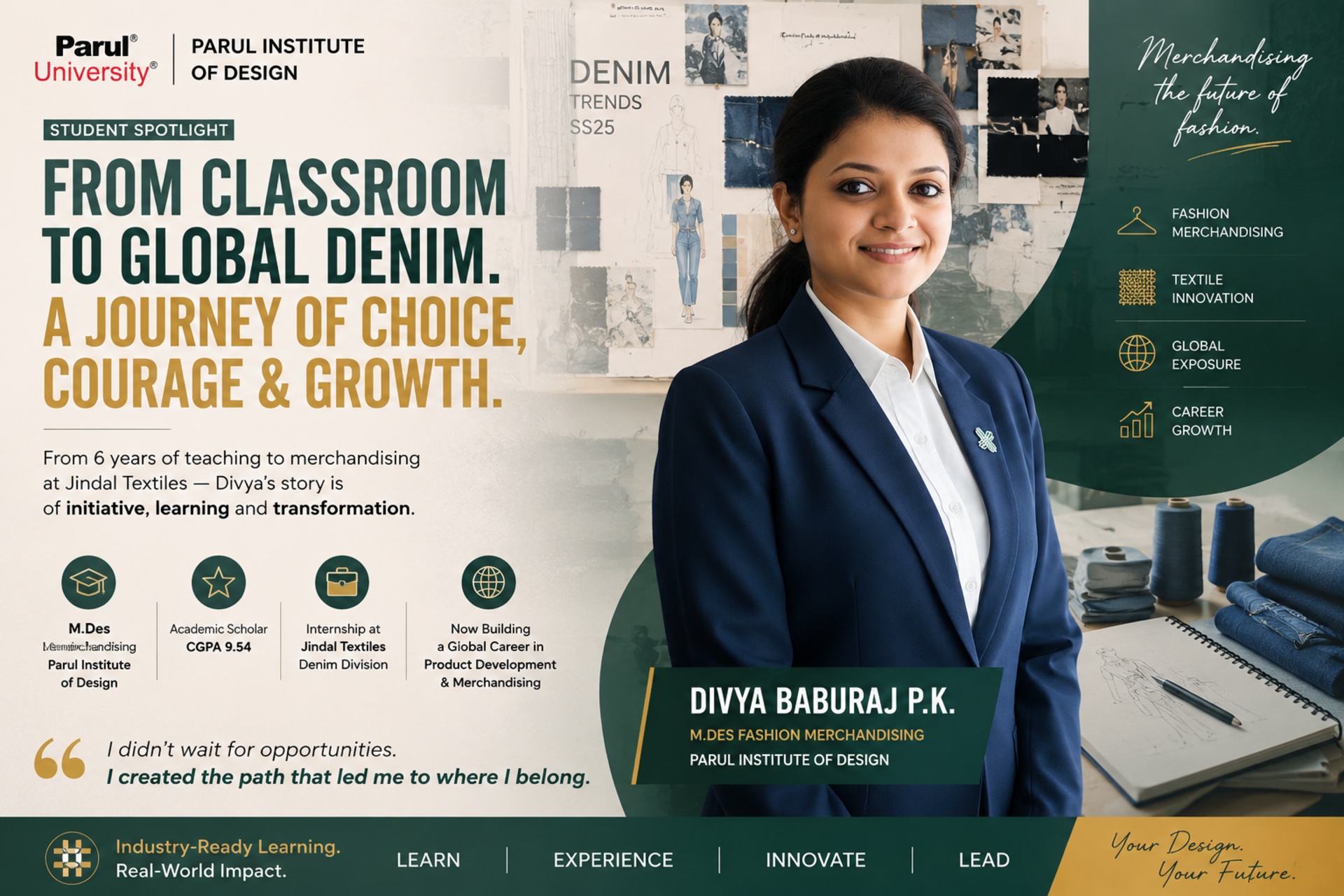
Divya Baburaj spent six years at the front of a classroom teaching fashion, pattern making, garment construction, 3D couture, CLO 3D, and CAD at a design school in Kannur, Kerala, and running seminars at Kerala government vocational schools. She was good at it and secure in it. That security is exactly what she decided to leave. She recognised that staying in the same teaching role had become a comfort zone, and that a subject she wanted to master, the business and merchandising side of fashion, was not something she could teach herself into. So she went back to being a student.
That decision, to trade a stable teaching career for postgraduate study in an unfamiliar field, is the spine of Divya’s story, and it runs on initiative from start to finish. She spotted the M.Des programme on Facebook, could not find a suitable one in Ahmedabad where she was based, and chose to study at Parul Institute of Design, part of the Faculty of Design at Parul University. Two years later, she had reframed her entire understanding of the fashion industry and completed a merchandising internship at Jindal Textiles that she secured through her own direct effort.
This sits alongside other documented outcomes from the Faculty of Design at Parul University, including the broader placement record at Parul University.
The background: a teacher who wanted to become a practitioner
Divya Baburaj was born in Kerala and later settled in Ahmedabad. She completed her Bachelor of Commerce and a 3-year Diploma in Fashion before moving to Kannur, where she worked as a fashion faculty member for around six years. During this time, she taught pattern making, garment construction, 3D couture garments, fashion styling, CLO 3D, and CAD.
The commerce degree and the design diploma had already given her an unusual combination of business grounding and technical craft.
As she wanted to move beyond teaching, she looked towards the product development chain, merchandising, and the retail side of the fashion industry. Here, experience mattered as much as academic qualifications, so she chose the M.Des in Merchandising at Parul Institute of Design, where she gained specialised learning and exposure that broadened her understanding of global career pathways.
The transition back to student, at a different stage of life
Returning to academics after six years as a faculty member was genuinely challenging, and Divya is candid about why. There was an age gap between her and her classmates, technologies had evolved, and she was learning merchandising, a subject entirely new to her, from the ground up. The early stages demanded real effort and adaptability.
What helped her throughout the journey was a combination of determination, confidence, and supportive faculty members. Being goal-driven and supported by Parul University’s academic ecosystem, she credits faculty members Dhara Parmar & Anand Bhargava for helping expand her understanding of the field. Over time, she grew more confident in her abilities. Although transitioning back to student life after working as a professional was challenging, the right academic guidance helped her succeed.
Taking the initiative: securing the Jindal Textiles internship
Divya knew what she wanted, and so her hands-on experience in merchandising helped her with a role that she desired, instead of settling for something less. Jindal Textiles is a leader in the Indian textile industry and operates in India and has international collaborations as well. She has received exposure across design, departments, pattern making, merchandising and a clarity to align with her real career goal. Indeed, it’s a lesson worth learning for any aspiring student or fashion designer – Know precisely what you want, and pursue it with your 100% efforts. It will surely give you worthy results, instead of settling for what’s nearest!
The internship that redefined what merchandising means
Divya joined Jindal Textiles in December, a timing that turned out to be valuable because it coincided with a season of international fairs. That exposure gave her in-depth access to market trends, research methodologies, and the workings of the textile and denim industry. She worked under the guidance of her mentor, Mr. Ankush Rao, and describes the entire team, up to the CEO, as consistently supportive.
The internship overturned a misconception she had carried into it. She had believed designers alone managed a product’s full lifecycle, including materials, manufacturing, vendor communication, costing, and execution. The reality of merchandising was broader and more demanding. She came to understand merchandising as a function spanning many responsibilities at once, requiring professionals to sustain performance under real industry pressure while playing a central role in how a product is developed and brought to market.
- Design forecasting. Within the design department, Divya studied ongoing market trends, identified emerging opportunities, and analysed concepts that had not yet entered the market—the forward-looking work that shapes what a brand develops next.
- Global industry exposure. She attended international fairs featuring brands from the United States, Germany, Italy, and other countries, gaining direct exposure to global product development practices beyond classroom learning.
- Competitor and product research. She analysed numerous denim brands to understand their techniques and identify opportunities for differentiated products that could strengthen Jindal Textiles’ market positioning.
The research: denim, at a level of detail most students never reach
The depth of Divya’s research is what sets her internship apart. Her assigned project, guided by faculty member Dhara Parmar, was a study titled A Study on Predictive Shrinkage Compensation in Denim Pattern Making Across Wash Types, combined with understanding the merchandising workflow across the design and sampling departments. This was specialised, technically rigorous work that focused on predicting how denim shrinks under different wash treatments so that patterns can be cut to compensate for those changes, addressing a real and costly challenge in denim manufacturing.
Around that core project, she analysed 30 to 40 domestic and international fashion brands to understand their market positioning, product differentiation, and design strategies. Her research covered multiple aspects of denim product development, demonstrating the depth of learning possible through merchandising education.
- Silhouettes and fits. Loose-fit, baggy, wide-leg, Korean-style, and cargo trouser silhouettes, along with jacket styles, garment construction methods, fits, and sizing trends.
- Wash techniques. Rinse, enzyme, stone, bleach, and overdye washes, as well as flare variations and contemporary silhouettes, representing the wash techniques that influence how denim products look and perform in the market.
- Materials and manipulation. The use of natural fibres and blended yarns in denim, textile surface ornamentation, and garment manipulation techniques, including cut-and-slash methods, building on her strong interest in pattern making.
- Seasonal themes and forecasting. Seasonal denim concepts such as Beyond Blue, Eternal Stone, Essential Threads, Forest Fade, Salad Bar (natural fibres), and Ballerina, alongside fashion forecasting, historical influences, and emerging denim trends.
The lesson in a single conversation
One exchange during an international exhibition crystallised what the internship taught her. A colleague, Mr. Amit, asked Divya to evaluate a display of denim samples and identify the one she preferred. She disliked the first sample because it appeared visually flat and chose the last one for its stronger visual appeal. She also rejected the middle samples because the garments looked uneven around the waistband and hems.
Her instinct turned out to be technically grounded. The first sample was made from plain cotton denim, while the one she preferred was a 100 per cent bleach denim with greater elasticity and stronger visual appeal. Mr. Amit explained that denim design depends heavily on wash techniques, that consumers generally prefer a variety of washed finishes over plain cotton, and that blended yarns improve fit, flare, and overall garment appeal.
The experience connected her visual judgement with the material science behind denim manufacturing and became one of her most valuable practical lessons. It also helped her understand why premium denim garments and jackets can command prices between three and five lakh rupees by examining vendor networks, sourcing practices, and detailed product specifications provided in brand instruction manuals.
Where she goes next, and what her path shows
Divya plans to pursue research or a PhD and eventually return to teaching, this time with the industry experience she felt was missing earlier in her career. It forms a clear journey: she left teaching to gain practical exposure and now intends to bring that experience back into the classroom. Throughout this journey, she credits her family, especially her husband, who serves in the Merchant Navy and encouraged her to pursue her master’s degree.
Divya recommends the M.Des in Merchandising at Parul Institute of Design because it combines practical exposure with academic learning and helped her build confidence in a subject she had started learning from the ground up. For professionals considering a thoughtful career transition, her experience demonstrates how a postgraduate programme can become a meaningful turning point rather than simply another qualification. Students interested in beginning their journey earlier can also pursue the Bachelor of Design in Fashion Design Technology, which provides guidance in the evolving fields of AI, design, and fashion technology.
Her journey also reflects Parul University’s broader approach to education, which extends beyond placements to developing industry-ready graduates who can shape their own careers. While Divya’s path is academic rather than entrepreneurial, the same philosophy supports students interested in innovation through PIERC, the Parul Innovation and Entrepreneurship Research Centre, which has supported 254 startups across sectors, including consumer and lifestyle brands.
The institutional ecosystem further strengthens this learning environment. Parul University holds NAAC A++ accreditation with a CGPA of 3.55, has Category 1 status with Grant of Graded Autonomy, and has been recognised as the Best University in Placements by ASSOCHAM for three consecutive years, supported by a network of 2,200+ recruiting companies. In the Times Higher Education Sustainability Impact Ratings 2026, the university ranks 7th in India for SDG 4 (Quality Education) and 6th in India for SDG 5 (Gender Equality), reflecting its commitment to building inclusive academic and professional opportunities.
FAQs
Who is Divya Baburaj and what did she study at Parul Institute of Design?
Divya Baburaj (P.K. Divya) completed an M.Des in Merchandising at Parul Institute of Design, part of the Faculty of Design at Parul University, in the 2024 to 2026 batch. Before the master's, she held a Bachelor of Commerce and a three-year Diploma in Fashion Design, and spent nearly six years as a fashion faculty member in Kannur, Kerala, teaching pattern making, garment construction, 3D couture, CLO 3D, and CAD. She chose the M.Des to move from teaching into product development and the business side of fashion. During the programme, she completed a merchandising internship at Jindal Textiles, where she researched denim product development, fashion forecasting, and a faculty-guided project on predictive shrinkage compensation in denim pattern making across wash types.
How did Divya secure her internship at Jindal Textiles?
Divya Baburaj secured her internship through her own initiative, contacting companies directly to find a role focused specifically on merchandising rather than general design. She knew precisely what experience she wanted and pursued it deliberately. Jindal Textiles was the right fit because it offered exposure across multiple departments, design, pattern making, and merchandising, rather than confining her to a single function. She joined in December, a timing that coincided with international fairs and gave her in-depth exposure to market trends and global product development. She worked under mentor Mr. Ankush Rao, with support from the whole team, including the CEO. Her approach demonstrates a key lesson: knowing exactly what experience you need and pursuing it directly produces a better outcome than accepting the nearest available opening.
What is fashion merchandising and why did the internship change Divya's understanding of it?
Fashion merchandising is the function that manages how fashion products are developed, positioned, priced, and brought to market, sitting at the centre of product development, vendor communication, costing, forecasting, and execution. Divya Baburaj entered her internship believing designers alone managed a product's full lifecycle, but her experience at Jindal Textiles showed that merchandising spans many responsibilities simultaneously and requires sustaining performance under real industry pressure. She worked on design forecasting (studying market trends and emerging opportunities), attended international fairs featuring brands from the United States, Germany, and Italy, and conducted competitor research across numerous denim brands to identify differentiation opportunities. Her assigned research project examined predictive shrinkage compensation in denim pattern making across wash types, a technically serious problem in denim manufacturing. The internship revealed merchandising as a demanding, central profession rather than a support function.
Is an M.Des in Merchandising a good option for a career change into fashion?
Divya Baburaj's experience demonstrates that it can be. She left a stable six-year fashion teaching career to pursue an M.Des in Merchandising at Parul Institute of Design, wanting practical industry grounding in product development and the commercial side of fashion that teaching had not given her. Despite the challenges of returning to study, an age gap with classmates, shifting technologies, and an entirely new subject, she built genuine confidence in merchandising through focused effort and faculty support from Dhara Parmar and Anand Bhargava. Her internship at Jindal Textiles gave her hands-on exposure to denim product development, global fashion fairs, and technical research. She recommends the programme specifically because it combines practical exposure with academic learning. For a mature student making a considered career change, the M.Des functioned as a genuine pivot into a new specialisation rather than merely an additional credential, and her plan to pursue a PhD shows the degree opening further academic and professional directions.