APPLAUSE ENTERTAINMENT SESSION AND STORYTELLING ARC
Storytelling has not changed in fifty thousand years. Distribution has changed in recent years. The difference is the entire shape of the modern entertainment business.
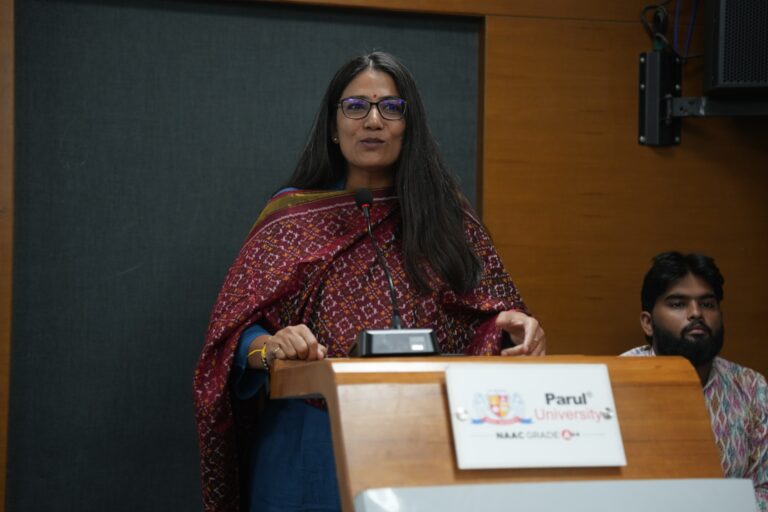
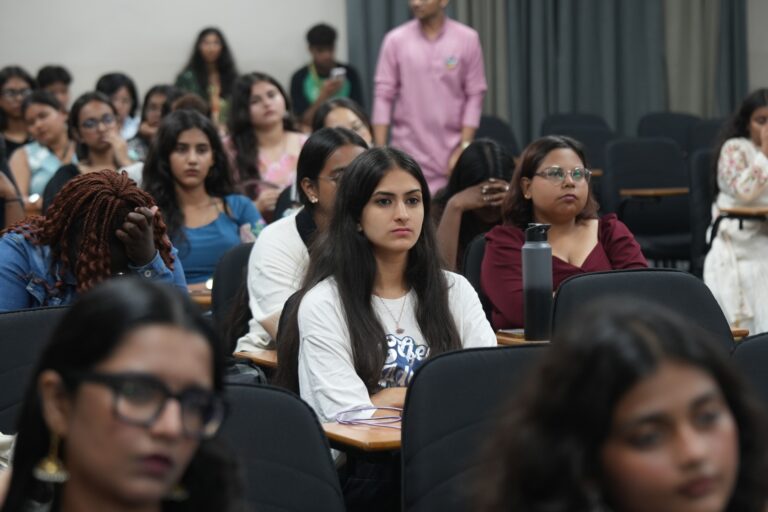
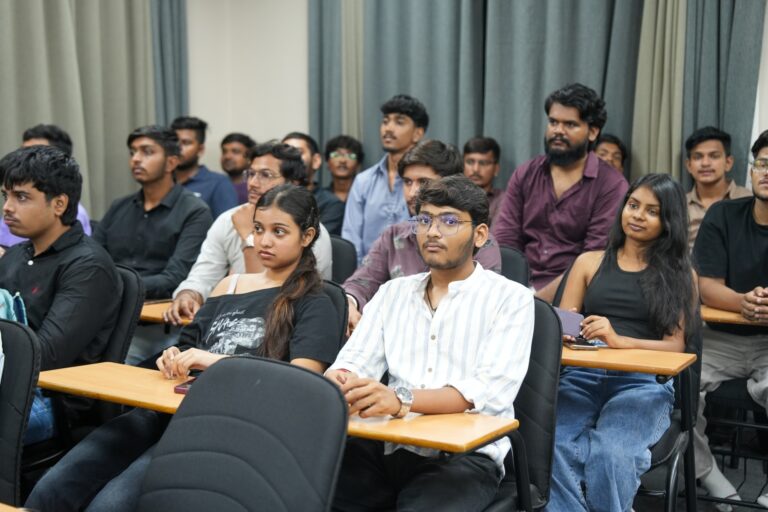
The last session of the PID Mumbai Industry Tour 2026 was held at Applause Entertainment. Where students got an opportunity to listen to and meet the entertainment production industry expert, Sameer Nair.
Sameer Nair, the managing director of Applause Entertainment, has more than thirty years of experience in the Indian media. He addressed students during the session and talked about the importance of visual communication, animation, fashion design, interior design, product design, and more. The session covered the topics of personal journey, the structure of how storytelling is done, leadership in creative industries, and the actual impact of AI on production pipelines and audiences as the final receivers who decide the success and loss of the creative decision.
From physics aspirant to media executive: the unconventional path
Sameer Nair was unusually candid about the meandering shape of his early career. As a student he was identified as a science type and wore thick glasses, which gave him a default reputation for being smart. He stayed in science through twelfth grade, attempted IIT, did not succeed, attempted a PhD, did not succeed. He switched contact lenses for glasses and entered St. Xavier’s. In the early 1980s, advertising was the most attractive professional option for someone interested in creative work, though his academically inclined family was sceptical of him going in that direction. He pursued Hotel Management in Chennai but did not enter the hotel industry afterwards, joining a media company and gradually moving into advertising and eventually into content leadership. The takeaway he offered students was not the linearity of the path but the willingness to keep trying things until something fit.
The two-year window theory: plan in 24, review in 18
Nair recalled a friend who had also studied hotel management and worked in hotels for three or four years before moving to the United States for an MBA and then into a food corporate, where he had stayed for decades. The friend offered a planning theory Nair has carried since: plan in two-year windows. Pick a goal for the next twenty-four months. But review your progress at month eighteen. If you are on track, you can plan the next goal immediately rather than wait. The theory rejects long-term life planning as impractical in an uncertain world. Nair gave a real example: he had recently been travelling globally to promote a film on Gandhi, who preached harmony and non-violence, when the United States attacked Iran on his return to India. The geopolitical environment moves faster than any five-year plan can accommodate.
If you are better every day, that incremental growth is a good way to progress. Cash is the king, but sentiment is God.
Sameer Nair, Managing Director, Applause Entertainment, on the practical philosophy of incremental progress
Storytelling structure has not changed since the cavemen
The structure of storytelling still continues to remain the same from the ancient caveman era.
That is a caveman sitting around the campfire, sharing hunting stories; traditional theater actors performing community Ramleela, and, in this digital era, a modern showrunner writing premium web series or TV serials. For a story to succeed, it relies on a successful and engaging start, an impossible-to-solve mid-conflict, and a satisfying emotional resolution. The intervals that Indian cinema has are not for the purpose of selling popcorn but for resetting the narrative and pacing for the second half. The actual evolution is in the distribution channels, the technology of distribution, and the social setting of consumption.
- Live performance: In early entertainment, both performers and audience had to physically travel to a single public venue at the same time to share a collective experience.
- Cinema: The invention of film allowed performances to be recorded once and replayed; the audience still travelled to dark auditoriums to share an emotional space with strangers.
- Television: Satellite TV brought content into the private household, turning viewership into a collective family activity around the living room.
- Streaming: Digital streaming placed content into the palm of the individual, making consumption personalised, asynchronous, and unbound by scheduled programming.
On the question of attention spans, Nair was unsentimental.
Audiences still watch a five-hour cricket World Cup or a three-and-a-half-hour film like Dhurandhar in a single sitting. Ninety-second short dramas still fail. Attention is not the problem. If a creator cannot hold an audience for six minutes with a short drama, they are not a good storyteller. And if the audience rejects a story, the creator cannot fight the audience. The audience is always the final judge.
Also Read: Design Education in India Needs to Evolve, Discussed at PID Industry Tour 2026
Leadership: bridging creative and business inside a studio
Leadership in entertainment is, in Nair’s framing, the art of bridging two traditionally warring factions. Studios spend crores on what they believe is a visual masterpiece, only for the audience to reject it on release. The producer cannot fight the audience. A creative-industry leader has to act as a bridge of common sense and mutual empathy between the creative team and the business division. For business and finance students entering media, Nair was strict: a creative company cannot be run purely through spreadsheets and return-on-investment formulas. Even if the executive does not have an artistic bone in their body, they must develop a genuine appreciation for good writing, acting, and visual aesthetics. Creative professionals will not respect a leader who is deaf to the emotional core of their work. For creative students, the symmetric warning was: unless they are financing projects from their own personal money, they must treat production budgets with financial responsibility and discipline, treating the studio’s capital as if it were their own.
Pitching: storyboards beat ideas, every time
Asked whether a young creator could approach a production house with a fully illustrated comic book or storyboard rather than a traditional script, Nair was enthusiastic. A visual pitch is incredibly exciting and refreshing to an executive. He cited the global case of The Walking Dead, which did not begin as a Hollywood-funded show; the creators built a fan base by publishing a black-and-white independent comic book series for years, which made it easy for a major network to later visualise its cinematic potential and greenlight it as a live-action series.
Walking into a producer’s office and saying you have a wonderful idea floating around inside your head is completely useless. Ideas are an incredibly cheap and abundant commodity.
Sameer Nair , Managing Director, Applause Entertainment, on what executives actually buy
If a visual artist walks in with a ten-page graphic outline or a tangible storyboard, they stand out from thousands of competing writers. It demonstrates professional commitment, labour, and clarity of thought, and it significantly lowers the risk for the executive who has to invest money into the project. He added a warning: never become so attached to your early drawings that you refuse creative feedback. Commercial filmmaking is collaborative and requires compromise.
The Amar Chitra Katha AI pivot: a real-time production decision
The most consequential piece of news from the session was Nair’s account of the studio’s current pipeline decision on the Amar Chitra Katha catalogue. Applause Entertainment had acquired the media rights to the Amar Chitra Katha library of historical and mythological tales. The original plan was to animate the stories traditionally into premium twenty-minute episodes. The creative teams spent nearly two years working through a standard 2D and 3D animation pipeline. Then, observing the exponential improvements in generative video and AI tools over the previous six months, Nair and the executive board halted the traditional pipeline and pivoted the entire project to an AI-assisted animation workflow. The results, in his account, have been revolutionary in cost-effectiveness, speed, and scalability.
On AI more broadly, Nair drew a direct historical parallel.
He compared the current AI anxiety to the corporate panic of the late 1990s when Microsoft Excel was first introduced. Before automation, teams of accountants spent days manually calculating ledgers on paper. Excel did not eliminate the accounting profession; it automated the tedious, mechanical aspects, allowing accountants to focus on high-level strategy. Similarly, AI will handle the mechanical drudgery of rendering and asset generation in animation, allowing animators to focus on visual storytelling, character emotion, and creative direction. Those who learn to master AI tools will thrive. Those who resist will become obsolete.
Studios prioritise scale and dependability when choosing VFX partners. A delay in post-production freezes millions of rupees in capital and derails a global release schedule.
Sameer Nair, Managing Director, Applause Entertainment, on the VFX and animation studio selection criteria
Design and UX for OTT: the invisible craft
Asked how product designers can contribute to OTT platforms, Nair returned to Steve Jobs’s principle that design is not how a thing looks but how it works. The entire backend of modern streaming, an immense universe of cloud computing, content delivery networks, and software engineering, hides behind a flat pane of glass on a phone. The user’s entire relationship with the media brand is conducted through swipes, pinches, scrolls, and clicks. Good UX design in entertainment must be invisible. The moment the user notices the design, it has failed. He drew the parallel to cinematic visual effects: when an audience watches a film like Jurassic Park, they need to believe instantly that the dinosaur is alive so they can stay inside the emotional journey. A clunky effect breaks the illusion and pulls the viewer out. The same rule applies to streaming interfaces: confusing navigation, slow filters, or unclear menus cause the user to close the app within seconds. Product designers in media must remove every friction between the human and the content.
Why Scam 1992 could only have been made on OTT
Streaming did not just add a new distribution channel. It liberated entire categories of story that broadcast TV could not handle.
Nair used the studio’s Scam 1992 as a case study for what OTT changed structurally. Traditional satellite TV is shackled by linear schedules and the need to serve a multi-generational family audience sitting together in a living room. The historical viewing dynamic forced TV executives to lean on never-ending family dramas, the classic Indian daily soap, and weekend reality competitions matched to the household’s weekly rhythm. Streaming individualised consumption. One family member can watch a gritty financial thriller on a phone while another watches comedy beside them. A dialogue-heavy, financially technical, ten-episode series like Scam 1992 could not have been produced for traditional Indian satellite TV. Executives would have demanded the technical jargon be dumbed down or the narrative stretched into a five-hundred-episode daily drama padded with artificial domestic conflict. The streaming format liberated storytellers to build finite, sharp, uncompromising series that prioritise depth over commercial homogenisation. OTT also shattered regional and linguistic barriers: a Malayalam or Tamil masterpiece that fifteen years ago would have required a niche single-screen morning show now sits on global streaming platforms with subtitles and dubs, accessible to millions, which has elevated the intelligence and expectations of the Indian audience overall.
Also Read: Vadodara’s celebrated film festival at Parul University.
The Undekhi origin: from a newspaper clipping to a multi-season franchise
Nair closed by describing how Applause develops material. The series Undekhi began life as a small newspaper clipping about a wealthy intoxicated groom’s father who shot a local dancing girl at a wedding because she briefly stopped performing. A traditional writer might have turned the incident into a one-dimensional crime drama about local police corruption. Applause’s development team added a layer: a group of urban film students hired to shoot the wedding accidentally capture the murder on their cameras, turning the story into a cat-and-mouse thriller about who controls the footage. To enable a multi-season franchise, the team made the bold choice to subvert the standard first-season resolution. Instead of the police catching the villain, they let the corrupt family win the first round and killed off the main heroic character fighting for justice. The shock devastated the audience and created an intense emotional demand for revenge in subsequent seasons, turning a single newspaper tragedy into a multi-season success.
Studios have not suddenly become brilliant. The audience has become incredibly smart, sharp, and demanding. They abandon a bad show within the first five minutes.
Sameer Nair, Managing Director, Applause Entertainment, on the modern viewer
Tough love for aspiring cinematographers
A media-department student asked Nair how a cinematographer could break into the industry when stuck in a same zone. Nair was direct. The pandemic allowed thousands of young people to teach themselves the basics of framing and lighting with a camera and online tutorials. But professional filmmaking is inherently a massive, highly collaborative team effort that cannot be practised alone. A working camera set requires synchronised crew, real-time problem-solving, and physical experience that solo practice cannot build. In the old days of celluloid film, a single exposure mistake destroyed expensive raw stock, which is why the industry developed strict apprentice hierarchies. The honest path for an outsider is to swallow ego and join a mid-level cinematographer’s crew as an assistant. Handle the cables, carry the lenses, set up the tripods, observe how seasoned professionals handle stress, changing sunlight, and demanding actors. Reliability, punctuality, and work ethic earn the cinematographer’s trust, which earns secondary camera units and independent corporate projects, which earns the gradual climb up the professional ladder.
What each design discipline took from the session
- Visual Communication and Animation students: Storyboarding as a more professional pitch than verbal ideas, the Amar Chitra Katha AI pipeline as a real-time production case, and the discipline of UX as invisible design.
- Fashion and Interior Design students: Audience engagement, visual appeal as a function of design intent, and how aesthetic choices land with viewers.
- Product Design students: The Steve Jobs principle that design is how things work, and the friction-removal discipline of UX in modern media platforms.
- All disciplines: The audience as final judge of any creative output, AI as a tool that displaces tedium rather than imagination, and the two-year window approach to career planning.
We have already ruined the planet by creating AI. Now it is on us to decide what to do with it.
Sameer Nair, Managing Director, Applause Entertainment, in the closing remarks of the session