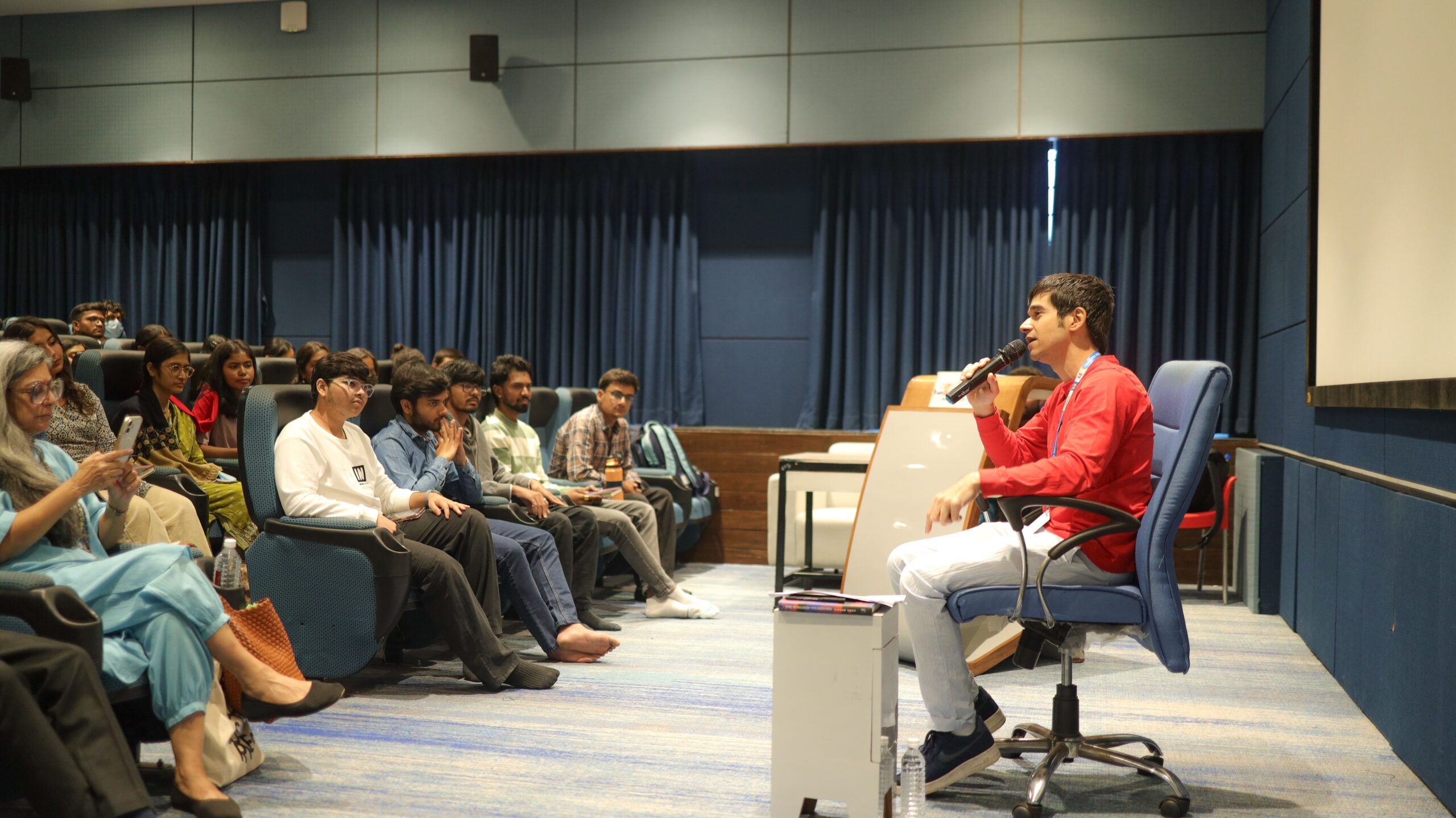
Vivaan Shah‘s profile at VLF – Vadodara Literature Festival 4.0 was not that of a film personality making a gracious festival appearance. It was that of a working artist – an actor trained in the ‘Motley’ theatre tradition, a published author of novels including Living Hell and The Midnight Freelancer, and a practitioner who had spent years observing and participating in rigorous acting workshops focused on what he calls the ‘purity of performance.’
He made his debut in Vishal Bhardwaj‘s 7 Khoon Maaf in 2011 and has worked across commercial cinema and serious stage. But at VLF – Vadodara Literature Festival 4.0, at the Parul Institute of Performing Arts on January 27, 2026, he showed up as a teacher – someone who wanted to transmit what he had learned before the students in front of him wasted years making avoidable mistakes.
His dual identity as actor and writer, he told the audience, had given him a structural perspective on storytelling that neither discipline alone provides. The actor sees what the words require from the body and the voice. The writer understands the architecture of the scene that the actor must inhabit. Each makes the other more precise.
The Trap of the Mental Oscar
The workshop opened with an observation that every person in the room who had ever imagined themselves performing recognised immediately: the trap of the Mental Oscar.
Many beginners, Vivaan explained, give brilliant performances inside their heads. The scene is perfectly delivered. The emotional truth is complete. The interpretation is original and nuanced. And then the camera rolls, or the curtain opens, and the technical demands of the actual performance – the microphone placement, the light hitting your eyes, the colleague who delivered their line differently than expected – intrude on the interior masterpiece, and the external performance falls apart.
The gap between the inner performance and the outer one is not, he argued, a gap of talent. It is a gap of training. Real success as a performer comes from externalising the internal work – from building, through constant practice, the capacity to deliver the interior truth through the body, the voice, and the eyes regardless of what external conditions are doing around you.
“Acting is not pretending,” he said, drawing from his father’s workshops. “It is doing.” The distinction is everything. Pretending is interior. Doing is external, physical, committed, repeatable. The move from pretending to doing is what training is for.
Literature as Radical Independence: The Case Against the Screen
A major highlight of the workshop was Vivaan’s passionate defence of traditional reading habits in a digital age – an argument that, coming from a working actor who spends significant professional time in front of screens, carried particular weight.
He categorised literature as a unique art form because it requires zero infrastructure. No lights. No cameras. No crew. No internet connection. No platform. “It only needs a pen, paper, and a study table,” he said, calling it a form of ‘radical independence’ from the technological apparatus that every other creative medium now depends on.
He warned that screens – phones, laptops – offer a ‘shortcut’ to dopamine that weakens the brain’s capacity for sustained focus. The brain trained on short-form content becomes increasingly incapable of the extended, deep attention that both good reading and good performance require. The concentration that a stage performance demands from its audience, and the concentration that writing a novel demands from its author, are the same muscle – and it is a muscle that is actively being weakened by the default digital environment most students inhabit.
His challenge to the audience was direct: treat attention as a muscle. Staying away from the screen for an hour, for two hours, for a focused work session – this is not self-denial. It is training. The creative work that distinguishes a career from a hobby is built in exactly those hours.
Grotowski, Poor Theatre, and the Body as Sufficient Instrument
The workshop’s most conceptually dense passage drew on Jerzy Grotowski‘s concept of ‘Poor Theatre’ – the idea that what an actor can do with nothing but their body and voice is more powerful than anything a technically elaborate production can achieve.
Vivaan’s version of the argument for the VLF – Vadodara Literature Festival audience: fancy effects often hide a lack of talent. The elaborate set, the sophisticated lighting rig, the visual effects – these are, in certain kinds of performance, ways of substituting production value for artistic truth. One should be able to move an audience with nothing but voice and body. That capacity – to be sufficient as an instrument, without external support – is what separates the artist from the performer.
His practical roadmap for students aspiring to creative careers, drawn from the workshop:
- Start from zero and start today – write a page a day, join a college theatre group; mastery is accumulated small effort
- Thoroughness is non-negotiable – when the door opens, you must be ready to walk through it
- Embrace ‘Poor Theatre’ – learn to be sufficient as an instrument before relying on production value
- Read one major work of Indian literature before graduation – understanding your roots is creative fuel
- Practice imagination exercises: perform mundane daily tasks entirely in your mind to build mental stamina
- Put down the screen, pick up a book, and start the hard work of training the mind – this is the whole advice
The Vessel and the Voice: On the Actor-Writer Relationship
Vivaan’s closing framework – the ‘Vessel Concept’ – was among the workshop’s most generative ideas for students in any creative discipline.
An actor, he said, is a collaborator who carries the writer‘s burden. Without the writer’s pen, the actor has no direction. Without the actor’s performance, the writer has no voice. The relationship is not hierarchical. It is metabolic: each depends on the other for completion.
For students who were at VLF – Vadodara Literature Festival 4.0 because they wanted to make things – films, novels, theatre productions, music, games, any form of narrative – the framework offered a way of thinking about creative collaboration that was neither competitive nor abstract. The writer needs to understand what the performer requires. The performer needs to understand what the writer intended. The gap between these two forms of understanding is where most creative projects fail. The session ended with the instruction to close the gap: pick one short story or poem, try to communicate its core essence to just one person, and notice how much work that single communication requires. That, Vivaan said, is the beginning of everything.


