The kid from Jhunjhunu who thought CAT was an actual cat is now the CEO of ExcelOne and founder of Stones2Milestones. Here’s what happened between mispronouncing words and helping 3.1 million children learn to read.
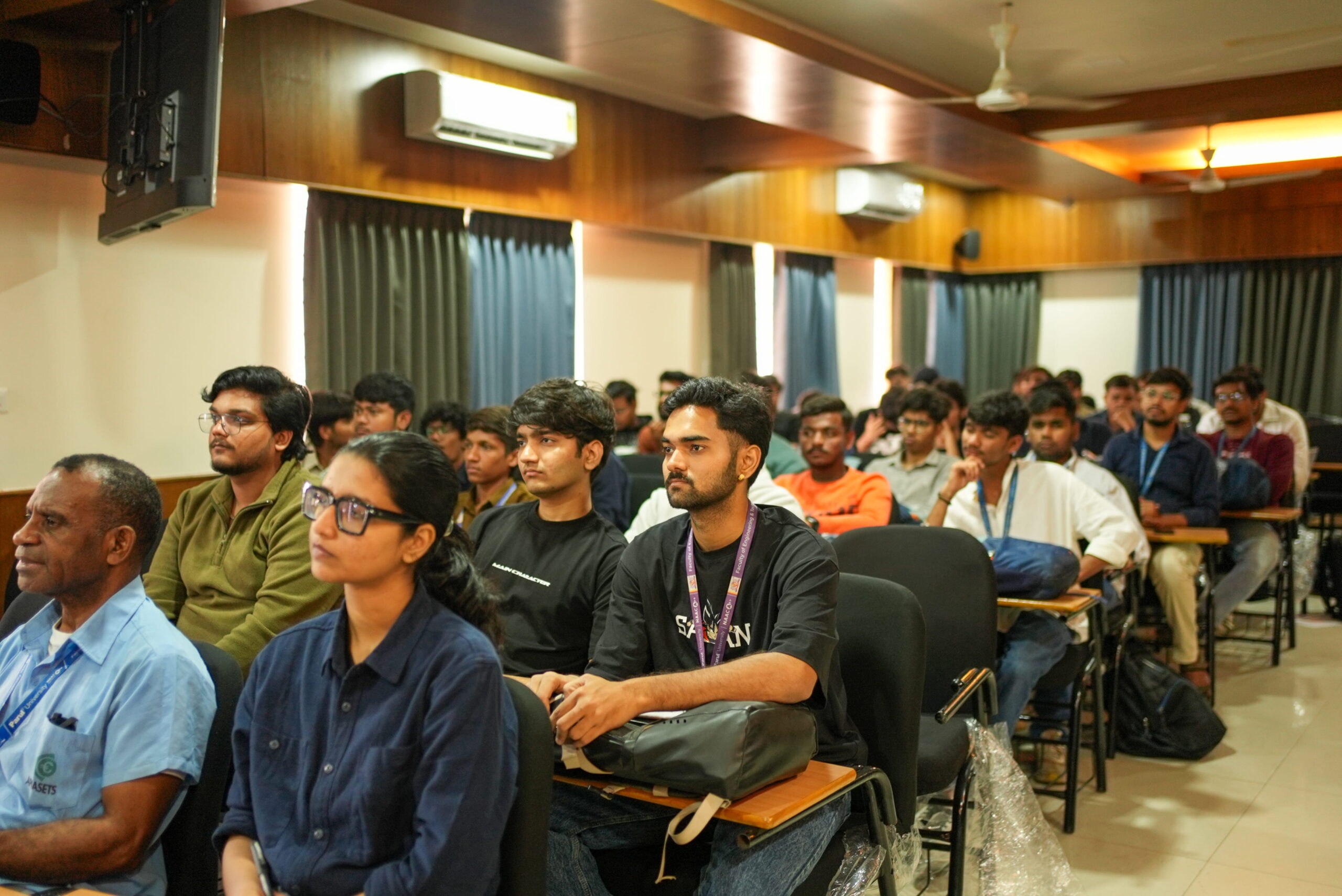
Kavish Gadia begins his talk at Vadodara Startup Festival 6.0 with a question:
“When was the last time you did or learned something for the first time?”
One student raises their hand. They’d started learning ukulele basics a month ago and had been practicing regularly.
Gadia keeps his promise and hands the student a book titled “The Breakthrough” by Megha Bajaj, a collection of 11 true stories of trailblazers.
While handing over the book, he says: “The world is waiting for you, only if you take a single step. And here, that step was raising your hand.”
That interaction sets the tone for everything that follows.
The Scholar from Jhunjhunu Who Couldn't Speak English
Kavish Gadia comes from Jhunjhunu, Rajasthan the town where BITS Pilani is located.
Middle-class background. Academically strong. Always ranked first in class.
But despite being a scholar, his English was miserable.
He has three sisters. All of them attended boarding school. Every summer vacation, they’d come home and make fun of him for mispronouncing even the simplest English words.
This wasn’t playful teasing. It affected him deeply.
Imagine being the top student in every subject except the one that determines whether you’re taken seriously in professional settings.
That was Gadia’s reality.
The Challenge That Changed Everything
One day, the father of a classmate, the student who always came second because Gadia always came first approached him with a challenge:
“Anyone can come first at the school level, but if you really have it in you, then clear CAT.”
At the time, CAT had just become a competitive exam.
Kavish Gadia’s awareness was so limited that he thought CAT referred to an actual cat, like a house pet.
When he realized it was an entrance exam, he prepared seriously.
He cleared it.
He got into IIM Lucknow.
Breakthrough #1: Cracking CAT
Gadia describes this as Breakthrough No. 1 the first major step.
He quotes Andrew Carnegie, who once said he didn’t know why he was so successful, but one thing he knew was that he never missed an opportunity.
Through this, Gadia encourages students to recognize and grab opportunities whenever they appear.
But cracking CAT was only the beginning.
The First Trimester Nightmare
Once he reached IIM Lucknow, reality hit hard.
In the first trimester, he found himself completely clueless because his English was too weak to cope with the curriculum.
Case studies. Group discussions. Presentations. Class participation.
All in English.
All requiring fluency he didn’t have.
At the end of the first trimester, there was a presentation scheduled.
At that moment, Gadia made a decision.
Breakthrough #2: Learning English and Delivering the Presentation
He told himself: “I will learn English and deliver that presentation perfectly.”
This became Breakthrough No. 2.
And according to Gadia, learning English and practicing presentations was even harder than clearing CAT.
Why?
Because he was often bullied for his Rajasthani accent.
The same classmates who respected his analytical abilities mocked how he spoke.
Despite this, he delivered the presentation with excellence.
From 0 Job Offers to 14 Job Offers
Because of Breakthrough No. 2, Gadia graduated from IIM Lucknow in 2005 with 14 job offers.
Companies included:
- KPMG Corporate Finance
- Other major organizations
The kid who couldn’t pronounce English words correctly now had multiple firms competing to hire him.
The Philosophy: It’s Okay to Start with a Job
Gadia states clearly: “It is completely okay to begin one’s career with a job.”
This matters.
Because entrepreneurship culture often glorifies dropping out, rejecting offers, starting immediately.
Gadia took a different path. He worked. He learned. He built expertise.
Then he built ventures.
The Railway Station Moment That Defined His Mission
While returning home with 14 job offers in hand, Gadia was standing at a central railway station.
He noticed two or three children poorly dressed, covered in dust and coal.
Looking at them, he silently started crying.
He realized: “The only difference between me and those children was that I was fortunate enough to be born into a family that could provide for me, while those children were helpless.”
He said: “Life has favourites and that it is not fair.”
At that moment, he made a promise to himself:
“One day I would do something for children like them.”
From Personal Experience to EdTech Mission
This wasn’t abstract social responsibility.
It was deeply personal.
Kavish Gadia’s own English weakness had almost derailed his career. He’d experienced firsthand how language barriers limit opportunity.
Those children at the railway station reminded him: millions of kids face the same barriers he’d overcome, but without access to the resources he had.
That realization shaped everything that followed.
ExcelOne: OECD-Aligned Assessment for Indian Schools
Today, Gadia is the CEO of ExcelOne (PISA for Schools – India).
ExcelOne is an OECD-aligned assessment system designed to measure reading, mathematics, and science proficiency among 15-year-old students.
It benchmarks school-level performance against international standards.
But it’s not just about rankings.
The assessment functions as a tool for school improvement helping educators identify gaps and implement targeted interventions.
Stones2Milestones: 3.1 Million Children and Counting
Gadia is also the Founder of Stones2Milestones (S2M), an EdTech organization established in 2008.
Focus: Improving English literacy for children aged 3 to 10 years.
Freadom: The AI-Driven Reading Platform
The flagship platform is Freadom a personalized, AI-driven application aimed at developing:
- Reading skills
- Speaking skills
- Thinking skills
The Three Major Divisions
Stones2Milestones operates through three major divisions:
- Investment banking arm
- Amrit Vidyalaya: A school established in 2015, with the objective of setting up 50 such schools by 2035
- Stanford University-linked research cell
The Numbers That Matter
- 600 employees
- 3.1 million children helped to pick up reading as a habit
That second number is staggering.
3.1 million children who might have faced the same language barriers Gadia experienced now have access to structured literacy development.
Entrepreneurship Isn’t About Markets It’s About Missions
During his talk at VSF – Vadodara Start-up Festival 6.0, Gadia made a key observation:
“Entrepreneurship often begins from something deeply personal rather than from market analysis alone.”
His ventures weren’t born from:
- Market research reports
- TAM/SAM/SOM calculations
- Investor pitch requirements
They were born from internal conviction and lived experiences.
The pain he experienced became his problem statement.
The promise he made at the railway station became his mission.
The Jar Model: Managing Five Life Aspects
Toward the latter part of the session, Gadia outlined five key aspects an entrepreneur must manage:
- Physical fitness
- Emotional well-being
- Mental well-being
- Material wealth
- Personal peace
Most entrepreneurs obsess over aspect #4 and neglect the rest.
Gadia argues all five are interconnected.
He stresses that curiosity is central to mental fitness and encourages students to:
- Read extensively
- Ask questions constantly
- Write regularly
- Attempt to solve unanswered problems
Entrepreneurship, he says, is one of the ways to manifest this problem-solving impulse.
Work-Life Balance: The Jar Concept
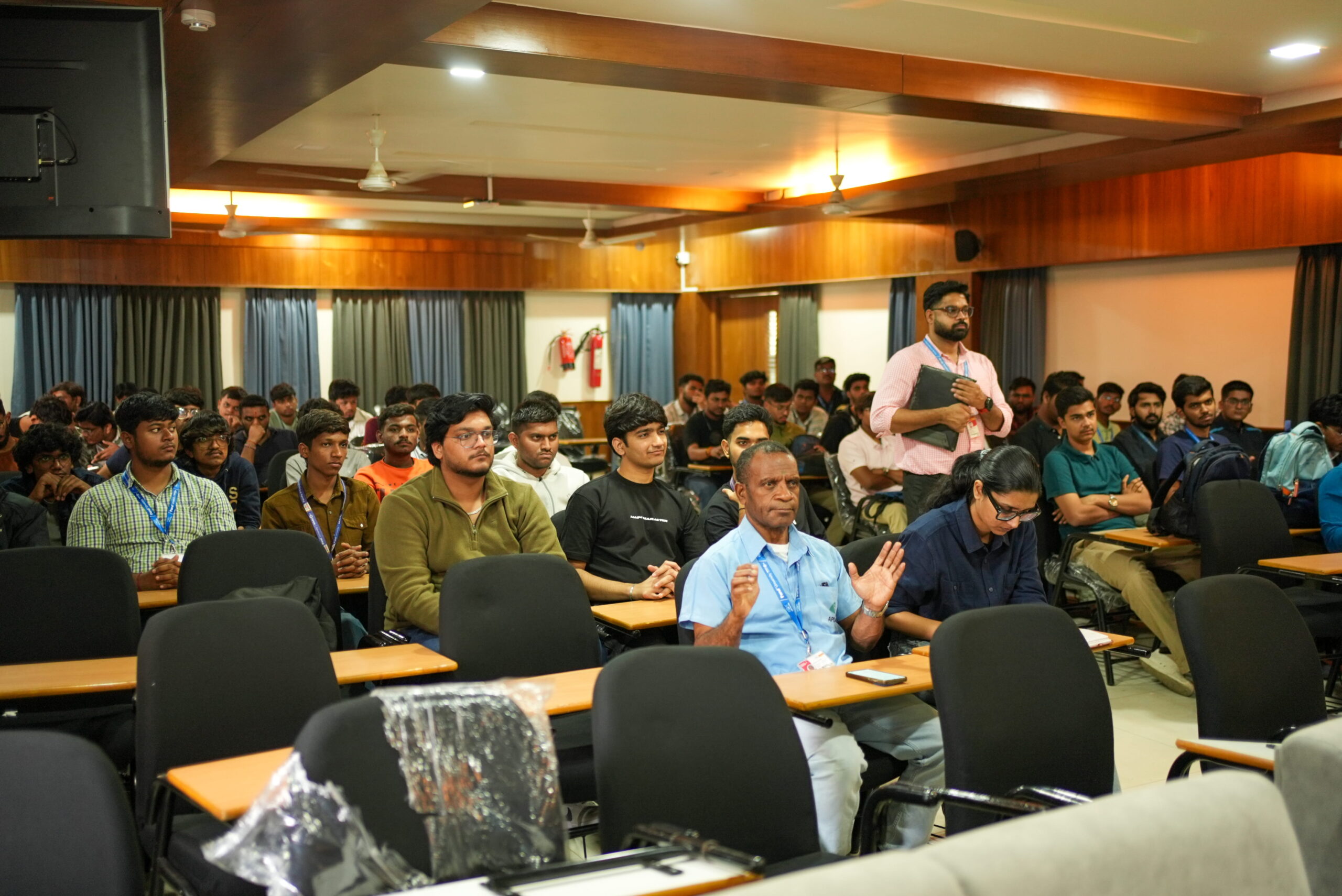
During Q&A, a student asked how Gadia maintains work-life balance.
He explained the “jar concept” with four elements:
- Rocks: Non-negotiable priorities (daily run, speaking to children, either virtually or in person)
- Pebbles: Commitments (meetings, responsibilities)
- Sand: Personal growth and hobbies
- Water: Distractions and minor tasks
Critical instruction: Rocks must go into the jar first.
If you fill the jar with water and sand first, there’s no room for rocks.
But if you place rocks first, pebbles fit around them, sand fills the gaps, and water fills the remaining space.
Gadia’s rocks:
- Daily physical exercise
- Daily connection with his children
Everything else arranges itself around these non-negotiables.
The Philosophy: There Are No Failed Entrepreneurs
Gadia makes a bold statement:
“There are no stories of failed entrepreneurs.”
His reasoning:
“The reason he is standing here today is because he succeeded. When an entrepreneur decides to start something of their own, they stand at the edge of either being remembered in business history or not being remembered at all, not even as a failed entrepreneur.”
He continues:
“If someone is brave enough to choose entrepreneurship when everyone else is opting for jobs and placements, they are already successful in taking the biggest risk.”
Even if they fail, they succeed in not being a coward and in not denying their own potential.
This reframes failure entirely.
Most startup culture treats failure as a badge of honor (“fail fast, fail often”).
Gadia treats the decision to try as the real success. The outcome is secondary.
The "Just One More Time" Principle
Gadia concluded his session with a strong message on persistence:
“One quality every entrepreneur must possess is the willingness to try ‘just one more time.'”
Entrepreneurship isn’t defined by uninterrupted success.
It’s defined by the ability to continue despite setbacks, rejection, and uncertainty.
According to him, persistence often determines long-term outcomes more than talent or background.
He reassured students: “There is space for everyone in the world.”
Don’t give up prematurely.
What Made Gadia “Deserving Enough” to Stand on Stage
Early in his talk, Gadia said:
“Yes, let’s talk about me and what exactly made me deserving enough to stand in front of you all today.”
The answer isn’t his CEO title.
It isn’t the 3.1 million children served.
It isn’t the 14 job offers or IIM degree.
What made him “deserving” was the willingness to:
- Take the first step (clearing CAT despite limited awareness)
- Take the second step (learning English despite bullying)
- Keep the promise (helping children who face language barriers)
Those three decisions created everything that followed.
The PIERC Connection: Where Student Entrepreneurs Get Real Support
Gadia’s talk was part of the Vadodara Startup Festival 6.0, organized by the Parul Innovation & Entrepreneurship Research Centre (PIERC) at Parul University.
PIERC isn’t just hosting events. It’s building the infrastructure for student entrepreneurship:
- Expert mentorship from industry leaders
- State-of-the-art incubation facilities
- Access to 50+ venture capital firms and angel investors
- Programs supporting startups from idea stage to growth stage
- Recognition as a Nodal Institution by the Government of Gujarat
For students at Parul University and across Gujarat, PIERC provides the ecosystem where personal missions can become scalable ventures.
Three Lessons from Gadia's Journey
Lesson #1: Your Weakness Can Become Your Mission
Gadia’s English weakness almost derailed his career.
Instead of hiding it, he built his life’s work around solving that exact problem for millions of other children.
Your biggest struggle contains your greatest contribution.
Lesson #2: Breakthroughs Are Decisions, Not Events
Breakthrough #1: Deciding to prepare for CAT
Breakthrough #2: Deciding to learn English and deliver the presentation
Both were decisions to take action despite uncertainty.
The results came later. The breakthrough was the decision.
Lesson #3: Personal Experience Beats Market Research
Gadia didn’t conduct surveys to validate demand for English literacy programs.
He experienced the pain personally. He saw children at the railway station facing the same barriers.
That lived experience became his competitive advantage.
What "The Breakthrough" Book Symbolizes
Remember the book Gadia gave the ukulele student?
“The Breakthrough” by Megha Bajaj 11 true stories of 11 trailblazers.
That book symbolizes Gadia’s core message:
Breakthroughs happen when you take the first step.
Not the perfect step.
Not the guaranteed-to-succeed step.
Just the first step.
For the ukulele student, it was raising their hand.
For Gadia, it was preparing for an exam he initially thought was about a house cat.
Why This Story Matters for Today's Students
Gadia’s journey from Jhunjhunu to IIM Lucknow to 3.1 million children served offers a blueprint:
Start where you are. Jhunjhunu, not Bangalore or Silicon Valley.
Use what you have. Academic strength, even if English is weak.
Do what you can. Prepare for one exam. Deliver one presentation.
Keep the promises you make to yourself. Especially the ones made at railway stations.
Build what you wished existed. English literacy programs for children who face the barriers you faced.
The Question That Started Everything
“When was the last time you did or learned something for the first time?”
Gadia asks this at the beginning of his talk for a reason.
Because entrepreneurship real entrepreneurship requires constant first-time experiences:
- First time pitching to investors
- First time hiring employees
- First time dealing with failure
- First time scaling beyond your capacity
- First time helping the millionth child learn to read
The willingness to keep doing things for the first time is what separates entrepreneurs from everyone else.
From Mispronunciation to Mission
The arc of Gadia’s story is clear:
- Struggle: Can’t pronounce English words correctly
- Challenge: Prove you can succeed at the highest level
- Breakthrough #1: Clear CAT
- Crisis: Can’t cope at IIM due to language weakness
- Breakthrough #2: Learn English, deliver perfect presentation
- Opportunity: 14 job offers
- Awakening: Children at railway station
- Promise: Help children facing language barriers
- Mission: Build ExcelOne and Stones2Milestones
- Impact: 3.1 million children and counting
That’s not a linear path. It’s a series of decisions to keep trying “just one more time.”
The Real Message to Aspiring Entrepreneurs
At the end of his talk, Gadia’s message is simple:
“The world is waiting for you, only if you take a single step.”
Not a perfect plan.
Not guaranteed funding.
Not certainty about outcomes.
Just one step.
For Gadia, that step was preparing for an exam he didn’t understand.
For you, it might be:
- Raising your hand in class
- Submitting that application
- Building that first prototype
- Delivering that first pitch
- Keeping that promise you made to yourself
The world doesn’t wait for perfect preparation.
It waits for people willing to take the first step despite uncertainty.
Why Breakthrough No. 2 Was Harder Than Breakthrough No. 1
Gadia emphasizes this repeatedly:
Learning English and delivering the presentation was harder than clearing CAT.
Why?
Because the CAT was a structured exam. Study these topics. Practice these problems. Take the test.
Learning English while being bullied for your accent? That’s internal work.
Fighting shame. Overcoming embarrassment. Building confidence despite mockery.
External challenges are easier than internal battles.
But the internal battles create permanent transformation.
The Promise That Became a Company
Most founders start with a business plan.
Gadia started with a promise to himself: “One day I would do something for children like them.”
That promise became Stones2Milestones.
That promise became 3.1 million children learning to read.
Promises to yourself are more powerful than promises to investors.
What VSF - Vadodara Start-up Festival 6.0 Represents for Student Entrepreneurship
The Vadodara Startup Festival 6.0, organized by PIERC at Parul University, isn’t just an event.
It’s a signal to students across Gujarat and beyond:
Your story matters. Your struggle contains your startup. Your weakness can become your mission.
Institutions like PIERC provide the infrastructure mentorship, funding access, incubation facilities.
But the breakthrough?
That happens when you decide to try, despite limited English, despite bullying, despite uncertainty. That decision is yours alone.
FAQs
1. Who is Kavish Gadia?
Kavish Gadia is the founder of Stones2Milestones and CEO of ExcelOne, organizations focused on improving reading and learning outcomes for children.
2. What is Stones2Milestones?
Stones2Milestones is an EdTech organization founded in 2008 that helps children develop strong reading habits and English literacy skills.
3. What is the Freadom platform?
Freadom is an AI-driven learning platform developed by Stones2Milestones that improves children’s reading, speaking, and thinking abilities.
4. How many children has Stones2Milestones helped?
Stones2Milestones has helped over 3.1 million children develop reading habits and improve literacy skills.
5. What lesson did Kavish Gadia share at VSF - Vadodara Start-up Festival?
He emphasized that persistence, curiosity, and taking the first step are essential for success in entrepreneurship and personal growth.
6. How does Parul University support student entrepreneurs?
Through PIERC, Parul University offers incubation, mentorship, funding access, and startup programs that help students transform ideas into real ventures.
Kavish Gadia spoke at the Vadodara Startup Festival 6.0 on January 22, 2026, at Parul University. For more information about PIERC’s student entrepreneurship programs, visit pierc.org.


