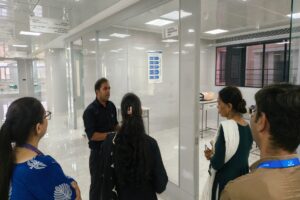
Before the MNRDC opened in September 2024, industries and researchers across Gujarat faced a fragmented testing landscape. Advanced material characterisation – the kind that requires SEM, XRD, or AFM – required sending samples to specialist facilities, often in Mumbai or Pune. The practical consequences were severe: turnaround times of up to three months, no transparency on sample status, coordination across multiple laboratories for different test types, and the logistical risk of sample loss or damage in transit.
The MNRDC was built to eliminate this fragmentation entirely. As a one-stop facility under the oversight of the Vice President of Quality, Research and Health Sciences at Parul University and funded by the Industries Commissionerate, Government of Gujarat , it offers the full spectrum of advanced material characterisation services from a single location in Vadodara – with a standard turnaround of 10 working days and an urgent option of one business day.
The Industry Client Portfolio
The MNRDC serves a diverse range of industry sectors. Its confirmed industry clients include BDR Pharmaceuticals International Pvt. Ltd. and BDR Lifescience Pvt. Ltd. (pharmaceutical API and formulation characterisation), AMI Lifesciences Pvt. Ltd. (pharmaceutical and life sciences materials), Nomisma Healthcare Pvt. Ltd. (healthcare materials and medical device components), SEASHORE NANOTECH (nanomaterials and nanoparticle characterisation), M19 – Material Intelligence Lab India (advanced materials analysis and consulting, which also serves as the MNRDC’s backup testing facility in Vadodara), PORELAB Scientific Private Limited (porous materials and filter characterisation), Aamyo Laboratories Pvt. Ltd. (analytical chemistry and materials), Gujarat Metal Cast (metal casting and alloy characterisation), Burakia Industrial Ltd. (industrial materials), SUDEEP ADVANCED MATERIALS Private Limited (advanced polymer and composite materials), Empire Industrial Service (industrial engineering materials), Shreeneel Chemical (chemical and process industry materials), Cloud Nectar Private Limited, Zerofold Internet, and MATPLAT.
This client portfolio spans pharmaceuticals, metals, nanomaterials, advanced materials, industrial engineering, and chemical processing – reflecting the breadth of the MNRDC’s instrument capabilities. External users as a category account for a larger proportion of total usage than internal university users, and approximately 60% of all clients return for repeat testing. This repeat rate – unusually high for a center that has been operational for under two years – reflects both the quality of results and the speed of delivery compared to alternatives.
Services Available and What Each Delivers
SEM + EDS - Surface and Elemental Analysis
The Hitachi SU3800 SEM with EDS provides surface morphology imaging (grain structure, particle size and shape, surface defects, coating uniformity) and elemental composition analysis (phase identification, purity verification, contamination detection, elemental mapping). Standard output: 8 SEM images + 2 EDS spectra + area mapping on request. Turnaround: 10 days standard, 1 day urgent (4 images). Over 897 samples analysed.
XRD - Crystal Structure and Phase Identification
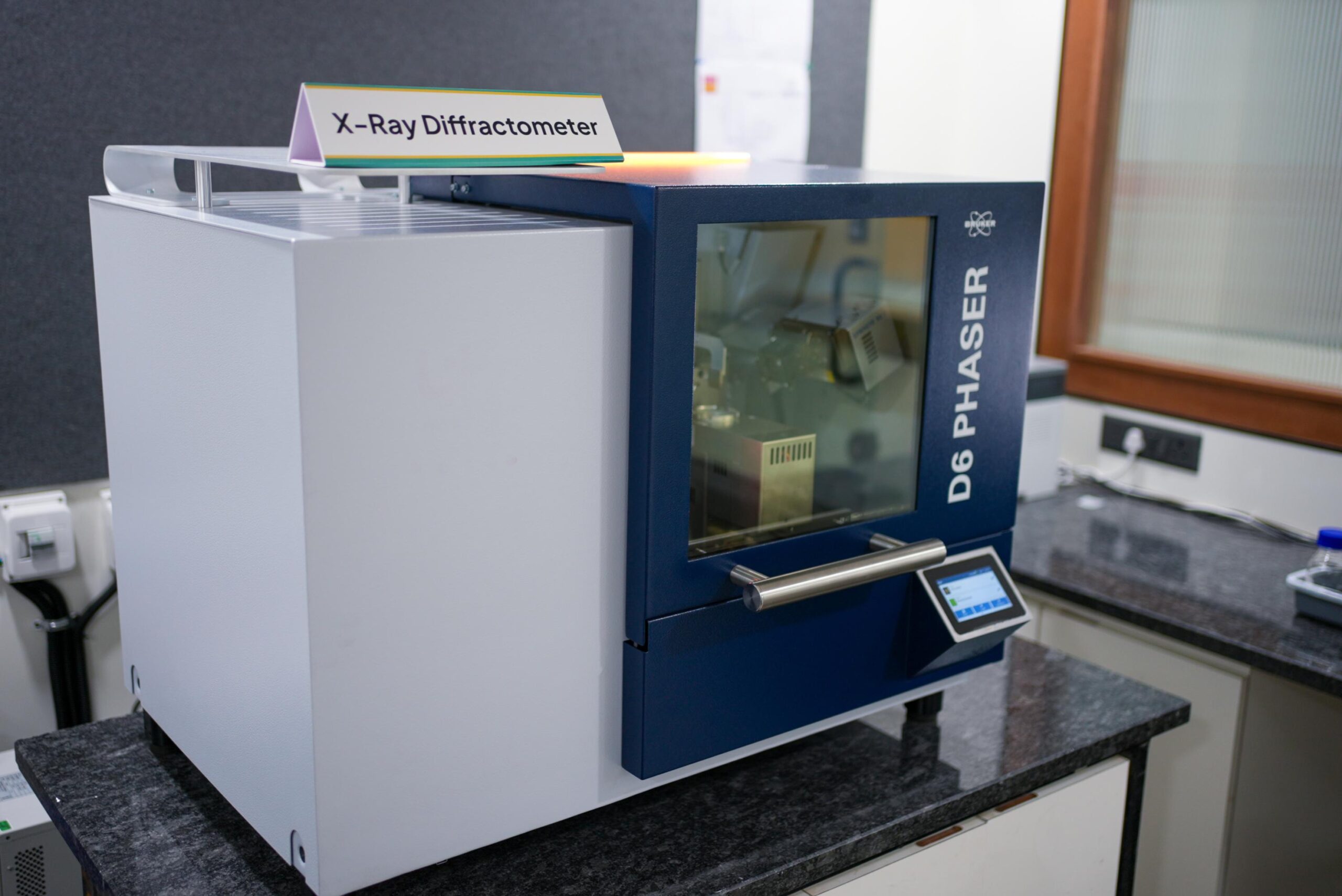
The Bruker D6 PHASER XRD identifies crystalline phases, measures crystallite size, quantifies phase proportions (Rietveld TOPAS analysis), and detects lattice strain. GIXRD available for thin film surface-sensitive analysis. XRR available for thin film thickness, roughness, and density. Over 600 samples analysed. Standard output: Intensity vs 2θ graph with ICDD PDF-4 identification.
AFM - Nanoscale Surface Roughness and Topography
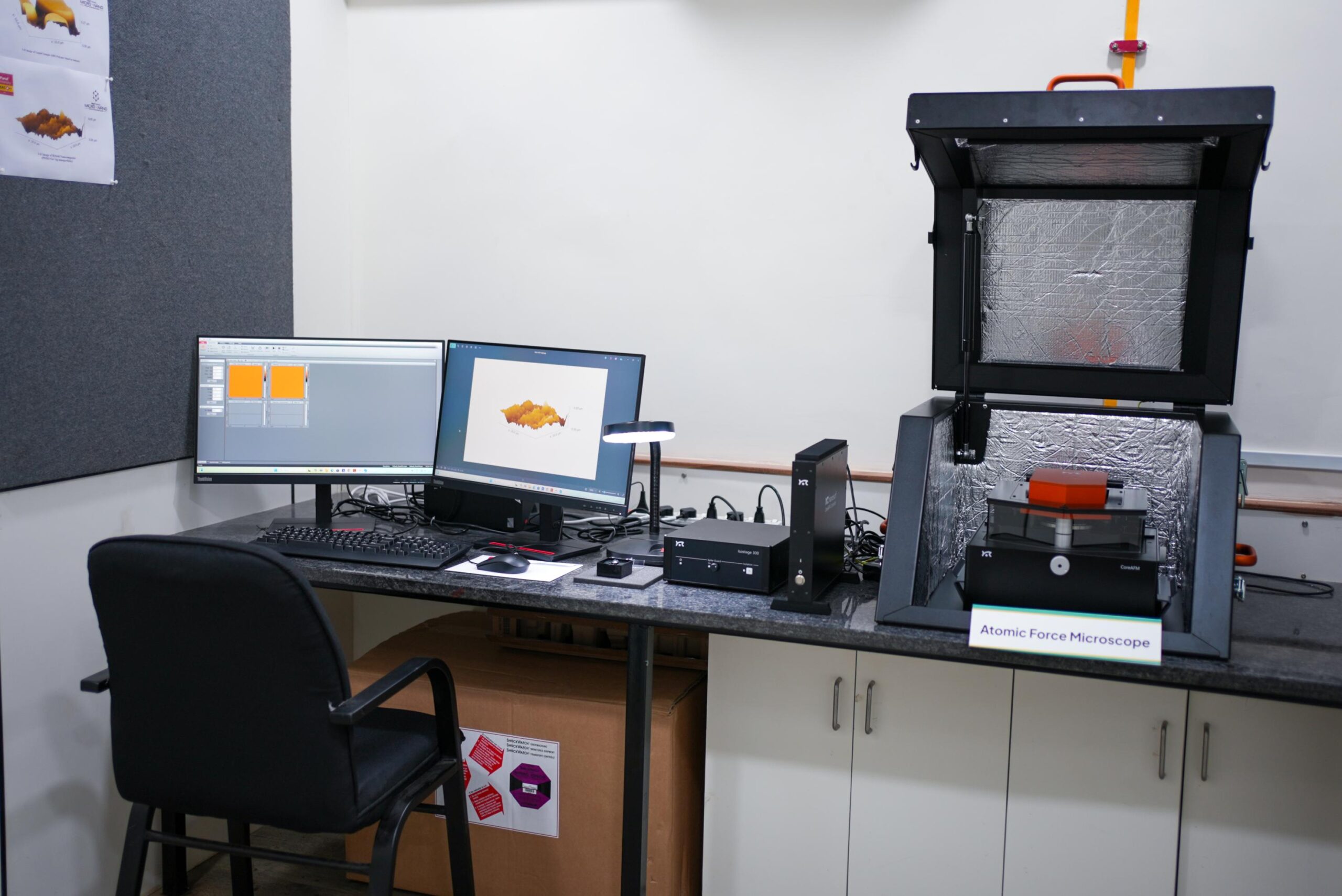
The Nanosurf Core AFM measures Ra, Rq, Rz and 50+ ISO surface parameters (MountainsSPIP), 3D surface maps, grain size analysis, and nanostructure imaging. Standard output: 2D image, 3D render, Excel roughness values, roughness graph. Over 145 samples analysed.
Pin-on-Disc Tribometer - Wear and Friction
ASTM G99 wear testing: coefficient of friction vs time, wear rate, sliding distance. Dry, lubricated, and heated test conditions available. Standard output: Excel file with time-resolved friction data. Over 118 specimens tested.
LCR Meter - Electrical and Dielectric Properties
Frequency sweep from 1 mHz to 5 MHz. Temperature-dependent testing up to 1200°C (furnace). Parameters: R, L, C, Z, Q, D, phase angle, admittance. Over 61 samples (12 furnace, 49 room temperature).
RF/DC Magnetron Sputtering - Thin Film Deposition
Three deposition methods: DC (metals), RF (insulators/oxides), thermal evaporation (soft metals/organics). Substrate heating to 600°C. Rotation to 20 RPM. Multilayer structures without vacuum break. 22 runs completed.
Service Terms, Queue, and Turnaround
Sample processing follows a strict first-come, first-served queue – there is no priority for internal university samples over external industry or academic submissions. Urgent samples may be prioritised with additional charges, though output scope is limited (e.g., 4 SEM images instead of 8 for urgent SEM runs). Standard results are delivered within 10 working days of sample submission. The MNRDC maintains an average instrument uptime of 99.9%. In the rare event of instrument unavailability, samples in queue can be tested at M-19 Labs, Vadodara – a backup arrangement that prevents delays reaching users.
Samples are rejected occasionally – approximately once per fortnight – for reasons including size non-compliance, contamination, bacterial growth, or cases where the sample would not yield meaningful results (e.g., liquid SEM samples showing no structural features after drying). When rejection occurs, users are contacted immediately with specific reasons and guidance for resubmission.
Confidentiality, NDAs, and IP Protection
All user data and test results are treated as strictly confidential. Results are shared only with the submitting user or organisation. For industry clients requiring formal confidentiality agreements, Non-Disclosure Agreements (NDAs) can be arranged prior to sample submission – making the MNRDC suitable for proprietary R&D projects, new product development, and competitive material analysis. The center does not publish user data without explicit permission, and does not retain ownership of test results.
For collaborative research involving joint development, the MNRDC’s IP framework follows a clear principle: if an MoU is signed establishing a joint collaboration, patent rights are filed in partnership. Without a formal MoU, IP rights rest with the industry client. This clarity – unusual in Indian university-industry research relationships, which often have ambiguous IP terms – makes the MNRDC a reliable partner for industry-driven innovation projects.
Pricing and Revenue Model
Charges are applied per sample or per run – not per hour or per report. Separate pricing tiers apply for internal university users, external academic institutions, and industry clients, with industry charged at higher rates than academic users. The full pricing schedule is available at the MNRDC official website. All revenue from testing is credited to the MNRDC’s dedicated account and reinvested in instrument maintenance, consumables, operational expenses, research activities, and minor upgrades – ensuring the center’s financial sustainability independent of grant cycles.
FAQs
How do I submit samples for testing at Parul University MNRDC?
Submit samples through the MNRDC official website at micronanornd.paruluniversity.ac.in. Samples must comply with instrument-specific size limits, must not be radioactive, explosive, or highly corrosive, and must be compatible with the relevant test conditions (vacuum for SEM/XRD, solid for AFM). The center will advise on specific preparation requirements. First-come, first-served queue applies to all submissions.
Does the MNRDC sign NDAs with industry clients?
Yes. NDAs can be arranged for industry clients requiring formal confidentiality agreements before sample submission. All test data is treated as confidential regardless of whether a formal NDA is in place - results are shared only with the submitting user. The MNRDC does not publish or share client data without explicit permission.
How does IP protection work when working with the MNRDC?
For collaborative research with an MoU in place, patents arising from joint work are filed in partnership between the MNRDC and the industry client. Without a formal MoU (i.e., for standard testing services), IP rights rest entirely with the industry client. The MNRDC provides testing and technical support but does not claim IP ownership for standard service engagements.
What industries does the MNRDC serve?
The MNRDC serves pharmaceutical (BDR Pharmaceuticals, AMI Lifesciences, Nomisma Healthcare, Aamyo Laboratories), nanomaterials (SEASHORE NANOTECH, PORELAB Scientific), metals and casting (Gujarat Metal Cast, Burakia Industrial), advanced materials (SUDEEP ADVANCED MATERIALS, M19 Material Intelligence Lab), chemical processing (Shreeneel Chemical, Empire Industrial Service), and technology companies (Cloud Nectar, Zerofold, MATPLAT). External industry clients account for the majority of MNRDC usage.