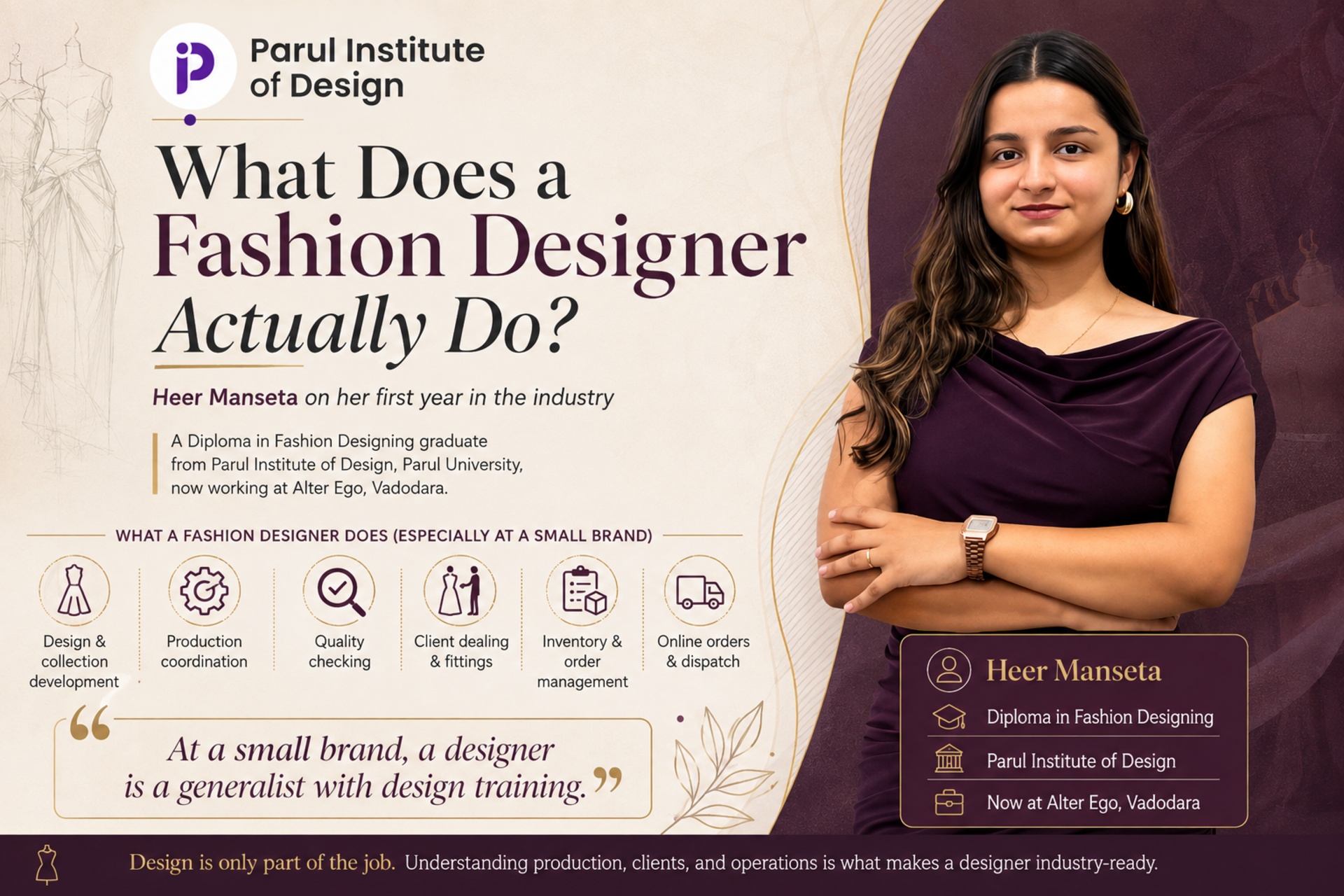
There is a persistent gap between what students think a fashion designer does and what the job consists of, and it causes a great deal of avoidable disappointment in the first year of work. The imagined version is a concept, sketch and collection. The actual version, particularly at a smaller brand, involves running a substantial portion of the business the garment passes through.
Heer Manseta completed her Diploma in Fashion Designing at Parul Institute of Design and moved into her first full-time role at Alter Ego, a fashion brand in Vadodara, obtained through a recommendation from a faculty member. Her description of what that role covers is the most useful thing a prospective fashion student could read, because it is specific and it is not romanticised. Her profile is on LinkedIn.
What the Job Actually Covers
Heer’s role at Alter Ego includes design work. It also includes the following, all of which she handles.
- Production: managing garments through manufacture, which means understanding what is feasible as well as what is desirable.
- Quality checking: inspecting what comes back against what was specified, and deciding what is acceptable.
- Client dealing: speaking directly to customers, which requires being able to explain, advise and occasionally disagree.
- Order management: tracking what has been ordered, what stage it is at and when it is due.
- Garment fitting: the practical work of making a garment fit a specific person, which is where technical training becomes immediately visible.
- Inventory: knowing what stock and materials exist and where.
- Online orders and dispatch: the e-commerce and fulfilment side, which for a modern brand is a significant share of the business.
The pattern here is worth stating plainly, because it is the single most useful thing in this profile. At a small or mid-sized brand, a designer is not a specialist in a large team. They are a generalist who happens to have design training, and the breadth is the job rather than an imposition on it.
Heer’s own conclusion from this is that she came to understand how a garment travels from design all the way to a customer, which is a form of commercial literacy that a purely creative role would never have given her this early.
At a small brand, a designer is not a specialist in a large team. They are a generalist who happens to have design training.
What Prepared Her, and What Did Not
She is clear that her course transferred directly. Garment construction, pattern making, fabric knowledge and practical project work let her understand the work quickly and settle into the company without a long adjustment, because she already knew how the objects she was handling were made.
Her diploma covered fashion illustration, pattern making, garment construction, textile studies and design collection development, taught largely through studio work, garment making and projects rather than through theory. She singles out the practical emphasis as the reason the transition worked: she had already made mistakes with fabric and corrected them, which is not something that can be learnt from a book.
What the course could not supply was the consequence structure. In college a mistake is a learning opportunity that a faculty member helps unpick. In a company, work carries a deadline and a client, and an error creates a problem for someone else. She describes understanding discipline and time management differently after arriving, and there is no version of a course that teaches that as effectively as the first month of a job does.
She also learnt things that were not fashion at all: working under pressure, running several tasks at once, speaking to clients, and coordinating across teams. These are the capabilities that turn a trained graduate into a functioning professional, and they are largely learned by being required to have them.
The Part Nobody Teaches: Operations and E-Commerce
The portion of Heer’s role least represented in fashion education is also among the fastest-growing parts of the industry: the operational and online side.
Order management, inventory, online orders and dispatch are not peripheral to a modern fashion brand. For many, direct online sales are a substantial share of revenue, which means the systems that track stock, process orders and get garments to customers are as consequential to the business as the collection is. A garment that exists but cannot be located or is dispatched late is a commercial failure regardless of how well it was designed.
Fashion curriculums worldwide are still weighted toward design and construction, which is appropriate, but it means graduates frequently arrive without having considered this layer at all. Heer picked it up in post, as most people do.
The advantage of learning it early is considerable, particularly for anyone intending to found a label. A designer who has personally handled quality checking, client queries, inventory and dispatch understands what a business needs to do rather than only what it needs to make, and that is the knowledge gap that closes most independent fashion ventures. Her stated ambition to start her own brand is unusually well served by having encountered the whole operation in her first role.
The Moment She Marks as the Turning Point
Asked what she remembers most, Heer identifies not a garment but a decision made about her: her seniors trusted her with significant production and client work.
For someone in a first role, that is the meaningful signal, more than praise is. Being given responsibility that matters is an employer stating that your judgement is reliable, and she describes it as the thing that most increased her confidence. It is also, incidentally, a good indicator for any student assessing whether a workplace is worth staying in.
How She Got There: Study, Then a Recommendation
Heer is from Vadodara, and like Vishakha Rami, her interest traces to a family business: her father runs a clothing rental business, Rajan Dresswala, so garments for weddings, festivals and functions moved through the household constantly. She grew up around fabric, costume and occasion dressing and describes fashion becoming interesting to her through that exposure rather than through media.
She had decided on fashion design by the end of school and chose Parul Institute of Design specifically for its practical emphasis, studio classes, workshops, exhibitions and industry exposure.
The change she describes most is in herself. She arrived shy and uncomfortable presenting, and the sequence of presentations, juries and design reviews built her confidence in explaining ideas, answering questions and absorbing critique. She credits faculty support directly, naming Meeta Kharadi and Kairavi Mankand among those who guided her, and notes that faculty consistently pushed students toward original work rather than imitation and encouraged participation in exhibitions, competitions and fashion events.
Her final collection was shown at Vadodara Fashion Week, which she describes as the work that contained everything the diploma had taught, from research and mood board through fabric selection, pattern making and construction to final presentation. Seeing it on the runway is the moment she names as her proudest. Her job then came through a faculty recommendation, which is a route worth noting: institutional relationships with industry are a real hiring channel, and it is covered further in the guide to careers in fashion design.
What She Tells Students
Her advice is shaped by having crossed into industry recently enough to remember what she wished she had known.
Take part in competitions, workshops, exhibitions, industrial visits and fashion events, because they teach what classes cannot. Take guidance from faculty seriously and maintain those relationships, since her own job came through one. Build a strong portfolio from the beginning rather than assembling one at the end. Accept feedback and keep improving on it. And understand that success is not a single event but an accumulation, which is the least glamorous and most accurate thing anyone tells design students.
Her own direction from here is to keep building experience with the intention of eventually starting her own fashion brand, which is the ambition most designers hold and which the breadth of her current role is unusually good preparation for. A founder needs to understand production, quality, clients, inventory and fulfilment, and she is learning all of it at once.
Frequently Asked Questions
What does a fashion designer actually do all day?
Considerably more than design, particularly at a small or mid-sized brand. Heer Manseta's role at a Vadodara fashion brand covers design work alongside production management, quality checking, client dealing, order management, garment fitting, inventory, online orders and dispatch. At this scale a designer functions as a generalist with design training rather than a specialist within a large team, and that breadth is the job rather than an addition to it.
Is a fashion design job mostly creative work?
No. Creative work is one component among several, and at smaller brands it is often the smaller share. Production feasibility, quality control, client requirements, deadlines, inventory and fulfilment occupy a large portion of the working week. Students expecting a purely creative role frequently find the first year disorienting, which is why understanding the full scope before entering the industry matters.
What college subjects help most in a first fashion job?
Garment construction, pattern making and textile knowledge transfer most directly, because they let a graduate understand the objects and processes they are handling immediately. Heer Manseta credits practical project work with allowing her to settle into her role quickly. The subjects that cannot be substituted are the practical ones, since having already made and corrected mistakes with real fabric is what makes industry work legible.
How do fashion graduates find their first job?
Through portfolios, internships and institutional industry connections. Heer Manseta obtained her first full-time role through a recommendation from a faculty member at her institute, which is a common and often underestimated route. Maintaining relationships with faculty, participating in exhibitions and fashion events, and building a portfolio from early in the course all contribute to being recommendable.
What is the biggest difference between fashion college and a fashion job?
The consequence structure. In college, experimentation is encouraged and mistakes are learning opportunities that faculty help unpick. In a company, work carries deadlines and clients, so an error creates a problem for other people. Graduates consistently describe understanding discipline and time management differently after starting work, alongside learning to operate under pressure and coordinate across teams.