Material characterisation without manufacturing context is incomplete. Understanding how a material behaves under a cutting tool, how it responds to casting conditions, or how it performs when moulded into a standard specimen requires instruments that go beyond analysis they must simulate and record the manufacturing process itself. The MNRDC’s manufacturing instrument cluster bridges this gap, enabling researchers to both fabricate specimens under controlled conditions and measure the forces, temperatures, and mechanical responses during fabrication.
This integration is particularly relevant to the MNRDC’s ongoing research themes: the ISRO Shape Memory Alloy project (which requires characterisation of SMA components after specific manufacturing processes), the tribology research using the Pin on Disc Tribometer (which requires specimens prepared to precise ASTM G99 standards), and the thermal analysis work using the incoming DSC and STA instruments (which requires polymer and composite specimens of controlled geometry and thermal history).
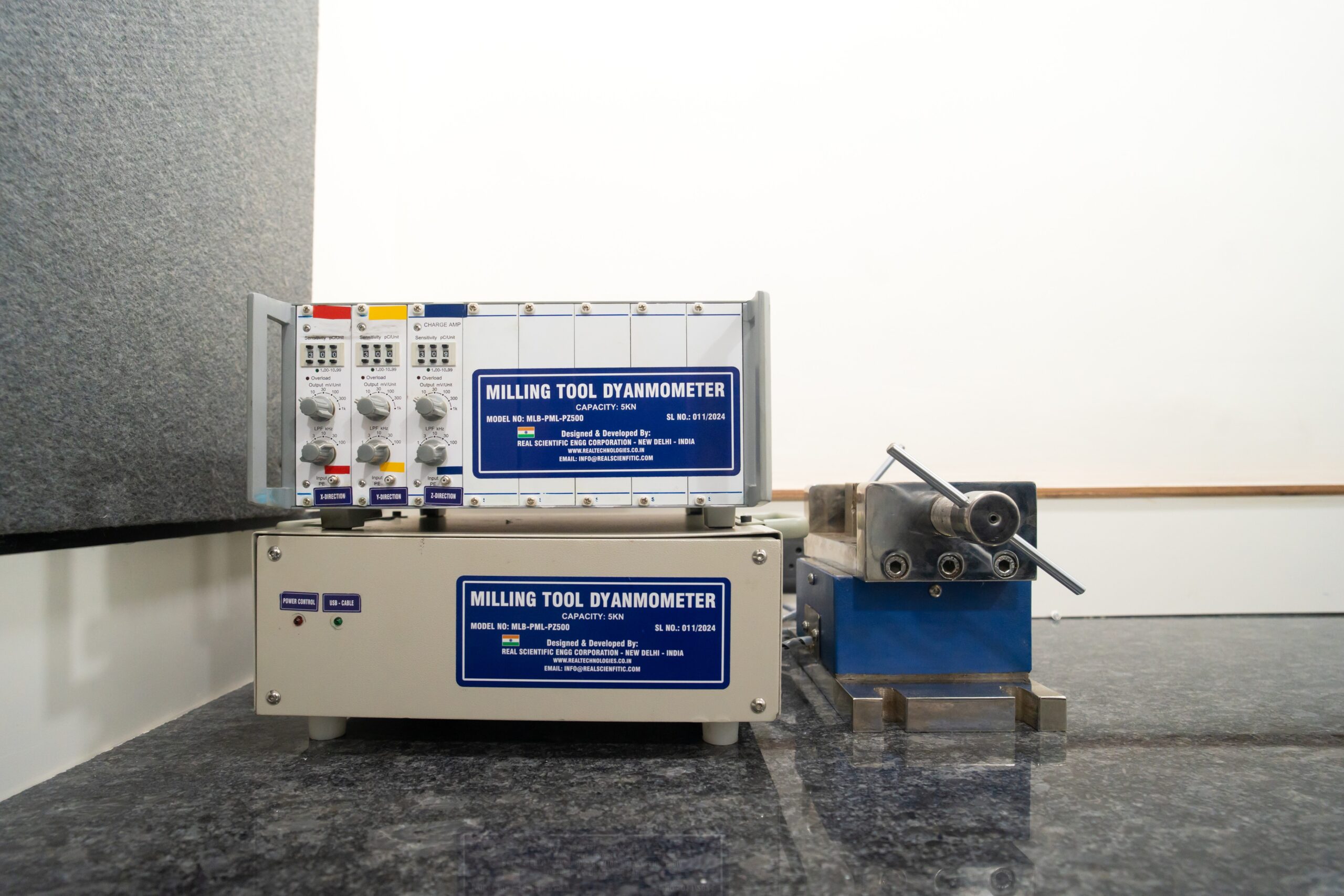
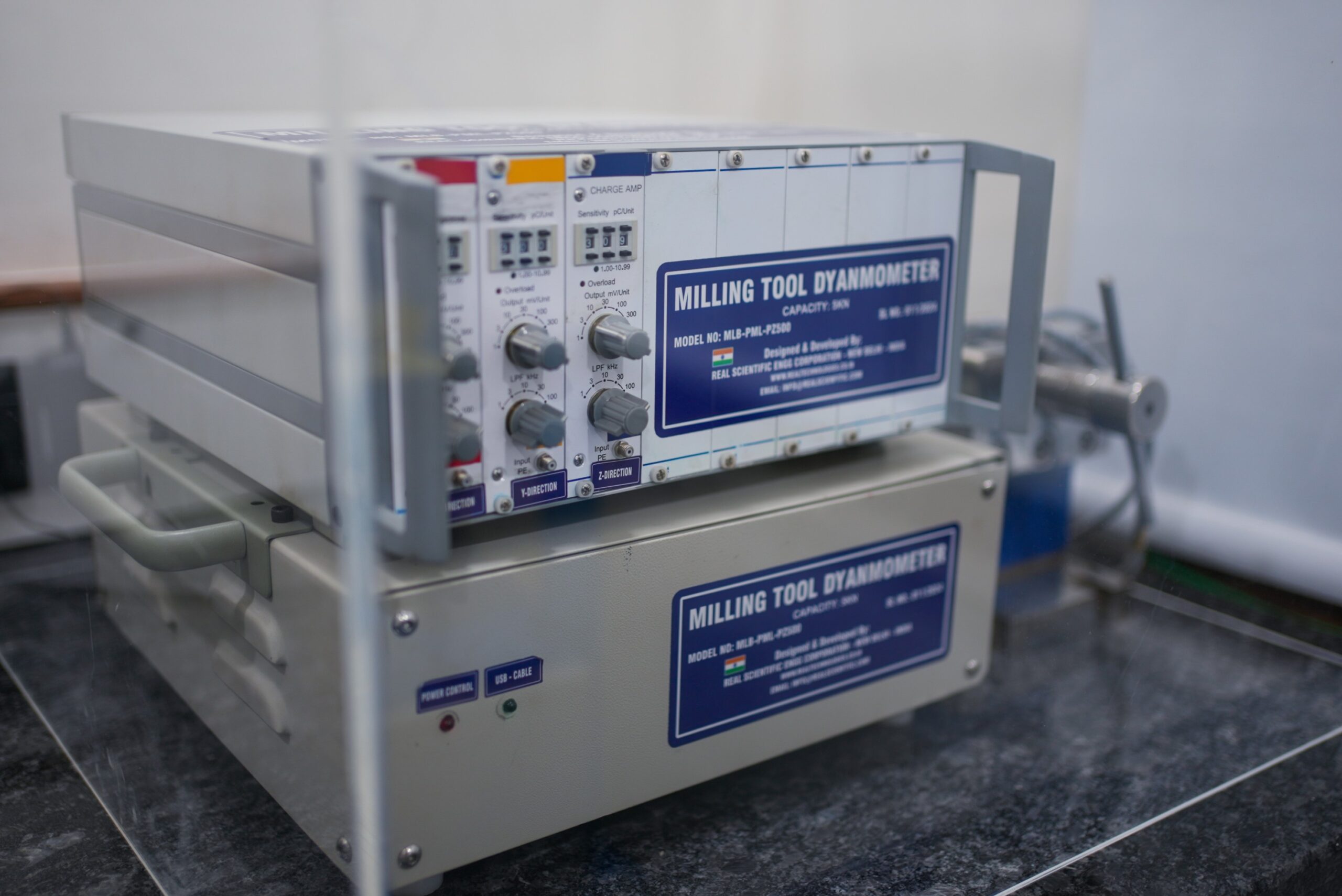
Instrument 1 - Piezo-based Multicomponent Dynamometer (MLB-PML-PZ500)
What It Does
The Piezo based Multicomponent Dynamometer manufactured by Medilab Enterprise is an instrument for measuring the forces generated during machining processes. When a cutting tool engages a workpiece turning, milling, drilling it generates forces in three orthogonal directions simultaneously: the cutting force (tangential), the feed force (axial), and the thrust force (radial). These forces directly determine tool wear rate, surface finish quality, energy consumption, and workpiece dimensional accuracy. Measuring them precisely as the piezoelectric sensors of the dynamometer do, with high sensitivity and fast response provides the data needed to optimise cutting parameters for any material.
Technology and Applications
Piezoelectric dynamometers work on the piezoelectric effect: certain crystals generate an electrical charge proportional to the mechanical force applied to them. By embedding piezoelectric elements in a precision machined housing, the dynamometer converts machining forces which can change rapidly as the tool engages and disengages into electrical signals that are recorded in real time. This enables not just average force measurement but force variation analysis, tool chatter detection, and comparative studies of how different cutting parameters or tool geometries affect the machining process.
Applications at the MNRDC include machinability testing of new materials (comparing how easily different alloys, composites, and polymers can be cut), tool life prediction (correlating cutting force patterns with tool wear progression), and surface integrity studies (relating machining forces to subsurface residual stresses and microstructural changes). For students in B.Tech Mechanical Engineering at Parul University, dynamometer data provides an experimental foundation for manufacturing process courses covering machining theory, tool design, and production engineering.
Instrument 2 - CNC Micro Machine Tool (Hyper-15, Sinergy Nano Systems)
What It Does
The Hyper 15 Tabletop Type Integrated Multi Process CNC Machine Tool, manufactured by Sinergy Nano Systems, is a compact precision CNC system designed for micro machining the fabrication of small scale components and features with dimensions in the micrometre range. Unlike standard industrial CNC machines that work in millimetre tolerances, the Hyper 15 enables micro drilling, micro milling, and micro turning of metals and polymers with feature sizes approaching the limits of conventional machining.
Significance for MEMS and Nanotechnology Research
Micro machining is a foundational technology for MEMS Micro Electro Mechanical Systems fabrication the field that produces accelerometers in smartphones, pressure sensors in medical devices, and gyroscopes in navigation systems. At the MNRDC, the Hyper15 enables researchers to fabricate the micro scale test specimens, sensor substrates, and precision components that other instruments then characterise. A component micro milled on the Hyper15 can be immediately examined for surface roughness on the AFM, for material phase on the XRD, and for wear behaviour on the Pin on Disc Tribometer creating a complete fabrication to characterisation workflow within a single facility.
For the MNRDC’s CSIR funded metamaterial MIMO antenna project , the Hyper15 can machine precision antenna substrates and fixture components that the sputtering system then coats with metallic and dielectric layers. This tight coupling between fabrication and characterisation instruments makes the MNRDC more than a testing facility it functions as a prototype development platform.
Instrument 3 - Computerised Bottom Pouring Stir Casting Machine (2kg, SwamEquip)
What It Does
The Computerised Bottom Pouring Type Stir Casting Machine 2 kg capacity, manufactured by SwamEquip, Chennai, installed in 2025 is designed for fabricating metal matrix composites MMCs materials consisting of a metal alloy matrix reinforced with ceramic, carbon, or other particulate materials to enhance specific properties such as strength, hardness, or wear resistance.
Stir casting is the most commercially viable method for MMC production: the matrix metal is melted, the reinforcement particles are added and mechanically stirred into the melt under controlled conditions to achieve uniform distribution, and the composite melt is then cast into a mould. The “bottom pouring” design means the molten composite is poured from the bottom of the crucible minimising oxidation and turbulence, and producing castings with fewer porosity defects than conventional top pouring methods. The 2 kg capacity is appropriate for laboratory scale specimen production.
Research and Industrial Applications
Metal matrix composites produced on the MNRDC’s stir casting machine aluminium reinforced with silicon carbide particles for aerospace components, or copper reinforced with graphite for electrical contacts can be immediately characterised on the SEM particle distribution uniformity, XRD phase identification, and Pin on Disc Tribometer wear resistance. This closed loop workflow fabricate, then characterise enables systematic optimisation of MMC composition and processing conditions. For students in B.Tech Mechanical Engineering and B.Tech Chemical Engineering at Parul University, the stir casting machine provides practical experience in advanced composite fabrication a skill in demand across automotive, aerospace, and defence manufacturing.
Instrument 4 - Compression Molding Machine (50-ton, Hexaplast)
What It Does
The 50Ton ASTM Specimen Molding Model Compression Molding Machine, manufactured by Hexaplast installed 2025, produces standard geometry test specimens from polymer and composite materials under controlled temperature and pressure conditions. ASTM standard specimens tensile bars ASTM D638, flexural bars ASTM D790, impact specimens ASTM D256 have specific dimensions required for mechanical testing results to be comparable across different laboratories and consistent with published literature.
Why Specimen Preparation Matters for Research Quality
A polymer or composite material’s mechanical properties are only meaningful if measured on a specimen of precise, standardised geometry. A tensile bar that is too thick, too thin, or has surface defects will give incorrect strength values. The compression molding machine applies controlled heat melting the polymer and controlled pressure filling the mould completely without void formation to produce specimens that meet ASTM dimensional tolerances precisely. This is particularly important for the MNRDC’s tribology and thermal analysis work, where specimen geometry directly affects the validity of test results.
Specimens moulded on the compression molding machine can be tested on the Pin on Disc Tribometer for wear resistance, the LCR Meter for dielectric properties, and when the new DSC and STA instruments are installed for thermal characterisation. The machine is also directly relevant to M.Pharm Pharmaceutical Technology research involving polymer excipients and drug delivery systems, where controlled specimen preparation is critical for reproducible characterisation.
FAQ
What is a Piezo-based Dynamometer and what does it measure?
A Piezo-based Dynamometer uses piezoelectric sensors to measure the forces generated during machining operations - turning, milling, and drilling - in three orthogonal directions simultaneously. It provides real-time data on cutting forces, feed forces, and thrust forces, enabling optimization of cutting parameters, prediction of tool wear, and study of machined surface integrity. The MNRDC operates the MLB-PML-PZ500 model by Medilab Enterprise.
What is stir casting and why is it used for metal matrix composites?
Stir casting is a manufacturing process where reinforcement particles (e.g., silicon carbide, alumina) are mechanically stirred into a molten metal matrix (e.g., aluminium, copper) to create a metal matrix composite (MMC). It is the most commercially scalable MMC production method. The MNRDC's 2 kg capacity bottom-pouring stir casting machine (SwamEquip, Chennai) enables laboratory-scale MMC fabrication with minimised oxidation and porosity defects.
What is micro-machining and what does the MNRDC's CNC machine do?
Micro-machining refers to precision machining of components with features in the micrometre range - dimensions far smaller than standard CNC machining achieves. The MNRDC's Hyper-15 Tabletop CNC (Sinergy Nano Systems) performs micro-drilling, micro-milling, and micro-turning of metals and polymers for MEMS fabrication, prototype development, precision specimen preparation, and antenna substrate machining for the CSIR metamaterial antenna project.
Why does specimen preparation matter for mechanical testing?
Mechanical test results are only valid and comparable with published literature if specimens conform to ASTM or ISO standard geometries. The MNRDC's 50-ton Compression Molding Machine (Hexaplast) produces ASTM-standard tensile bars, flexural bars, and impact specimens from polymer and composite materials under controlled temperature and pressure - ensuring dimensional accuracy and freedom from voids that would invalidate mechanical and tribological test results.