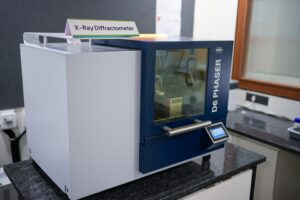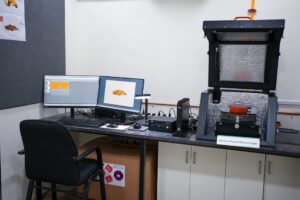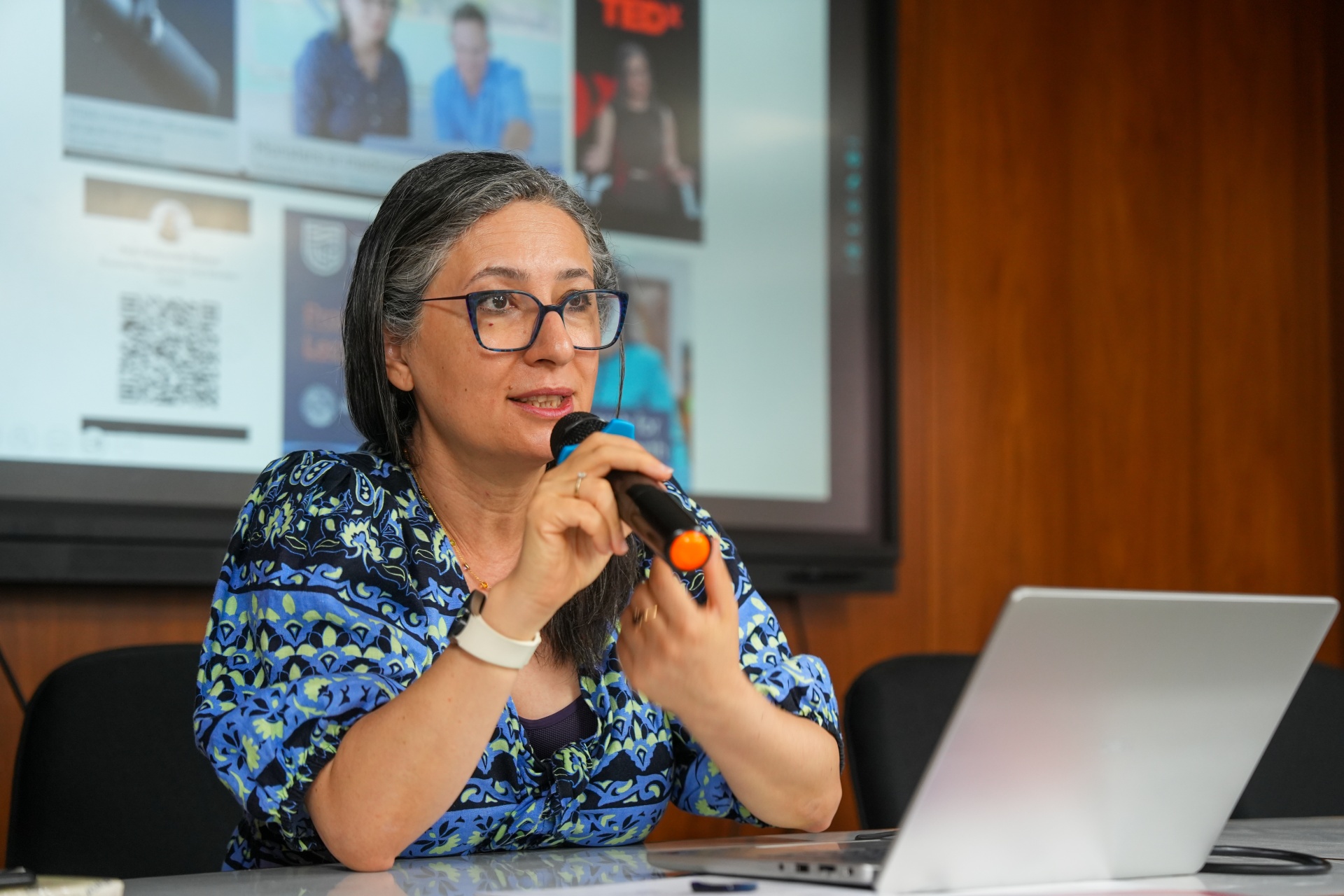
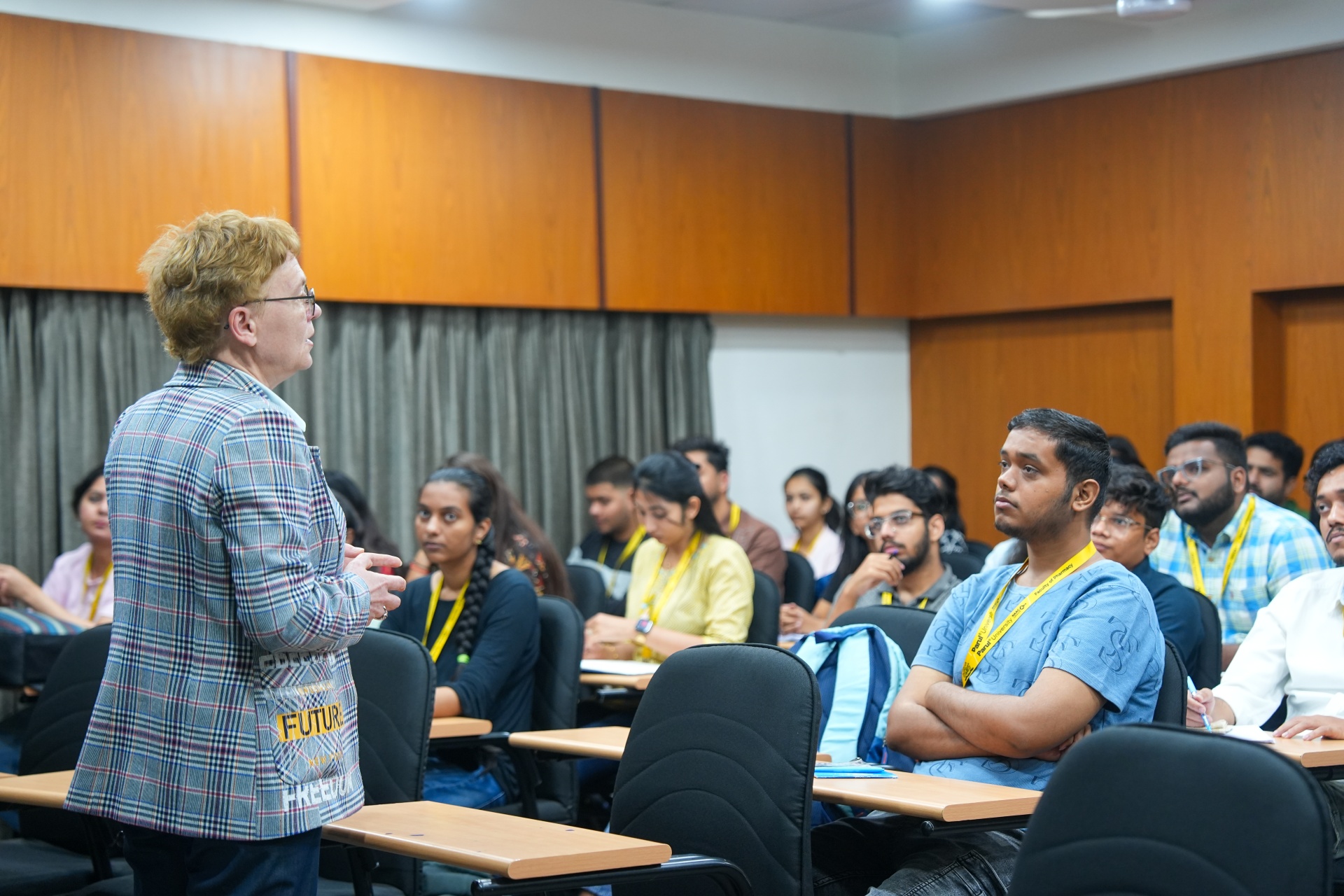
Dr. Shokoofeh Shamsi from Charles Sturt University (Australia) conducted a session specifically for faculty members at Parul Institute of Technology. Her core message: research should not be scattered. Instead of working on many small ideas, faculty should focus on 2-3 strong projects that lead to clear outcomes like datasets, working models, or research papers. She introduced a structured workflow:
- Step 1: Idea (define research problem and question based on a real-world need)
- Step 2: Asset (build something useful like a dataset, prototype, or model)
- Step 3: Evaluation (test results using proper methods, compare with existing solutions)
- Step 4: Paper (write up findings for publication)
She laid out an 8-week execution plan.
- Weeks 1-2: Understand and ideate on the idea and collect raw data.
- Weeks 3-4: Run a basic plan and initial testing.
- Weeks 5-6: Enhance the model and add more depth in testing.
- Weeks 7-8: Work on the final paper, analyze the data and ensure allocating tasks to your team. Keep clear roles for writing, technical execution, testing and final documentation.
On student projects, she identified a common problem: many final-year projects are too theoretical and lack real-world impact. Her solution: faculty should actively pitch well-designed project ideas to students rather than leaving topic selection entirely to them. Suggested student projects included cybersecurity tools for small businesses, women’s safety applications, air quality monitoring systems, waste segregation using image processing, and water leakage detection systems. If you’re a technology enthusiast, enrol into programmes of Parul Institute of Technology.
Dr. Quazi Mamun, also from Charles Sturt University, conducted a separate boardroom conference with senior faculty and associate professors. His session covered the importance of HDR (Higher Degree Research) programmes in developing research scholars, a comparative discussion on examination systems and digital monitoring between India and Australia, the role of Cisco development labs in bridging theoretical knowledge with industry application, and the impact of AI in education. On AI, he explored both opportunities (personalised learning, adaptive assessments, predictive academic tracking) and challenges (academic integrity, ethical considerations, balancing human mentorship with technology). He encouraged faculty to integrate AI responsibly into curricula and research.
Poland: Simulation as a Decision-Making Tool
Dr. Bozena Mielczarek from Wroclaw University (Poland) showed management faculty how simulation modelling supports decision-making under uncertainty. Her framework covered:
- System Analysis: understand process flows and system behaviour in real time
- Decision Support: explore what-if scenarios without the risks of real-world failure
- Structured Thinking: gain clarity through safe experimentation
On sustainability research, she focused specifically on SDG 13 (Climate Action) and broke down greenhouse gas emissions into three scopes. Scope 1: direct emissions under the organisation’s control.
Scope 2: indirect emissions from purchased energy.
Scope 3: all other indirect emissions in the value chain, including business travel and waste disposal.
She told the audience: as researchers, you cannot change the world, but you can change one small thing, and that one small thing can result in a domino effect. She openly encouraged faculty to use her research findings in their own teaching. MBA at Parul University helps students in finding the right idea to end to end execution with rigorous support of PIERC as well. So why settle for less when you can study and build?
South Africa: Research Methodology and the Case for Nursing Entrepreneurship
Dr. Suresh Babu Naidu Krishna from Durban University of Technology (South Africa) taught nursing students and faculty a comprehensive research methodology session. Key approaches covered:
- Experimental, survey, quasi-experimental, secondary data analysis, content analysis, historical comparative methods, participant observation, ethnography, individual qualitative interviews, textual analysis, focus group discussion, and the Delphi Method
- Primary vs secondary data: secondary saves cost and time but may lack suitability, contain inaccuracies, or have excess variables requiring sorting
- The Delphi Method: anonymity reduces bias, structured communication ensures systematic knowledge gathering, iterative process allows experts to revise opinions, geographical reach enables dispersed participation, avoids groupthink
- Interview guides in health research: ensure consistency, explore complex issues, facilitate understanding of illness impact on daily life, relationships, and mental health
He challenged a common perception directly. People often feel nursing students are just caregivers. But I emphasise that they should be entrepreneurs. They should be entrepreneurial in their approach, become their own bosses, and give jobs to others.
He announced an upcoming webinar specifically on nursing entrepreneurship. His parting advice: achievement comes to those who dedicate themselves. Spend more time to achieve your goal. Connect with your research passionately. Nothing happens by chance. But growth definitely comes when you choose education and progress in a health-care career, hand-in-hand, explore B.Sc. Nursing at Parul University to experience both!
Russia: Endocrine Research at PhD Level
Dr. Svetlana Nikolaevna Morozkina from ITMO University (Russia) delivered the most technically demanding session of the programme to pharmacy students and PhD scholars.
She spoke on these topics –
- Endocrine theory in breast cancer (affecting both women and men), hormonal ratios, and the protective role of hormones in hair, mental stability, and bone health
- Biochemical transformation pathways involving Androst-4-en-3,17-dione, aromatase action, estrone sulfate, estradiol, and estrone
- The unique amino acid FGly75 (formylglycine) and its role in enzyme ion complex stabilisation
- Principles of enzymatic catalytic processes, nucleophilic attack, and factors modifying drug effects including D-homo analogues, B-nor analogues, and the Torgov synthesis scheme
- Comparative drug testing and regulation between USA and Russia
PhD scholars asked advanced questions about enzyme kinetics, catalytic regions, and drug modification pathways. The faculty appreciated the comparative insight into Russian and American pharmaceutical research frameworks. Hence, you can achieve the same international exposure by exploring programmes of Parul Institute of Pharmacy. Delay no more and save your seat right away!
Germany: Business Statistics and Regression Analysis
Dr. Daniel Alexander Porath from Hochschule Mainz University of Applied Sciences (Germany) taught BBA students business statistics with a focus on practical application. He spoke on these topics –
- Regression analysis fundamentals: estimated regression residual (ei = yi – yi-hat), measuring the gap between observed and predicted values
- Five key components of simple linear regression, interpretation of regression coefficients, and goodness of fit (R-squared)
- Assumptions of the regression model: linearity, independence, homoscedasticity, absence of multicollinearity
- Multiple regression analysis, OLS (Ordinary Least Squares) estimation, and the Classical Regression Model
- Desired properties of estimators: unbiasedness, consistency, efficiency, and sufficiency
His practical data analysis steps: collect a sample, inspect data, identify qualitative and quantitative variables, use descriptive statistics (mean, median, max, min), detect outliers, calculate correlations between metric variables, run simple regressions before estimating a full multiple regression model using OLS. Students actively cross-questioned assumptions of the classical regression model, leading to deeper academic discussion that Dr. Porath encouraged, preferring analytical thinking over rote learning. BBA in International Business at Parul University helps you master global trade, analytical thinking and various business backgrounds.
ISRO: Satellite Control and Mathematical Modelling
Dr. Raju K. George from the Indian Institute of Space Science and Technology (academic wing of ISRO) delivered a lecture at PIT as part of an engineering conference. While not part of the CIRR IVPP series, the session complemented the international programme.
- Mathematical modelling as translating real-life systems into equations: most engineering challenges reduce to solving mathematical problems
- Satellite systems discussed: Cartosat, RISAT, NavIC
- Orbital position (translational control) and attitude control (rotational dynamics) using radial and tangential thrusters
- Non-linear coupled differential equations representing satellite motion, transformed into first-order systems
- Controllability: determining whether a satellite can be guided back to its desired state through continuous monitoring and corrective action Passionate about engineering & technology? Explore B.Tech programmes at Parul University, choose what fits the best to your interest and say yes to your dreams.
What Students and Faculty Said at IVPP 2026: LinkedIn Testimonials
The student and faculty responses after the programme were not institutional press releases. They were personal reflections posted publicly on LinkedIn. Key voices:
- Khushi Gajjar (MBA): Communication is not just about language but about empathy, context, cultural awareness, and mutual understanding
- Firdaus Alam (MBA): This was more than a seminar. It was a journey of perspectives. He did not just teach us. He connected with us, and we all learned from each other
- Harsh Gupta (MBA): Described Day 7 of Indonesian sessions, listing every framework from Kim’s micro-level synchrony to Jackson’s Development Model, ending with: we ended our day with a big smile and eagerness for the next session
- Yuvraj Singh (MBA): His group from Punjab, Delhi, and Gujarat found that Hindi acted as a unifying link across cultures, reinforcing unity in diversity as lived experience
- Jayasri Acharya: Described a 3-week session concluding with research papers, project reports, and presentations on Harmony in Diversity, analysing HCL Technologies, Glenmark Pharmaceuticals, and Waste Management Inc.
- Tanush Jajoo (MBA): Learning how simulation supports decision-making, risk analysis, and business planning added great value to my understanding of modern management
- Jayesh More (Liberal Arts): Dr. Gatcho’s teaching style allowed ideas to breathe freely. His farewell referenced the Japanese concept of Ichigo Ichie, cherishing fleeting moments
However, in response to the same, Dr. Bonifacius Hendar Putranto thanked Parul University and students for hosting international and intercultural collaboration in the future. If you’re equally passionate about building your own startup, you can enroll into MBA at Parul University.
FAQ: Research and Faculty Development at Parul University
Does IVPP include sessions for faculty, not just students?
Yes. Dr. Shamsi (Australia) trained faculty on an 8-week research workflow. Dr. Mamun (Australia) discussed HDR and AI with senior professors. Dr. Mielczarek (Poland) taught simulation to management faculty. The IFDP (International Faculty Development Program) ran in parallel with 20 speakers from 18 countries, the first time at this scale.
What research areas were covered?
Cybersecurity and IoT (Australia), simulation modelling and climate action (Poland), health research methodology and Delphi Method (South Africa), endocrine theory and steroid chemistry (Russia), business statistics and regression (Germany), satellite control and mathematical modelling (ISRO/IIST), and AI in education (Australia).