
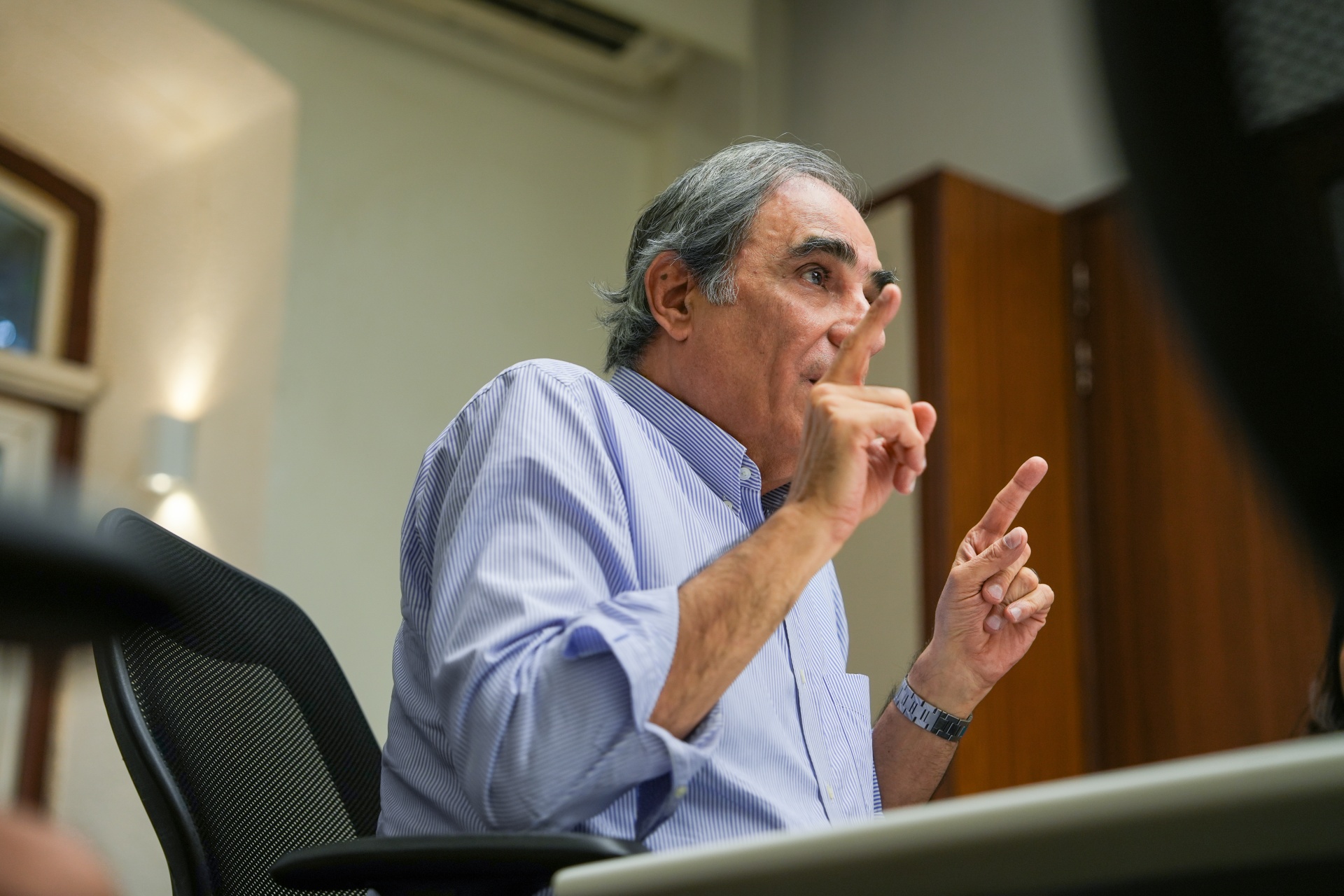
1968 was the year when Ar. Hafeez Contractor was doing apprentice work under his uncle T. Khareghat and was pursuing morning college at the same time. Nobody called it a strategy. It was just what was happening. Started with Academy of Architecture, Mumbai, 1975, then a Tata Scholarship and Columbia University in New York and a Master’s degree finished in 1977, after which he came back to India and eventually, in 1982, opened his own firm in Mumbai. Two people on staff at that point, the same firm is functioning with 600 people now.
Architect Hafeez Contractor, AHC, is one of the largest architectural practices in Asia and the way it got there was not one landmark commission that changed everything but decade after decade of work that kept coming and kept getting done.
Imperial Towers in Mumbai stood as India’s tallest residential buildings from 2010 to 2017, 254 metres, seven years at the top before something else overtook them. The 42 in Kolkata is still Eastern India’s tallest. 23 Marina in Dubai was at one point the tallest all-residential building on earth, briefly, which is still a thing to have built. DY Patil Stadium is where Mumbai Indians play, Mumbai City FC too, so it fills up a lot and gets seen by people who are not particularly thinking about architecture at the time but are inside it regardless.
Hiranandani Gardens in Powai ended up in Slumdog Millionaire because it looked like what India becoming looked like. The Infosys campus near Mysore. The domestic terminals at Chhatrapati Shivaji Airport in Mumbai, where the passenger numbers are relentless and every design decision gets tested daily whether anyone planned for that or not.
He has received Padma Bhushan in 2016 and was felictiated with more than 75 awards collected over five decades. The count stopped being the interesting part a long time ago. When Ar. Hafeez Contractor spoke to Parul University students during their Mumbai civil engineering tour, he did not use slides or statistics. He told seven stories. Each story contained a professional lesson that students training to be engineers and architects will face in their careers. And if you too wish to be inspired by such stalwarts in person, then you’re landed at the right place. Parul University’s B.Tech in Civil Engineering Program offers a perfect combination of dream package + exposure.
Read more about Architect Hafeez Contractor Official
Story 1: The Lady From Pune Who Wanted a Simple House
In 1969, in Pune, a woman carrying a sari and handbag wanted a bungalow for her family. This was the only brief Hafeez Contractor’s cousin received.
The cousin designed something modern with vaulted roofs, the kind of drawing that makes sense when you have just finished architecture school and want someone to notice.
When the drawing was presented to her, she said no. Then she opened her handbag, took out a photograph from her purse, and placed it on the table. It showed an old house somewhere with a pitched roof, rubble walls, and vines growing outside, the green overgrown kind that only appear when a house has stood for a long time.
This was what she wanted. The designer picked up the photograph, looked at it, and told her that it was not architecture. Those were his exact words apparently. She said nothing in return. She simply folded her papers, placed everything back into her handbag, stood up, and left. The surprising part was that she never argued, never returned, and never cared to visit again.
“We as architects are supposed to provide a service to the client. Do not impose your own style if the client does not like it.”
The lesson: your design ego is not more important than the client’s vision. If the client wants something that is not illegal or structurally unsound, build it. The comparison Hafeez Contractor used was simple: if you invite a guest who likes meat, serve meat. Do not force them to eat plain rice because that is what you prefer. Architect your dreams with Parul University’s M.Tech in Construction Project Management Program.
Story 2: The Double Wall That Stopped Mumbai Buildings From Leaking
In the early years of Hafeez Contractor’s practice, every builder in Mumbai used the same construction method: columns, concrete beams, and plain brick walls. The problem was universal: buildings leaked when it rained. Water penetrated through joints. Nobody was solving it.
“Every time you take a job, you must try to solve a problem.”
His solution was the double wall concept. Instead of a standard 9-inch single wall, he built a 4-inch inner wall (saving space that was returned to the buyer as extra carpet area), left a 2-foot gap, and built a smaller outer wall that acted as a raincoat for the building. The rain hit the outer wall and never reached the interior. Flats stopped leaking entirely. Builders were happy because they could sell more space. Buyers were happy because their homes stayed dry. The buildings looked distinctive.
The engineering lesson: the best solutions benefit everyone in the transaction. The builder did not lose money. The buyer gained space and waterproofing. The architect gained a reputation for solving a problem nobody else was addressing.
Story 3: The Pune Building With a Pitched Roof That the Builder Loved
For a project opposite a beautiful government building with a pitched roof in Pune, Hafeez Contractor knew that a flat roof would look ugly in context. He also knew the builder would reject a pitched roof because it costs more. So he built the business case before the design presentation: a pitched roof means no money spent on waterproofing, the space under the roof becomes a sellable mezzanine, and the top floor can be priced as a premium penthouse. The builder agreed immediately.
“Always find a way to show the business benefit to your client.”
Admissions are live for Architecture and Planning at Parul University
Story 4: Kitika's 80-Square-Metre Apartment With Circular Rooms
A client named Kitika wanted an 80-square-metre apartment with a 20×20-foot living room and two 14×10-foot bedrooms. Hafeez Contractor accepted the brief. Then he sat down to draw and realised the numbers did not add up. The large rooms consumed the entire 80 square metres, leaving no space for bathrooms, kitchen, or hallways.
His solution: make the corners of the rooms round instead of square. Circular corners eliminated wasted space in the geometry. The rooms still felt large to stand in, but on paper they measured smaller. The math finally worked. Everything fit within 80 square metres.
The lesson for engineers and architects: when arithmetic says no, geometry might say yes. Creative spatial thinking is a professional skill, not an aesthetic preference. Such stories have inspired PU students at all levels, something no classroom can teach. You too can turn your dreams into reality by enrolling in Parul University’s Diploma in Civil Engineering Program!
Story 5: The Village School Built for Rs 1 Lakh 10 Thousand
A government official came to Hafeez Contractor’s office asking him to design a school. Her total budget was Rs 1 lakh 10 thousand. She wanted to build 500 such schools across Maharashtra villages. She assumed a concrete box, 10 feet by 10 feet, where children sit outside and lock their books inside after class.
“Never say a demand is stupid just because it sounds impossible.”
Hafeez Contractor did not dismiss the budget. He asked about the villages. Every village has shops selling cheap old wooden doors. The land has abundant mud and stones. He designed a school using local materials: mud and stone walls with holes for book storage, a shaded area under existing trees, a roof of cheap wooden poles and local tiles, and two separate toilet areas for boys and girls. The entire school cost exactly Rs 1 lakh 10 thousand. The design was beautiful, natural, and functionally complete.
“If you apply your mind, you can solve any budget problem.”
This story directly connects to the entrepreneurial problem-solving mindset that Parul University’s ecosystem is designed to build. PIERC (Parul Innovation and Entrepreneurship Research Centre) has incubated 254 startups with Rs 20 crore plus in funding and Rs 40 crore plus in revenue.
Startups like Yield Pro Earth (affordable irrigation solutions, Rs 75 lakh purchase order from ICICI Foundation) and Dori Handcrafts (sustainable lifestyle brand showcased at the Republic Plenary Meet before the Prime Minister) operate on the same principle: solve real problems within real constraints.
Story 6: Decoding Osho's Three-Word Brief for an Ashram
Two men visited Hafeez Contractor’s office and said Osho, the spiritual leader, had chosen him to design a new ashram campus. Hafeez Contractor designed something beautiful. Osho rejected it. Instead, Osho sent a heavy book containing a photograph of a barn house at sunset, and a note on yellow paper with three lines: black on black, blue tinted windows, barn house.
Hafeez Contractor was confused for weeks. He kept the book near his desk. At 3 AM one night, while his team was working, a boy cutting chart paper on a black painted board made a scratching sound. The knife left a mark on the black surface.
Suddenly, Hafeez Contractor understood: black on black meant etching or cutting into a dark surface. A barn house shape is a triangle, which is a pyramid. A pyramid is a stable shape that some believe preserves energy. Black, when you mix all colours, is all colours combined. Blue tinted windows represented the blue light that some traditions associate with spiritual peace.
At 3 AM, he made his team build a paper model: a pyramid shape with blue windows. He sent it by taxi at 7 AM. Hours later, Osho called. He loved it.
“Even the most confusing demands can be solved if you think deeply.”
Story 7: The Slum Women Who No Longer Wait Until Sunset
Students asked Hafeez Contractor how it felt to receive the Padma Bhushan. He said it was a nice feeling. Then he told them why he received it.
He created a policy for building homes for slum dwellers. At an opening ceremony for new homes, two women came dressed in traditional nine-yard saris and nose rings, as if attending a wedding. They brought a prayer plate and took Hafeez Contractor and the political leader Mr. Uddhav Thackeray to a temple.
One woman looked at him and asked if he knew what he had truly done for them. He said he did not know. The woman explained, with tears, that before these homes, there were no toilets in the slums. The women had to wait all day for the sun to set so they could go to the toilet in the dark behind a wall. They held their bodies in pain for hours every single day. Because Hafeez Contractor built homes with indoor toilets, they never had to suffer like that again.
“Good architecture can remove human suffering and change lives completely.”
This is the moment that justifies an entire career. Every lecture about structural loads and material science leads, eventually, to a woman who no longer has to hold her body in pain because an architect thought about dignity, not just square footage.
His Warning About India's Future
Hafeez Contractor ended his session with a serious message. India has 20 percent of the world’s population but only 2 percent of the world’s land. Cities are spreading too fast, destroying farms and cutting forests.
His calculation: India needs to build a city the size of Mumbai every year for twenty years to house its population. Those cities must be dense, not spread out, and must be built near water sources. Delhi and Jaipur do not have water. Climate change is already happening.
“The youth must figure out how to build dense cities and increase forest cover.”
For civil engineering students at Parul University, this is not an abstract environmental message. It is a career directive. The engineers who solve India’s urban density challenge, who build tall, sustainable, water-efficient cities that preserve farmland and forests, will be the most in-demand professionals of the next three decades.
Frequently Asked Questions
Who is Ar. Hafeez Contractor?
One of India's most recognised architects. Padma Bhushan recipient (2016). Columbia University graduate (Master's degree, 1977, Tata Scholarship). Founded AHC in 1982 with 2 staff, now 600+ employees. Architect of India's three tallest buildings: The Imperial Towers Mumbai, The 42 Kolkata, 23 Marina Dubai. 7.2 billion square feet of ongoing projects across 100 cities. 75+ national and international awards.
What did Hafeez Contractor tell Parul University students?
Seven stories, each with a professional lesson: never impose your style on clients, solve leaking problems with double walls, show business benefits to builders, use circular geometry to beat arithmetic, design village schools with local materials for Rs 1.1 lakh, decode abstract briefs by thinking deeply, and build homes with toilets that remove human suffering. He also warned about India's urban density crisis and climate change.
What is the Padma Bhushan and why did Hafeez Contractor receive it?
The Padma Bhushan is one of the highest civilian honours in India, awarded for distinguished service of a high order. Hafeez Contractor received it in 2016 for his contributions to architecture, particularly his work on slum rehabilitation and affordable housing. He told students that the real reward was seeing the change he made in the lives of poor women who, before his housing, had to wait until sunset to use a toilet.
Did Hafeez Contractor design India's tallest buildings?
Yes. As of 2019, he was the architect of India's three tallest buildings: The Imperial Towers in Mumbai (254 metres, India's tallest residential from 2010-2017), The 42 in Kolkata (Eastern India's tallest), and 23 Marina in Dubai (briefly the world's tallest all-residential building). He also designed DY Patil Stadium, Hiranandani Gardens, Infosys Mysore campus, and Mumbai airport terminals.
What is the double wall concept in construction?
A waterproofing innovation by Hafeez Contractor. Instead of a single 9-inch wall, he uses a 4-inch inner wall (saving space returned to the buyer as carpet area), a 2-foot air gap, and a smaller outer wall that acts as a rain shield. The outer wall stops water. The inner wall stays dry. Buildings stop leaking. Builders gain sellable space. Buyers get waterproof homes.