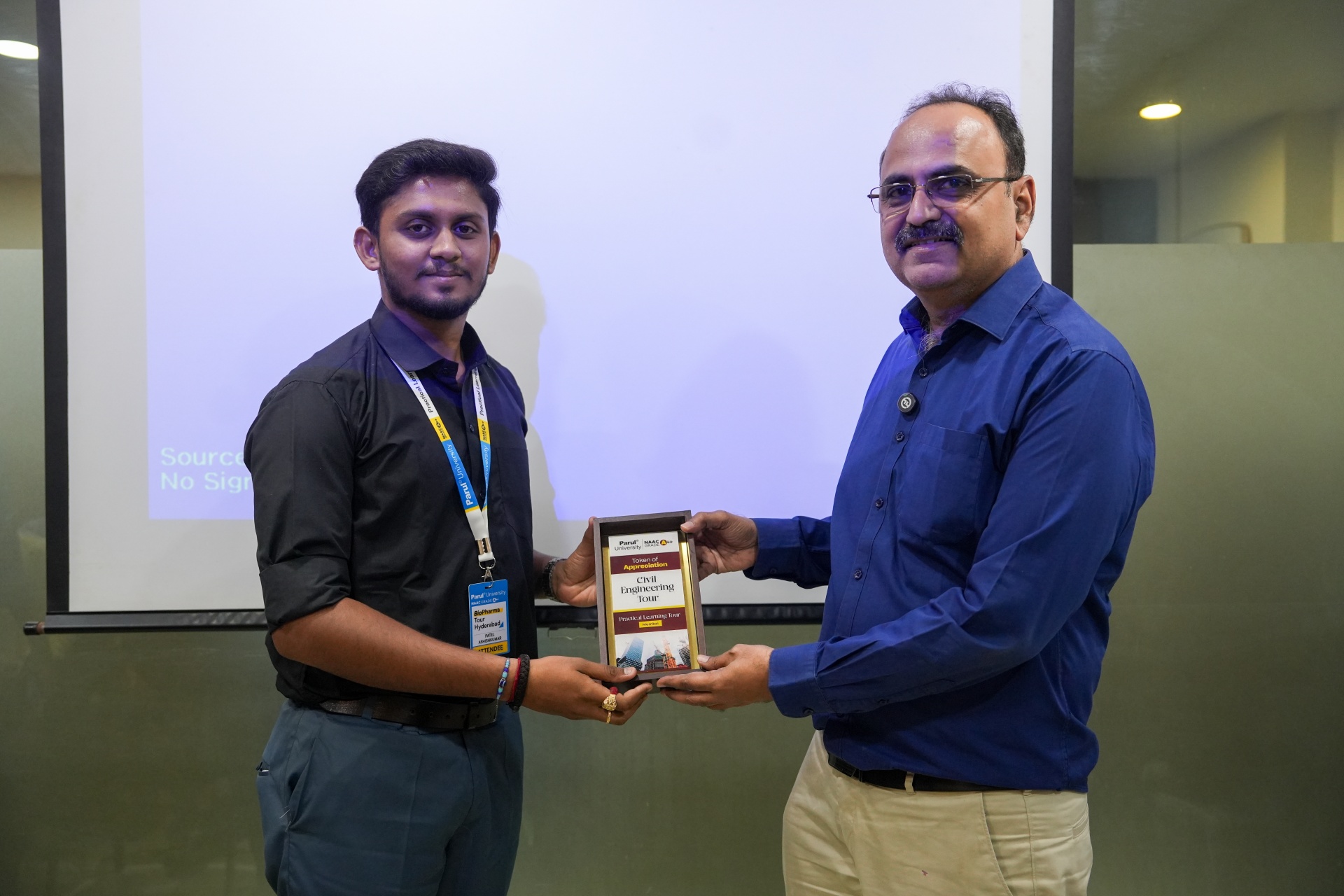
4 Days, 9 Sessions, Mumbai - A City That’s Living Engineering Lab
Bombay as known as Mumbai is not a case study, it’s a construction site. The city builds metro tunnels under traffic, inspecting 100-year old British bridges with underwater divers, 85-storey towers in middle of 16.5 acre cluster re-development projects, and constructs bullet trains using tunnel machines, imported for a single corridor.
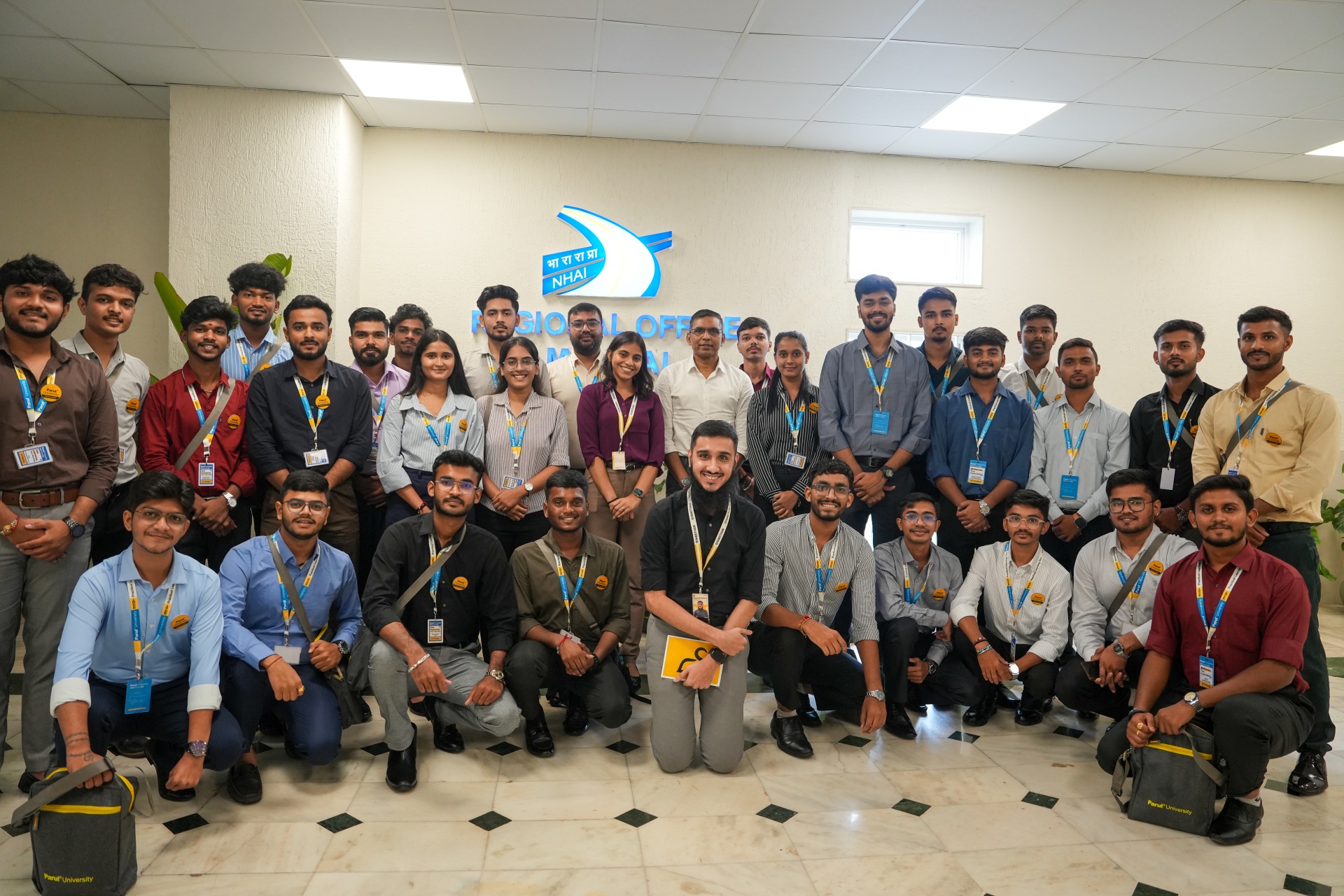
For 28 students of Civil Engineering, spending 4 days inside such ecosystem was once-in-a-kind learning experience that no classroom can ever explain or replicate.
This exclusive tour was organized as part of Parul University’s Practical Learning Tour Programme, running across 146 tours across 19 cities covering 280+ Companies. The faculty mentor Mr. Darshit Shah accompanied the group and the sessions spanned across concrete technology, architecture, academic research, highway management, tuneeling, real estate, affordable housing, airport construction, and a expo based on national road infrastructure.
Day 1: Concrete, Precast, and 33 Years of Construction Reality
Session 1: CIDCO Package 4 with L&T (Mr. Sanjay Dahedar, Mr. Sunil Samantaray, Mr. Nawaz Shareef)
The tour opened at the CIDCO office in Navi Mumbai with a briefing from Mr. Sanjay Dahedar (Superintending Engineer, retired), Mr. Sunil Samantaray (Project Director, TCE HSA JV), and Mr. Nawaz Shareef (Project Director, L&T).
The session covered CIDCO Package 4, part of the Navi Mumbai Mass Housing Project containing 23,432 tenements across Bamandongri, Kharkopar East and West, and Sector 39 of Taloja. Students observed precast structure assembly, monolithic construction techniques, and grouting processes at the active construction site. If you’re passionate about spaces and infrastructure, say yes to your dream company in civil domain by enrolling in B.Tech in Civil Engineering program of Parul University!
Session 2: Er. Mahesh Tendulkar on Challenges in Civil Engineering
Er. Mahesh Tendulkar is the Chief General Manager and Concrete Technologist at the Saifee Burhani Upliftment Trust (SBUT), the largest cluster redevelopment project in India at Bhendi Bazaar, Mumbai. He holds an M.Tech in Construction Technology and Management from IIT Bombay, completed at age 46.
His 33-year career spans Tata Power (underground hydro power projects, 100 metres below ground), Ambuja Cement (12 years under Mr. Remedios, known as the father of concrete), and Mumbai Metro Lines 2A and 6 (team leader for quality audits with Reliance).
His session covered the evolution from 500 cubic metres of concrete being a major pour to 3,000 cubic metres being routine, bridge health inspections (1,000+ bridges in Maharashtra, including underwater diver inspections in the Godavari River with head-mounted cameras at 10 metres depth), the SBUT Bhendi Bazaar project (85-storey towers, mass concrete bases 3 to 5 metres thick, self-compacting concrete, on-site ready-mix plant), and the future of precast housing (a 22-storey tower in 2 to 3 months using factory-made rooms stacked by crane). If you’re interested in building a career at the intersection of technology & construction, then level up your career with M.Tech in Construction Project Management course from Parul University!
He quoted – “Artificial Intelligence can never build a bridge or pour concrete on a site. Civil engineers will always have a career with a bright future.”
Day 2: Highways, Tunnels, and the Bullet Train Shaft
Session 3: Mr. Sanjay Jaiswal, Chief General Manager, NHAI
At the NHAI Regional Office in Mumbai, Mr. Sanjay Jaiswal briefed students on highway project implementation models (EPC, BOT, HAM), sustainability measures (waste plastic in roads, fly ash, plantation drives along highways), digital monitoring using drones and advanced project management systems, and flood-control strategies for expressway design. The session demonstrated that NHAI’s work extends far beyond road construction into planning, environmental management, and technology-driven maintenance.
Session 4: AFCONS Infrastructure (Mr. Sunil Tyagi and Mr. Arun Deore)
Mr. Sunil Tyagi (Director, Project Operations) and Mr. Arun Deore (Chief Risk Officer) at AFCONS Infrastructure hosted students at the C-2 site of the Mumbai-Ahmedabad High-Speed Rail (MAHSR) Project. The session covered the Atal Tunnel (world’s longest highway tunnel above 10,000 feet) and the Ahmedabad-Mumbai bullet train tunnel project.
Students observed the double-D shaped tunnel shaft, advanced tunnel boring machines (TBMs), NATM tunneling techniques, geological analysis, and safety systems for high-speed rail at 250+ kmph. The shaft, once breakthrough is complete, will serve as an air conditioning point.
AFCONS Infrastructure, a Shapoorji Pallonji Group company, also posted about the visit on their official LinkedIn page, confirming that over 30 Parul University engineering students received guided tours and first-hand insights from senior leadership.
Day 3: The Padma Bhushan Architect, a Township, and Sustainability in Practice
Session 5: Runwal Garden City (Mr. Prashant Dhole and Mr. Raj Rangani)
Mr. Prashant Dhole (Executive Vice President and Head of Construction, Runwal Group) briefed students on the vision, sustainability practices, IGBC certification alignment, and master planning of Runwal Garden City in Dombivli. The site visit led by Mr. Raj Rangani (Planning and Construction Engineer) covered the sewage treatment plant (STP), biogas plant for organic waste, advanced pumping systems, aluminium formwork technology, and cluster development approach for phased construction.
Session 6: Ar. Hafeez Contractor (Padma Bhushan, Columbia University, AHC)
Ar. Hafeez Contractor is one of India’s most recognised architects. Columbia University graduate. Padma Bhushan recipient (2016). Architect of India’s three tallest buildings: The Imperial Towers in Mumbai, The 42 in Kolkata, and 23 Marina in Dubai. Firm AHC has 600+ employees with 7.2 billion square feet of ongoing projects across 100 cities. He has received 75+ national and international awards.
His session with Parul University students was built around stories, not slides. He told seven stories, each containing a professional lesson: the client who wanted a simple house (lesson: never impose your style), the double wall concept that stopped buildings from leaking (lesson: solve a problem without costing the builder money), the Pune building with a pitched roof (lesson: show the business benefit), Kitika’s circular room that defeated arithmetic (lesson: creative geometry solves budget constraints), the village school built for Rs 1 lakh 10 thousand (lesson: design with local materials for local budgets), the Rajnish Ashram decoded from a three-word note (lesson: think deeply about abstract briefs), and the slum rehabilitation women who no longer had to wait until sunset to use a toilet (lesson: architecture removes human suffering). If you too wish to build your career just like him, do not delay your dreams and enrol into Parul University’s Diploma in Civil Engineering Program!
“Good architecture can remove human suffering and change lives completely.”
Day 4: IIT Bombay, the National Road Expo, and a New Airport
Session 7: Prof. Tarun Kant at IIT Bombay
Prof. Tarun Kant is the Institute Chair Professor at IIT Bombay. He is the only civil engineer in India elected as Fellow of all four premier national academies: Indian National Academy of Engineering, Indian National Science Academy, Indian Academy of Sciences, and National Academy of Sciences India.
He has guided 27 PhD scholars, 77 Master’s students, and published 166 research papers over a career spanning 50+ years. He entered IIT Bombay in 1963 and has been associated with the institution since 1971.
His session covered the history of IIT Bombay’s civil engineering department (founded 1958), why civil engineering is the mother of all engineering branches (applicable to nuclear containment, aerospace structures, and ISRO), career paths after graduation (GATE for M.Tech at IITs, UPSC for government, consulting firms, construction companies), and his personal journey from a Rs 650 salary at Tata Consulting to being interviewed by the Prime Minister for the Jawaharlal Nehru Memorial Trust UK Fellowship.
“Teaching and research is a unique place where nobody tells you what to do and you have the freedom to chart your own path.”
Session 8: RAHSTA Expo at Jio World Convention Centre
RAHSTA Expo – Asia’s largest road and highway infrastructure exhibition. 200+ companies exhibited. Students explored innovations in sustainable road construction, intelligent infrastructure solutions, tunneling technologies, and bridge engineering. Live demonstrations of machinery and equipment provided exposure to cutting-edge construction technology.
Session 9: Mr. Prabhat Mahapatra, COO, Navi Mumbai International Airport
Mr. Prabhat Mahapatra briefed students on one of India’s most ambitious infrastructure projects. The session covered land acquisition challenges, community rehabilitation, river rerouting, hill removal, high-tension power line shifting, mangrove preservation, environmental clearances, advanced construction technology, and multi-stakeholder coordination between engineers, architects, planners, environmental experts, and government agencies.
#ProudlyPlaced – Tanish Patel: 7.04 CGPA to 60 LPA at Microsoft
Session with Mr. Ravi Kevalramani (Real Estate, 2M+ Social Media Followers)
Mr. Ravi Kevalramani, director of RK Mumbai Realtors (established 1988) and founder of Straight Talk, demonstrated live AI-assisted office design using ChatGPT, Gemini, and Grok. He showed students how a photo of an empty cement box was transformed into a modern office rendering in five minutes.
He compared Mumbai and Dubai construction cultures, discussed Mivan technology for fast high-rise construction, 3D printing limitations, the hidden maintenance costs of luxury housing (referencing the 432 Park Avenue elevator and pendulum problems in New York), and social media brand-building (his Karjat property video crossed 20 million views).
30 + LinkedIn Posts & 15 + Quora Experiences
Multiple Parul University students documented the tour on their personal LinkedIn profiles. Ritik Sai Patel published day-by-day coverage (Day 1 through Day 4) with detailed session notes, and one of his posts crossed 45,000 impressions and 850 likes. Bhargav Pillai wrote individual posts for CIDCO, Hafeez Contractor, NHAI, and the airport session. AFCONS Infrastructure’s official LinkedIn page published a post confirming the visit.
Ritik Sai Patel Day 1 LinkedIn Post
On Quora, students answered questions including how NHAI works, whether industrial visits are useful for civil engineering students, the best way to learn concrete technology, and the impact of the Mumbai-Ahmedabad bullet train on travel time. Every Quora answer references the Parul University tour as the evidence base.
The Institutional Foundation Behind the Tour
This tour is one of 146 Practical Learning Tours Parul University runs across 19 cities covering 280 companies including Tata, Microsoft, Google, L&T, Reliance, NSE, ISRO, and Parliament of India.
The civil engineering tour to Mumbai sits within a broader ecosystem that includes NAAC A++ accreditation (CGPA 3.55), NIRF Top 50 Innovations ranking, QS Asia 1001-1100 Band, Rs 58.31 crore in government-funded research through the Micro Nano Research and Development Center (MNRDC), 7 faculty in the Stanford-Elsevier global top 2 percent, 254 startups incubated through PIERC with Rs 20 crore plus in funding, and 3,500+ recruiters with the highest placement of 60 LPA at Microsoft (Tanish Patel and Suraj Jagtap, B.Tech CSE, 2027 batch).
Read the Complete Series
Article 2: Er. Mahesh Tendulkar on 33 Years of Concrete
Article 3: Ar. Hafeez Contractor: Seven Stories From a Padma Bhushan Architect
Article 4: Prof. Tarun Kant at IIT Bombay: Career Paths and a PM Interview
Article 5: Inside the Atal Tunnel, the Bullet Train Shaft, and a Precast Factory
Article 6: Will AI Replace Civil Engineers?
Article 7: Parul University Civil Engineering Review