Most researchers interact with a testing facility at the point of sample submission: they bring a sample, receive data, and leave. MNRDC is structured to engage at a deeper level. The Center provides consultancy and support services that begin before a sample is ever prepared and extend through publication of results.
Read more about – MNRDC Facilities and Services
Technical Consultancy
MMNRDC’s research cadre offers technical consultancy in these three areas:
Experimental Design
Right before a researcher begins the initial testing, the centre advises on which instruments are most suitable for the research objectives, what sample preparation protocols will produce reliable results, and what sequence of tests will provide comprehensive characterisation. For example, a PhD scholar studying nanocomposite properties may use SEM to analyse morphology and a pin-on-disc test to evaluate wear behaviour. The centre helps researchers plan the testing sequence to achieve a more complete understanding of their research outcomes.
Method Development
For novel materials or unconventional sample types, standard testing protocols may not apply directly. MNRDC supports method development: adapting instrument settings, sample preparation techniques, and analysis parameters to handle materials that fall outside standard categories. This is particularly relevant for interdisciplinary research where a pharmacy researcher needs materials characterisation tools typically used in mechanical engineering, or vice versa.
Deep dive in Proposal Preparation & Support
Ideating & crafting a competitive research proposal for revered agencies like DST, SERB, CSIR, or ISRO requires end-to-end acknowledgement of the proposed methodology in sync with the feasibility and infrastructure. MNRDC assists researchers at all levels, from structuring the methodology & instrumentation sections of grant proposals to ensuring that claims about equipment, testing excellence, and turnaround times. The Center’s leadership has direct experience with successful grant applications: the ISRO SMA project, the CSIR Massive MIMO antenna project, and the Royal Academy of Engineering UK green hydrogen project were all secured through competitive proposal processes.
Read more about – ISRO-Funded SMA Research at MNRDC
Interpretation-Heavy Analytical Reports
Standard testing output at MNRDC includes raw data and processed results. However, the Center can also provide interpretation-heavy analysis where the research cadre goes beyond data generation to offer analytical interpretation of results. This is a consultancy-level service that bridges the gap between raw instrument output and research conclusions. For researchers unfamiliar with advanced material characterisation, this service transforms data files into actionable research insights.
Read more about – Prof. Ganesan AFM Masterclass at MNRDC
Read more about – CSIR-Funded 5G MIMO Research
Researcher Training: 113 People Trained
MNRDC conducts instrument-specific workshops designed to build practical competence in advanced material characterisation. Training is structured at two levels:
One-Day Workshops: Demonstrations
A single-day workshop focuses on instrument participants merely observing the instrument in operation, learning the principles, mastering standard outputs, and seeing how sample preparation affects results. These end-to-end workshops are designed for researchers who will submit samples for testing and need to understand how data functions, rather than operate the instruments!
Two and Three-Day Workshops: Hands-On Training
Multi-day workshops include actual hands-on instrument operation. Participants prepare samples, load them into instruments, configure measurement parameters, run analyses, and interpret the results under supervision. These workshops are designed for researchers and faculty who want instrument-level competence, whether for their own research or to supervise students using MNRDC facilities.
To date, 113 people have been trained across MNRDC workshops. Participants include Master’s students and faculty members, with the majority being students. The training programme focuses on instrument handling, experimental techniques, and research readiness. The Center provides certification-based training upon completion.
Read more about – Electron and Probe Microscopy 3-Day Workshop
The Funding Foundation: Gujarat Industrial Policy 2020
MNRDC was established through the Scheme for Assistance for Research and Development Activities under the Gujarat Industrial Policy 2020, administered by the Industries Commissionerate, Government of Gujarat. The Industries Commissionerate is the state-level authority responsible for implementing industrial policies of the state and central government, offering schemes and subsidies, and supporting the creation of a strong startup ecosystem.
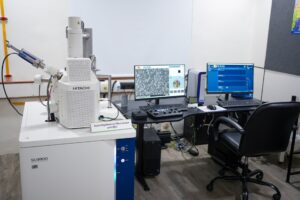
The initial equipment procurement grant was Rs 1.49 crore, sanctioned for a duration of one year, specifically allocated for equipment procurement (not recurring research or manpower costs). This grant funded the acquisition of the Center’s core instrument portfolio: the Hitachi SU3800 SEM (Rs 1.9 crore), Bruker D6 PHASER XRD (Rs 1.06 crore), Nanosurf Core AFM (Rs 76 lakh), Pin-on-Disc Tribometer (Rs 7.08 lakh), LCR Meter ZM2376 (Rs 12.86 lakh), and HHV Auto 500 Sputtering System (Rs 41.30 lakh).
The Center was approved in early 2023, commenced operations in September 2024, and was formally inaugurated on 5 March 2025. Following the MNRDC’s demonstrated performance, the Industries Commissionerate awarded a second, separate grant of Rs 1.17 crore to establish the Center of Excellence (CoE) in Advanced Manufacturing Research and Technology at Parul University. This dual-grant pattern (Rs 1.49 crore + Rs 1.17 crore = Rs 2.66 crore from the same state authority) reflects the government’s assessment that the Center delivers on its mandate.
Read more about – CoE Expansion + IIT Ropar Partnership
FAQ
Does MNRDC help with research proposal writing?
Yes. MNRDC assists with the methodology and instrumentation sections of grant proposals for agencies like DST, SERB, CSIR, and ISRO. The Center's leadership has direct experience securing competitive grants: ISRO (SMA), CSIR (Massive MIMO), and Royal Academy of Engineering UK (green hydrogen).
How many people has MNRDC trained?
113 people to date, across 1-day demonstrations and 2-3 day hands-on workshops. Participants include Master's students and faculty. Training covers instrument handling, experimental techniques, and research readiness with certification.
How was MNRDC funded?
1.49 Crore equipment grant from the Industries Commissionerate, Government of Gujarat, under the Gujarat Industrial Policy 2020 Scheme for Assistance for Research & Development Activities. Secondly, another grant of Rs 1.17 Crore was awarded for the Center of Excellence in Advanced Manufacturing Research & Technology.