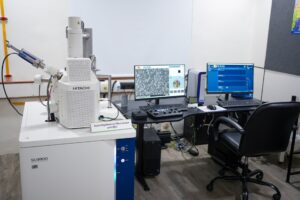
The decision to create MNRDC was driven by a specific problem: Gujarat lacked a single, comprehensive advanced testing facility for material characterisation. Researchers and industries had to approach multiple laboratories for different tests, resulting in long delays, coordination challenges, and inefficiency. MNRDC was created as a one-stop facility to serve nearby academic institutions, researchers, and industries by providing all major advanced material testing services under one roof.
Read more about – Advanced Material Characterisation Lab in Gujarat
The Problem MNRDC Solves
Before: Fragmented Testing
- A researcher studying nanocomposite properties needed SEM from Lab A in Mumbai, XRD from Lab B in Pune, and tribometry from Lab C in Ahmedabad.
- Each lab had its own submission process, queue, pricing, and turnaround.
- Total turnaround for a complete characterisation: up to 3 months.
- Coordination overhead: multiple emails, invoices, shipping logistics, and differences in report formats.
- No ability to iterate: if SEM results suggested the need for additional XRD analysis, the researcher had to start the entire submission process at a different lab from scratch. Doctoral students who are actively seeking opportunities in Materials Science and Nanotechnology should explore the PhD Research Guide at MNRDC.
After: Centralised at MNRDC
- SEM, XRD, AFM, Pin-on-Disc, LCR Meter, Sputtering, CNC, Dynamometer, Stir Casting, Compression Moulding, DSC, STA: 12 instruments under one roof.
- Single submission point, single queue system, single invoice.
- Standard turnaround: 10 working days for all instruments.
- Iterative testing: if SEM results indicate a need for XRD follow-up, the sample is already at the Center.
- Deposit-then-characterise workflows possible in a single visit.
MNRDC – The Silent Force Powering Smarter Research & Stronger Grant Proposals!
The Closed-Loop Research Advantage
The most significant capability of a centralised facility is not convenience but scientific capability. Certain research workflows are only possible when fabrication and characterisation instruments exist in the same facility:
- Fabricate a thin film on the Auto 500 sputtering system, then immediately characterise its crystal structure on XRD, surface roughness on AFM, morphology on SEM, and dielectric properties on the LCR meter. No shipping. No atmospheric contamination between steps. No waiting.
- Cast a metal matrix composite on the stir casting machine, prepare a wear specimen on the compression moulder, test its friction behaviour on the tribometer, then examine the worn surface on SEM. The entire fabrication-to-characterisation loop happens under one roof.
- Deposit a multilayer solar cell on the Auto 500 (molybdenum back contact via DC sputtering, nitride buffer via reactive RF sputtering, ITO front electrode via RF sputtering), then measure film thickness via XRR on the same XRD instrument. No vacuum break between deposition layers; no facility change for characterisation.
University-Based vs Commercial Testing Labs
Researchers choosing between university-based Centers like MNRDC and commercial testing labs encounter different trade-offs:
- University-based Centers (MNRDC model): lower academic pricing, consultancy support for experimental design and proposal writing, access to PhD supervision and collaborative research, training workshops, publication support. Trade-off: queue-based scheduling, not 24/7 operation.
- Commercial labs: fixed-price services, typically faster turnaround for single-instrument testing, standardised reporting formats. Trade-off: higher pricing, no consultancy, no training, no research collaboration, no proposal support.
The 60% repeat client rate at MNRDC suggests that the combination of academic pricing, consultancy support, and comprehensive instrument coverage outweighs the convenience advantages of commercial alternatives for the majority of users.
Read more about – Industry Services at MNRDC: Why 60% Are Repeat Clients
FAQ
What does centralised testing mean at MNRDC?
12 advanced instruments (SEM, XRD, AFM, tribometer, LCR meter, sputtering, CNC, dynamometer, stir casting, compression moulding, DSC, STA) under one roof at Parul University. Single submission point, single queue, single turnaround of 10 working days. Complete fabrication-to-characterisation research workflows possible without leaving the facility.
How much faster is MNRDC than fragmented testing?
Before MNRDC, Gujarat researchers waited up to 3 months by sending samples to multiple labs across Mumbai and Pune. MNRDC delivers results within 10 working days (standard) or 1 working day (urgent). That is a reduction from approximately 90 days to 10 days for equivalent testing.